All posts by Lynn

Unknown's avatar

About Lynn

Learning

365 Frankendael day 88

Three lovely people joined me to learn about Ribwort (Plantago lanceolata, NL: weegbree) this afternoon. We made Ribwort succuss honey, Ribwort ointment from Ribwort infused oil and learned of the many ways in which Ribwort, and it’s sister Greater Plantain (Plantago major), have made themselves indispensable to communities around the globe.

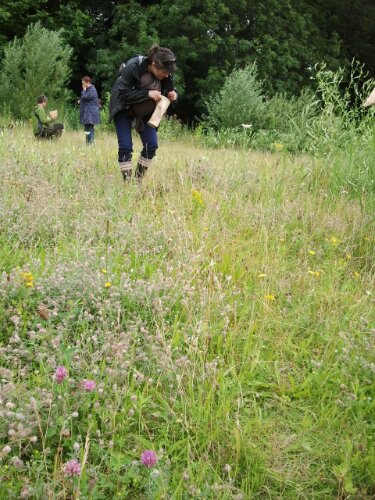
We harvested a small paper bag full of Ribwort leaves from the meadow section of Park Frankendael and whilst doing that noticed some other very lovely plants…
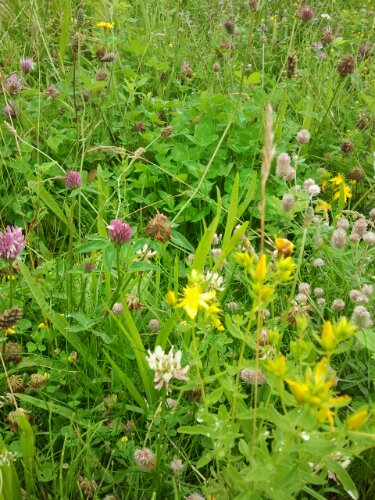

Here is a tiny section of the meadow with St. Joan’s / St John’s wort (Hypericum perforatum, NL: Sint Janskruid), Red and White clover, Ribwort and more.


Above is Teasel (Dipsacus fullonum, NL: Grote kardebol) in flower. That beautiful ring of tiny blooms will move as the flower head progresses into an equally stunning seed head.


Chicory (Chicorium intybus, NL: Wilde cichorei) in flower, I think this is the most beautiful blue in the plant kingdom. It always calms and cheers me when I am fortunate enough to see it.

Here is a a very furry looking and feeling clover, Hare’s-foot clover (Trifolium arvense, NL: Hazenpootje). A very pretty spreading plant which really livens up this already beautiful meadow. Its silky flower heads bob about in the breeze and I must say that apart from the hairs, it looks almost good enough to eat. I can only find confusing information about the eatability of this plant online and no reference to it in my wild food books. I did fine one definitive “don’t eat it” reference on a useful website, which is good enough for me to say – probably poisonous, not one to eat.
365 Frankendael day 87

I’ve been preparing for tomorrows Ribwort workshop but found time for a few photos of other herbs in the park..


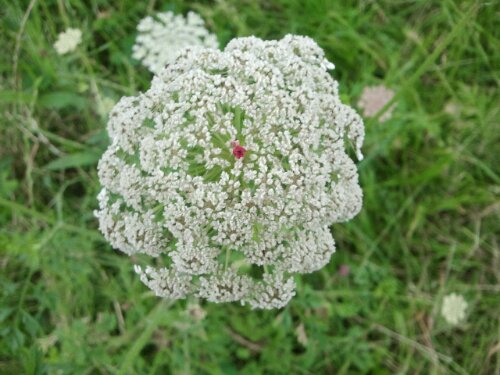
This one shows the signature red spot in the centre of a Queen Anne’s Lace flower. Apparently, if you eat enough of those spots alone you may experience a hallucinogenic effect. Not sure about that but I think they are really pretty flowers and they signify the Wild Carrot growing beneath. As I mentioned on the herb walk yesterday, I’m not a big fan of hunting for wild roots, due to the harm it causes, and less still of the carrot family, due to the numerous toxic family members, but it’s good to know that Wild Carrots are around.


The photo above is of Motherwort (Leonurus cardiaca) in full bloom.


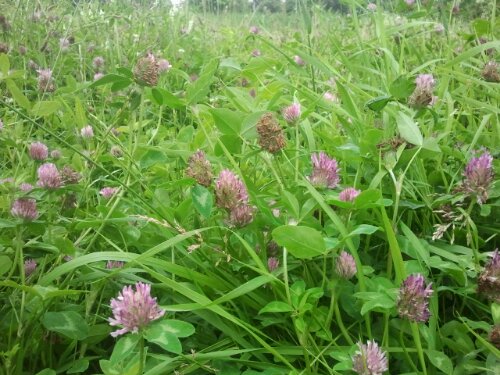
And here is a field of Red Clover looking very fertile in the park.


Lastly today, is a Garlic Mustard plant with ripe and dry seeds – well until it rained again today. I took two seed pods home and will save them for sewing in my street or nearby next spring. I love that plant!

Wormwood Rescue

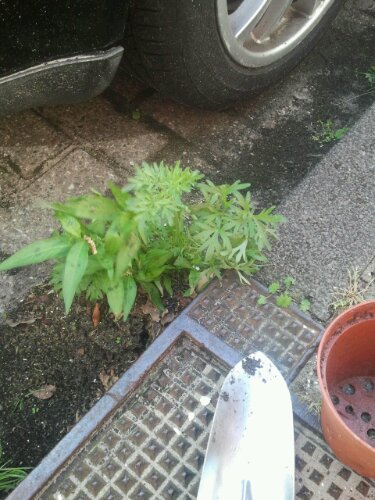
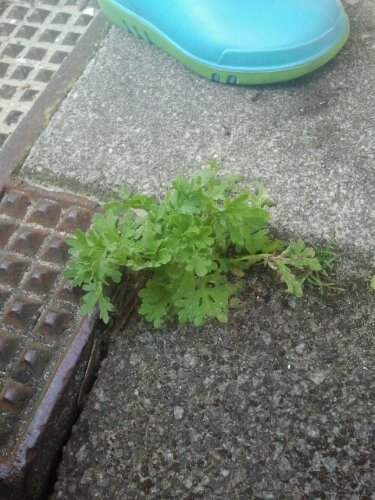
When the council next comes to strim weeds in my street, these lovely Wormwood babies would be lost, so this afternoon I whipped lots of them out of the ground, to save them in plant pots.

I grow a vigorous and useful Wormwood plant in our super-dry geveltuin. I wrote about it recently, when I had to harvest lots of its growth to prevent damage by builders.

Since then I’ve been noticing its seedlings all down the street! The recent weather seems to have helped them to thrive in the road gutter, treepits and pavement cracks.

Wormwood (Artemisia absinthium) is a herb which gives Absinthe its flavour, works internally and externally as a natural pesticide (think intestinal parasites, plant pests, malaria etc) and can help with several digestive disorders including indigestion, gut spasms and lost appetite. Wormwood contains a mind altering, dangerous chemical which shouldn’t be consumed in quantity. It increases the likelyhood of a person having brain seizures, gives Absinthe it’s flavour, increases creativity and is the reason for Absinthe’s prohibition in some non-European countries. Wormwood is a rare plant in The Netherlands. It can be eaten very sparingly, in salads or cooked food. It is easily vinegared, tinctured, dried, infused in oil and more. Wormwood is the most potent member of the Artemisia family and needs to be treated with great respect. If you’d rather not consume the herb, be aware that it is associated with magical properties related to love and protection and I think it smells very pleasant when dried or fresh. I also find it very beautiful and love seeing it’s shimmering silver-grey foliage outside of my home.

If you would like one of these easy to grow Wormwood babies, please contact me. Bring me a clean small plant container with a little soil and you are welcome to have one or, for a Euro, you can buy one from me that is already potted-up.

I find that the plant grows best in well drained, sandy soil and a good sunny location. I grew it on a north facing balcony for a few years and it did fine but it revealed itself as a real goddess, when I planted it in the south facing pavement garden. I have uprooted only the seedlings that would have been strimmed, about ten more continue to grace the plant pots and tree pits of my neighbours.

365 Frankendael day 86 – Thank you!

Here are some of today’s urban herb walkers, taking time for a freshly brewed herbal cuppa as we ended our walk, in Frankendael’s hidden herb garden.

All times of year offer special delights when herb walking but I think most would agree that mid July is a particularly interesting time. There are still plenty of flowers around, plenty of rich foliage and also plenty of seeds forming on plants. This is not the time for smart spring freshness, it’s the time for herbs that are so big they spill over paths and mix right in amongst each other. This is a time of hedonistic herbal plenty.

We looked at too many herbs to mention here (most are on the walk handout) but a few, which I want to give links to, are as follows:

Birthwort (very poisonous) (Aristolochia clematis). See day 83 for a few details.

Motherwort (Leonurus cardiaca), my thrice daily tincture tipple, for combatting stress and far more.

Hedge Woundwort (Stachys sylvatica) which we found smelling interesting amongst a patch of another edible wound herb called Enchanter’s nightshade (Circaea lutiana)

Meadowsweet (Filpendula ulmaria), Please see day 14 for details.

Thank you again, to everyone who joined me for today’s walk. I thoroughly enjoyed meeting you and I hope that your herbal adventures are filled with fun, health and good flavours!

For forthcoming herb walks and gatherings, please see my Events page.

365 Frankendael day 85


Another monsoon day today, so here’s an edible that loves to have its feet very wet – Cat’s Tail (Typha sp.)
A plant with a multitude of uses. Here’s a useful Wild man Steve Brill link about the plant.


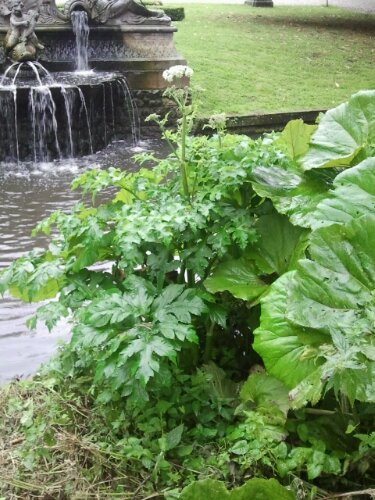
The plant to the left in this next photo is likely to be Common Hogweed (Hereacleaum sphondylium). Common Hogweed is edible and much loved by many foragers so there are many traditional and modern recipes for those who like it but it is easily confused with poisonous plants (especially Giant Hogweed) so if you are interested in it be sure to identify it using several reliable sources before picking and again before cooking.

Thank You Canalside Walkers!

A lovely group of Urban Herbies braved the weather today and joined me for a herb walk in the centre of Amsterdam. Writing my book has begun so the walk was able to help me to identify which of the Urban herbs I already know are also growing happily in the most pressured city centre habitats. We found lots of useful and tasty herbs. Here’s a brief summary of the plants we found and a few others which I found en route to the walk.

Fat hen (Chenopodium album) NL: Melganzenvoet

Geranium species.

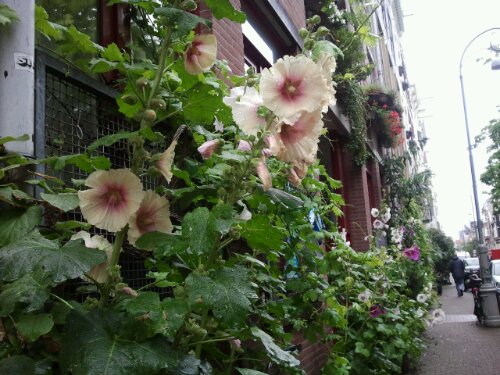
Hollyhocks NL: Stockroos

A tiny Rosebay Willow herb (Epilobium angustifolium) NL: Wilgenroosje.

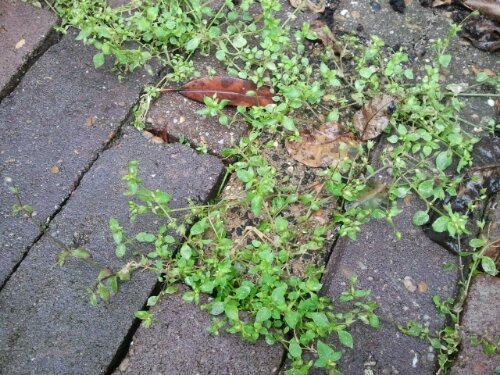
Chickweed (Stellaria media) NL: Vogelmuur

Probably Russian Comfrey (Symphytum uplandicum) Smeerwortel

German Chamomile (Matricaria chamomilla) Echte kamille This is the type used in commercial Chamomille tea.

Pellitory of the wall (Parietaria officinalis) NL: Groot Glaskruid. I found this on Kerkstraat before the walk. I am delighted to find this as it is hard to find elsewhere. Pennsylvania Pellitory grows abundantly in Amsterdam parks but this species is medicinally superior.

St. John’s / St Joan’s wort (Hypericum perforatum) Sint Janskruid

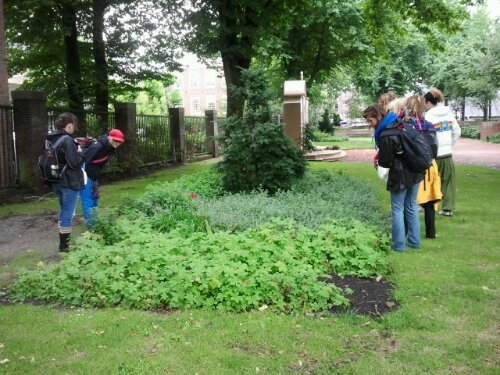
Some of today’s group looking at Catnip (Nepta sp.) Kattenkruid, Yew (Taxus baccata) and Geranium.

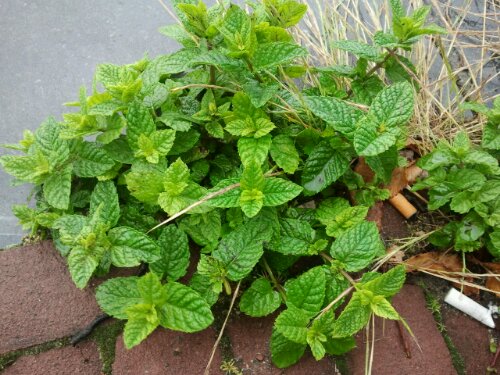
Mint (Mentha sp.) NL: Munt

Plantain (Plantago major) Wegbreed

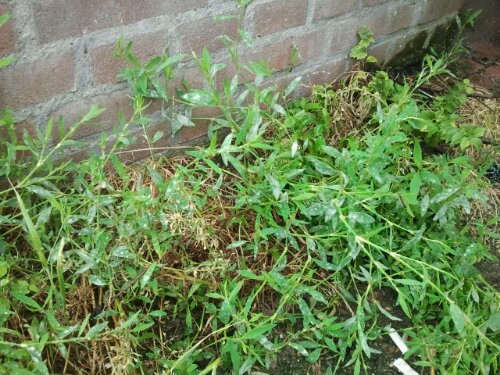
Knot grass (Polygonum sp.) Varkensgras (edible but not to my liking)

We found many other herbs including Valerian, Lime…

365 Frankendael day 84

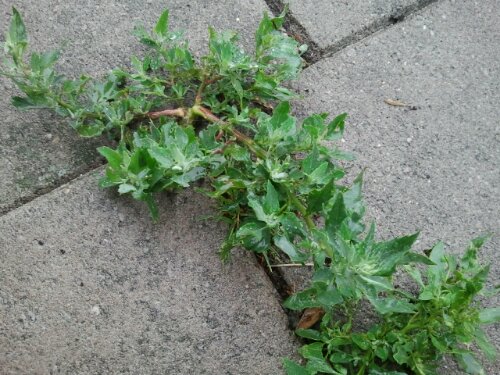
Waiting at the bus stop today, I was delighted to see that there is a survivor from the council mowed Fat Hen (Lambs quarters) population in the nearby scrubland! Here it is, looking defiant and determined to spread seed, in a pavement crack close by. Not one for picking though as its likely been walked over many times and is so close to the road.  Its seeds won’t know the difference however and this little urban warrior may help to populate the scrubland next year. I do hope so, Fat hen is one of the tastiest wild* vegetables that I know.

*Fat hen was once a popular cultivated vegetable which fell out of favour for some reason. Perhaps it was knowledge of its high Oxalic acid content or simply that blander palates fancied growing and eating something more spinach-like. Whatever the reason, Fat hen (Chenopodium album) is now a scrubland and hedgerow delicacy which I and many others, love to find!

Later today I’m hoping for a little sun and drier weather as its my first Canal side urban herb walk. What will we find, I wonder…

Aloe Omelette Shampoo

A little while ago Frida Ahrlin, who co-runs a good blog called Duurzaamjezelf.nl (literally, make yourself sustainable), joined one of my herb walks. I don’t usually take much notice of my walkers hair condition but Frida’s is quite wonderful and when the topic of Aloe vera arose in conversation and she told me that she makes a shampoo using it, I had to take notice. Frida kindly sent me the recipe that she uses once every week or so, for her thick wavy hair. Today my scalp was in great need of some TLC so I decided to give the recipe a try.

My little girl thought I was putting omellete on my hair and I had to agree that it looked very like it but the results were well worth it. I now have a calm scalp and clean, bouncy, shiny hair! My hair is nothing like Frida’s, it’s pretty fine and straight but the recipe worked none the less.

I used a nice fat Aloe leaf from my Aloe mama who lives on the roofterrace. I filetted out the gel as described below, discarding anything green or yellow, as this contains an acrid chemical that will irritate the skin. But then I chopped the gel with scissors as I was in a rush to try the recipe. I think I’ll blend it more thoroughly in future as I had big blobs of aloe gel filet falling into the bath as I rubbed the mixture in, but other than that I wouldn’t change a thing. Perhaps a vegetable masher would to the trick for the blending? Maybe there’s also scope for a single drop of a carefully chosen essential oil? Or even using a suitable herb infused oil rather than plain olive oil? I’m planning on a drop of Chamomile infused olive oil and a good session with the masher, next time I make this.

If you try this recipe please let us know and do have a look at Frida’s website as it has some very useful ideas and you can see her lovely hair!

Frida previously posted the recipe in Dutch on her website last year. Here is her message to me about the shampoo…

Frida’s shampoo recipe

1 egg
1 tablespoon oil (I often use sunflower oil or olive oil)
1 tablespoon vinegar
Aloe vera gel

My aloe vera leaves are usually quite small, around 15 cm long and one thumb wide. Mostly I only use one but sometimes two. I use a small sharp knife to open the leave and scrape out the gel. I just mix everything together in a cup and it’s ready to use.

After trying out different methods, bending over the shower/tub/sink works the best. I rinse the hair and scalp first and then add the egg-mix. First massage in at the scalp and then combing it with my fingers out in the lengths. The longer I leave it in, the softer my hair gets. Usually I leave it in (with a towel around my head)  around an hour. Then rinse it with COLD water. Warm water with egg is not a hit in this case. To give the hair a nice and fresh shine I do a last rinse with 1 cup water with another tablespoon vinegar. The vinegar smell goes away as the hair dries.

Thanks again Frida! I was so excited to try this that I forgot to photograph the omelette mixture, next time…

365 Frankendael day 83

It rained a lot today…

I went looking for poisonous Birthwort (NL: Pijpbloem, Aristolochia clematis) which earned a fatally flawed reputation as a remedy for women’s reproductive system ailments, due to the Doctrine of Signatures. Some still advocate its use for birth control and other uses but there is lots of evidence linking it to cancer of the urinary system, cancer of the liver and kidney failure or at least kidney damage. I steer well clear of this plant, it is quite striking in appearance and in the spring the leaves look very exotic. All parts are poisonous.

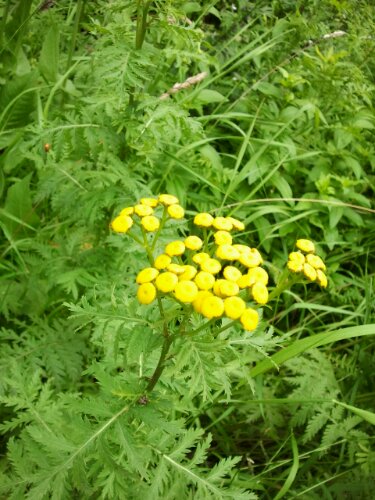
I also found Tansy (Tanacetum vulgaris) in bloom. Some cut leafy stems are drying in amongst my wardrobe clothes, to ward off moths.

Here is Comfrey (Symphytum uplandica). Still looking verdant and potent after flowering.

Edible Goat’s-beard (Tragopodon pratensis).

And lastly, Soapwort with pale pink flowers. Called Bouncing Bet in the US and Saponaria officinalis in Latin.

365 Frankendael day 81

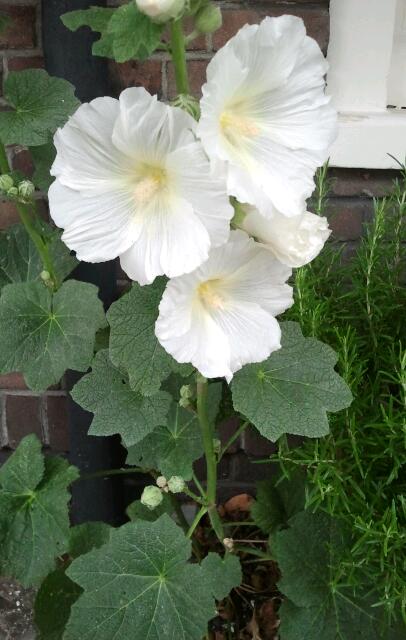
Today’s photos are from the geveltuin and tree pit, I tend beneath our apartment. I wanted to share this beautiful Hollyhock and to mention some of the forgotten uses of the plant. It is a biennial, flowering in its second year after germinating and this plant arrived by luck two years ago. We have an extremely dry, south facing geveltuin (pavement garden) beneath a bay window. Very few weeds are able to set down their roots and survive amongst the Mediterranean herbs, I have planted there. But this lovely Hollyhock did find its feet and what beautiful flowers we have been treated to this summer! Hollyhock is a member of the Mallow family and can be made into an inflammation calming tea, to soothe sore thoats and bronchitis for instance, a poultice to soothe inset stings and is sometimes used in cosmetics to soften the skin. This Hollyhock serves its purpose by looking very pretty at my front door. Maybe in the next year or two I’ll try some Hollyhock remedies, if it throws down any seeds this summer.

Whilst outside taking the Hollyhock photo, I noticed that a little Tomato plant has sprung up next to yet another welcome guest – Wormwood. I planted the small Lady’s Mantle plant myself, it had self seeded into a roof pot some months ago and I transplanted it downstairs. How nice that Wormwood, a rare plant in the Netherlands, has made it self at home next to it. I don’t think the tomato play will be able to bear fruit this year but it’s very welcome none the less.