Category Archives: Food

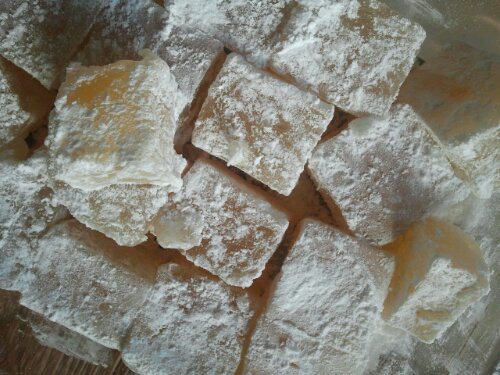
Elderflower Delight


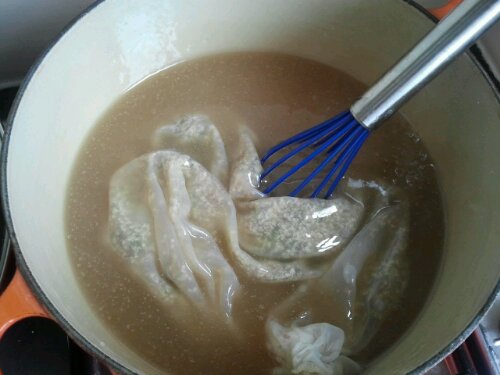
Not much to say about this other than TRY IT, we loved it! It also made me feel like someone from the pre Victorian age as I stirred the syrup with an enormous bag of Elderflowers immersed in it.

This was required for quite some time, to prevent it sticking or bubbling over, so be prepared to focus solely on this whilst you make it. Well worth the effort though. The cooking and cooling process seem to intensify the flavour of these wonderful flowers ten fold. Make sure you harvest from more pleasantly scented Elders.


I bought the River Cottage Hedgerow Handbook which this recipe is from recently. However it is also posted online by the author, within the River Cottage website. So no need for me to hold back, have a look at the link and get picking and brewing those flowers!

Urban Herb Love


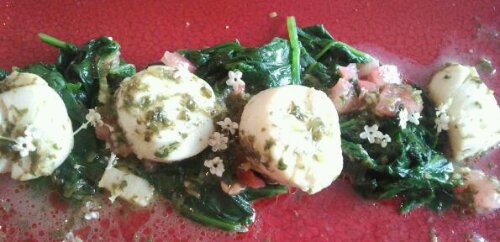
Yesterday was our seventh anniversary, here is what we cooked: Scallops, marinated in the juice of half a lime, a sprig of fresh coriander leaves, finely chopped and a small nugget of fresh ginger, squeezed. After cooking in the marinade, the scallops and sauce were laid on wilted spinach and Elderflowers were sprinkled on top.

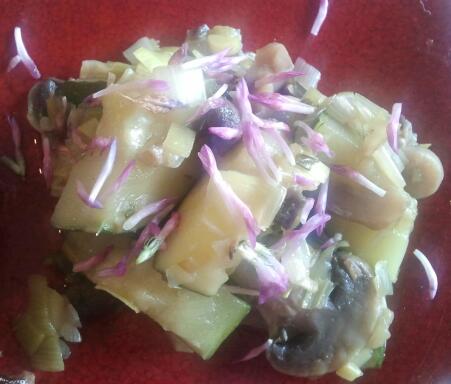
Next came grilled lamb cutlets served with a caprese salad and most importantly, Mugwort vegetables. The taste of a top of almost flowering Mugwort (Artemisia vulgaris) infused into mixed vegetables, as they cooked in one of my magical cast iron pots. It was served sprinkled with detached individual Red Clover flowers. Mugwort (Cronewort, Artemisia vulgaris, NL: Bijvoet)  is extremely tasty and aromatic when cooked in this gentle way. Just a splash of olive oil, finely chopped leeks softened then chopped aubergine and courgette added to the pan. Lid on and simmer gently for ten minutes or so.

Umm, now that’s Urban Herb Love!

Wild Herb Pasta


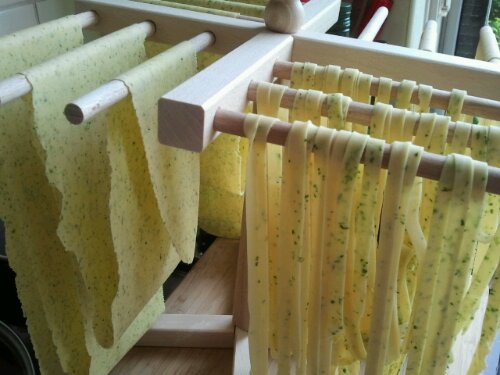
If you enjoy making fresh pasta and would like to inject some herbal magic into your creations, this recipe may interest you. Fresh herb leaves are blended through the pasta as it is repeatedly rolled in a pasta machine.

I heard about incorporating basil in this way from a colleague, who’d been to an Italian cooking workshop. I’ve made pasta with nettle juice before but find that quite a slow process so I thought I’d try it this way but incorporating some unusual foraged and pot grown herbs.

This method is very easy, it just takes a little more time than regular pasta making. I’ve no idea if this is how the Italian workshop prescribed it but this way certainly works and produces very herby pasta!

If you don’t know how to make pasta I recommend Jamie Oliver’s method. It’s very simple and works for me everytime:

A. Basically fork 4 eggs into 400g of tipo00 flour.
B. Do what you can with the fork then knead it thoroughly with your hands.
C. Wrap in clingfilm, or similar and refrigerate for 2 hours or so.

Whilst it settles in the fridge, get foraging! I used garlic mustard, basil, ground elder and parsley when I took these photos. Use what you have available. Curley Parsley was a challenge to incorporate but it eventually broke down well and tasted great. The other herbs broke down very quickly. Obviously, use herbs which are safe for you and your guests. Basil for instance is often avoided by pregnant women. A small quantity is unlikely to harm but be aware that even seemingly innocuous culinary herbs, can be very potent.

Now, how to incorporate the herbs…

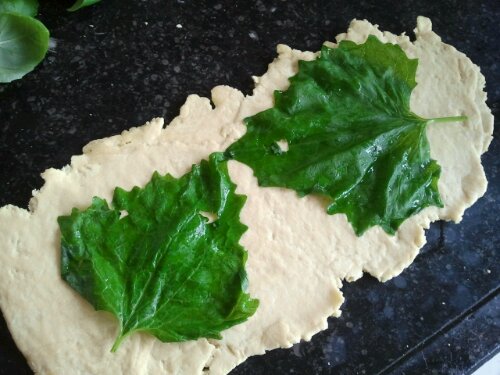
1. As you progressively roll your pasta dough in the usual way, through a pasta machine, or by hand with a rolling pin, simply lay a few herb leaves down the middle of the pasta sheet.

2. Fold over the two sides to cover the herbs.

3. Continue running the dough through the increasingly narrow pasta machine. Each run through, will break down the herbs. Eventually tiny fragments will be distributed throughout the entire pasta sheet – it’s quite extraordinary to watch it happen!

4. Keep going until the pasta dough is as thin a you like and cut or process it as you wish.

I always make heaps of pasta (6 eggs, 600g flour), we then eat a hearty pasta meal and freeze the rest in portion sized containers, when still fresh and just dry enough to handle.

Easy Dandelions


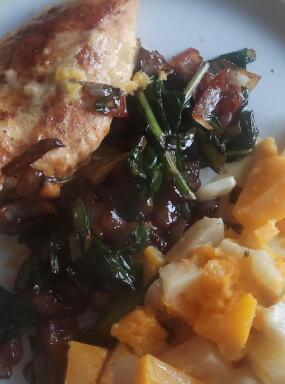
Here’s our dinner this evening.
Between us, as a side dish, we enjoyed the leaves of two large dandelions (Taraxacum officinale) picked from Ben & Riny’s garden a couple of hours ago.

After a good rinse, I roughly chopped the leaves and simply added them to the pan juices after frying chicken and eventually an onion. I added a slosh of the vegetable cooking water, from the celeriac and pumpkin you can also see in the photo. that just loosened things up a little and helped to stop the dandelion from frying. The result was very tasty indeed and rather healthy!

The root came up easily, from one of the plants so I’ll add that to a soup tomorrow.

365 Frankendael day 20

Day 20 of the project and after going to the park expecting to see just one or two new things I was delighted to find my first Elder blossom of the season, Wild Aspraragus shoots and several other delights. Here are a few…


Above, Japanese knotweed is still fair game for Foragers looking for something a little exotic in Amsterdam. Here’s a link to my
sweet sour JKW yoghurt recipe

.
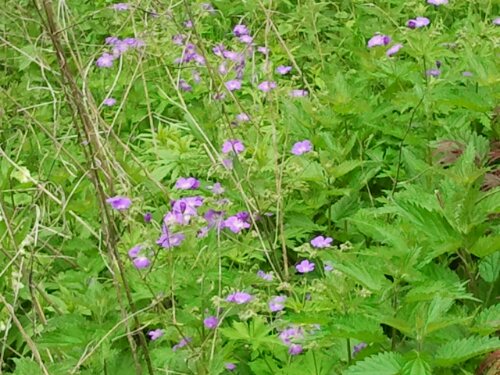
Next is A Geranium species in flower. Very tasty cooked or raw.


Someone got to this Asparagus before me. It makes a stunning tall feathery plant when allowed to flower. I hope that whoever harvests this one leaves some other shoots to flower and fruit unhindered.


Above is Plantago major (NL: Wegbrood, Plantain) in full effect, prior to flowering. It’s not as useful a medicinal than its slender sister Ribwort (Plantago lanceolota) but its useful and quite good eating.

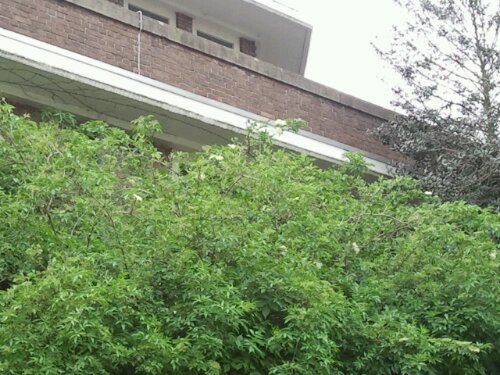
I feel like a bird spotter with this one… Above is my first sighted Elder blossom of 2012 and it gets me very excited. Elderflower fritters, Elderflower champagne, Elderflower tea and a host of other flower and Elderberry recipes are not far away! This huge Elder shrub is on the Middenweg, just up from the top entrance of Frankendael and opposite the Vomar supermarket. If only my arms were long enough! Remember to harvest with respect and leave LOTS for the birds and bees. Also be very aware of Elderflower look-a-likes. Here’s a photo of Ash or Rowan in flower, growing above an Elder shrub which is not in flower. It would be an easy mistake to harvest the flowers believing them to be Elderflower, when here is nothing to compare them with.

Guerilla Beans = Rabbit Fodder

Anyone with ideas for edible climbers, suitable for a spot of guerilla gardening in a rabbit hot spot? I went back to Oosterpark today, to check on the runner beans which Sameena, me and two young guerillas planted out last week. Unfortunately, not a single one is evident but there are mounds of rabbit droppings everywhere and lots of fresh warren holes. It seems that I chose a rabbit haven, rather than a runner bean haven. If you have any top tips for suitable plants for this sort of place, or have tried runner beans in good locations, please let me know…

Edible Table Planter Update

Today, a quick update on the Edible Table Planter which I set up on our roof terrace on April 11th. Just a few weeks on, herbs and salads in the planter are now pluckable! That seems pretty good to me, especially during a very dull weather period.

Here’s a before photo…

Here’s today’s photo…

I planted self seeded plantlets which had sprung up in my Permapots. The plants I included are:

Cut and come again lettuce
Chamomile
Welsh onion
Watercress

I also threw in a sparse handful of beetroot seeds, we will eat the leaves.

Eating Foraged Greens

Aside from knowing what is safe to forage, it’s rather important that foragers know what they are going to do with their harvest. After all, what’s the point in harvesting a heap of plant material when only a couple of leaves are needed for seasoning, or only the youngest leaves are tasty? At the end of the day, many foragers end up with a slightly smaller heap of unwanted plant material in their kitchen which ends up in the bin, or at best, on the compost heap. If you dont know which part of an edible plant to harvest or how much of it is needed to make a food item, please leave those plants where they belong.

Just because there is a wild glut of a plant, you don’t need to harvest much of it to make a great difference to your diet. This thought is central to my reasoning for foraging herbs rather than other edible plants. Generally a little goes a long way, in terms of flavour and benefits. An exception is Stinging Nettle, where I like to harvest a bowlfull of ‘tops’ at a time, many days in a row, to make tonic infusions.

Here are a few ways to use just a little foraged Spring Greens, such as Chervil, Ramsons, Geranium, Nettle or Ground Elder. These are my favorites, no measurement involved and less is more…

1. Finely chop a few leaves and add, ten minutes or so before the end of cooking, to whatever you are cooking (stews, casseroles, soups, fried chicken, baked fish, baked beans! etc). The photo above shows my pan cooked chicken with some sour cream added to the juices near the end along with a few chopped leaves of ground elder and wild garlic.

2. Add whole or chopped leaves to a pan of spinach and cook As usual for spinach.

3. Eat raw in a mixed salad (obviously the leaves or flowers need to be super clean and above suspicion for this)

4. Boil the greens in a little water for ten minutes, adding a chopped or pressed clove of garlic and a pinch of salt & pepper, near the end of cooking. This even works well for edible tree leaves such as Beech.

If you prefer a little sophistocation for your foraged fayre, there are plenty of recipes around. I like to experiment sometimes but if you want to incorporate more wild food into your diet then I suggest you keep it simple, keep it sparse and use those vitamin packed spring greens to spice up your usual meals. It’s also safer that way.

Pea Dosa with Yoghurt & Fresh Mint

Dosa are Indian pancakes, traditionally made by soaking and then fermenting rice and black lentils, in a ratio of 2 parts rice: 1 part lentils. They are extremely tasty, popular and versatile. I recently read in Wild Fermentation that the lentils may be substituted by other dried legumes. So I have been trying dried peas, left over in my cupboard from the winter.

To be honest, I prefer this pea version to the traditional recipe so thought I’d share it. I also found it easier to blend the soaked rice and peas, than blending rice and lentils. It was less effort for my Kitchen Aid which is also a bonus.

To make pea dosa I follow my usual dosa recipe and simply substitute dried peas for lentils. The toppings are endless, today I used a mixture of fresh yoghurt, two finely chopped mint leaves from the balcony, a dribble of runny honey and some blueberries.

Mint is a great wake up call in the morning and extremely easy to grow in a pot. It’s probably better in a pot than anywhere else as this perennial is very invasive and if allowed, can take over a garden in no time.

Another great topping is mashed banana and yoghurt, with or without honey.

I hope you enjoy it! Do let me know if you try any other legumes in place of peas.

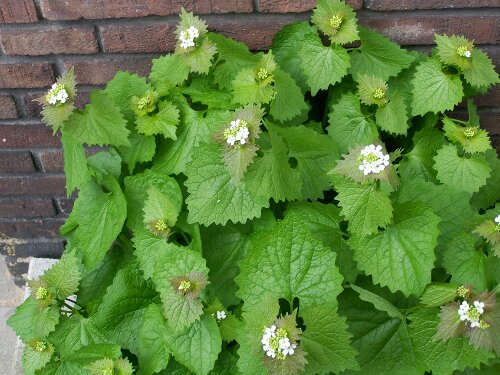
Garlic mustard, Jack in the hedge (Alliaria petiolata)


Photo courtesy of Elodie and Herman, in De Baarsjes, Amsterdam. 25th April 2012.

Garlic mustard (Alliaria petiolata) is easy to find in many cities and is also very easy to eat!

It is often easy to spot them at the base of large tree trunks and along the edges of woodland and hedges. They also thrive within woodland. It flowers at the end of April into May. Whilst flowering, it is very easy to identify, not only by the distinctive smell of garlic when the leaves are bruised but also by the tiny white flowers at the top of the plant. Garlic mustard is a favorite amongst foragers and can grow up to 120 cm in the right location.

This plant is a biennial and can provide year round nutritious greens, for salads or the cooking pot. All parts are edible. Even the roots can be eaten, they should be harvested just before flowering, but of course removing the whole plant will limit the foraging potential the following year as the plant will be unable to spread by seed. Far better is to pick a leaf or two at intervals, throughout the growing season and leaving the plant to flower and set seed unhindered.

Garlic mustard isn’t known as a medicinal herb, more a culinary one. It is a member of the mustard family, Brassicaceae, so I like to think of it as a tasty replacement for sprouts.

I see lots of Garlic mustard growing around Amsterdam. You are very likely to find it along the edges of canals, hedges and overgrown areas, such as railway embankments. Mid to late spring is probably the best time to identify it.

Eating Garlic mustard is straightforward. It can be eaten raw, if very clean or cooked. It has a garlicky spinachy taste so works well with many ingredients. In like to chop up a leaf or two and mix them in with other spring greens, which I steam.