Category Archives: Shrubs

The Sap is Rising…

I like winter, it’s a good time to retreat into oneself  and listen to what the darkness has to teach but I am always happy when I can see signs life reappearing in the plants around me.  This week I can smell and see that happening as the sap starts to slowly rise in many plants.  One of the most useful and familiar of herbs is certainly showing those signs at the moment.  Elder (Sambucus nigra, NL:Vlier) is thankfully so common that there is most likely a modest specimen growing quite close to where you live.  Perhaps you use it wisely already or perhaps you would recognise its flowers or berries.

I remember a very resilient old Elder which hung over my family’s driveway as a child. We didn’t know how to work with Elder at that time but the local birds evidently did.  Each year our car would become covered with staining purple droppings as the birds gorged themselves on its ripe berries.  The shrub was severely pruned each year to limit the damage and each year it bounced back, absolutely thriving in the clay soil and sunshine.

Elder has so many uses in traditional medicine that it is really worth getting to know.  I shall post in detail about Elder one day soon, when I feel spring’s energies flowing through my own veins again.  Until then I wanted to share with you one remedy which I used a few weeks ago with success.

Elder (in winter) for fever.
Sambucus nigra is known, among other things, as a traditional fever remedy.  It is effective at inducing perspiration which in turn lowers the bodies temperature yet is reputedly mild enough to be used for childhood fevers, when they are not extreme. Generally the flowers are used to treat fever and the berries to reduce the severity and longevity of cold and flu.  Recently I felt a cold or flu creeping up on me and wanted to self treat with Elder however in late December neither fresh berries or flowers were available to me here in Amsterdam.  A tea, using dried organic flowers from a healthfood shop, might have been an option but I wanted to experiment with a local Elder.

It is said that one should always ask permission of the Elder before harvesting from her so I sought out a strong Elder shrub in my nearby park and mentally asked to harvest enough material to treat myself. The bark and leaves of Elder also contain some of the fever reducing agents found in the flowers and berries.

I harvested a few healthy (and budding) young twigs and small branches (about 2 feet long in total and mostly second year growth).

  • I cleaned them a little with water and scraped the outer and inner bark from the branches and broke up the twigs which were too small to scrape.  The remaining Elder material was kept aside.
  • The twigs and bark were placed in a small heavy pan.
  • I added about 700ml filtered and freshly boiled water to the pan and covered with a heavy lid.
  • This infusion was left at a fairly cool room temperature for 48 hours.
  • As time progressed I checked the infusion a few times and the smell of Elder became increasingly intense and the liquid became slightly gelatinous.  It smelled fresh and tasted smooth, soothing and slightly sweet.
  • After 48 hours the infusion was strained and the spent plant material was kept aside with the unused material.
  • I drank the infusion over the following 4 hours, rested and wrapped up comfortably warm. I sweated more than usual and noticed a feeling of being cleansed and nourished.  The threatening cold/flu came to nothing more than a few hours of feeling tired and hot with a slight headache.  Of course this may or may not have been thanks to the Elder infusion but I will happily try it again when I feel a cold or flu trying to take hold.
  • The used Elder material was returned with thanks to the foot of the shrub from whence it came.  One small branch was not used at all and is currently rooting easily in a vase of water on my kitchen windowsill. It has several healthy new leaves. 
  • Witch Hazel (Hamamelis virginiana, NL:Toverhazelaar)

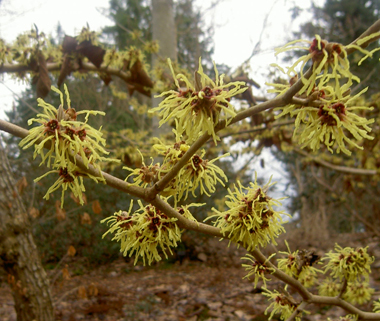
    Witch hazel is one of my favourite shrubs and I am hoping to introduce it to my pavement garden this winter.  When unrestricted its crooked, apple tree-like branches grow to 4 – 6 inches in diameter and the whole shrub can reach around 12 feet in height.  However it can also do well in small spaces, such as large pots or pavement gardens (geveltuinen). It grows best in moisture retentive, acid to neutral soil and is adapted to living in light shade.  Witch hazel is also tolerant of polluted city air and its unusual yellow October flowers make it a good option for the urban herbologist.

    The leaves and bark of Witch hazel are very useful.  They taste bitter, containing tannic and gallic acids as well as a volatile oil.  Its effects are  astringent, tonic and sedative so preparations of Hamamelis virginiana are often used to treat internal and external bleeding.  The most well known uses of this herb are for treating piles, bruises and inflammatory swellings but it is sometimes used for diarrhoea, dysentery and mucous discharges.  Please be aware that using Witch hazel internally should only be done under expert guidance.  Due to its astringent effect, Witch hazel distilled extract (available cheaply from many chemists) makes a great skin toner.  I used it as a teenager, it works well and I think it smells great.  These days I use it mostly for treating bruises.

    Chips of dried Hamamelis virginiana bark can be obtained from herbal suppliers.  You may find this beautiful shrub in local parks, hedgerows and areas of woodland.  It is also a fairly popular garden shrub due to the unusual winter flowers.  Apparently it is very difficult to propagate Witch hazel by cuttings and the edible seeds (if you can find them as they are dispersed far and wide by explosion) can take over a year to germinate.  I am hoping to take a winter cutting from a friend’s plant very soon.  I’d be very interested to hear from anyone who has been successful in this.

    Witch hazel can be used in many ways;

    • Tea (made from the leaves and young twigs or bark, fresh or dried) can be applied directly to piles or dabbed onto bruised or inflamed areas of skin.  This also makes a milder skin toner than the distilled extract, often good for acne, oily skin and shrinking bags under the eyes.
    • Tincture, best made from the bark.
    • Fluid extract, if you can squeeze the juice out, can be included in ointments to calm varicose veins.
    • Distilled extract, easily obtained from chemists, great for dabbing onto bruises, insect stings and bites, applied very quickly as a compress for burst varicose veins – which are life threatening and need immediate medical attention. Can be applied to intact varicose veins as a soaked lint bandage, wrapped gently around the area loose enough to allow the blood to flow unrestricted.
    • Powdered bark, if you can make it then this can be applied to piles when combined in a cream or paste.