Tag Archives: Elder

365 Frankendael day 42

Today a post about one plant, my favourite, Elder (Sambucus nigra).

This wonderful ancient healing plant, which has been steeped in mysticism and folklore for millennia, is producing flowers that cheer up almost every hedgerow in town, right now.

Where you find one Elder shrub, you are likely to find others close by. It springs up in the most unexpected places and is a true survivor. It has bumpy, brittle, crooked branches, smelly leaves and phenomenal frothy flower heads, stacked all over the plant. They remind me of small terraces, tilting in almost the same direction, all over the shrub.

This photo shows one of many Elder shrubs, along the Hugo de Vrieslaan hedgerow which provides a boundary for Park Frankendael. Now the flowers are mature and plentiful.

I’ve talked about this plant quite a lot previously, Google Elderflower recipes and you may be amazed by how many people like to eat this flower. Remember to avoid eating the leaves amd twigs, they will likely make you ill. I was refreshing my knowledge of the plant this evening by reading Wild Man Steve Brill’s book, Edible and Medicinal Plants. He talks about an American cousin of our local Sambucus nigra, called Sambucus canadensis and I was surprised to learn that the stems and leaves can sometimes yield cyanide, when a bitter alkaloid and glycoside within them change. So definitely parts of Elder to avoid in your diet!

One piece of Elder history I want to mention today, is how ancient Christians were irritated or threatened by the Elder Mother cult in Europe. The Elder mother was/is said to live within the Elder bush. You should ask her permission to harvest from her tree, should never burn her, should never chop her down, without asking her to leave. Ancient Europeans revered the Elder, welcoming and encouraging it to grow near their homes. the Elder mother protected homes from fire and lightning, kept your cattle safe and of course provided simple medicine for your whole family. This folklore helped to make the shrub commonly available for all manner of uses. In an attempt to rid communities of their attachment to the Elder Mother, the plant became embedded in the most negative ways, within Christian stories. Judas was said to have hanged himself from an Elder and Christ was said to have been nailed to an Elder cross. But of course this couldn’t be true due to the brittle nature of the tree. The tree was also much associated with witchcraft and yet was also said to protect you from witches. It seems that everyone had something to say about this shrub which points to it having had many uses.

I’ll be harvesting some more Elderflowers tomorrow, probably to be broken up and sprinkled into a light batter, some to be added to general cooking (we had it on baked fish last week, very good and interesting), some to make a face wash and some to be dried for use as a fever remedy when needed. I also fancy making some Elder leaf infused oil this weekend, for external use in an ointment. It is often useful on bruises, sprains and chilblains.

Love Elder and she will love you back, but be gentle with her and ask (and listen) when you’d like to take some of her gifts. She has many, many gifts and is not to be overlooked or underestimated.
365 Frankendael day 40

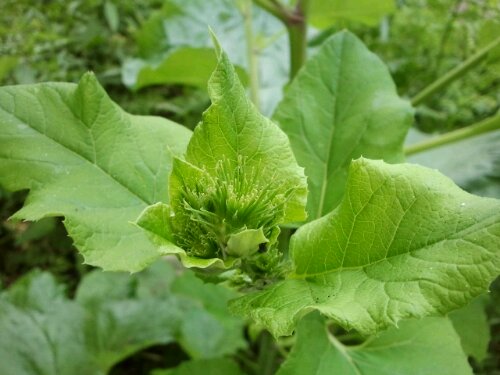
Burdock (Arctium lappa)

Today, many Burdock plants (Arctium lappa) are easily identified because their flower heads, or burs (which give the plant it’s common English name) are developing at the top of the plants. I’ve not really noticed them at this stage, before this year. They look very stately at the moment because the stems are growing fast so the large leaves are clearly separated. Burdock is a biennial plant, flowing during its second year. The roots are the part of interest to herbalists and those are only useful when harvested from first year Burdock plants. So although harvesting of Burdock roots should occur in the autumn, now is a great time to identify Burdock which is not flowering, is in its first year and may be of interest. Here’s a link to a Susun Weed article about Dandelion and Burdock.

Elder (Sambucus nigra)

Here is a little Elder (Sambucus nigra) shrub, growing at the base of a tall park side tree, on the Middenweg. Not a great location for harvesting the flowers. At this height you may also better understand why Ground Elder (shown yesterday in flower) is so named. Fortunately, although both are edible (at least in part), the flowers look quite different, one is a shrub and the other is clearly not.

White Dead Nettle (Lamium album)


Next, a lovely White Dead Nettle (Lamium album). This member of the mint family, which looks very like Stinging Nettle but is totoally unrelated, is still in flower and yielding a tiny sip of sweet nectar, if you pluck a flower and suck its base. This can also be done with Honeysuckle. However the Honeysuckle species is seen as poisonous and White Dead Nettle is edible. The whole plant may be enjoyed and benefitted from. This plant is good cooked like spinach.Here’s a nice recipe from a lovely blog about wild food called Eat Weeds.

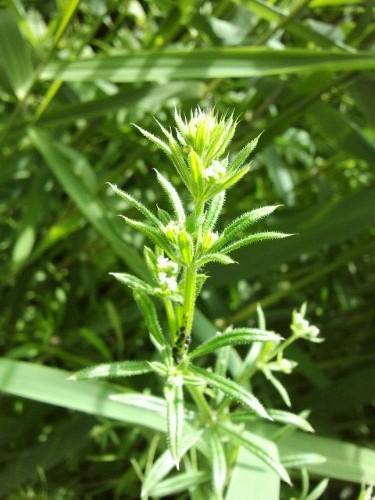
Cleavers (Gallium aparine)

Lastly today, Cleavers (Galium aparine) with flower buds clearly developing. It may still be used a tonic herb when freshly juiced or made into a tincture.

The Sap is Rising…

I like winter, it’s a good time to retreat into oneself  and listen to what the darkness has to teach but I am always happy when I can see signs life reappearing in the plants around me.  This week I can smell and see that happening as the sap starts to slowly rise in many plants.  One of the most useful and familiar of herbs is certainly showing those signs at the moment.  Elder (Sambucus nigra, NL:Vlier) is thankfully so common that there is most likely a modest specimen growing quite close to where you live.  Perhaps you use it wisely already or perhaps you would recognise its flowers or berries.

I remember a very resilient old Elder which hung over my family’s driveway as a child. We didn’t know how to work with Elder at that time but the local birds evidently did.  Each year our car would become covered with staining purple droppings as the birds gorged themselves on its ripe berries.  The shrub was severely pruned each year to limit the damage and each year it bounced back, absolutely thriving in the clay soil and sunshine.

Elder has so many uses in traditional medicine that it is really worth getting to know.  I shall post in detail about Elder one day soon, when I feel spring’s energies flowing through my own veins again.  Until then I wanted to share with you one remedy which I used a few weeks ago with success.

Elder (in winter) for fever.
Sambucus nigra is known, among other things, as a traditional fever remedy.  It is effective at inducing perspiration which in turn lowers the bodies temperature yet is reputedly mild enough to be used for childhood fevers, when they are not extreme. Generally the flowers are used to treat fever and the berries to reduce the severity and longevity of cold and flu.  Recently I felt a cold or flu creeping up on me and wanted to self treat with Elder however in late December neither fresh berries or flowers were available to me here in Amsterdam.  A tea, using dried organic flowers from a healthfood shop, might have been an option but I wanted to experiment with a local Elder.

It is said that one should always ask permission of the Elder before harvesting from her so I sought out a strong Elder shrub in my nearby park and mentally asked to harvest enough material to treat myself. The bark and leaves of Elder also contain some of the fever reducing agents found in the flowers and berries.

I harvested a few healthy (and budding) young twigs and small branches (about 2 feet long in total and mostly second year growth).

  • I cleaned them a little with water and scraped the outer and inner bark from the branches and broke up the twigs which were too small to scrape.  The remaining Elder material was kept aside.
  • The twigs and bark were placed in a small heavy pan.
  • I added about 700ml filtered and freshly boiled water to the pan and covered with a heavy lid.
  • This infusion was left at a fairly cool room temperature for 48 hours.
  • As time progressed I checked the infusion a few times and the smell of Elder became increasingly intense and the liquid became slightly gelatinous.  It smelled fresh and tasted smooth, soothing and slightly sweet.
  • After 48 hours the infusion was strained and the spent plant material was kept aside with the unused material.
  • I drank the infusion over the following 4 hours, rested and wrapped up comfortably warm. I sweated more than usual and noticed a feeling of being cleansed and nourished.  The threatening cold/flu came to nothing more than a few hours of feeling tired and hot with a slight headache.  Of course this may or may not have been thanks to the Elder infusion but I will happily try it again when I feel a cold or flu trying to take hold.
  • The used Elder material was returned with thanks to the foot of the shrub from whence it came.  One small branch was not used at all and is currently rooting easily in a vase of water on my kitchen windowsill. It has several healthy new leaves.