Tag Archives: Sambucus nigra

365 Frankendael day 40

Burdock (Arctium lappa)

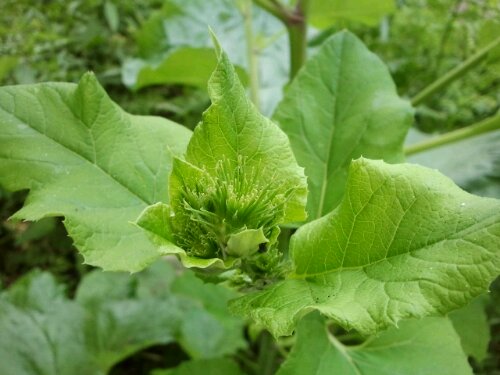
Today, many Burdock plants (Arctium lappa) are easily identified because their flower heads, or burs (which give the plant it’s common English name) are developing at the top of the plants. I’ve not really noticed them at this stage, before this year. They look very stately at the moment because the stems are growing fast so the large leaves are clearly separated. Burdock is a biennial plant, flowing during its second year. The roots are the part of interest to herbalists and those are only useful when harvested from first year Burdock plants. So although harvesting of Burdock roots should occur in the autumn, now is a great time to identify Burdock which is not flowering, is in its first year and may be of interest. Here’s a link to a Susun Weed article about Dandelion and Burdock.

Elder (Sambucus nigra)

Here is a little Elder (Sambucus nigra) shrub, growing at the base of a tall park side tree, on the Middenweg. Not a great location for harvesting the flowers. At this height you may also better understand why Ground Elder (shown yesterday in flower) is so named. Fortunately, although both are edible (at least in part), the flowers look quite different, one is a shrub and the other is clearly not.

White Dead Nettle (Lamium album)


Next, a lovely White Dead Nettle (Lamium album). This member of the mint family, which looks very like Stinging Nettle but is totoally unrelated, is still in flower and yielding a tiny sip of sweet nectar, if you pluck a flower and suck its base. This can also be done with Honeysuckle. However the Honeysuckle species is seen as poisonous and White Dead Nettle is edible. The whole plant may be enjoyed and benefitted from. This plant is good cooked like spinach.Here’s a nice recipe from a lovely blog about wild food called Eat Weeds.
Cleavers (Gallium aparine)

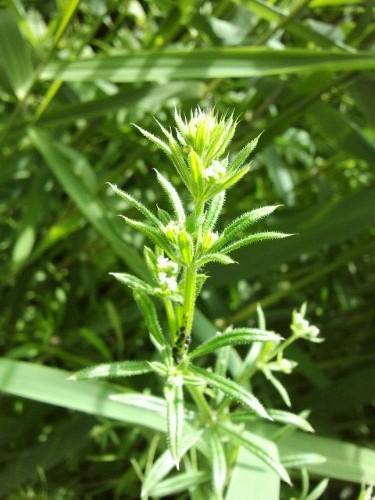
Lastly today, Cleavers (Galium aparine) with flower buds clearly developing. It may still be used a tonic herb when freshly juiced or made into a tincture.
365 Frankendael day 32


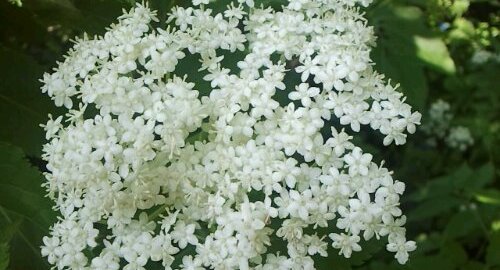
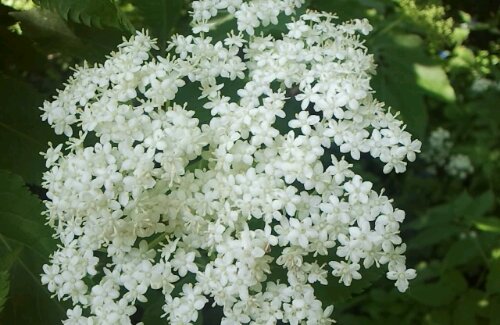
Today a lovely elderflower on the Hugo de Vrieslaan edge of the park. There are Elder shrubs all over the city and now is the time to covet those in the cleanest spots. Each day for the next couple of weeks elder blossoms will burst open, inviting local insects to do their thing and foragers and herbalists to get harvesting! You only need a flower head or two to make a great addition to a meal. As I have mentioned recently, only seven flower heads are required for a hearty quantity of Elderflower Champagne. So if you want to pick elder flower, be nice, thi about how many you really need and spread your harvest between healthy well flowered shrubs. In years gone by, Elderflower lovers would know which local Elders yielded the sweetest flowers. These days I think it’s more a matter of where there are healthy shrubs in the least polluted areas. I’ll certainly be out and about in clean spots, with my paper bag and scissors, over the next few weeks.

It is possible to confuse Elderblossom with other flowers (such as distastful and smelly Ash blossom). Look closely at the photo here (which is deliberately large) and others in good guide books. Notice the way the inner male parts (stamens loaded with pollen) of the tiny flowers protrude between the petals. Notice the colors of the parts of the flowers. Elder blossom is a creamy white, not a stark white. The flower heads are flat, aligning themselves to attract insects the best they can. Learn the shape of the shrub. It is often a messy shape, with areas where quite brittle branches have stapped off. Elder can be enormous, like those against buildings and at other times can hug the ground where they constantly fight their way back from repeated attempts to prune them to death. Be nice to Your local Elders this foraging season. Get to know This herbal medicine chest and in time, it may become a good friend. See the comment about Elder on 365 day 20 for several useful Elder links.

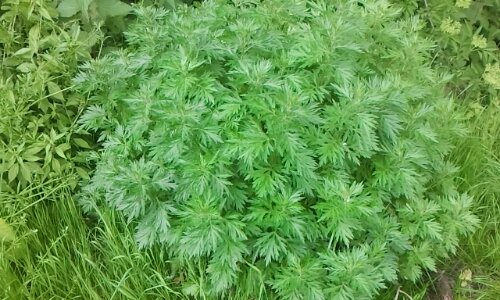
Here’s my favourite Frankendael bus stop clump of mugwort again; still growing, still no flowers, still dreaming.

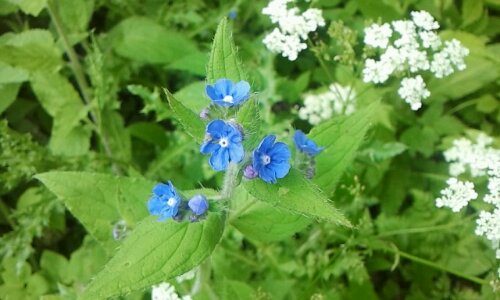
And finally today, a pretty Green Alkanet (Pentaglottis sempervirens) plant. Also from the edge of the park. Green Alkanet is a lovely plant with many uses. It is edible and medicinal.

Elderflower Tea

Following on from my recent post about Elder, here’s how to make Elderflower tea.

It is very easy to make fresh Elderflower tea and there should be some Elder close to your home.  When the shrub is in full bloom (May/June here in Western Europe) and on a warm dry day find an Elder away from polluting roads.  Check you like the smell of the flowers, the scent of Elderflower varies from shrub to shrub and it is not always fragrant!  Ask permission of the plant, in some way, to harvest flowers. Most countries have lots of  folk lore about being especially respectful of the Elder and if you are not of the superstitious kind then do remember that Elder berries are important to wildlife later in the year – less flowers, less berries.

Select only healthy looking flower heads (umbels) which have creamy-yellow stamens as shown in the photo.  Pick them carefully as they are very easily damaged, I tend to collect them into a paper bag to avoid squashing the umbels on the way home.

Don’t wash the umbels before use but do snip off any thick stemy parts and shake off any insects and unwanted bits.  If possible return the insects and bits to the plant soon afterwards.  After gently shaking, it helps to lay the umbels on some white paper for a few minutes. The tiny insects then tend to crawl out or at least may be easily spotted and removed.

Use one or two big umbels per cup of tea.  You can use the actual flowers alone (although its a bit fiddly to separate them when fresh) or the entire umbels.  I simply place whole umbels (sort of folded up) in a small tea pot, add boiled water, cover and infuse or 5 – 10 minutes.  If making it in a cup, do cover with a saucer whilst it infuses.

If you would like to harvest Elder flowers to dry and store then collect them just before the shrubs are in full bloom (May/June).  Harvest as above, lay out on paper to dry in a warm, well ventilated place. When thoroughly dry the little flowers can be rubbed off the umbels and stored in jam jars, in a dark place, for up to a year.  You would use about 1 heaped teaspoon of dried herb per cup of tea.

It is well worth keeping some dried Elderflower in stock over the cold and flu months. Herbals generally recommend that it is freely taken for a few days during a cold or flu (up to 8 cups daily) and up to a few cups per day at other times.  Refer to the post about Elder for a little more information about the properties and uses of this wonderful plant.

The Sap is Rising…

I like winter, it’s a good time to retreat into oneself  and listen to what the darkness has to teach but I am always happy when I can see signs life reappearing in the plants around me.  This week I can smell and see that happening as the sap starts to slowly rise in many plants.  One of the most useful and familiar of herbs is certainly showing those signs at the moment.  Elder (Sambucus nigra, NL:Vlier) is thankfully so common that there is most likely a modest specimen growing quite close to where you live.  Perhaps you use it wisely already or perhaps you would recognise its flowers or berries.

I remember a very resilient old Elder which hung over my family’s driveway as a child. We didn’t know how to work with Elder at that time but the local birds evidently did.  Each year our car would become covered with staining purple droppings as the birds gorged themselves on its ripe berries.  The shrub was severely pruned each year to limit the damage and each year it bounced back, absolutely thriving in the clay soil and sunshine.

Elder has so many uses in traditional medicine that it is really worth getting to know.  I shall post in detail about Elder one day soon, when I feel spring’s energies flowing through my own veins again.  Until then I wanted to share with you one remedy which I used a few weeks ago with success.

Elder (in winter) for fever.
Sambucus nigra is known, among other things, as a traditional fever remedy.  It is effective at inducing perspiration which in turn lowers the bodies temperature yet is reputedly mild enough to be used for childhood fevers, when they are not extreme. Generally the flowers are used to treat fever and the berries to reduce the severity and longevity of cold and flu.  Recently I felt a cold or flu creeping up on me and wanted to self treat with Elder however in late December neither fresh berries or flowers were available to me here in Amsterdam.  A tea, using dried organic flowers from a healthfood shop, might have been an option but I wanted to experiment with a local Elder.

It is said that one should always ask permission of the Elder before harvesting from her so I sought out a strong Elder shrub in my nearby park and mentally asked to harvest enough material to treat myself. The bark and leaves of Elder also contain some of the fever reducing agents found in the flowers and berries.

I harvested a few healthy (and budding) young twigs and small branches (about 2 feet long in total and mostly second year growth).

  • I cleaned them a little with water and scraped the outer and inner bark from the branches and broke up the twigs which were too small to scrape.  The remaining Elder material was kept aside.
  • The twigs and bark were placed in a small heavy pan.
  • I added about 700ml filtered and freshly boiled water to the pan and covered with a heavy lid.
  • This infusion was left at a fairly cool room temperature for 48 hours.
  • As time progressed I checked the infusion a few times and the smell of Elder became increasingly intense and the liquid became slightly gelatinous.  It smelled fresh and tasted smooth, soothing and slightly sweet.
  • After 48 hours the infusion was strained and the spent plant material was kept aside with the unused material.
  • I drank the infusion over the following 4 hours, rested and wrapped up comfortably warm. I sweated more than usual and noticed a feeling of being cleansed and nourished.  The threatening cold/flu came to nothing more than a few hours of feeling tired and hot with a slight headache.  Of course this may or may not have been thanks to the Elder infusion but I will happily try it again when I feel a cold or flu trying to take hold.
  • The used Elder material was returned with thanks to the foot of the shrub from whence it came.  One small branch was not used at all and is currently rooting easily in a vase of water on my kitchen windowsill. It has several healthy new leaves.