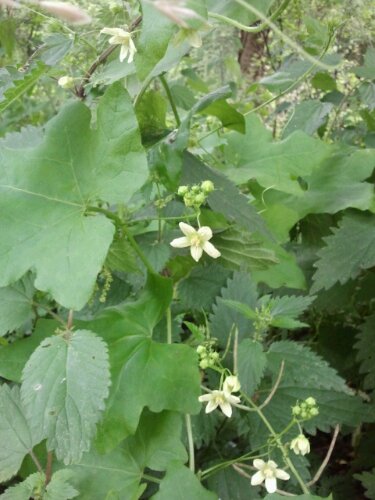
Here is beautiful and extremely poisonous native climber called White Bryony (Bryonia alba), which I noticed today in a shady Frankendael hedgerow, growing over some Stinging Nettles. This is a new place for me to spot the plant. It also luxuriates throughout the woodland quarter of the park, where I see it a lot. It grows all around the city and thrives with something to scramble up and over, so it is often found against fences, hedges and shrubs. At the moment, whilst in flower it is even easier to identify.
Above is Yarrow(Achillia millefolium), flowering all over the city at present. A very useful and tasty herb. Known as Nosebleed in some parts, it has the ability to staunch or start bleeding. Not one for pregnancy or infancy. A prized women’s herb.
I thought I’d take this photo today to show how easy it can be to confuse plants. It shows Pensylvannian Pellitory (Parietaria pensylvanica) my neighbours’ dog’s favourite, growing beside a seed-setting White Deadnettle ( Lamium alba). Both are edible and both are, amongst other things, both are diuretics. Do you know which is which?
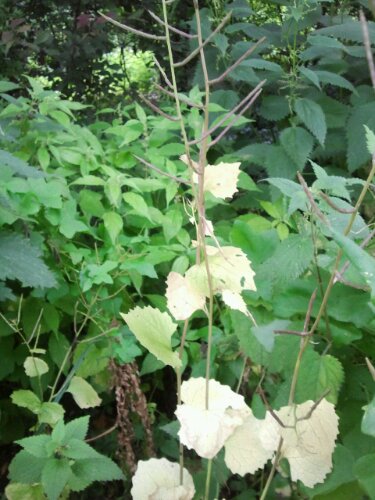
Lastly today, here is a sure sign that the main Garlic Mustard (Alliaria petoilata) season is coming to an end. Today I spotted lots of very yellow looking plants, putting all their remaining energy into seed production, rather than those delicious leaves. So if you have a penchant for this plant, now is the time to harvest from the small, younger plants . Please remember to leave the plants with plenty of foliage and the seed pods intact. That way, hopefully we can all benefit from a good crop next year.
Today we did a Herb Sit, rather than a Herb Walk. It’s amazing what you can sometimes find when you simply sit still and take a close look at what’s around you…
Here’s a Ribwort (Plantago lanceolata), with a small Dandelion (Taraxacum officinalis agg.) plant and some Field Horsetail (Equisitum arvensis) growing just behind it.
Above is a feather leaf of Yarrow (Achillea millefolium).
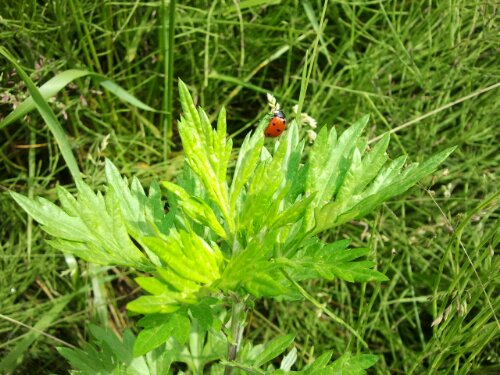
The tip of a young Mugwort (Artemisia vulgaris) plant featuring a Lady Bird.
Above, a not so clear photo of Salad Burnet (Sanguisorba minor).
We also found several types of clover and other legumes, within an arms reach of where we sat. I need my better camera to take decent photos of those. Here are the leguminous plants that we found and were able to identify today:
Red clover (Trifolium pratense)
Zigzag clover (Trifolium medium)
White (Dutch) clover (Trifolium repens)
Lesser Trefoil (Trifolium dubium)
Bird’s-foot-trefoil (Lotus corniculatus)
Please be aware that Bird’s-foot-trefoil is not a clover and is poisonous and should not be eaten. It has some historic medicinal uses. The clovers are edible. The flowers and leaves are tasty in salads and Red clover has many medicinal uses.
I’ve been walking in Frankendael with Elodie today, we found heaps of herbs, several new to us. If you’d like to join me for a herb walk there are a few spaces left for the Sunday May 27th Amstel to Frankendael walk. Here are some striking examples from today… Solomon’s Seal looks rather like an enormous version of Lily of the Valley so I always steer clear of it. I have always thought of Lily of the valley as a poisonous plant so lethal that I shouldn’t even go near it. Upon reading about it last night I learned that it is called the herbalist’s Digitalis. It has a potent specific effect on heart muscles, causing them to open and fill more intensely and to raise blood pressure. It is thus lethal in even small doses and is not a herb of interest to me. However this arching beauty of the woods is very interesting. Solomon’s seal is used to make traditional remedies for many ailments, ranging from speeding muscle and bone healing, to menopausal symptoms, diabetes, acne and other skin afflictions. The native Americans reportedly ate it frequently.
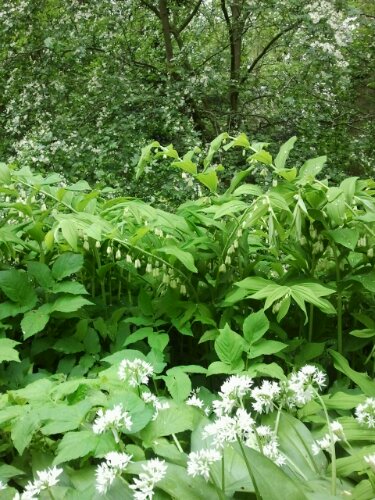
I was thrilled to turn a corner in the wood today and be greeted by this scene:
It is difficult for a photograph to do it justice – especially one of mine! Here is Hawthorn arching over a swathe of Solomon’s seal and Wild garlic, all three in flower at the same time.
Other herbs of note today…
Below, endangered Hoary Plantain (Plantago media). I first saw this herb last year and remember not really knowing what it was, although it was obviously some kind of plantain, but wanting to hide it and protect it from trampling feet! Of course I couldn’t and this plant is well adapted to living in well trodden locations. However, should you find it, especially in a week or two when it’s flower stalk will look like some sort of moth-plant hybrid, then please don’t touch it. I hope that this one has a chance to set seed.
You may already know about Elderflower fritters, even if you have never tried one. Did you realise that many other herb flowers can be used to make even more delicious fritters? Today I have been on the roof and in the park looking for suitable flowers and I was not disappointed. I gathered Lady’s mantle, Yarrow and Chive flowers from the roof and plucked Rose petals from pollinated wild Dog Rose flowers in the park. I also gathered a few Honeysuckle blooms and of course a handful of frothy Elderflower heads.
I must say that I think it a waste to make some flowers into fritters, some taste so wonderful, untouched in salads or deserts that I don’t think they need be tampered with. Others are a little bit messy and these are the ones I suggest you try in fritters. Elderflower and for instance, is rather an unusual mouthful in it’s raw form and Yarrow flowers are just too strong for my palate. Turned into fritters they become something quite different; Dandelion flowers resemble artichokes, Rose petals take on a slightly meaty texture, Yarrow becomes a savoury delight and Chives become mini onion baghees.
Here is my recipe for flower fritters, many others are available, often including beer, liquor, sugar and so on. Mine simply uses my Yorkshire Gran’s batter recipe (it makes the best Yorkshire puddings in the world by the way). It does not contain any sweetening or seasoning so you can add a little whatever you wish to the basic recipe. I do encourage you however to try a flower in the basic batter alone, at least once. This will allow you to appreciate the true flavour of that flower. Perhaps have some yoghurt and honey to hand for dipping.
Here are a few suggestions: (Please follow the foraging rules and remember that some beautiful flowers are highly poisonous)
Dandelion Fritters – I suggest that you simply wash the flowers (with a little stalk still attached), dip them into a little flour (I prefer Chickpea flour), shake off the excess and then fry gently in a little Olive oil. Elderflower – the sweet classic. Perhaps use a splash of rosewater and a teaspoon of sugar in the batter Robinia pseudoacacia (Black Locust tree, False acacia) – I have not tried this, many American’s seem to like it. Don’t confuse with poisonous Laburnum! Rose petals or Rose flowers – slightly astringent and fragrant. Wild and cultivated Roses are edible. Ladies mantle – Much of the bitterness is lost in cooking Mint – Dip sprigs of young mint in the batter. Great with chocolate sauce. Mallow – Petals or whole flowers with a little stalk attached Onion flowers on short stalks Chive flowers on short stalks Lime tree blossom Honeysuckle Yarrow – Strongly savoury Valerian Meadowsweet And many many more!
Basic batter recipe: (Courtesy of Edith Shore)
Break one egg into 3 tablespoons of plain flour.
Mix the egg and flour thoroughly, using a fork.
Add three tablespoons of milk (one tbsp at a time) whilst mixing with a metal spoon.
Ensure everything is well combined.
Beating well with the fork.
Add a tiny drop of water.
Whisk up well. You should now see plenty of trapped air bubbles in a smooth mixture.
Cover and set aside to rest in fridge, for at least half an hour and preferably overnight.
Just before using, whisk up again with the whisk or fork.
The dipping and frying process is very easy: Simply dip one flower at a time into the batter. Place in a small frying pan which contains about 1/2 cm of medium-hot Olive oil and or butter. Several flowers can be cooked at once. Keep a good eye on the pan and budge the fritters around a little with a wooden spoon. When they are golden brown they should be cooked through and ready to serve with a little of your preference – honey, sugar, cream, yoghurt, chocolate sauce…










 Simply dip one flower at a time into the batter.
 Several flowers can be cooked at once.
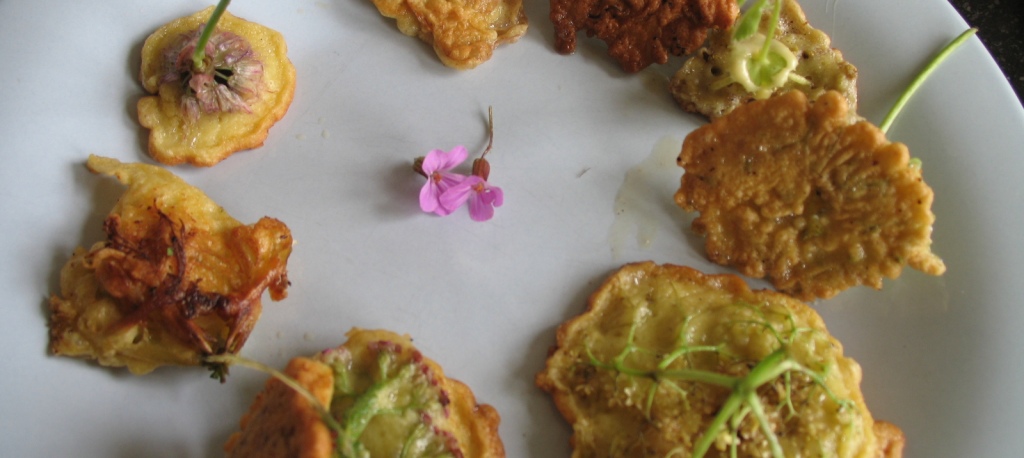 When they are golden brown they should be cooked through and ready to serve with a little of your preference – honey, sugar, cream, yoghurt, chocolate sauce…
 Urban Herbology