A quick tram stop hunt for herbs today as I ran the Honey and Herbs workshop this afternoon.
Here’s a lovely little Hazel tree growing in the lowerparts of a beech hedge.
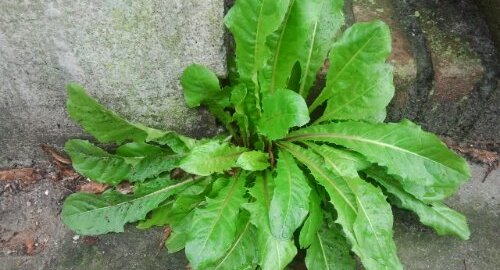
Here’s a very vibrant Dandelion(Taraxacum officinalis agg.) growing in a dirt filled pavement crack above a bridge.
I harvested lots of Plantain (Plantago major) today, from close to de Kas restaurant. I’ll be dressing the leaves as I haven’t had time to make a succus with it and I don’t want to waste them.
I’ve been to Proef in Westerpark today to have a look at their organic garden, which City Plot tend. It is another inspiring example of how to grow lots of food and herbs without a garden. The site is next to the old gas factory storage tanks and hence the soil is deemed unsuitable for directly growing crops. City Plot have overcome the problem by using raised beds. They look great, house hundreds of very healthy plants and are quite a haven for wildlife. The Growing and Using Exotic Herbs Workshop on Sunday October 14th will take place there. Myself and Suzanne from City Plot will run it.
On my way back home I found this exciting sight… A fully ripe Elderberry spray!
So the time has arrived. Get your paper bags and recipes ready, these berries are packed with nutrients and can be cooked and preserved to deliver them when needed, through the winter.
Beautiful weather today and a lovely stroll through the park.
Day Lilies (Hemerocallis fulva), beautiful, edible flowers, not to be confused with standard Lilies which are highly toxic. Please scroll through the photos on day 75 to see what they look like.
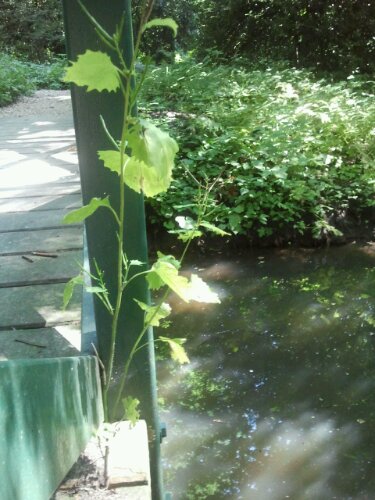
Garlic mustard (Aliaria petiolata) growing out of some dirt on a woodland bridge.
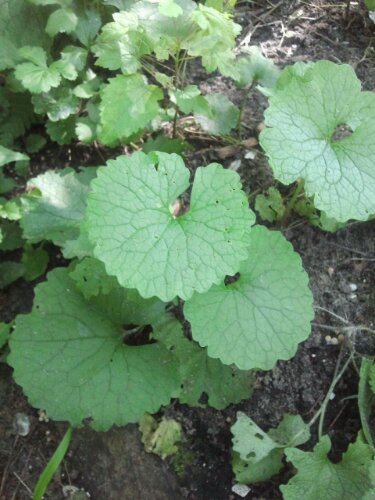
Garlic mustard seedlings, coming up for a second edible crop of the year. This is a biennial plant so although there is not enough time for these seedlings to mature and set seed before the frosts, they should survive and flower next year. Probably best to forage only from the second year plants (which are now almost over, foraging wise).
Motherwort (Leonurus cardiaca) is setting seed and what spiky seed heads they are proving to be! If you need to harvest some, it’s probably best to have gloves on and shake the seeds straight into a paper bag. I gave up trying today and threw the few I collected into nearby soil.
It’s still going strong in some areas: Ground Elder (Aegopodium podograria).
First year Burdock (Artica lappa). This is what is needed if harvesting the medicinal and nutritious Burdock roots, is your mission.
These plants are growing alongside Frankendael by the windy dirt path that follows the Middenweg. At first glacé everything simply looks green there but if you take a closer look there are several great edibles and a few plants that if eaten, would upset your body quite substantially.
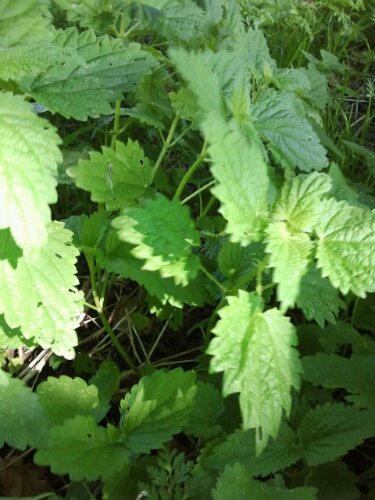
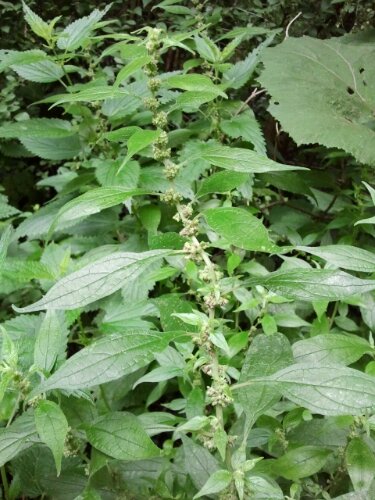
Here is nutritious Stinging Nettle (Urtica dioica), regrowing after a recent mowing.
Next is White Deadnettle (Lamium alba). Not a stinger but very useful and also nutritious.
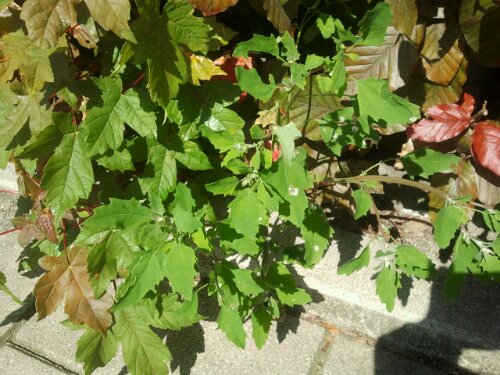
Here’s a poisonous berry, I know it as Snowberry (Symphoricarpus alba).
Here are some of those half eaten unripe Elderberry heads, that I mentioned last week. We can only eat them safely when they are fully ripe, for birds it’s obviously another story.
Lastly today some ripening Hawthorn berries (Crataegus monogyna). If you are not sure then how’s a good time to get to know how to identify them, in readiness for the autumn harvest.
This morning a group Urban Herbies gathered alongside a park hedgerow and took cuttings of a wonderful herb shrub – Elder (Sambucus nigra). We are going to look after the cuttings for as long as it takes for them to find their feet and be mature enough to survive planted out, in another Amsterdam hedge or edge. I was inspired to try this by the work of Glennie Kindred, a wonderful, community-spirited wise woman from Britain. Her website contains very useful information about many herbs and has especially detailed information about native trees. Thank you Glennie!
Here’s How to Make Elder Babies:
1. Most shrubs and trees are best propagated in the autumn and winter but its also possible to try easily-rooting Elder in the summer. Choose very healthy parts of very healthy shrubs, ask the permission of the shrub you are drawn to with your heart and actions. Be gentle, and respectful and only harvest a little from one shrub. If your cuttings fail to survive then return them to the soil. Never burn Elder and listen to the wisdom it has to offer. All parts of the plant are medicinal and have been revered for millennia. These days we tend to make the most use of elderberries and flowers. The leaves and twigs also make an excellent skin cream but it is best not to ingest them.
2. We used secateurs or our hands to carefully remove the last 6-8 inches (14-20cm) of a healthy branch. Avoid those laden with berries, the plant’s energy needs to focus on that task rather than growing new roots.
3. Remove all but the last couple of leaf pairs, and gently slide them off with your hands. Return these to the foot of the mother Elder. If harvested in winter, all of the leaves could be removed from the cutting.
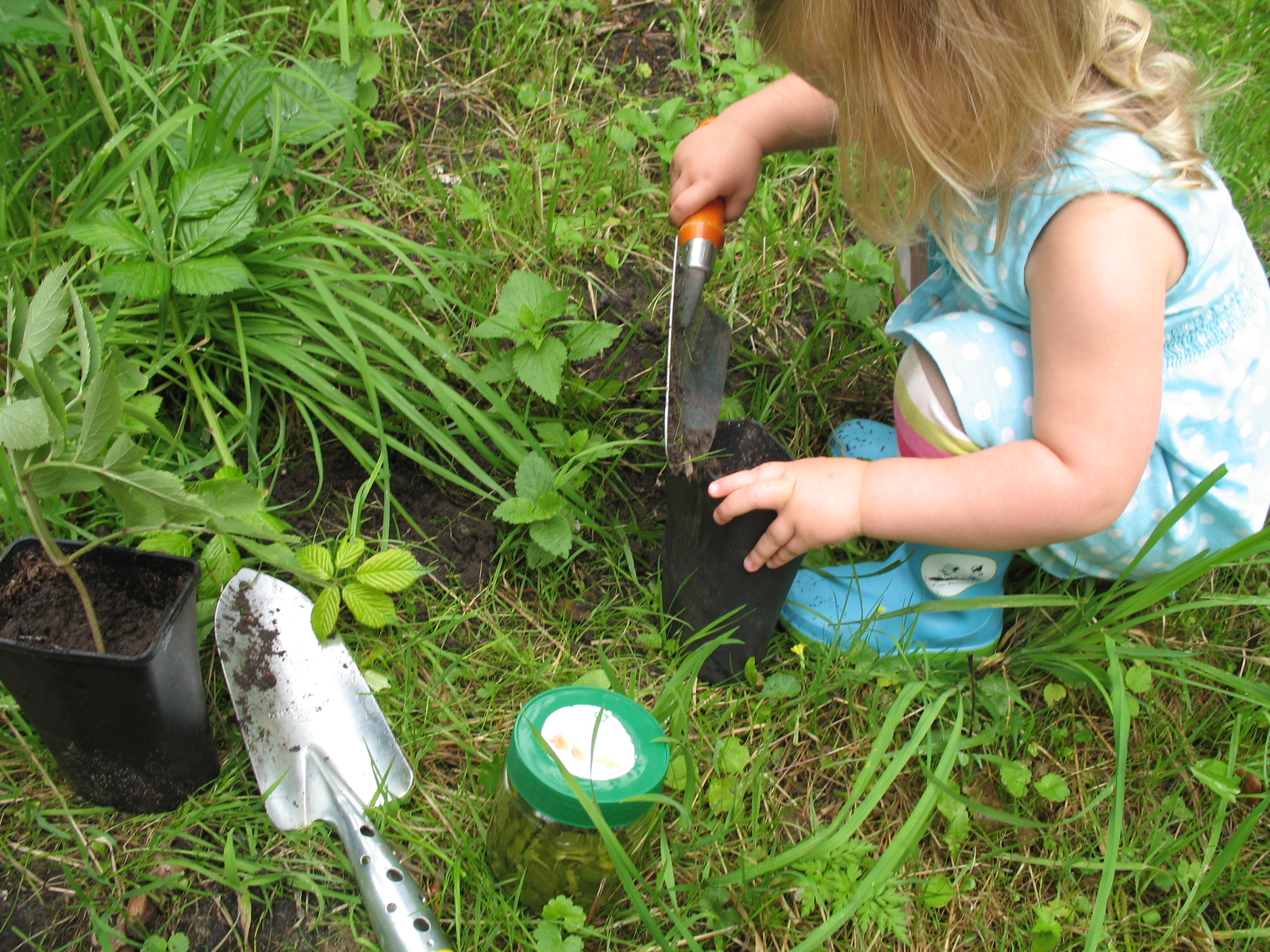
4. If using it, dip the bottom end of the cutting into a jar of Willow or Meadowsweet rooting hormone tea. Poke the cutting quite deeply into a pot of good quality soil, so that it is about half buried and won’t topple over. Firm the soil slightly.
5. Ideally, water the pot from beneath by standing it in a bowl of water for a while, until the soil is thoroughly dampened. Ensure that excess water can freely drain from the pot.
6. Place the pot, with damp soil and comfortably pushed-in cutting, in a place of semi shade, or in a loosly closed translucent plastic bag and leave it to grow roots. This will take some time so you’ll need to be patient, maybe for a few weeks. There is no need to remove the cutting to check on progress, just let it do it’s thing and you’ll be pleasantly surprised the day you see Elder roots, poking out of the drainage holes.
7. Keep an eye on the dampness of the soil, Elder will rot if it gets soggy but it will also die if the soil dries out completely. Lightly water the soil when needed. Misting with a water spray is a gentle way to water from above.
8. When the cutting has set down a good root network and has grown a couple of feet tall (about 50cm), it should be ready to plant out when mild spring weather arrives. This may take a couple of years but sometimes it can happen more quickly.
9. Plant out during moderate weather in an area where Elder bushes are sparse. Elder fairs well in most conditions, it will tolerate full sun, lots of shade or partial shade. A hedgerow setting is most suitable. The shrub can be pruned into a hedge if needed or allowed to grow in which ever direction it prefers.
Here’s another link to Gennie Kindred’s website where you will find lots of useful Elder information and several wonderful Elder recipes.
To make the Willow rooting tea simply harvest a few Willow tendrils, chop them and place in a clean glass jar. Cover with freshly boiled water and cover. Leave to infuse as the water cools, for about 8 hours. Then the infusion may be strained or not. It will keep a few days in the fridge if needed or use what you require and pour the rest on your other plants.
I collected some more seeds today, from edible, medicinal and beautiful perennials in Park Frankendael. The only wild Angelica that I know of there set and spread its seed in the water some time ago but this beauti in the maintained herb garden is just ripe. I harvested just a tiny proportion of the seeds on the plant and will use them for the River of Herbs project. Angelica archangelica is such a gorgeous plant to look at and has so many uses for humans and wildlife. I hope some other people will enjoy growing it in the city.
If you would like to collect some seeds from plants growing in the city or anywhere else, do remember to:
1. Leave most of the seed on the plant for birds and small mammals to eat and use.
2. Leave the seed heads and stems on the plants, they often make excellent look out posts for birds in winter, create beautiful frosted and dew covered structures until the spring and some become hollowed out homes for all manner of bug life. If you must chop off the seed making structures, to access the seeds, it probably indicates that the seed is not yet ripe anyway.
3. Take only from plentiful perennial plants, which are generally able to proliferate from their root stock and seed. If you take from annuals or biennials the forget to sew the seed, or they fail, then the plants you harvested from may have lost all chance to reproduce.
4. Only harvest seed when ripe and allow them to dry off extra well at home before packaging in small labelled envelopes or similar for future use.
5. Sew your seed as soon as possible. Think about the plants natural cycle, when the plant sets seed the seed usually finds its way to the soil and when ready will germinate. Try to mimick this if possible.
My attempt at Skullcap (Sculleraria sp.) seed collection was disappointing. I had missed the boat almost completely on two accounts, firstly someone had cut off heaps of flower stems from the large plant shown here and secondly when I examined more skullcap plants they had already set seed. I managed to collect about six seeds. Next year I must look for them earlier.
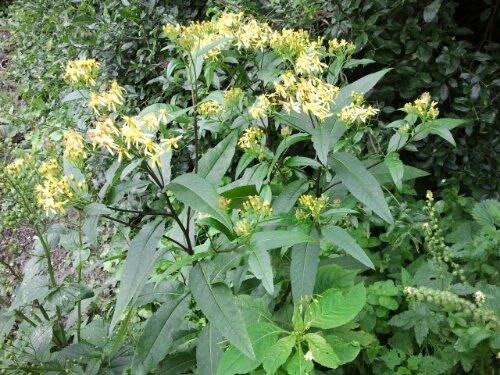
I then turned my attention to the tall wild flower meadow (shown above). Too early for seed collection here but right on time to see Goldenrod in full glory,
And Tansy (here’s a photo illustrating why Tanacetum vulgare is known as Buttons in some regions),
River of Flowers is a UK based initiative which helps to plant Urban Flower Meadows, of all shapes and sizes, providing corridors of insect pollinated plants throughout cities. I read about it today, in the latest copy of Permaculture Magazine and got very excited about the project! Rather than wild flower meadows (which are of course wonderful and useful in many ways) I would like to create Urban Herb Meadows, here in Amsterdam and beyond.
River of Flowers began in London and seems to encompass many of the ideas that have come up in this website and the Amsterdam Urban Herbologists meetup group. We love nature, we want to learn from the plants, we continue to try our hands at guerrilla gardening and we like to put something back into the environment from which many of us harvest food and medicinals. We also appreciate that a world without pollinators would be very dark.
Amsterdam is rich in plant species and many Amsterdammers enjoy taking care of plants in tree pits, tiny pavement gardens and other strips of reclaimed land. I often look at and photograph these places and wish that more of the plants used could be edible or medicinal. And of course I wish that more of these urban gardeners knew how to harvest and use some of those amazing plants.
So with River of Herbs (the name will stay, if the folks at River of Flowers don’t mind – I have asked them) I’d like to do the following, with your help:
1. Identify and prepare unused spaces, however small, for growing useful perennial, biennial and annual herbs. I’m talking about spaces from plant pots to wasteland.
2. Sew suitable herb seeds and plant cuttings, roots etc. in these places. Suitable for the location, insects and food or medicine.
3. Tend the developing Urban Herb Meadows.
4. Map the locations of these Herb Meadows and photograph them.
4. When ready, harvest some of the material without compromising their usefulness to pollinators such as bees, hoverflies and butterflies.
5. Learn and teach how to use these herbs.
6. Build on successes and learn from the group process, to make more and more Urban Herb Meadows, creating an urban pollinator and food security friendly corridor.
So what do you think of this?
Am I just getting overexcited?
I wonder if our friends at Boskoi and City Plot may like to help out with this in some way? Design& Collaboration, how about those seeded cards and papers we talked about ages ago?
Would YOU like to come and collect wild herb seed with me, or your friends and family, over the coming summer weeks and through autumn? We can then make little packets of Urban Herb Seedmix, to sew in those new meadows when the time is ripe.
Please let me know what you think. I’m all ears and green fingers.
Not much time to write today, I really need to get my UH essentials book finished!
I did find some lovely herbs though..
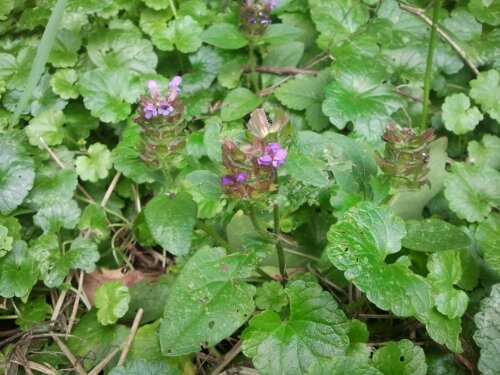
Firstly, a carpet of dark green evergreen Ground ivy (Glechoma hederacea) with a few purple flowering spikes of Self Heal (Prunella vulgaris) poking through.
Greater celandine (Chelidonium majus), fading but still flowering and still oozing that amazing (poisonous orange) wart zapping sap, when a stem is broken.
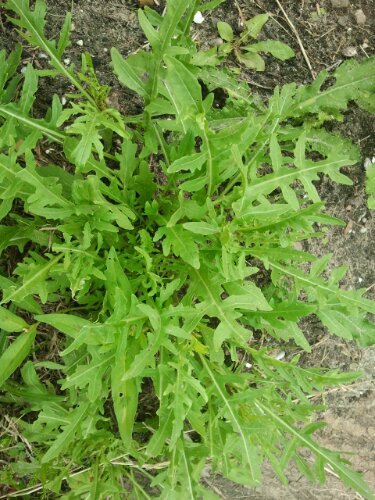
Wild Rocket(Eruca sativa), Arugula.
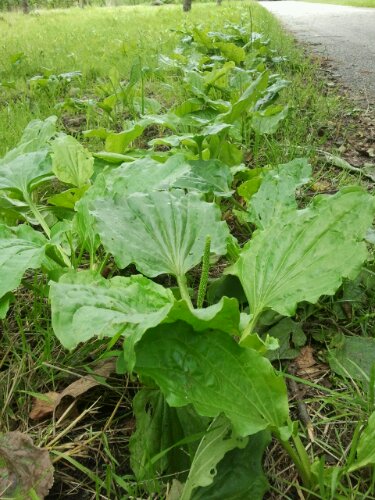
Plantain (Plantago major).
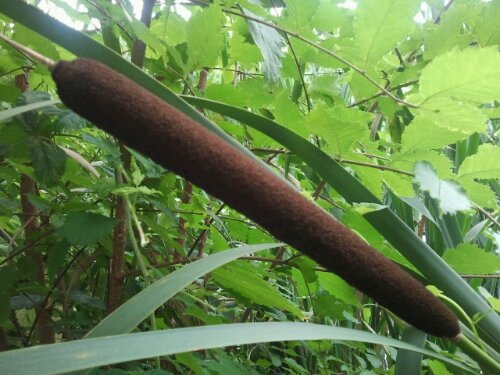
The flower head of a Reed Mace / Cat’s Tail (Typha sp.)
My little girl and I were so pleased to meet this flower head as it is developing on a bent over stem. All other flower heads in this part of the park are growing too far out in the water for us to reach safely. I don’t know if that’s the reason for the US common name, but it feels very like our cat’s tail when you stroke it! Maybe I’ll ask the Park gardeners, if I can help out when the autumn clearing comes?
I harvested some of this beautiful Pennsylvania pelitory this morning and set up a vodka tincture for Tobias my canine neighbour.
I’m looking out for Arnica at the moment, I’ve no idea if it grows in Amsterdam or this park, but I want to make a fresh batch of Arnica gel so need to make a tincture first. I found this pretty plant on my quest…
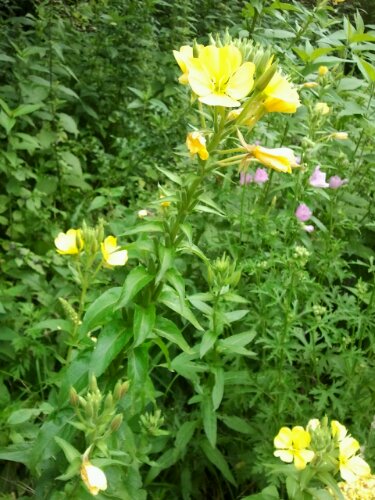
Also today, I’m often asked about Evening primrose. Yes its edible and medicinal and you can see it has big blousy flowers. I’m not a big fan of taking the seed oil but its nice to make a tincture from or to cook the leaves or roots.
Ground Elder (Aegopodium podograrium) is making a comeback in parts of the woodland. I suspect that the recent plentiful rain has helped it to freshen up. There is a little Enchanter’s nightshade also in this photo.
Here is a beautiful Marsh Mallow plant (Althaea officinalis) downy and gentle amongst Tansy and Geraniums and more, not so far from a waters edge.
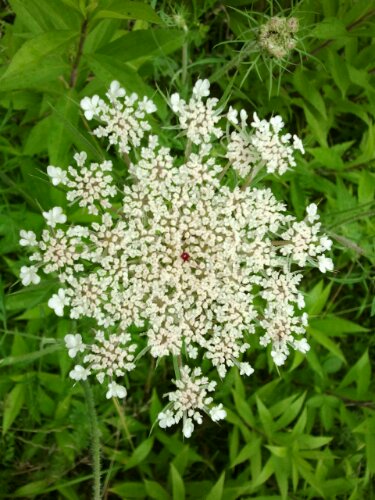
And lastly, another beautiful Queen Anne’s Lace flower (Daucus carota) with the tell tale red spot.
Firstly today is Yarrow, NL: Duizendblad (Achillea millefolium) growing in a protected and well fertilized spot, next to a lamppost on Hugo de Vrieslaan. I use it mainly as a wound herb, I rub the juices gently on lightly wounded skin as an antisptic and to stem bleeding and as a fast remedy to nosebleeds. There are a great many uses for this herb. It is definitely one that far more people should know about and learn how to use. My daughter loves to nibble on this plant, perhaps because she can easily recognize it and pick the leaves from my roof pots but it shouldn’t really be ingested by under 5 year olds due to the strength of its blood regulating action. This plant grows all over the place, very easily and there are coloured flowered varieties which also have the same medicinal effects. I have a red flowered one on the roof. It makes an interesting addition to salads, just a leaf or two chopped up a little is all that’s needed. Be aware that it will bring on bleeding so not for pregnant women. Having said that it also helps to normalize mentrual cycles in some women. A very useful herb.
Above is the uniquely “fragranced” Field Woundwort (Stachys arvensis). Another wound herb, not as potent as Yarrow and not bitter tasting but very aromatic. Its a member of the Labiates and tastes a little of mint, but its quite different aswell. Good as a tea now and then, also a herb with many historic uses. See day 52 for some more information and links about this prolific urban waterside herb – why it’s called field woundwort, I’m not sure, I always find it beside water.
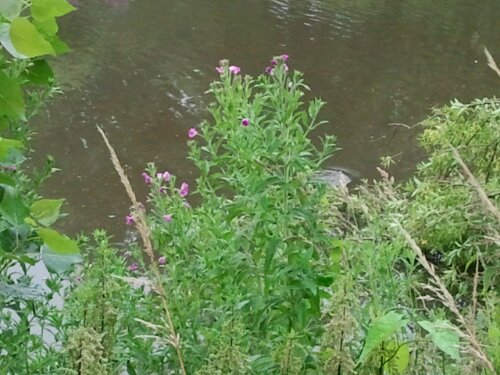
Above is Rosebay Willowherb (Epilibium angustifolium). Edible and medicinal (some use it for treating puss filled boils) not one I’ve really used, just eaten the odd flower and young shoot. Apparently it’s popular in several countries as a spring vegetable. Patrick Whitefield taught me about it some years ago, on a permaculture course. It often grows profusely on wasteland. I remember a lot of it growing on freshly cleared building plots, near my home as a child. It is a pioneer species, giving it the common name in North America of Fireweed.












 Urban Herbology