Each year, I get approached by a small handful of inspiring students who want to spend some internship time with me. Learning about their studies is always enlightening but usually, I need to say no to their requests. Not because of their ideas and motivation, but because I lack the time these enthusiastic students deserve.
Last year, Neleah Moureau, from HAS green academy of Den Bosch, contacted me. She wanted to conduct herb-related research as part of her Horticulture and Business Management course. Aeroponics, an innovative growing system where nutrient-rich water is sprayed onto plant roots, was the topic of Neleah’s research. With the right setup, and without soil, aeroponics can offer optimal light, temperature, moisture, and micronutrients to a wide variety of interesting plants. Neleah wanted to know if aeroponics could be a viable solution for the lack of prime herb growing space in urban settings. I was intrigued. Perhaps this could be an energy-efficient way to grow herbs in tiny urban spaces. Could aeroponics reduce the need for soil, transport, and the heavy water tanks of hydroponics I have seen in Amsterdam? Maybe this type of system could improve the life of city pot plants, by replacing some of that depleted store-bought compost I see them struggling in. And just possibly, aeroponics could provide an alternative for what most urban herbalists lack and long for; a fertile garden in which to grow their supplies.
Seeing the potential in this concept, and wanting to know the answer to her research question, I said yes and Neleah promptly joined me as a regular volunteer. We met at the foraging orchards in Amsterdam Oost. Hidden within an Amsterdam park, the herb orchards are rich in local edible and medicinal herbs; a place where those in the know learn about herbs, and forage without being disturbed. I have run the orchards for the past ten years, in a way that supports local wildlife, people, and plants. Neleah took part in our low-intervention herb-growing, helped catalog the plants, and worked on her main research question back at the college campus.
So how do aeroponics work?
The plants are set up in “plugs” which stabilize the plants in the absence of soil. Their roots hang naked beneath, periodically sprayed with aeroponics substrate. That is water enriched with organic fertilizer. The composition is fine-tuned to satisfy the known needs of the target plants. Because the spraying happens in a sealed system both evaporation of water, and fertilizer run-off don’t happen. The system can be made from repurposed materials and root spraying can be timed and controlled using solar-powered apparatus.
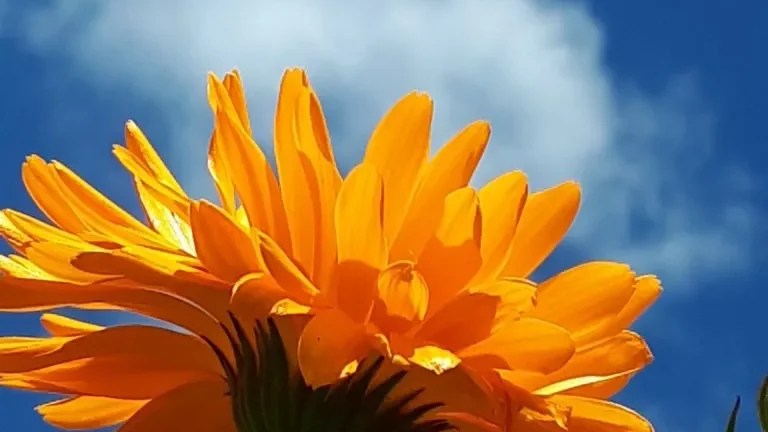
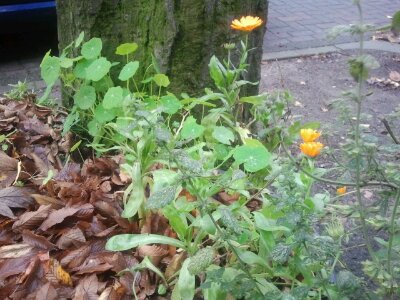
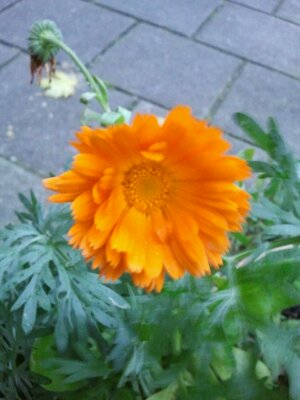
Neleah chose an easy-to-grow popular medicinal herb – Pot Marigold (Calendula officinalis). She found that it has significant commercial value here in Europe and of course, has many therapeutic uses. She wanted to compare how Calendula performed in pots of soil or an aeroponics system. Lighting, CO2, and temperature were kept the same for both sets of plants. By the end of Neleah’s research, the outcome was clear (and little surprise to the volunteer gardeners); although everything these plants are thought to need can be provided by aeroponics, the Pot Marigold plants did far better in soil. Plants grown with aeroponics, at least in this experiment, were a poor version of what they could have been. The soil-grown plants had more flowers, bigger flowers, more foliage, and richer colour, and were more appealing to herbalists and wildlife.
Soil
So what exactly was lacking from the aeroponic setup, to cause such a difference? I am sure that it was the ecosystem of the soil itself. Most plant roots have not evolved unclothed, dangling in a nutrient-rich mist (although air plants such as Tillandsia spp. have). In nature, roots spread out to anchor the plant and to capture watery resources. The plugs in Neleah’s system took over the anchorage role, and the spray delivered nutrient-rich water but what else is in soil?
Naturally, plant roots are surrounded by and penetrated by an almost invisible ecosystem. It lives on, in, and between the non-living particles of soil. Soil is a complex living community. When examined with a lens, grains of sand, clay, and stone are visible in the soil. Those grains are the inorganic components of soil, they are not living but lifeforms and water in the soil, gradually break them down. Within tiny pores in the grains and on their surface, life cycles relentlessly. Fragments of decaying plants, tiny bugs, and maybe even the fungi and bacteria which connect it all up, can be found. With the bare eye, worms, ants and beetles can be seen, all helping move things around and shake things up.
Soil is not simply a mix of NPK a few trace elements and water, it is a complex ecosystem that we can hardly begin to understand. Soil is magical, a place of constant transformation, alchemy beneath our feet! For me, there is no substitute for real soil, that stuff made from molehills, compost, leaf litter, and more; that stuff teaming with lifeforms. That is what plant roots need to be surrounded by. Without it, I don’t see how the magic of plant growth can occur. And what use is a herb if not a magical plant?
I wonder how far aeroponics will go. Solutions for small urban growing spaces are certainly needed and I hope that in time, aeroponics will incorporate plant pro- and pre-biotics, as well as the usual nutrients. Neleah’s work has opened my eyes to the soil-less growing of herbs, and I look forward to seeing where it goes. But in the necessary striving for solutions, I hope we don’t lose sight of the life of the soil.
May plant roots of the future be stylishly clothed in the ecosystem they belong to, one of cycling life, death, microbes, and magic.








 Urban Herbology