Tag Archives: Wild Garlic

365 Frankendael day 345

Today is Puur markt in park Frankendael and that brings lots of extra traffic to the woodland as well as the main park.

image

As I arrived, a fire was being put out on the edge of the woodland.

Here are a few plants which I noticed today:

Lungwort (Pulmonaria officinalis)

image

Primrose (Primula vulgaris)

image

Marshmallow (Althaea officinalis) of last year. There are still a few seed heads on these dry flower spikes.

image

Wild garlic (Allium ursinum) Daslook. A nice area of it with a toxic Arum maculatum (Lords and ladies) growing proudly in the middle of this shot.

image

365 Frankendael day 344

I passed by Flevopark this afternoon and saw masses of Wild Garlic, still looking very good! At the front of the photo you may be able to see lots of Elder (Sambucus nigra) shrubs, just coming into leaf.

image

At the nearby childrens farm and outdoor play centre there were some lovely wild plants and cultivated ones.

Here’s the strawberry planter that I noticed last year..

image

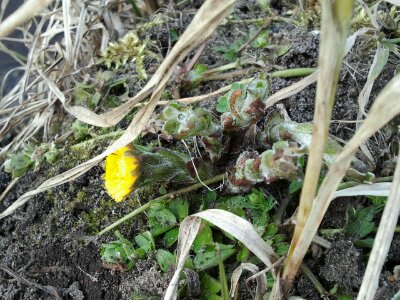
My favourite find of the day, Coltsfoot (Tussilago farfara). It makes a wonderful mild but effective remedy for coughs. Here’s a link to Susun Weed harvesting and preparing it for such a purpose. Making Coltsfoot honey is very easy and very useful.

image

Coltsfoot is of the same family as Butterbur and Fuki which I’ve been noticing a lot lately. All of these plants send up flowers before their kidney shaped leaves. All are quite striking. I’ve never found enough Coltsfoot in Amsterdam to harvest but I’ll keep on hoping.

image

Here’s a plentiful herb which nobody ever minds me harvesting – Stinging Nettle (Urtica dioica). It is getting better by the day at present.

image

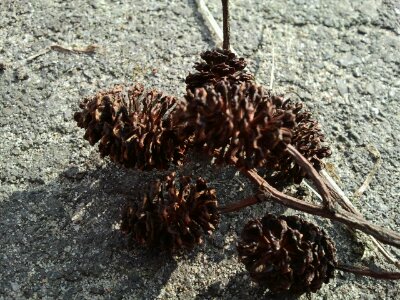
And lastly today, another plant I was delighted to find on our trip today. These are the cones of an Alder tree (Alnus sp). Alder is the only deciduous tree which bears cones. I’m saving lots which I collected from the ground today, to help create a well dressing. Glennie Kindred has helped revive this ancient craft and I’ll be having a go at making one very soon in Amsterdam. Scroll through the 18 images on that link and you’ll see how the cones are used – quite stunning! Alder comes were traditionally used to create the edges or lines of the designs.

image

Alder also bears beautiful catkins, giving more than a hint that it belongs to the Birch family. I found a branch of Italian Alder on the ground in Oud Zuid a few weeks ago. That is now growing lovely leaves in a base of water at home. Still no roots though.

image

365 Frankendael day 342

Perishingly cold in Amsterdam today but most of the local plants don’t flinch at this strange weather! Here’s a small sample of what you could be harvesting or eating from Amsterdam streets and green spaces today:

Today perennial Russian Comfrey (Symphytum uplandicum x) plants are standing proud again. I’m very pleased about this as I’d like to try placing a Comfrey leaf beneath my potato plants this year. My spuds are almost ready to be planted out, just in time for the Comfrey fertiliser!

image

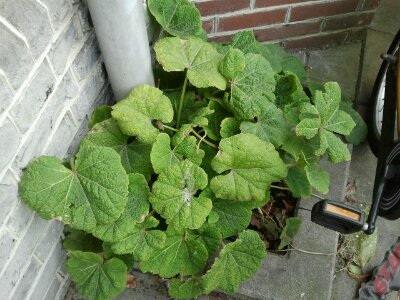
Hollyhock plants (biennials) are looking strong and almost ready for some leaf harvesting. I’ve got lots of plans for this plant this year. An interesting herb to help soothe bronchial congestion and infection.
image

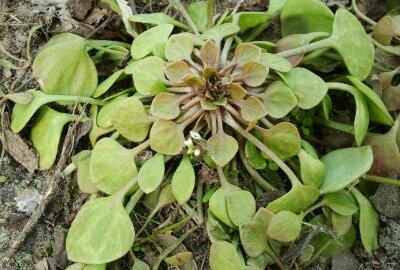
This lovely plant (in Sarphatipark, next to the railings along Centuurbaan) is Miner’s Lettuce, Winter Purslane (Claytonia perfoliata) and delicious it is too! This is the basal rosette of young leaves. Just wait until the little white flowers come in abundance – they grow out of the centre of the mature leaves. Quite amazing!

image

A Butterbur species (Petasites sp), in alien-like flower. Edible in small quantities, contains a liver toxin. It will have massive kidney shaped leaves soon, less interesting to the forager and then more likely to be dangerously confused with other very irritating plants. Now is the time to be interested in this plant.
image

Beautiful (not edible) Bluebells, just coming up beside a Lime tree trunk and an up coming Garlic Mustard perennial plant.

image

This purple flowering perennial is Red Dead-nettle ( Lamium purpureum). Edible, nutritious and gently medicinal.

image

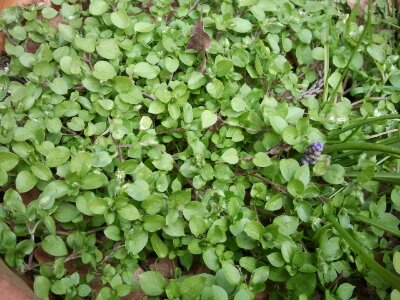
Below is flowering Chickweed (Stellaria media)
image

Here is Wild Garlic (Allium ursinum). Mouth wateringly delicious, if you like the taste of garlic, and with the benefits of garlic, though probably less effect on vampires as it’s milder in strength. Now’s the time to try it if you haven’t already.

image

Next, a Mallard duck checking out Park Frankendael’s Japanese spring delicacy – Fuki (Petasites japonica), before checking out my telephone and trying to eat it – or me, not quite sure which. The beautiful yellow flowers look like primroses from a distance. Primroses are also in flower in the park right now but shouldn’t be touched as they don’t multiply very well here.

image

And last but not least the plant which I found recently and thought was Black Horehound (Ballota nigra). It could also be Common/White Horehound (Marrubium vulgare) I’m measuring this patch each day, waiting patiently for it to be big enough to harvest for a tincture. For the first option, its Latin name, Ballota, comes from its unattractive scent. Its not so bad and helps to identify the plant. It can be used to lift the spirits, act as a mild sedative, ease morning sickness, nausea, gout, bronchial congestion, nervousness, menopausal ailments and many more conditions. I’ve been munching it in the park each day I see it and find it really quite palatable, the smell doesn’t seem so strong or distasteful. Those who named it Ballota must have smelt not so many foul odours! Or perhaps I’ve smelled lots in the chemistry lab so am not so bothered anymore… Or perhaps it is Common Horehound instead? Either way, the two options are edible and I’m really looking forward to trying the tincture and feel that it may become a staple for me during times when I’d usually reach for Motherwort but also feel the effects of cold dampness and chestiness. An infused honey will be the second thing I make from this plant.

image

Wild Garlic Meat and Potato Pie

Meat and potato pie is the comfort food that potatoes were designed for. Well, in my mind anyway.

I had lots of yoghurt pastry dough, potatoes and some meatballs to use up today. I also had a couple of succulent, fresh Wild Garlic leaves in my fridge, which I had picked this morning. The logical combination for these ingredients was a meat and potato pie, packed with Wild Garlic flavour.

image

500g caserole beef
(I used 2 big meatballs in gravy from Scharrel Slagerij de Bouter and 250g organic minced beef)
1 medium onion
Olive oil
500g peeled potatoes
2 Wild Garlic leaves, torn or chopped
1 quantity of yoghurt pastry dough
1 stock cube (I used mushroom)
1 heaped desertspoon miso paste
1 egg

Chop and boil the potatoes in plenty of water, until just tender, so a sharp knife can go in with ease but they don’t fall apart.

Meanwhile finely chop the onion and fry it gently in a small saucepan with some olive oil, until transparent.

Add the meat to the onion, stir now and them whilst the meat cooks through.

Add the stock cube to the meat and enough water to make a plentiful gravy.

Drain the potatoes.

Roll out 2/3 of the pastry, to a size that will comfortably line the base and sides of a buttered pie dish.

Line the dish with the pastry.

Spoon the potatoes into the pastry, follow with the meat, onion, chopped wild garlic and gravy.

Roll our the rest of the pastry, to make a nice pie top. Lay this over the filled pie, crimp it at the edges so it stats together during cooking and fork the top in several places, to slow steam to escape during cooking.

Beat the egg in a cup and brush the tip of the pie.

Cook on a preheated oven at 180°C for about 40 minutes, until the pie crust is a beautiful golden brown and your kitchen smells of wild garlic heaven!

This makes enough to serve 4 – 6, accompanied with vegetables such as carrots

365 Frankendael day 331- River of Herbs

image

It was the second River of Herbs meeting today and we took a stroll through part of park Frankendael, hunting for Molehills.

I used a few hills to build a lovely aerated soil mound around my geveltuin Lavender shrub. Molehills generally contain lovely rich soil – just the thing to encourage the Lavender to set down roots along it’s aging branches, for new plants to form.

We removed a few wild garlic plants from a path in the park, where they never reach maturity due to foot traffic and gardening. These babies will have new homes with Urban Herbies in shady balconies and pavement gardens.

image

There is plenty of Yellow Archangel to be seen (or eaten) at the moment.

image

And this looks like Garlic mustard early leaves to me… I can’t wait (but must) for these plants to bolt upward and produce absolutely delicious leaves!

image

Here’s a photo of one of our first River of Herbs projects… Edible and medicinal Violas and Primroses. Not obtained from the wild, cultivated varieties.

image

Thanks everyone who came for your help and inspiring ideas and enthusiasm!

UPDATE: Next Meeting – Starting at Mercatoplein
Please see this event link to River of Herbs website.

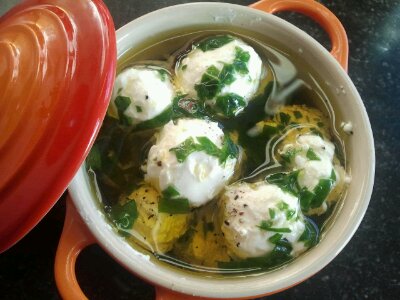
Wild garlic cheese balls

I’ve been making different types of soft cheese at home and this weekend and wanted to share this incredibly simple recipe. The soft cheese is made from yoghurt and then is infused with wild garlic leaves, fresh from the local park.

image

All that you need is:
A cup or two of good quality yoghurt (no added thickners etc, goats or cows is fine),
Cheesecloth, very clean and just scalded (by dunking in boiling hot water for a few seconds),
Olive oil
2 wild garlic leaves, finely chopped (other fresh herbs can be substituted)

To make the yoghurt cheese simply…
1. Pour the yoghurt into the centre of the cheesecloth and pull up the four cloth corners to prevent the yoghurt spilling out.
2. Use a rubber band/clean string etc to tie up the cheesecloth somewhere convenient.
3. Hang it up somewhere clean for about 24 hours, over a bowl so that the drips are collected.
4. After that time you should have a cream cheese consistency, with a milder taste than yoghurt – soft cheese!
5. Scoop out teaspoons of the cheese and form into small balls with your hands.
6. Place in a clean container along  with enough olive oil to cover the balls and of course, the chopped wild garlic.

image

7. You can eat it straight away but after a half a day or so, the cheese will become deliciously infused with the wild garlic flavour.
8. If you manage not to use it all up before hand, it should keep well in the fridge for a week.

365 Frankendael day 300

A lovely walk through the snowy woods of Frankendael for me today. I picked a few Ramson (Allium ursinum) leaves to make infused olive oil and then wild used that to make garlic bread sticks.

image

Apart from Ramsons and trees like these coppiced Willows, the most obvious plants at present are the dry seedheads of Teasel and Figwort.

image

For once, I can photograph the pretty Figwort, it usually merges so well with the background. I’m very much looking forward to the spicy smell of this plant in the late spring.

image

365 Frankendael day 289

Oh I’m so excited! In the park today…

image

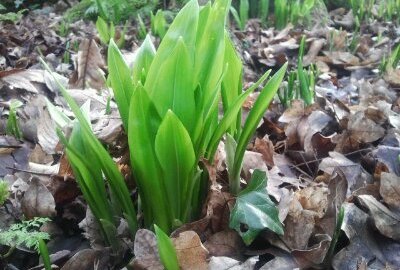
Wild Garlic (Allium ursinum) Ramsons. It’s up! It smells great. I love it!

Please be aware that anyone who takes up a wild garlic plant, bulb and all, is acting illegally. Anyone ripping handfuls of the leaves or harvesting when the plants are too young to recover, is acting unethically. I shall continue to carefully harvest one or two individual leaf blades as and when I know I will use them directly. I only harvest from huge swathes of the plant and I suggest that others who like the plant do the same too. Most of the plants are too small to harvest from today but some are fine and their potency (as for regular Garlic but it’s less irritating to the tissues) is greatest before the plant flowers. So from now on, until the flowers come on the plants, I consider it Ramsons season. I walked through all the Ramson areas of park Frankendael today and some are completely without signs of life, so we are really fit at the binning of their time above ground. Keep your eyes open for them and be very attentive to their state of health, vigor and whether or not they are big enough to disturb by plucking a leaf. Flevopark has masses of Ramsons and I am sure the other big parks also. I’ll stick with my most local plants and plan to make some wild garlic ghee from a few leaves, for the apprentices next week. Here’s an interesting blog post about Ramsons in Amsterdam and some comments about the ethics of eating some.

Also today:
image

Lesser celandine. A sign of early spring, not for eating, not for picking but with historical uses.

image

And lastly another beauty not to pick because of it’s rarity – Primrose. Very tasty and very very useful!

365 Frankendael day 19

I’ve been walking in Frankendael with Elodie today, we found heaps of herbs, several new to us. If you’d like to join me for a herb walk there are a few spaces left for the Sunday May 27th Amstel to Frankendael walk. Here are some striking examples from today…
Solomon’s Seal looks rather like an enormous version of Lily of the Valley so I always steer clear of it. I have always thought of Lily of the valley as a poisonous plant so lethal that I shouldn’t even go near it. Upon reading about it last night I learned that it is called the herbalist’s Digitalis. It has a potent specific effect on heart muscles, causing them to open and fill more intensely and to raise blood pressure. It is thus lethal in even small doses and is not a herb of interest to me. However this arching beauty of the woods is very interesting. Solomon’s seal is used to make traditional remedies for many ailments, ranging from speeding muscle and bone healing, to menopausal symptoms, diabetes, acne and other skin afflictions. The native Americans reportedly ate it frequently.

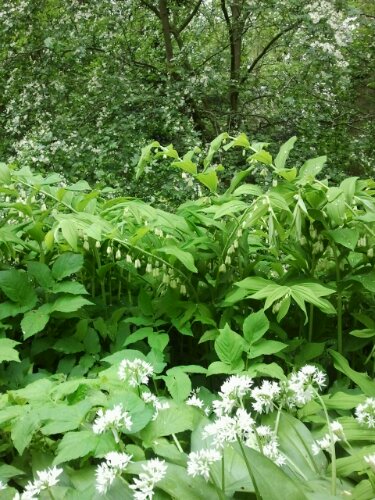
I was thrilled to turn a corner in the wood today and be greeted by this scene:

It is difficult for a photograph to do it justice – especially one of mine! Here is Hawthorn arching over a swathe of Solomon’s seal and Wild garlic, all three in flower at the same time.

Other herbs of note today…
Below, endangered Hoary Plantain (Plantago media). I first saw this herb last year and remember not really knowing what it was, although it was obviously some kind of plantain, but wanting to hide it and protect it from trampling feet! Of course I couldn’t and this plant is well adapted to living in well trodden locations. However, should you find it, especially in a week or two when it’s flower stalk will look like some sort of moth-plant hybrid, then please don’t touch it. I hope that this one has a chance to set seed.

Chicory foliage:

Yarrow (Achillea millefolium)

Endangered Greater burnet (Sanguisorba officinalis)

What a waste!


Finding this discarded bunch of foraged ramsons, made me very sad yesterday. Not only did someone harvest the flowers of this wonderful wild herb but they also didn’t even eat them! I was even sadder to see them still on the ground, this morning. The flowers of wild garlic taste inferior to the leaves and by removing them, careless foragers prevent new seeds being formed so this bulbous plant can spread far and wide.

Please spread the word about how to forage responsibly so that everyone can enjoy herbal beauty and bounty in our cities, for generations to come.