Category Archives: Alchemy

365 Frankendael day 59

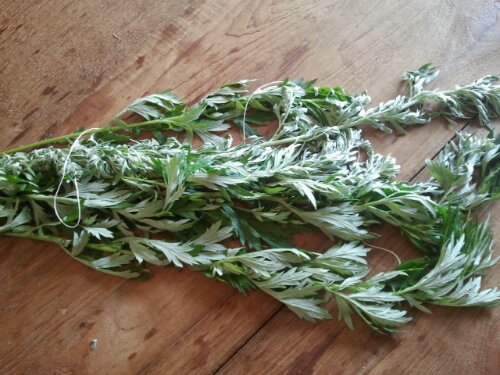
Today was the first Urban Herbology Herb-by-Herb workshop, introducing Mugwort to a small group and helping them to experiment with making tinctures, infused oils and other herbal preparations. So my photo for today is simply of the remains of our Mugwort (and Wormwood) harvest!

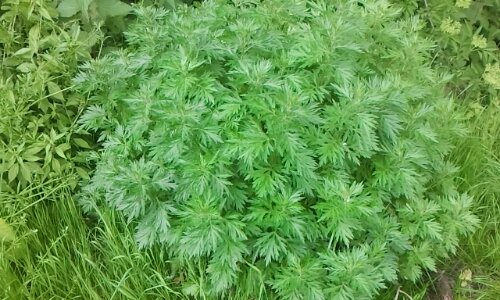
Mugwort (Artemisia vulgaris) which is dark green on the top leaf sides and silver grey beneath, is very closely related to Wormwood (Artemisia absinthium) (silver-grey all over). Mugwort is a very common scrubland herb and Wormwood is currently quite rare, here in the Netherlands at least. The Wormwood we harvested today comes from my front pavement garden and the Mugwort comes from behind my local bus stop, alongside Frankendael Park.

Both are edible but both who should not be consumed in quantity. At this time of year, the active chemicals within the plant are at their most potent so only small amounts are advisable for consumption but both do give a wonderful and unique savory flavour to cooking. Mugwort is considered a powerful dream herb but as the workshop discussed today, this is most likely due to the fact that it is a slight irritant. It is thought to simply keep the Mugwort “consumer” in a slightly lighter sleep state than normal and so they are more likely to remember their more vivid dreams. Whatever the reason, I really like both of these herbs and use them for various applications throughout the year. I’ll post the Mugwort Tea bread recipe, as requested, seperately in a moment.

Thank you again to the lovely people who joined me for the Mugwort workshop today!

Mugwort Bread

Mugwort (Artemisia vulgaris) is one of my favourite herbs, particularly at this time of year. It grows as a tall, bushy, common weed in cities. It is easy to identify by appearance and scent and I love to add it to cooking, several remedies and household herbal products. After one of my recent Herb Walks, two of the group reported back that they had incorporated some Mugwort into homemade bread. Today I had a go at the same, adding a good heaped tablespoon of fresh, chopped Mugwort leaves to my usual bread recipe. I think it tastes very nice and I’ll use it this way again. Mugwort bread is not as dramatic tasting as using Mugwort as a vegetable but it is pleasantly savory and quite aromatic. It also seems to add to the moistness of the bread. Very agreeable. I have just enjoyed a few slices, loaded up with peanut butter, not a bad combination!

I’ll add my bread recipe another time but there are plenty to find online and in cookbooks. I make mine with half Speltflour and half Wheatflour, 4 cups in all, plus 1 teaspoon dried yeast, 2 teaspoons salt, 1 3/4 cups water. Simply add the chopped herb at the start of the dough making process.

Mugwort used to be a popular culinary herb but has fallen out of fashion. The herb is bitter and aromatic and can be substituted for similar, more familiar herbs such as Tarragon (Artemisia dracunculus) and Sage (Salvia officinalis). As with all familiar culinary herbs, it should be used in small quantities and introduced gradually into the diet, keeping an eye out for personal reactions. You should also be aware that Mugwort is said to be unsafe for ingestion during pregnancy (although in China it is sometimes recommended to prevent miscarriage).

So if you like making bread and you have properly identified some Mugwort near your home, maybe give Mugwort bread a try. Thank you Daniel and Amalie for the tip!

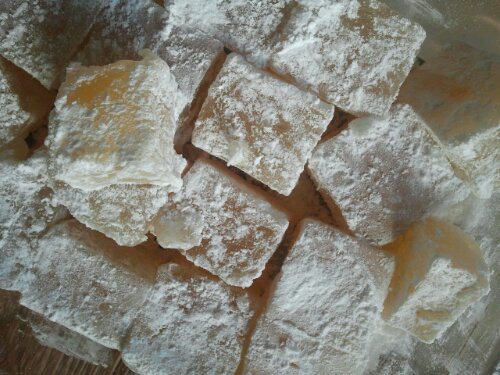
Elderflower Delight


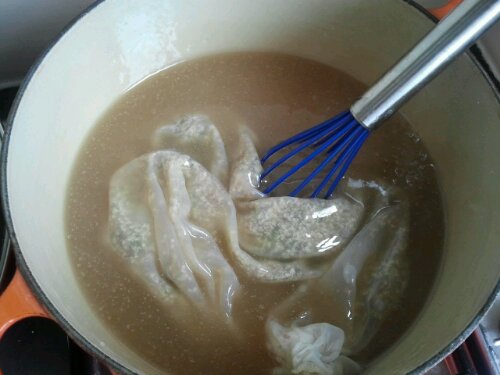
Not much to say about this other than TRY IT, we loved it! It also made me feel like someone from the pre Victorian age as I stirred the syrup with an enormous bag of Elderflowers immersed in it.

This was required for quite some time, to prevent it sticking or bubbling over, so be prepared to focus solely on this whilst you make it. Well worth the effort though. The cooking and cooling process seem to intensify the flavour of these wonderful flowers ten fold. Make sure you harvest from more pleasantly scented Elders.


I bought the River Cottage Hedgerow Handbook which this recipe is from recently. However it is also posted online by the author, within the River Cottage website. So no need for me to hold back, have a look at the link and get picking and brewing those flowers!

Urban Herb Love


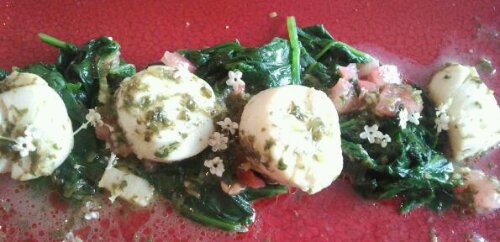
Yesterday was our seventh anniversary, here is what we cooked: Scallops, marinated in the juice of half a lime, a sprig of fresh coriander leaves, finely chopped and a small nugget of fresh ginger, squeezed. After cooking in the marinade, the scallops and sauce were laid on wilted spinach and Elderflowers were sprinkled on top.

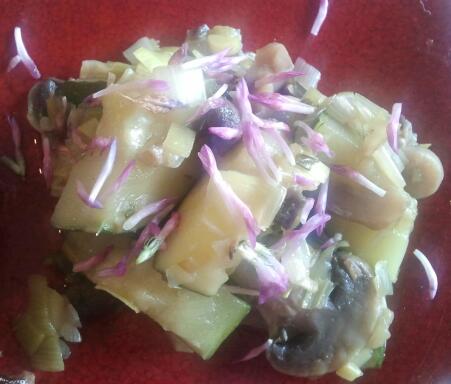
Next came grilled lamb cutlets served with a caprese salad and most importantly, Mugwort vegetables. The taste of a top of almost flowering Mugwort (Artemisia vulgaris) infused into mixed vegetables, as they cooked in one of my magical cast iron pots. It was served sprinkled with detached individual Red Clover flowers. Mugwort (Cronewort, Artemisia vulgaris, NL: Bijvoet)  is extremely tasty and aromatic when cooked in this gentle way. Just a splash of olive oil, finely chopped leeks softened then chopped aubergine and courgette added to the pan. Lid on and simmer gently for ten minutes or so.

Umm, now that’s Urban Herb Love!

365 Frankendael day 44

Today is drizzly and cool; the same temperature as last Christmas Day. Umm, a far cry from the heat of a week ago.  So today’s photos look as though I took them at dusk but in fact they were taken at about 2pm.

I have had another one of my bird spotter moments. I identified a plant from the park which looked pretty when I found it, but not spectacular. It wasn’t one that I recognised, although I was drawn to it and wanted to know  it. I took a little part of the plant home from my walk yesterday and used my books and the Internet to identify it.  Today I went out and photographed it along with some other June beauties:

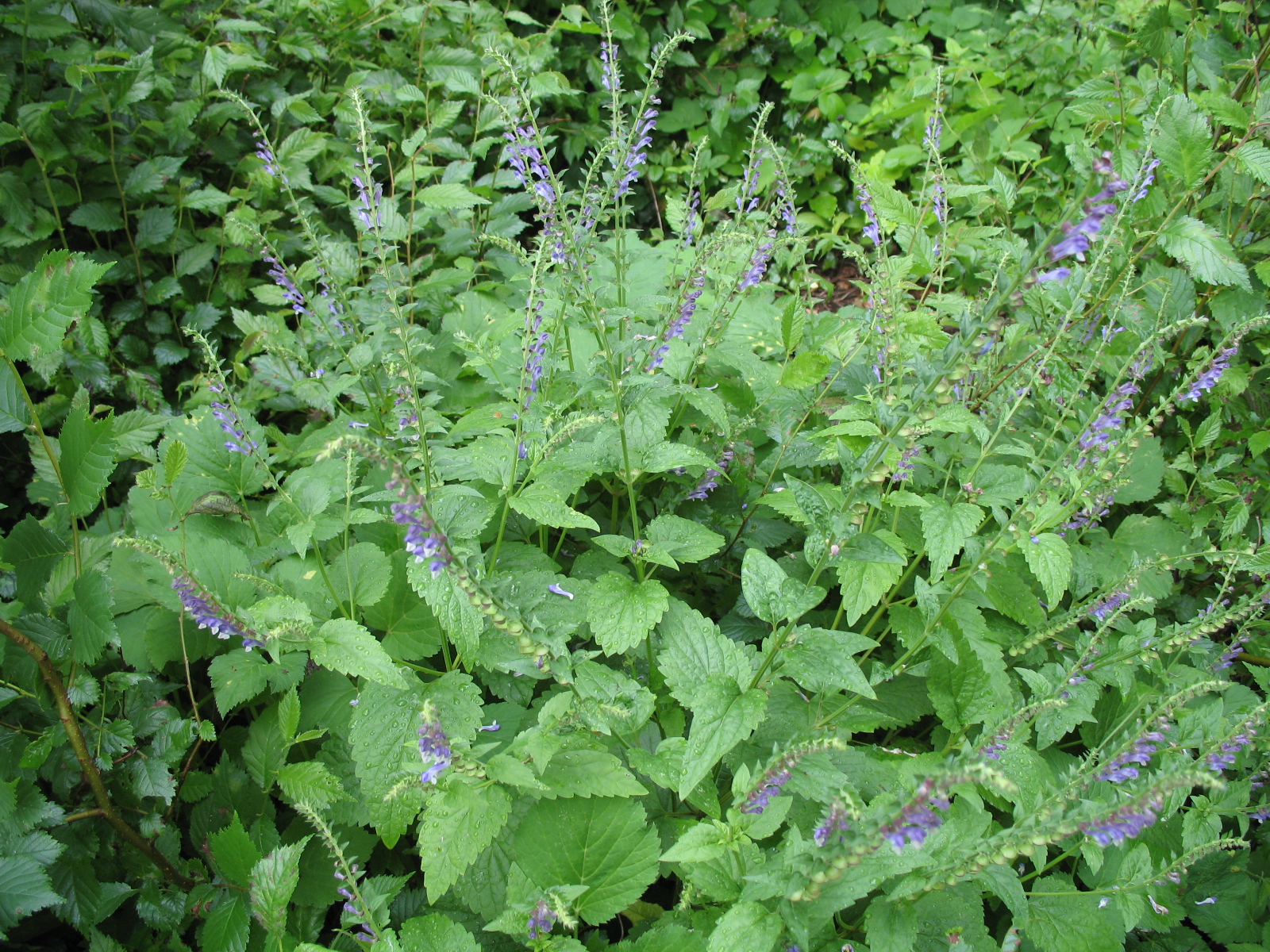
Above is the plant I am so excited about – Skullcap.  It has pairs for slender, hooked Labiate flowers, running down adjacent corners of quite long flower stems. The flowers are a lovely deep mauve on the upper lip and contrasting white on the lower lip. This two tone flower is not obvious until you get right up close to it. The plant is clearly a member of the Labiates, not only due to the flowers but also because it has square stems and leaves coming off the stem in opposite pairs.  The leaves taste strongly bitter, they taste amazing actually, of strong Scullcap tincture, the type I use at home quite regularly for pain relief and relaxation. I especially love this herb and have been using it for some years with great success, since beginning study with Susun Weed.  It gives subtle releif to pain, especially pain in the head and it brings on sleep when it is needed.  I am so happy to have stumbled upon this beautiful herb in Park Frankendael as I not seen it (or at least noticed it) growing wild before, I only knew it from books and bottles.  All members of the Scullcap family contain the active ingredient and this is quite volatile thus the plant should be tinctured in situ.

There are many Scullcaps and all have the same active constituents. Most likely, this one is Sculletaria altissima, Tall Skullcap, Glidkruid in Dutch. It is labelled as Tros Glidkruid (Sculletaria columnae) in the herb garden of the park but I am not convinced.  The flowers are very similar but the underlip of this Frankendael plant is definitely white, throughout, it doesn’t blend from white to mauve at all, there is clear definition.


Above is flowering Scrophularia nodosa, Common Figwort, NL: Helmkruid.  A very strangely scented Labiate, which Claud Biemans helped me identify a few weeks ago.  I still need to do some proper research into its internal and external uses but it certainly has many historic applications, such as being used to relieve skin eruptions and swelling for painful joints.  It is prolific in some parts of this park.

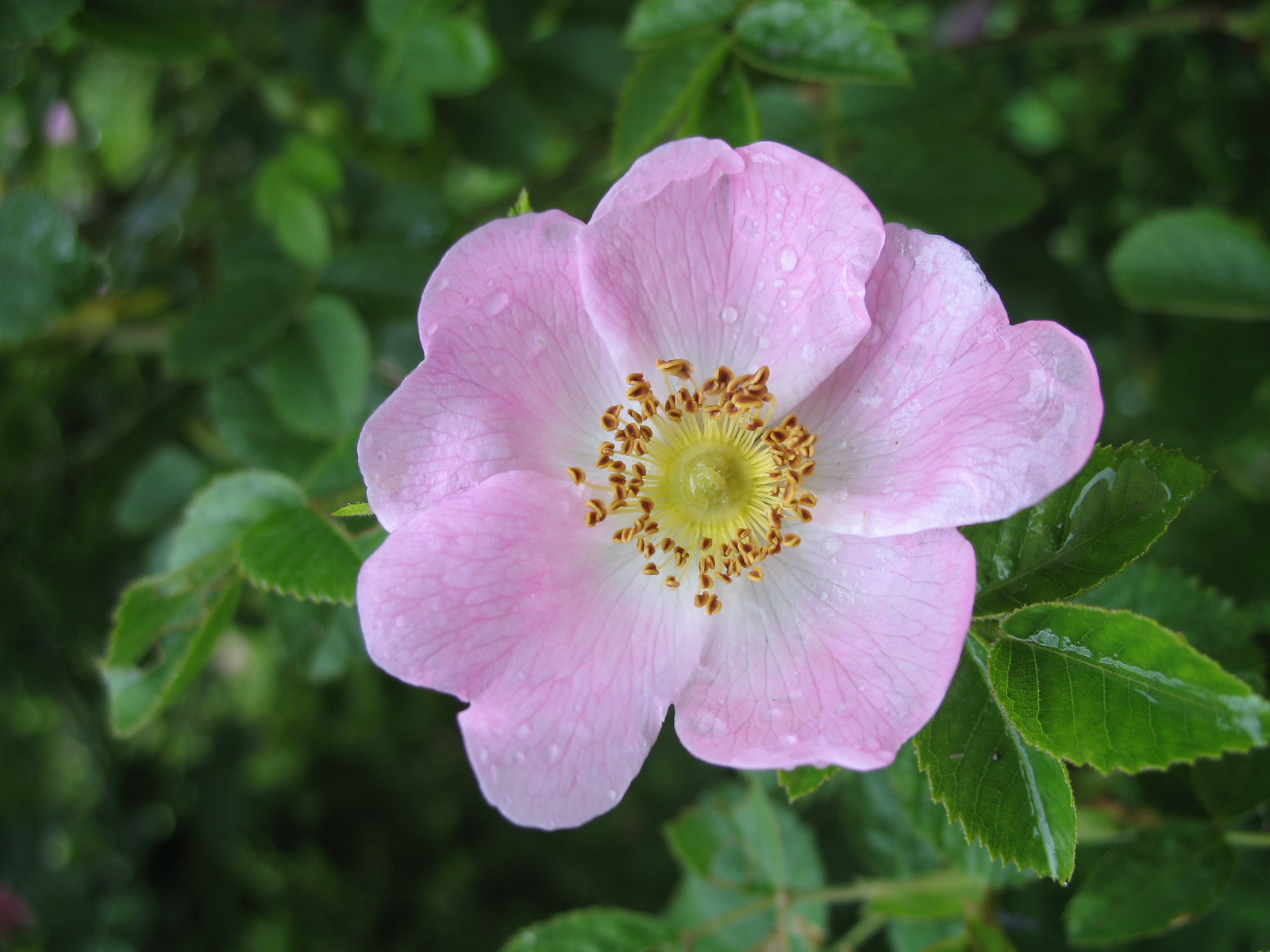
Next today, Wild Roses.  It has rained today and the scent of Rose, close to these bushes is extraordinary.  If you haven’t been outside to smell Roses after light rain then try it!  I’ve mentioned Rose many times before.  They are tasty and have many uses.  These are both most likely to be Rosa canina, Dog Rose and how beautiful they are!  But one of them could possibly be Rosa rubiginosa, Sweet Briar, it certainly smells good enough to be that.  I will have a better look at the defining parts another day. For today I simply enjoyed them.

Here is Pellitory Parietaria sp., Glaskruid in Dutch.  Another useful herb to learn more about as it is again prolific in arts of Frankendael.

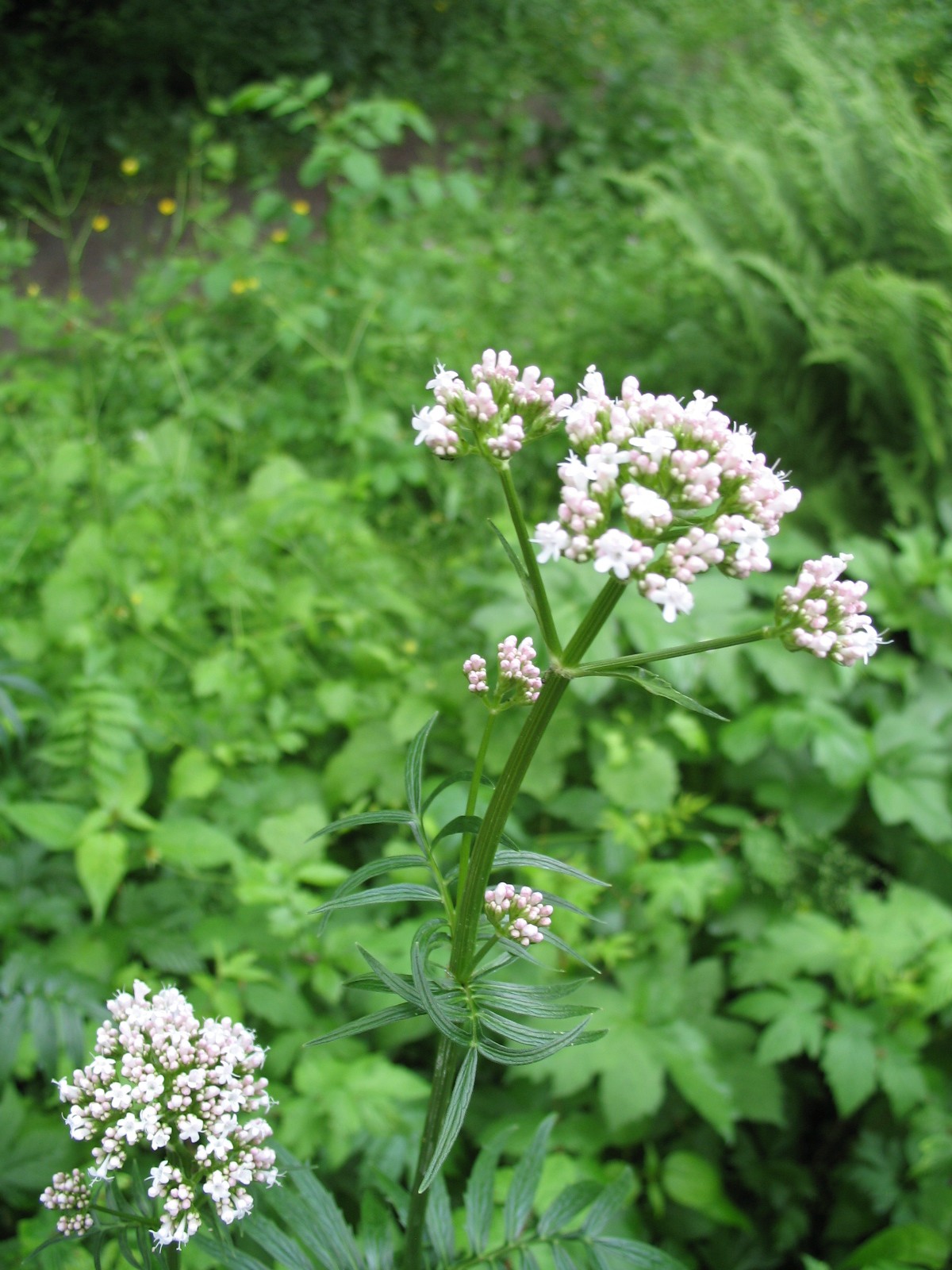
Lastly today gorgeous Valerian flowers, on the edge of the main woodland pond.
They smell great, they look great and they are very useful if you need to relax.

Herb by Herb – Part one – Mugwort


Once a month a chance to learn in detail about a different common urban herb from either Jennie (who I run the meetup group with) or me, Lynn. 

Part one is about Mugwort (Artemisia vulgaris). An amazingly mystical, powerful and yet underused plant, usually found in neglected places.  Cronewort, the Dreamherb, is a great herb to learn crafting techniques on, such as how to make an infusion, oil, tincture, dream pillow and more. I will take this session in Park Frankendael on Monday 18th June 2012. 10.30 – 12.00.

In this short and sweet field workshop, you will make (or prepare for) all of those things and learn about the properties, habitat, folk and medicinal history and up to date uses of the plant. You will take home a bag full of little herbal preparations and knowledge of how to do it time and time again with everyday materials.

We will try to run each monthly Herb by Herb workshop near the New Moon and the days of the week will vary. You are welcome to attend all, some or none of the series! Most materials will be provided. You’ll receive a simple pack list when you subscribe. Cost of the workshop is €10.

Please contact me by email or through the meetup group if you are interested in joining this workshop.

Wild Herb Pasta


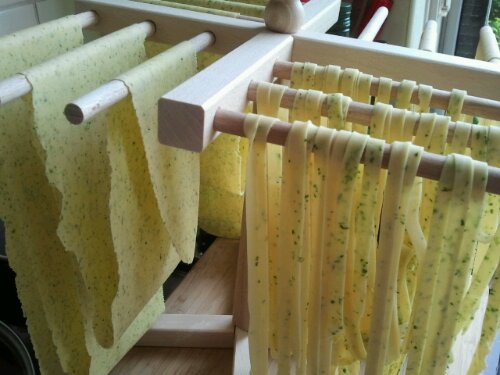
If you enjoy making fresh pasta and would like to inject some herbal magic into your creations, this recipe may interest you. Fresh herb leaves are blended through the pasta as it is repeatedly rolled in a pasta machine.

I heard about incorporating basil in this way from a colleague, who’d been to an Italian cooking workshop. I’ve made pasta with nettle juice before but find that quite a slow process so I thought I’d try it this way but incorporating some unusual foraged and pot grown herbs.

This method is very easy, it just takes a little more time than regular pasta making. I’ve no idea if this is how the Italian workshop prescribed it but this way certainly works and produces very herby pasta!

If you don’t know how to make pasta I recommend Jamie Oliver’s method. It’s very simple and works for me everytime:

A. Basically fork 4 eggs into 400g of tipo00 flour.
B. Do what you can with the fork then knead it thoroughly with your hands.
C. Wrap in clingfilm, or similar and refrigerate for 2 hours or so.

Whilst it settles in the fridge, get foraging! I used garlic mustard, basil, ground elder and parsley when I took these photos. Use what you have available. Curley Parsley was a challenge to incorporate but it eventually broke down well and tasted great. The other herbs broke down very quickly. Obviously, use herbs which are safe for you and your guests. Basil for instance is often avoided by pregnant women. A small quantity is unlikely to harm but be aware that even seemingly innocuous culinary herbs, can be very potent.

Now, how to incorporate the herbs…

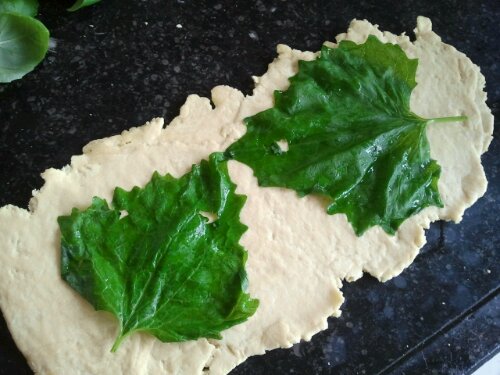
1. As you progressively roll your pasta dough in the usual way, through a pasta machine, or by hand with a rolling pin, simply lay a few herb leaves down the middle of the pasta sheet.

2. Fold over the two sides to cover the herbs.

3. Continue running the dough through the increasingly narrow pasta machine. Each run through, will break down the herbs. Eventually tiny fragments will be distributed throughout the entire pasta sheet – it’s quite extraordinary to watch it happen!

4. Keep going until the pasta dough is as thin a you like and cut or process it as you wish.

I always make heaps of pasta (6 eggs, 600g flour), we then eat a hearty pasta meal and freeze the rest in portion sized containers, when still fresh and just dry enough to handle.

Herb by Herb – Part 2 – Ribwort

Once a month a chance to learn in detail about a different common urban herb from either Jennie (who I run the meetup group with) or me, Lynn.

Part two is about Ribwort (Plantago lanceolata). An amazingly simple looking plant, found right under your feet, with a multitude of uses. It’s a great herb to cut your teeth on, regarding how to make an infusion, poultice, infused oil and ointment. I will take this session in Park Frankendael near the New Moon in July 2012. 12.00 – 13.30.

In this short and sweet field workshop, you will make all of those things and learn about the properties, habitat, folk and medicinal history and up to date uses of the plant. You will take home a bag full of little herbal preparations and knowledge of how to do it time and time again with everyday materials.

We will try to run each monthly Herb by Herb workshop near the New Moon and the days of the week will vary. You are welcome to attend all, some or none of the series! Most materials will be provided. You’ll need to bring along a small pair of scissors, perhaps a flask of hot water and 2 small and clean glass jars (such as 90ml pesto jars).
Cost of the workshop is €10.

Please contact me by email (lynn.shore@gmail.com) or through the meetup group if you are interested in joining this workshop.

Easy Dandelions


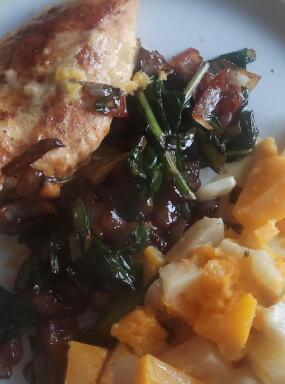
Here’s our dinner this evening.
Between us, as a side dish, we enjoyed the leaves of two large dandelions (Taraxacum officinale) picked from Ben & Riny’s garden a couple of hours ago.

After a good rinse, I roughly chopped the leaves and simply added them to the pan juices after frying chicken and eventually an onion. I added a slosh of the vegetable cooking water, from the celeriac and pumpkin you can also see in the photo. that just loosened things up a little and helped to stop the dandelion from frying. The result was very tasty indeed and rather healthy!

The root came up easily, from one of the plants so I’ll add that to a soup tomorrow.

Horsetail Nail and Cuticle Cream


Horsetail is a traditional remedy for weak and brittle nails. The source of it’s reputation is plant silica which it contains in relatively high quantities. The following recipes are adapted from Josephine Fairley’s book..

Make a heat infused oil of Horsetail, which has been left to wilt overnight after harvesting. Then stir in enough beeswax to make a light salve. (You can test the solidity of your salve before it sets, by dabbing a drip or two of your mix onto the back of a cold spoon. Add more base oil if it’s to solid, as more beeswax if it’s too runny)

If you have it available, add 5 drops Benzoin tincture, just before the beeswax, as it may help to further nourish cuticles. You could also add a few drops of a complementary essential oil (such as Lavender) at the beeswax stage but it’s not really necessary.

Quantities:
50g Fresh Horsetail stems, preferably in spring (or 25g dried)
150 ml Olive oil
1 tablespoon grated beeswax

Follow the instructions for making heat infused oils, simmer gently for 30 minutes.

Another way to nourish nails with Horsetail, is to make a heat infused oil and use it as a warm nail soak, once a week our so. The book says you can reheat this oil as often as you like but I urge you to beware of impurities entering your infused oil by repeated use and rewarming. You could achieve a similar effect by coating your nails and cuticles with a sufficient amount of the oil then put a pair of cotton socks or gloves on your hands for 10 – 20 minutes to retain the heat and help the oil to penetrate.