Category Archives: Potions

Tapping Birch Blood (Betula spp., NL: Berk)

This afternoon I was privileged to collect and drink sap from a mature birch tree in a friend’s Amsterdam garden.   Today’s tapping was something of an experiment, the process went quite smoothly and we managed to collect about 75ml of Birch Sap (Birch Blood) in about 20 minutes.  I shall certainly be trying it again on other trees, hopefully this spring.

[If you would like to learn more about this in practice, check out my blended learning apprenticeship course.]

Allergic to apples = allergic to Birch
It seems that those with an allergy to apples are very likely to be allergic to Birch sap and thus should avoid it.

Benefits of drinking Birch blood
Birch blood or sap is a weak solution of nutrients which were stored in the roots over winter and are pumped up through the trunk and branches in spring, for the tree to use in new growth.  The sap is drawn upwards through a system of vascular cells, from roots to crown by osmotic pressure. It is mainly water and contains some vitamins (mainly C), minerals (mainly potassium, calcium, magnesium and zinc), amino acids, fructose, glucose and other fruit sugars.  It is clear (not blood red), has a slightly soapy appearance when shaken and has a refreshing watery taste with a hint of birch aroma, a little sweetness and perhaps little bitterness in the aftertaste.  Some say it can taste slightly of Wintergreen, I’m not sure I could taste that today but there was certainly more to it than water.  Sugar content in Birch blood peaks in the middle if the tapping season.

Across cultures, there are a great many health claims associated with drinking Birch sap.  It is said by many to be an excellent spring tonic, to help prevent scurvy and rickets, to help relieve rheumatoid arthritis and gout symptoms, to ease symptoms of multiple sclerosis, to accelerate the metabolism, to help with diabetes myelitis, to help kidney disorders and to cure birch pollen allergy symptoms.  That’s quite a reputation to live up to!

I recommend Hedgerow Medicine by Julie & Matthew Bruton-Seal for further information about the virtues of Birch.

Which birch trees and when?
Sap should only be collected from healthy birch trees, with a base trunk diameter of at least 25cm.  The owner’s permission should be obtained before attempting to collect any sap and care should be taken to prevent further damage to the tree during and after tapping.  If drilling a hole, use a very clean drill bit and insert very clean collection materials.

If you can reach the branch tips of a birch tree in spring, you could break off the tip of a twig and watch for dripping sap.  If it happens quickly, this is a good sign that the sap is flowing well and that it may be possible to collect from the trunk.  Spring time, before the leaves form, is the best time to collect birch sap.  Some say that the best time to collect is when the nights are cold (below zero) and the days are warm.  The tapping season varies depending upon climatic region but it generally only lasts for a month or so.

Some say the same tree can be tapped yearly, others say no more than once every three years.  Be cautious and look after the tree.  One tree can be tapped continuously through one season (change the collection vessel regularly of course).

How to tap Birch Blood
(I used a cordless drill (thank you Herman!), part of an old but tidy metal olive oil spout, 1 meter of aquarium tubing from my local pet shop (cost 1€) or find it here on Amazon, used plastic baby milk bottles for sap collection and an old plastic tub to stop the baby bottle falling over).

  1. You must get the permission of the land owner first.
  2. The tree must have a trunk diameter of at least 25 cm and must be healthy and strong.
  3. Ask permission mentally or audibly of the tree itself.  If you are inclined as I am, then discretely make an offering of something precious to you and natural, to the roots of the tree.  You are taking some of it’s life force so be respectful, careful and only take what you need.
  4. Between 50cm and 1 meter up the trunk, drill a 1 inch deep hole through the bark, at a slight upward angle (about 30 degrees) with a very clean drill bit (about 6mm diameter bit).
  5. The sap will immediately or very soon start to flow out of the hole.
  6. Insert sterile, sturdy but flexible tubing (about 1 meter long), of the same diameter as the hole (this will be a little bigger than the bit size) into the hole.  Like me, you may like to insert a graduated metal tube into the hole to ensure a good seal and then fit flexible tubing over that short tube.
    N.B. Tubing and collection vessels can be sterilised in various ways; I choose to clean them well in slightly soapy water, then boil in clean water for about 10 minutes, then dry on a clean muslin or tea towel..
  7. Insert the flexible tubing into a sterile collection vessel such as a plastic drink bottle.
  8. Collect as much sap as required or possible in the time you have available.  If leaving the tapping unattended make sure to cover the collection vessel well (plastic bag and elastic band?) so that insects etc. won’t climb in.
  9. Seal the collection vessel and use the sap immediately or refrigerate or freeze.
  10. Carefully remove the tubing and or metal spout from the hole. See the following section about sealing or not sealing the wound.
  11. Clean your tubing, dry it and store for future use.

To seal or not to seal?
There are differing opinions about whether the hole should be plugged or not after tapping.  Some say the tree should be left with an open hole as it will seal it and heal itself best this way.  Recent research on Maples in Canada, suggests this is the best method.  Others warn against leaving the tree to literally bleed to death with an open wound.  Today we plugged the hole as best we could with a twig of the same diameter as the drilled hole.  It worked fairly well and stemmed most of the flow.  Beeswax is suggested by some as another way to seal the hole, I have not yet tried that.  Others suggest inserting a cork, I tried this before the twig today and it was ineffective; the cork had to be whittled to fit and then became too pliable and weak.

It felt better to seal the hole today, I didn’t like to leave all that beautiful sap running down the trunk, although as the weather is not too warm at present and any seepage from the wound runs down the trunk towards the roots, I can’t really imagine that the loss of sap would cause too many problems for a healthy tree.

An easier way to collect a little sap
Simply cut off the ends of some birch twigs or branches and point the cut ends into a bucket or ease them downwards into a bottle.  Sap will soon start to drip out of the cut ends.

Storing and using the sap
Birch sap should be consumed quickly and stored at refrigerator temperature.  The sap can apparently be frozen for some time.  Birch sap can be made into a delicious wine, be boiled down to make a syrup – rather like maple syrup and can be drunk fresh. I have also heard that some chefs like to make Birch vinegar from the sap.

Cleavers (Galium aparine, NL:Kleefkruid)

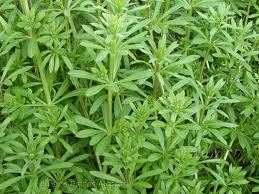
Cleavers (Galium aparine)
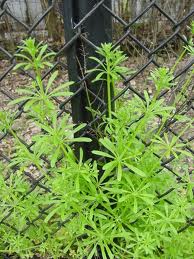
I remember having a lot of fun with cleavers or “sticky weed” as a child.  This is a wonderful sticky, annual plant that often grows wild and prolifically against fences, in hedgerows, crop fields, and beneath trees.  I know I was not the only child who delighted every time I found a patch of sticky weed, throwing it at my friends to see it stick to their clothes and hair.  If I had known then about how useful it is as a cleansing herb, I may have been more careful with it – or maybe not!

The leaves of Galium aparine grow in whorls of 4 – 8 around its stem, which can grow to 2 metres long.  The plant’s sticky nature comes from tiny hooked hairs growing out from the leaves and ridges of the stems.  It produces tiny greenish white flowers from May to October.  Seeds are set in small sticky hairy burrs and can remain viable in soil for up to 7 years.  The sticky hairs enable Galium aparine to grow upwards by clinging to other plants and fences. They also assist in seed dispersal.

Cleavers are held in high esteem as a spring tonic.  The herb is said to promotes lymphatic flow, to be cooling, soothing and cleansing. It is best harvested when young and prolific from early February.  It can be added to salads, though the hairs give an interesting effect, or cooked in a little water as a leaf vegetable.

Sometimes confused with…
As ever, when harvesting from the wild you should use a good field guide, be aware of look-a-like plants and follow the picking rules which I have mentioned previously.  I think the most likely plant to be confused with Cleavers (Galium aparine)  is Sweet Woodruff (Galium odoratum).  Sweet Woodruff is also a useful herb but unlike Cleavers it contains substances which can be poisonous in very large doses. Sweet Woodruff is darker green and has sticky hairs on its seeds, but the leaves tend to be smooth.  Sweet Woodruff is a perennial whereas Cleavers is an annual.

Cleavers juice – This is said to be the most potent way to consume cleavers. To make it all you need to do is to clean your harvested cleavers, chop it roughly and then squeeze out the juice through a jelly bag or clean tea towel.  The recommended dose is 1 teaspoon, 2 – 3 times daily as a tonic.

Cleavers tea – Again, clean your harvested cleavers then chop it.  Add 1-2 tsp of this per cup of boiled water.

Cleavers tincture – Harvest the top two thirds of plant when in flower or setting seed. Tincture in 100 proof vodka.  Dosage is 0.5ml – 1ml in water a few times daily when called for.

Cleavers has a folk reputation as a remover of lumps and bumps.  So enthusiastic were many claims that there has been some clinical research, in the hope that it could help reduce certain cancerous lumps.  However the results were not supportive of the traditional claims.

Cleavers is often used by herbalists for cystitis, swollen glands, swollen breasts, PMS, mild lymphedema, prostatitis and as a diuretic for a general spring clean.  Susun Weed reports that it can also be helpful in reducing allergic reactions.  Due to it’s gentle diuretic cleansing action, Galium aparine often also helps to ease some skin disorders such as psoriasis and eczema and gout.

Ramsons (Allium ursinum, NL:Daslook)

The woodland floor in Frankendael Park is carpeted with flowering snowdrops and the emerging leaves of Ramsons (wild garlic, Allium ursinum). I’m sure snowdrops have their uses but when you find them, Ramsons are an urban herb forager’s dream.  All parts of the plant are edible and very useful, though the leaves and flowers are all you should use.  The bulbs should be left alone and only pick a leaf or two from any plant.  They taste truly delicious – if you like the taste of garlic!  They taste best, by far, before the pretty white flowers open and can be eaten from early spring, when the first leaves emerge from the soil.

Ramsons have similar properties to Garlic but are milder in all respects.  They are also more tolerable to those you have difficulty digesting other members of the onions family.

  • Ramsons can be eaten raw or cooked and act as a gentle spring tonic.
  • They act as a gentle blood cleanser, stimulating the circulatory system and so benefiting the heart, memory, eye sight and skin.
  • They can be very helpful to those suffering from bowel problems, such as Crohn’s disease, IBS, colic, ulcerative colitis, flatulence, gas and bloating.  They have a mild cleansing and calming effect and are said to balance gut flora.
  • They have mild antibacterial and antifungal properties, making them useful as a poultice for boils and minor cuts.

Featured Image -- 15472

Until yesterday I had only eaten Ramsons as a spicy addition to salads and cheese sandwiches.  Michael & Elodie at de Hortus told me about Ramson pesto last week so, after a quick afternoon forage, Ramson pesto and home made pasta was on the menu at my home last night.

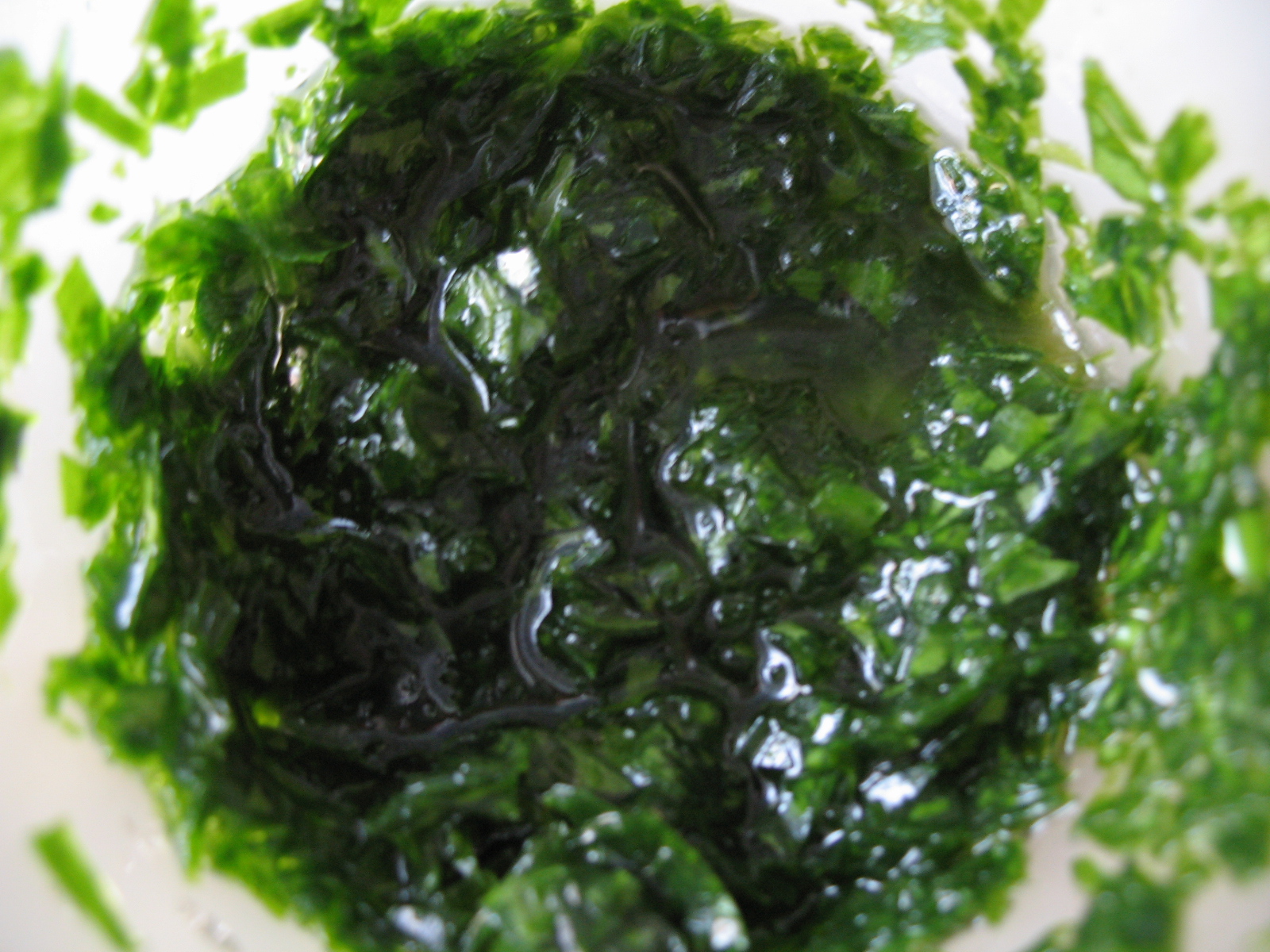
The recipes I found for Ramson pesto called for a heap of leaves; fine if you live in the country and have access to huge swathes of Ramsons but I don’t.  The Ramsons in city parks need to be shared by many and have more pressures to endure throughout the year.  So today I picked twelve leaves and made enough pesto for two people – it was delicious and as you an see, the intense colour is striking.

ramson-pesto-003

Urban Ramson Pesto
6 Ramson leaves per person
Olive oil
10 Pine nuts per person (optional)
Pecorino or firm goats cheese (optional)

  1. Gently but thoroughly wash the Ramson leaves. Pat them dry.
  2. Chop as finely as possible, using a sharp knife.
  3. Place chopped leaves in a small bowl and add enough olive oil to loosen them up and create a useful pesto type consistency.
  4. Add finely chopped pine nuts and grated cheese if you like.
  5. Use in salad dressings, as a pasta sauce and generally in cooking in place of garlic.

Willow weaving, pruning (and vinegar making) this weekend

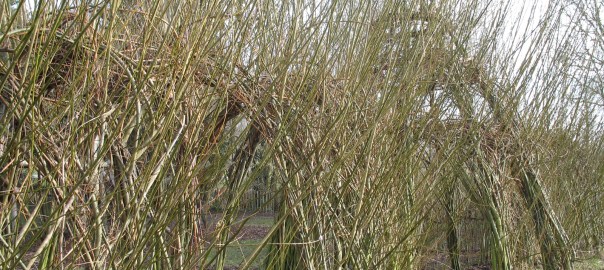
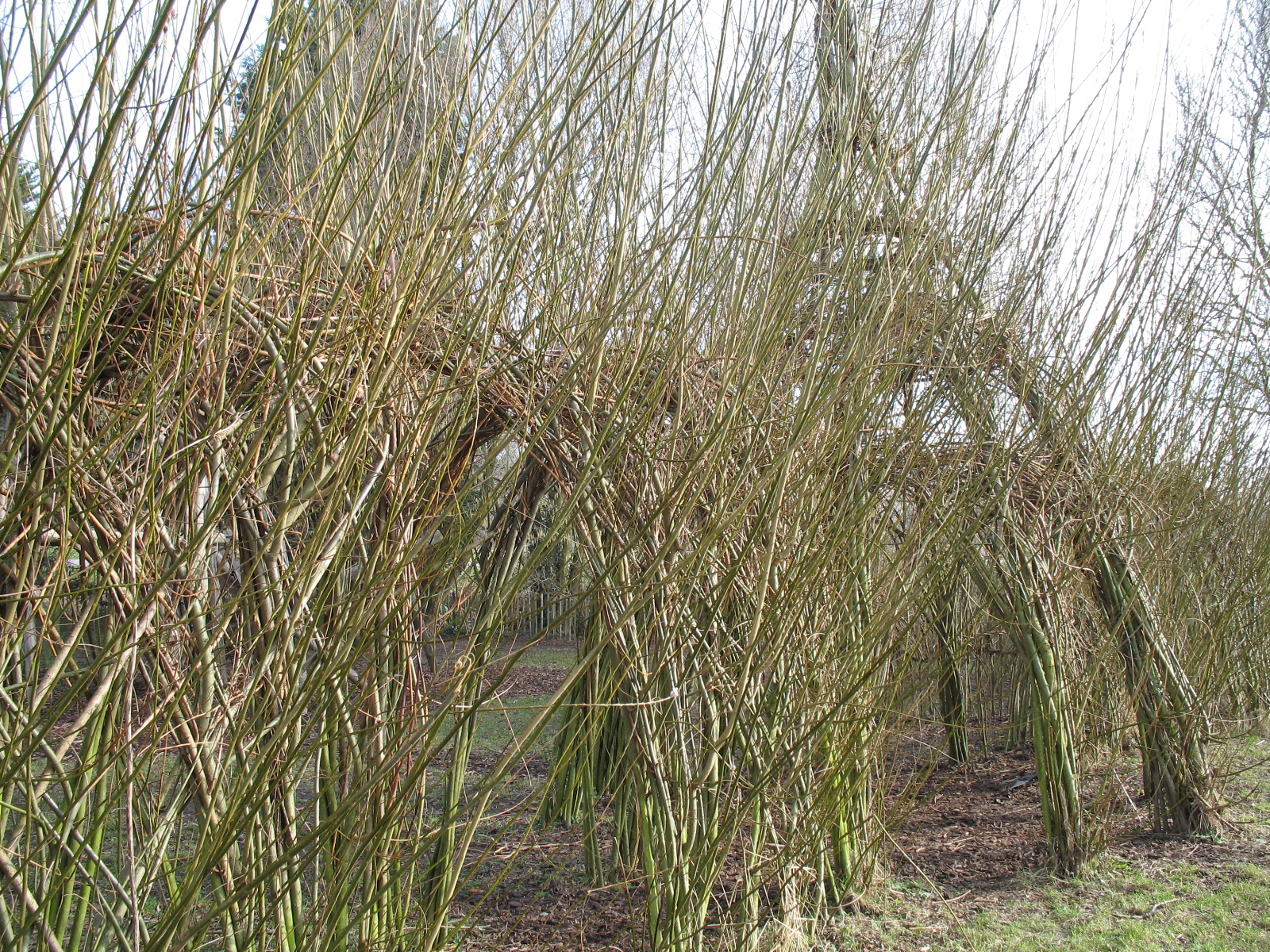
There is a lovely natural children’s play area in Frankendael Park, made from woven living willows.  As you can see, from the photo taken today, the willow structures have sent out lots of new growth and need some pruning and reweaving.

This Saturday, 19th February, at 10am locals interested in helping to tidy up the structures are invited to meet at the play area.  Warm drinks will be provided by the Friends of Frankendael.  This was posted in Het Parool newspaper yesterday.  I suggest that taking a pair of gardening gloves and secateurs would be useful.

Willow (Salix alba, S. fragilis, NL: Wilgen)
A wonderful pain reliever.

Willow bark contains salicin which is the active ingredient in aspirin, but unlike the isolated ingredient, Willow bark  doesn’t irritate the gut or thin the blood.  A country remedy I can vouch for is to chew the twigs of willow for headache relief.  I have found it works and it is also quite tasty!

Willow tincture or vinegar made in spring, can also be very effective. It can be taken for headaches, muscle pains & cramps, rheumatism, arthritis, period pain, colds, flu.  However Willow should not be used by those allergic to Asprin, pregnant or breastfeeding women.

  • Pack a sterile jam jar full of leaves and young twigs.
  • Cover completely with vodka or apple cider vinegar.
  • Seal the jar with a well fitting lid.
  • Leave for 4 – 6 weeks at room temperature
  • Strain and pour the tincture or vinegar into a sterile bottle
  • Label and store in a coolish dark place
  • Take a few drops of tincture in water or a teaspoonful of vinegar for mild pain relief.

.

Sweet Cicely Schnapps (Myrrhis odorata, NL:Roomse Kervel)

Whilst walking around town today I noticed that Sweet Cicely (Sweet Chervil, Myrrhis odorata, NL: Roomse Kervel) is currently looking really strong and fresh.  It is a member of the Apiaceae family and is quite easy to identify at this time of year because it is one of the few plants which survives above ground throughout the winter.  It is useful as green leafy vegetable in its own right, the roots are also very tasty however if you are foraging, roots are not an option. Pulling Apiaceae roots destroys the whole plant.  Sweet Cicely has a distinctly Anise flavour and smells rather like Lovage. It is packed with nutrients at a time when not many other leafy wild herbs are around and is found to be aromatic, stomachic, carminative and expectorant by herbalists.

Caution
Many members of the Apiaceae family (formerly called Umbelliferae family) are highly poisonous (e.g. Hemlock), others are edible and several have been cultivated such as parsley, coriander and carrot. Few members of the family are above ground right now but when foraging for Sweet Cicely, as ever, you should consult a good feild guide before deciding to pick.  If in any doubt don’t pick or taste.  Sweet Cicely makes a lovely, easy to grow pot plant and seeds are available through gardening suppliers.

Uses
If your reliable source of Sweet Cicely is unpolluted you may like to eat it raw, chopped into a salad.  A simple tea can be made from the fresh leaves and stems, which is said to help releive indigestion and possibly help calm coughs.  I prefer the following recipe from Denmark.  I found it on a Danish Schnapps Recipe website which also contains some useful information about the herb and how to make the Schnapps from other parts of the plant, if you are using your own rather than foraged material.

Danish Sweet Cicely Schnapps

  1. Put about 200ml chopped fresh Sweet Cicely leaves or stems into a clean glass jar.
  2. Add 350ml vodka and seal with a well fitting lid.
  3. Let the mixture steep/infuse at room temperature for 1 to 3 days.
  4. Shake lightly and taste your infusion from time to time.
  5. Strain and enjoy.

An alcoholic infusion can also be made using brandy.  The vodka version apparently tastes rather like Greek Ouzo, I’m not sure if connoisseurs would agree.

Elderflower Tea

Following on from my recent post about Elder, here’s how to make Elderflower tea.

It is very easy to make fresh Elderflower tea and there should be some Elder close to your home.  When the shrub is in full bloom (May/June here in Western Europe) and on a warm dry day find an Elder away from polluting roads.  Check you like the smell of the flowers, the scent of Elderflower varies from shrub to shrub and it is not always fragrant!  Ask permission of the plant, in some way, to harvest flowers. Most countries have lots of  folk lore about being especially respectful of the Elder and if you are not of the superstitious kind then do remember that Elder berries are important to wildlife later in the year – less flowers, less berries.

Select only healthy looking flower heads (umbels) which have creamy-yellow stamens as shown in the photo.  Pick them carefully as they are very easily damaged, I tend to collect them into a paper bag to avoid squashing the umbels on the way home.

Don’t wash the umbels before use but do snip off any thick stemy parts and shake off any insects and unwanted bits.  If possible return the insects and bits to the plant soon afterwards.  After gently shaking, it helps to lay the umbels on some white paper for a few minutes. The tiny insects then tend to crawl out or at least may be easily spotted and removed.

Use one or two big umbels per cup of tea.  You can use the actual flowers alone (although its a bit fiddly to separate them when fresh) or the entire umbels.  I simply place whole umbels (sort of folded up) in a small tea pot, add boiled water, cover and infuse or 5 – 10 minutes.  If making it in a cup, do cover with a saucer whilst it infuses.

If you would like to harvest Elder flowers to dry and store then collect them just before the shrubs are in full bloom (May/June).  Harvest as above, lay out on paper to dry in a warm, well ventilated place. When thoroughly dry the little flowers can be rubbed off the umbels and stored in jam jars, in a dark place, for up to a year.  You would use about 1 heaped teaspoon of dried herb per cup of tea.

It is well worth keeping some dried Elderflower in stock over the cold and flu months. Herbals generally recommend that it is freely taken for a few days during a cold or flu (up to 8 cups daily) and up to a few cups per day at other times.  Refer to the post about Elder for a little more information about the properties and uses of this wonderful plant.

The Sap is Rising…

I like winter, it’s a good time to retreat into oneself  and listen to what the darkness has to teach but I am always happy when I can see signs life reappearing in the plants around me.  This week I can smell and see that happening as the sap starts to slowly rise in many plants.  One of the most useful and familiar of herbs is certainly showing those signs at the moment.  Elder (Sambucus nigra, NL:Vlier) is thankfully so common that there is most likely a modest specimen growing quite close to where you live.  Perhaps you use it wisely already or perhaps you would recognise its flowers or berries.

I remember a very resilient old Elder which hung over my family’s driveway as a child. We didn’t know how to work with Elder at that time but the local birds evidently did.  Each year our car would become covered with staining purple droppings as the birds gorged themselves on its ripe berries.  The shrub was severely pruned each year to limit the damage and each year it bounced back, absolutely thriving in the clay soil and sunshine.

Elder has so many uses in traditional medicine that it is really worth getting to know.  I shall post in detail about Elder one day soon, when I feel spring’s energies flowing through my own veins again.  Until then I wanted to share with you one remedy which I used a few weeks ago with success.

Elder (in winter) for fever.
Sambucus nigra is known, among other things, as a traditional fever remedy.  It is effective at inducing perspiration which in turn lowers the bodies temperature yet is reputedly mild enough to be used for childhood fevers, when they are not extreme. Generally the flowers are used to treat fever and the berries to reduce the severity and longevity of cold and flu.  Recently I felt a cold or flu creeping up on me and wanted to self treat with Elder however in late December neither fresh berries or flowers were available to me here in Amsterdam.  A tea, using dried organic flowers from a healthfood shop, might have been an option but I wanted to experiment with a local Elder.

It is said that one should always ask permission of the Elder before harvesting from her so I sought out a strong Elder shrub in my nearby park and mentally asked to harvest enough material to treat myself. The bark and leaves of Elder also contain some of the fever reducing agents found in the flowers and berries.

I harvested a few healthy (and budding) young twigs and small branches (about 2 feet long in total and mostly second year growth).

  • I cleaned them a little with water and scraped the outer and inner bark from the branches and broke up the twigs which were too small to scrape.  The remaining Elder material was kept aside.
  • The twigs and bark were placed in a small heavy pan.
  • I added about 700ml filtered and freshly boiled water to the pan and covered with a heavy lid.
  • This infusion was left at a fairly cool room temperature for 48 hours.
  • As time progressed I checked the infusion a few times and the smell of Elder became increasingly intense and the liquid became slightly gelatinous.  It smelled fresh and tasted smooth, soothing and slightly sweet.
  • After 48 hours the infusion was strained and the spent plant material was kept aside with the unused material.
  • I drank the infusion over the following 4 hours, rested and wrapped up comfortably warm. I sweated more than usual and noticed a feeling of being cleansed and nourished.  The threatening cold/flu came to nothing more than a few hours of feeling tired and hot with a slight headache.  Of course this may or may not have been thanks to the Elder infusion but I will happily try it again when I feel a cold or flu trying to take hold.
  • The used Elder material was returned with thanks to the foot of the shrub from whence it came.  One small branch was not used at all and is currently rooting easily in a vase of water on my kitchen windowsill. It has several healthy new leaves. 
  • Witch Hazel (Hamamelis virginiana, NL:Toverhazelaar)

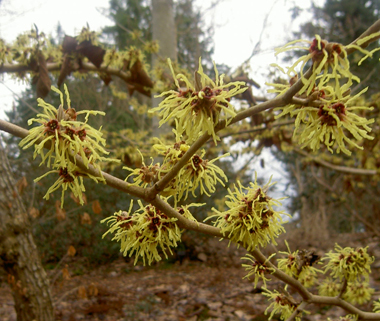
    Witch hazel is one of my favourite shrubs and I am hoping to introduce it to my pavement garden this winter.  When unrestricted its crooked, apple tree-like branches grow to 4 – 6 inches in diameter and the whole shrub can reach around 12 feet in height.  However it can also do well in small spaces, such as large pots or pavement gardens (geveltuinen). It grows best in moisture retentive, acid to neutral soil and is adapted to living in light shade.  Witch hazel is also tolerant of polluted city air and its unusual yellow October flowers make it a good option for the urban herbologist.

    The leaves and bark of Witch hazel are very useful.  They taste bitter, containing tannic and gallic acids as well as a volatile oil.  Its effects are  astringent, tonic and sedative so preparations of Hamamelis virginiana are often used to treat internal and external bleeding.  The most well known uses of this herb are for treating piles, bruises and inflammatory swellings but it is sometimes used for diarrhoea, dysentery and mucous discharges.  Please be aware that using Witch hazel internally should only be done under expert guidance.  Due to its astringent effect, Witch hazel distilled extract (available cheaply from many chemists) makes a great skin toner.  I used it as a teenager, it works well and I think it smells great.  These days I use it mostly for treating bruises.

    Chips of dried Hamamelis virginiana bark can be obtained from herbal suppliers.  You may find this beautiful shrub in local parks, hedgerows and areas of woodland.  It is also a fairly popular garden shrub due to the unusual winter flowers.  Apparently it is very difficult to propagate Witch hazel by cuttings and the edible seeds (if you can find them as they are dispersed far and wide by explosion) can take over a year to germinate.  I am hoping to take a winter cutting from a friend’s plant very soon.  I’d be very interested to hear from anyone who has been successful in this.

    Witch hazel can be used in many ways;

    • Tea (made from the leaves and young twigs or bark, fresh or dried) can be applied directly to piles or dabbed onto bruised or inflamed areas of skin.  This also makes a milder skin toner than the distilled extract, often good for acne, oily skin and shrinking bags under the eyes.
    • Tincture, best made from the bark.
    • Fluid extract, if you can squeeze the juice out, can be included in ointments to calm varicose veins.
    • Distilled extract, easily obtained from chemists, great for dabbing onto bruises, insect stings and bites, applied very quickly as a compress for burst varicose veins – which are life threatening and need immediate medical attention. Can be applied to intact varicose veins as a soaked lint bandage, wrapped gently around the area loose enough to allow the blood to flow unrestricted.
    • Powdered bark, if you can make it then this can be applied to piles when combined in a cream or paste.

    Herbal Vapours

    In the winter I often enjoy burning herbs and recently the spicy scents of Frankincense and Myrrh have been wafting around our apartment.  All of the senses are emotive and can conjure up long forgotten memories but for me the sense of smell is most potent.  The scent of a particular time of year, the plants in bloom, humidity levels and so on, can combine and take me straight back to a unique event or emotion.  Frankincense and Myrrh resin, burned over a candle on a dark winter day, do just that and they make useful room fumigants.  I also enjoy the smell of good quality incense and of several dried herbs as they are directly warmed or gently burned.  I am not a smoker but enjoy the smoking blend mentioned below by adding a little to the top of an aromatherapy oil vapouriser.  In this case and when burning resins, I first cover the top of the vapouriser/burner with a little aluminium foil, it prevents cracking of the ceramic and makes cleaning much easier.

    Inhaling herbal vapours allows them to enter the bloodstream and reach the brain quickly.  Care should be taken to select herbs for this purpose wisely and it is best to begin with a very small amount, to see how you react.  Some herbal vapours can quickly lift your spirits, such as Fennel seed.  Others can be relaxing or overstimulating.  If you are feeling exhausted or stressed out, you are more likely to react strongly to inhaled herbs.  Be cautious and respectful of them.

    There is a lot of folklore associated with burning herbs. Smudge sticks to cleanse spaces, moon lodges & sweat lodges where herbs are heated over hot stones, herbal fumigation in Chinese traditional medicine and herbal smokes to induce visions in spiritual aspirants are but a few uses for burning herbs.  Sage commonly features in recipes; it burns well and in many cultures is believed to ward off evil. It is often used to “smudge” or cleanse spaces. Some communities burn it in the presence of new born babies, to prevent evil spirits from entering the child’s body via the cut umbilical cord.  Other commonly used herbs are Frankincense, Myrrh, Artemisia spp., Fennel seed, Aniseed and Thuja (Cedar).  I find that gently inhaling the vapours of herbs, feels more healing and natural than using concentrated essential oils.  I am interested to know of your experiences.

    If you are interested in making your own incense there is a lovely book by Scott Cunningham which details dozens of recipes. You can see an extract here: Scott Cunningham’s Incense Book
    Several years ago I bought a few kilos of hand made incense sticks from Mysore market.  They were apparently rolled from a blend containing honey and sandalwood. They smell absolutely divine, very clean burning with no hint of chemicals (which many commercial versions seen to contain). I only have a few sticks left so will try to find a recipe in the Cunningham book to match it.

    Honey cured herbal smoking blend
    This is a simple recipe which works well. Just preparing the herbs makes me feel good, warming or burning them feels soothing and a sprinkling of the mix goes well with a few grains of Frankincense and Myrrh.

    1. Powder some fennel seeds (this is tricky without a spice grinder). I do this with a food processor but always end up with two grades of fennel – fine powder and bruised seeds (which is good for tea or bread).
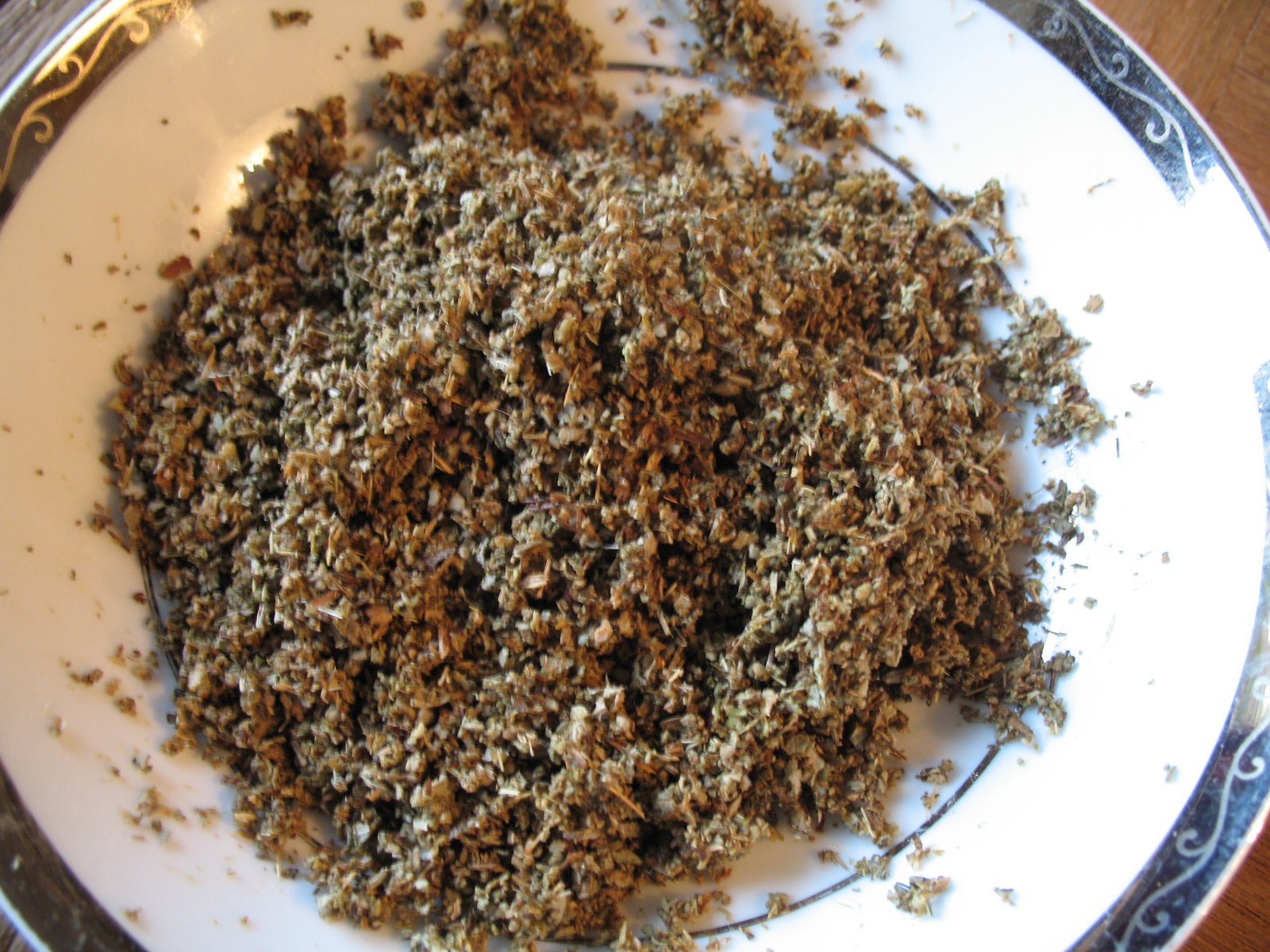
    2. Add 2 teaspoons of fennel powder to 12g of chopped dried sage.  Mix together.
    3. Separately, mix one teaspoon of honey with 4 teaspoons of water.
    4. Gradually add the honey water solution to the herbs.  You will need to rub the solution into the herbs so that they really soak it up evenly.
    5. Stop adding the solution when you feel all of the herbs are damp.
    6. Spread out the damp herb mix in a bowl.
    7. Leave the bowl uncovered (or perhaps covered with a muslin or clean tea towel) for about 48 hours.  Turn the herbs now and then.
    8. When you feel the herbs are almost dry transfer to an airtight container and label.
    9. If you find the mix is too dry for your needs you could add a little more water and shake up in the container OR add a potato peeling or two a few hours before use.  The herbs will absorb the water from the peelings.

    Indian Day Dreams

    I was day dreaming about being in India this afternoon and rustled up a really tasty drink which helped to transport me back to Mysore. It cleaned the cobwebs from my mind and got me back on my Yoga mat.  You may like to try it…

    Lynn’s Ginger Pineapple Cobweb Cleaning Lassi
    1 cup Goat’s Yoghurt
    4 Pineapple slices (fresh or canned in pure juice)
    1 teaspoon honey
    1 teaspoon dried or 1/2 teaspoon fresh grated ginger

    Adjust the quantities to suit your taste buds and mental cobwebs.

    Simply blend all the ingredients together and drink!
    I’m afraid the photo is not mine as my lassi tasted so good I drank it all before I could reach for my camera.

    Lassi is a traditional yoghurt based drink from India, there are lots of variations.  If you request lassi in a restaurant you will be asked if you’d like it “sweet or salty”. My version is definitely sweet and the ginger gives it quite a kick.  Have a look at the Wiki Lassi page for more inspiration.