Category Archives: Growing herbs

Embrace Your Weeds!

image

Sunday 2nd June
3-5pm
Westerpark (Proef Restaurant to the Educational Garden)
€25 per person

There are so many incredible plants which we dismiss, dig-up or discard. We could do so much with these humble weeds, if only more people knew how!

image

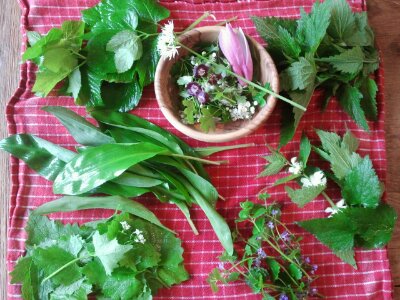
This workshop with foraging walk will open your eyes to the wonders of the weed world! Together with Ann from City Plot Amsterdam, I will lead you from Proef restaurant in Westerpark through to the City Plot educational garden, right at the back of the park. We will wander through prime public foraging grounds on our way. When we get there, we will plant some of our weedy wonders in the River of Herbs section of the Educational Garden.

Bring (if you like):
Paper bags for foraged finds,
Flask of hot water, to make a herb tea
Hand trowel, if you have one,

image

I will tell you about medicinal, nourishing and historical uses of the plants and Ann will show how to make the most of them in the garden and kitchen.

You will receive a comprehensive colour handout, to help you at home and the chance to spend quality time with us and the weeds, in a small group. To book, please email me or click here.

image

The Educational Garden is an inspirational place: It has been divided into different mini gardens, from a Mushroom farm, Permaculture patch, Medicinals section to the River of Herbs meadow.

image

Proeftuin is maintained as an organic restaurant garden by City Plot.
Westerpark is big, bold and full of foraging spots!

Our walks and talks go ahead, unless there’s a hurricane overhead. So please come prepared to get stuck into our wonderful urban nature, whatever the weather.

20130523-133953.jpg

So whether you have a garden, a plant pot or like to forage, join us to discover how to find, identify and Embrace Your Weeds!

Herb and Strawberry Tower

image

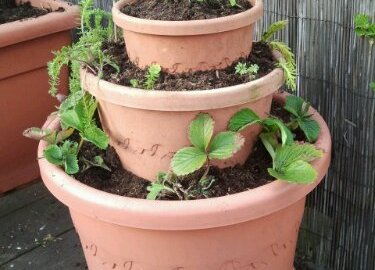
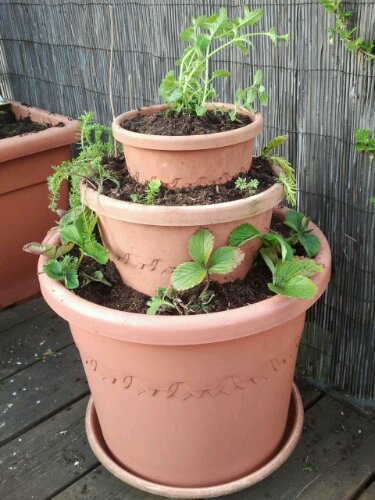
Here’s my latest rooftop planting creation: A simple tower of three plastic plant pots, packed with plenty of molehill soil and organic compost.

The plants used are babies from those we grow already on the roof, except the tiny Wormwood, which I found growing in between street pavers. I planted a mixture of Strawberries, Wormwood, Lady’s Mantle, Strawberry scented Mint, Sedum reflexum and Yarrow. All of these plants are edible and most have medicinal properties as you will see from the links.

This is a simple way to plant vertically, creating herb habitats offering areas of relative shade and wind shelter, little space for weed seeds to settle and it is easy to tend – all very handy on a small plot.

I’ll see how these plants fair and will no doubt add or substitute others as time goes on. It’s my equivalent of a premaculture herb spiral, something I covet but just don’t have space for at home.

image

Here’s the beautiful (and enormous) Strawberry tower at Jeugdland in Amsterdam Oost. I wrote about it last year. Now that would make a fabulous herb tower!

Bug Hostel

image

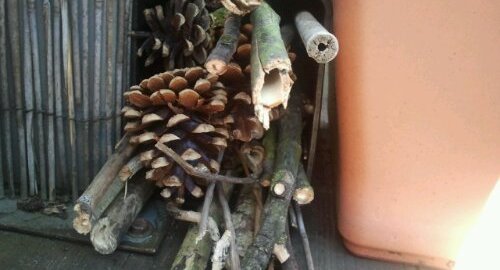
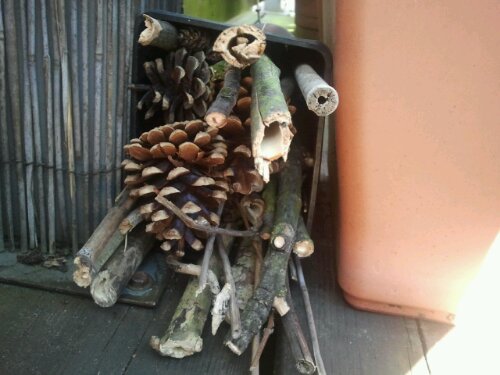
Here’s my first attempt at a rooftop bug refuge. It’s simply a long slim plastic plant pot, stuffed full of dry hollow stems which I found in my kitchen and around the rooftop planters. The stems are from long dead Fig trees, Honeysuckle, Chamomile, Hollyhocks, Clematis, Elder, Reed fencing and a few old and snapped Bamboo canes. I packed it all into place with some dead Apple tree twigs (not hollow but sturdy and available) and also some beautiful Pine and Alder cones, which I collected around town.

Once assembled I wedged it between the roof fence and a Goosberry bush pot. It faces roughly south and is less exposed than most other parts of the roof terrace.

I’m more used to making big wildlife piles in quiet corners of land so I’m sure that I’ll need to improve on this a lot. But for now it offers a place for native bees, ladybirds and other useful wildlife to lay eggs and find refuge.

Making Bug Hotels was one topic at this weekend’s River of Herbs meeting. If you’d like the booklet then let me know. For more information about what we did, some useful links and details of how to make well designed bug and bee hotels, see this post on the RiverofHerbs.org website. Encouraging bees and bugs into your herb garden is something not to be overlooked. They help to pollinate your plants, keep aphids in check and generally keep your plot (however small) healthy.

Herbal Moon Gardens

Last month, I asked my apprentices to think about planting a herbal moon garden, in whatever space they can find. I finally got around to making my own last night.

The idea of a moon garden, for me at least, is to welcome the moonlight into a peaceful outdoor space. Moon gardens catch the moonlight with plants and reflective objects. They are spaces to meditate or just sit at night whilst able to see and smell beautiful herbs. I like to know where the Moon is in its monthly cycle and creating a space to contemplate the moon is a good way to keep that connection. Here’s a link to previous UH information about gardening by the moon.

Colours
Most gardens are planted with daylight in mind, this is of course understandable. I still needed to consider the amount of sunlight in my chosen location but when selecting plants, I looked for colours that linger as the sun goes down. Silver and white flowers and foliage are generally the last ones you will see as the sun sets completely. Blues and violets are the next colours to fade and are associated with spirituality and intuition.

wpid-2013-04-11-09-22-20

Location
Choose somewhere safe and accessible to you at night and where plants will grow! Preferably select someplace where you can see the moon as it charts its path across the sky. This is not always possible of course. Try your best for a moon view but above all aim for somewhere that is relaxing in the evening and nighttime. I chose the sheltered upstairs balcony of my home. I can always get to it, plants grow there, it often provides a glimpse of the moon and is a little further away from barbecuing neighbours and signs of active daily life. My balcony gets some sun but faces North-East. It becomes quite windy up there, especially in the winter so I’ll try to provide extra protection for the plants as the year moves on. All of my plants are in pots, due to my home being an above ground apartment, so I must also be able to water and feed the plants.

wpid-2013-04-11-09-22-53

Moon Garden Herbs
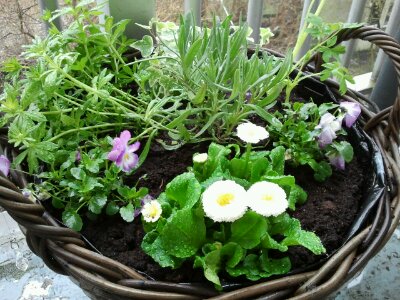
I tried to find herbs with silvery leaves as well as white, purple or violet coloured flowers. But my main aim was for a succession of flowers and of course I wanted only edible and medicinal plants. The herbs I chose should provide a succession of colour from March to September. Later in the year, I’ll see how the plants have managed, will move some away and add others to fill gaps in the flowering year.

Crystals, Light, Shapes
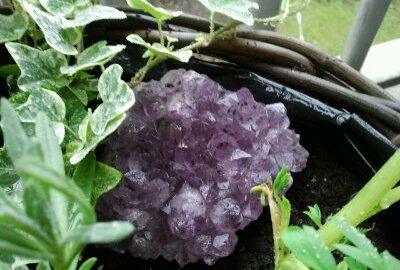
I have added a few crystals to the balcony, to catch the moon light. Also a couple of pretty candle holders to produce extra light when I want it. The shapes I have added remind me of the moon. So far I have a woven willow ball, a little star decoration, some amethyst and quartz crystals. I’ll add more as time goes on but for now I am pleased to have created an edible and medicinal herbal moon garden which I enjoy glimpsing during the day and sitting in at the night.

Now I know that not all of you will be limited to creating a moon garden in a pot, balcony or other small space. I also know that you may be far more creative than me! So he are a few links which may inspire you to get out your gardening tools and get planting a moon garden…

Images of moon gardens
Plants that give scent at night
Moon garden herbs

365 Frankendael day 355

I met the gardener who looks after Park Frankendael today. He’s happy with our little Elder babies and suggested another location for additional planting. He also taught me about the the Primrose species which live in the park. I’ll order some seed of those species soon and will be bringing on Primrose and Violet plants to add to the park at suitable locations.

One of the Elder babies is in the middle of this photo.

image

The Comfrey (Symphytum uplandicum x) plants are looking great today.

image

As is Ground Ivy (Glechoma hederacea), in flower in some situations.

image

Love your Elders!

Love Your Elders – Plant Your Elders!
Sunday 7th April 11.00-12.30

Time to join me to either plant your Elder cuttings from last year, or to learn how to take cuttings and propagate this medicine chest of the European hedgerow. Native Elder (Sambucus nigra, NL:Vlier) grows easily and offers familiar flowers and berries each year. But all parts of the shrub have medicinal, magical and culinary uses. Learn which parts of this beloved urban herb are safe, which parts are toxic and how to make simple remedies, tasty concoctions and fibre dyes from each.
Park Frankendael

As a regular city forager, I think it’s vital to give something back to the land which I harvest from. Of course there are other ways to show gratitude the the Earth but I find that one of the most powerful ways is to add more of the native plants which I use.

€10 per adult
Free for apprentices
€5 if you bring along a rooted Elder baby from last year
Or no cash exchange for a few nice herb seed packets

Includes handout
Please contact me directly (lynn.shore@gmail.com) if you would like to come along.

If you can’t come but want to know how to grow Elder, here’s a link to instructions I wrote last year. Let me know if you need any tips.

New Events

Please check out the a Urban Herbology events page for details of my forthcoming herbal forays in Amsterdam.

Love Your Elders  (Sunday 7th April)

365 Frankendael Urban Herb Walk (End April/Start May)

Embrace Your Weeds (June)

As well as details of the new Apprenticeship group and River of Herbs.

I’m also planning a spring picnic in the park for people who have helped me during the  365 Frankendael project and a street herb walk in Bristol, later in the year.

River of Herbs

A little update on what is happening with the River of Herbs project

I have chosen two sites to focus on for the course which I’m running between February and June 2013. One will be Fraunhofferstraat in Oost Watergraafsmeer and the other is hopefully going to be a portion of Spuistraat, in Amsterdam Centrum. We will work on the two sites as a group, helping to spruce up the neighbourhoods and to create public examples which will hopefully inspire people to recreate the idea in their own streets.

By planting appropriate medicinal and edible herbs in dull patches of land (however small or large) we aim to make the place more beautiful, more attractive to wildlife, to increase urban food security and to encourage community participation with improving the immediate environment.  I don’t envisage Amsterdammers harvesting heaps of herbs from doggy tree pits but I do see them harvesting useful seeds to grow in clean spots or use directly, taking cuttings from the public herbs, making spaces look and feel better and safer and of them learning about how useful and essential plants are to us on every level. All this in addition to boosting the wildlife population of the city – that’s more pollinating insects, birds & bats which feed on them and less mosquitoes! If people get something from these deliberately planted “herb meadows” then I trust that they will be better maintained and provide usefulness to people and wildlife for far longer (than the insect friendly plantings I notice here and there).

If you have ideas of other areas which could benefit from a River of Herbs makeover then please contact me via the comments box below, or directly by email (lynn.shore@gmail.com)

Fraunhofferstraat is a street which I look at from my front windows at home. It’s a typical tidy Watergraafsmeer street that has a children’s play ground partway along and about a dozen bare treepits. the tree pits are so uninteresting and uninspiring, especially those running beside the playground. They are simply strimmed back by the council a couple of times a year and left to do their own thing for the rest of the time. When most lucky, we get Chickweed, some Brassicas and Fat Hen growing there along with poisonous Euphorbia species and heaps of low growing tree burrs. The pits get plenty of dog interest and they are sites where a small amount of litter collects at times. Because they are unplanted (aside from the trees of course) the pits beside the playground get a fair bit of human trampling. The Fraunhoffer tree pits are next to the road, a local street which is a turn off from the Middenweg (a main road into the centre of town).

I have been quietly collecting seeds from locally growing Hollyhocks, Poppies, Calendula, Rocket and other easy to grow plants. Whenever I remember, I strew a handful in the tree pits of Fraunhofferstraat and nudge them into the soil with my shoes. Maybe some will germinate in the spring, maybe not but either way I believe it’s a better fate than the seed being swept up and thrown in the garbage and incinerated.  In the early spring the River of herbs group will start by looking at the site, thinking about the uses of the area and how the tree pits could be planted and simply managed with minimal effort and upkeep, to create a more useful and beautiful scene.

Spuistraat
My friends at Funky Chickin hotel, Spuistraat 90 have been inspired by the River of Herbs project from it’s conception. They are located on part of a busy central street which could do with some greening.  I have chosen that area  as the second location. Just as with Fraunhofferstraat, I’ll be working closely with the local council to ensure that the herbs and exact locations chosen are suitable and useful and that they help to enhance the area in many ways.

On my quest to get this project going I’ve learned about tree pit adoption protocol, geveltuin (pavement garden) regulations, council spraying policies and realities, restricted plants, invasive plants, perfect city herbs and people who consider matching unmanaged geveltuinen with folks who’d like to tend them. There is a lot of interest and need, it seems. I’m really excited about starting with the group in February, I hope it takes off.

Proposed dates for 2013 River of Herbs course

Some time ago, 24 people signed up for my River Of Herbs training course, which will take place during 2013. There are no more spaces available at this time. The course is being completely funded by a Dutch government initiative to help the volunteer greeners of this country, obtain training.

I’d like to set the dates for the meetings now. If you are one of the 24, please could you take a look at the dates listed below and let me know if you are able to make them. Either reply to this post in the comments box or email me at Lynn.Shore@gmail.com.

Clearly, I’d like the dates to work for as many of people as possible so please feel free to suggest alternatives. Timings to be 10.30 – 12.30 for all the meetings and the venues will alternate between Oost / Oost Watergraafsmeer (near Park Frankendael, Oosterpark or Linneausstraat along tram 9 route) and Spuistraat (Centrum).

Thank you!

(NB: These dates are not yet fixed)
Sunday 10th February (Oost)
Sunday 17th March (Oost)
Sunday 28th April (Mercatoplein, West)
Sunday 19th May (TBA)
Sunday 30th June (TBA)

365 Frankendael day 210

image

Inside all day today, my little foraging buddy is poorly and my throat is pounding, so a balcony photo for a change and lots of herbal honey for us both!

This is the Camellia sinensis (Tea) plant which I bought in the summer from Intratuin. It’s still doing well, in the bonsai form and pot.  As you can see here, it is developing pretty little flower buds. I look forward to seeing them open in the very early spring.

I’ve not tried it yet but it is perfectly possible to make all types of conventional tea from the leaves if this lovely plant. White tea being leaves almost straight from the plant. Soon, I’ll give it a try.