Category Archives: Herbs

Seeds For Food

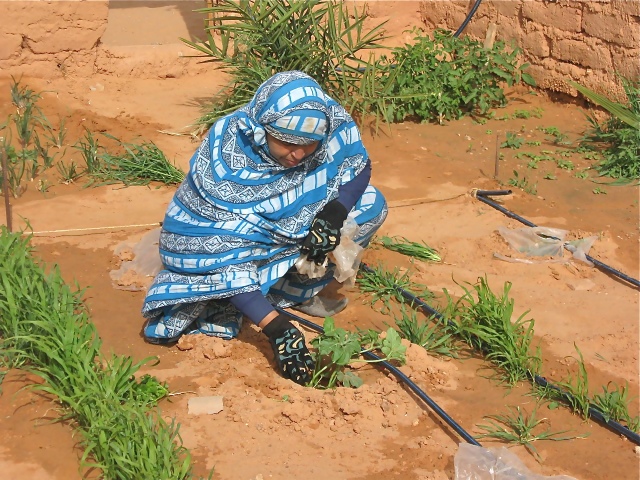
There’s an interesting little article in the spring 2011 issue of Permaculture Magazine about the Seeds For Food project.  It aims to provide saved fruit and vegetable seeds to hungry people in developing nations.   The idea for the project arose in Saharawi refugee camps, in South-East Algeria, where there is a desperate need for fresh food and yet limited resources to purchase seed.  You are invited to save the seeds from fruit, vegetables and herbs which you already eat (simply collect, rinse and air dry them) and then post them to the following address:

Prof. Dr. Willem VAN COTTHEM
Beeweg 36
B-9080 ZAFFELARE (Belgique)

They will be used to help families grow their own food.  This seems to be an excellent initiative, I shall certainly be collecting and sending seeds to Prof. Dr. Willem Van Cotthem from now on.  He began the project after working as a UNICEF advisor at sub-Saharan refugee camps and learning how unaffordable fruit and vegetable seeds are to these needy people.

Lunar Herb Gardening

Spring is well underway here in Amsterdam and I plan to begin indoor planting of a few annual herbs this week. As I pulled out my box of saved seeds it reminded me to find my lunar gardening guide so that I can get the seedlings off to a really good start.   Gardening by the moon is thought by many to increase crop yield and quality.  It is at the heart of biodynamic gardening and farming practices. Given the choice I buy biodynamic vegetables; I think they taste better and they seem more healthy.  I’ve been dabbling in lunar gardening for about 15 years, I’ve never approached it scientifically but it seems that when I pay more attention to lunar gardening my plants do better.  Perhaps they simply benefit from more love and attention, perhaps it is indeed the lunar effect.  I don’t mind which it is but my plants generally do very well when I garden by the moon.

Getting started
It is not difficult to get a feel for lunar gardening, you can start by simply:

  • Planting annuals which “produce” above the ground (such as Calendula & Nasturtians) during the increasing light half of the moon cycle (waxing moon).
  • Planting herbs which store energy below the ground; biennials, perennials, bulbs, and root plants (such as Madder, Dandelion, Garlic, Ginger & Soapwort) during the darkening half of the cycle (waning moon).
  • Increasing light (waxing) means the period from dark/new moon to full moon, decreasing light (waning) means the period from full moon to dark moon.

Going deeper
If you find gardening by the dark and light periods straight forward you may want to take things a step further.  This involves considering each quarter of the moon cycle. The 1st quarter begins straight after a New Moon:

1st Quarter (Increasing to Half Full Moon):
During the waxing moon gravitational forces are thought to pull water higher in the ground and plants. This is thought to assist seed germination and the growth and development of leaves and stems.

  • Plant leafy annual herbs which produce above ground and have seeds outside of fruit
    (E.g. Basils, Coriander, Borage, Dill, Rocket, Safflower, Stevia, Parsley-a biennial but treated as an annual)

2nd Quarter (Half Full to Full Moon):

  • Plant viny annuals that yield above ground and have seeds inside their fruit. (E.g. Red Clover, Dyer’s Broom, Nightshade family, Bitter Gourd, Chickweed – though it usually plants itself).

3rd Quarter (Decreasing to Half Full Moon):
During the waning moon, lunar gravitational forces are said to pull water down in plants and the soil.

  • Plant biennials, perennials, bulbs, and root herbs, those that overwinter and produce their crop the next year, trees, shrubs, berries and grapes
    (E.g. Dandelion, Rosemary, Sage, Gogi berry, Mellissa, Witch Hazel, Chives, Lavender, Myrtle, Garlic, Thyme, Oregano, Marjoram, Valerian, Yarrow, Mints, Lovage, Winter Savory, Marjoram & Lemongrass).

4th Quarter (Half Full to New Moon):

  • The best time to cultivate, prune woody shrubs, pull weeds, discourage garden pests and turn the soil (especially when the Moon is in a barren sign).

And finally…
If you fancy taking lunar gardening to the next level then you will also need to consider Moon Signs.  The following details of how to incorporate them is taken directly from the Llewellyn books website.  If you want to do this then it is probably best to get a copy of Llewellyn’s Astrological Calendar, Gwydion’s Planting Guide or another similar publication, to ensure your dates are correct.

Even simpler, visit Lunarorganics.com. A useful website on this subject, they sell a very easy to use lunar gardening year planner.

Planting by Moon Signs (From Llewellyn’s 2008 Astrological Calendar.

  • MOON IN ARIES: Barren, dry, fiery, and masculine; use for destroying noxious growths and pests, and for cultivating, plowing, and tilling.
  • MOON IN TAURUS: Productive, moist, earthy, and feminine. Use for planting crops, particularly root vegetables and potatoes, when hardiness is important.
  • MOON IN GEMINI: Barren, dry, airy, and masculine. Use for cultivating, or for destroying noxious growths, weeds, and pests.
  • MOON IN CANCER: Very fruitful, moist, and feminine. Use this productive sign for planting and irrigation.
  • MOON IN LEO: Barren, dry, fiery, and masculine. Use this barren sign for killing weeds, and other noxious growths, and for cultivation.
  • MOON IN VIRGO: Barren, moist, earthy, and feminine. Use this sign for cultivating, weeding, and destroying pests.
  • MOON IN LIBRA: Semi-fruitful, moist, airy, and masculine. Use for planting crops and enhancing root growth. It is a good sign for flowers and vines, seeding hay, corn for fodder, and other livestock needs.
  • MOON IN SCORPIO: Very fruitful, moist, and feminine. Use this very productive sign for planting most things; especially good for vines and sturdiness.
  • MOON IN SAGITTARIUS: Barren, fiery, dry, and masculine. Use this sign for planting onions, seeding hay, etc. Also good for cultivation.
  • MOON IN CAPRICORN: Productive, but dry, earthy, and feminine. Plant potatoes and other root crops.
  • MOON IN AQUARIUS: Barren, dry, airy, and masculine. Use for cultivation and for destroying noxious growths, weeds, and pests.
  • MOON IN PISCES: Very fruitful, moist, and feminine. Use for planting most things, and especially good for root growth.

Imbolc Herb Walk – Thank you!

Just a quick post to say thank you to everyone who came out on this chilly afternoon, to join me on the Frankendael herb walk.  It was lovely to share some of my favourite herbs with  you and also to learn from you.  We looked in some detail at nine herbs which are currently available and also spotted a few others which will be available soon. The herb tea and chat in Merkelbach afterwards also went down a treat!

Links to previous posts about a few of the herbs we looked at today:
Elder, Elderflower tea
Witchhazel
Sweet cicely
Birch oil – how to make cold infused oils
Wild rocket
Rosehip syrup recipes

I will be organising another urban herb walk in March and also a lotions and potions workshop sometime soon. More details to follow…

Imbolc wild herb walk – Celebrate the first signs of spring!

There will be an Urban Herbology Wild Herb Walk on Wednesday 2nd February 2011 at 13:00.

The walk will be in Frankendael Park, Amsterdam, starting at the main (old) gate. The plan is to take a relaxed look at which wild herbs are available at the moment, which will be ready soon and to share ideas about how to use them.  A simple recipe sheet will be provided and €2 will be asked of attendees to help me cover the costs of this blog. Places will be limited.  I have set up a new meetup.com group called Amsterdam Urban Herbologists so if you would like to attend you are invited to RSVP via http://www.meetup.com/Amsterdam-Urban-Herbologists/ as soon as possible.  You will need to create a log-in for that site, if you don’t already have one.  If it is too tricky and you would like to come along then please feel free to simply email me at lynn.shore@gmail.com or reply to this post.

I am really looking forward to seeing everyone on Imbolc (the first day of spring in the Pagan calendar) and having a relaxed look at some of the herbs which are currently available in the park.

Sweet Cicely Schnapps (Myrrhis odorata, NL:Roomse Kervel)

Whilst walking around town today I noticed that Sweet Cicely (Sweet Chervil, Myrrhis odorata, NL: Roomse Kervel) is currently looking really strong and fresh.  It is a member of the Apiaceae family and is quite easy to identify at this time of year because it is one of the few plants which survives above ground throughout the winter.  It is useful as green leafy vegetable in its own right, the roots are also very tasty however if you are foraging, roots are not an option. Pulling Apiaceae roots destroys the whole plant.  Sweet Cicely has a distinctly Anise flavour and smells rather like Lovage. It is packed with nutrients at a time when not many other leafy wild herbs are around and is found to be aromatic, stomachic, carminative and expectorant by herbalists.

Caution
Many members of the Apiaceae family (formerly called Umbelliferae family) are highly poisonous (e.g. Hemlock), others are edible and several have been cultivated such as parsley, coriander and carrot. Few members of the family are above ground right now but when foraging for Sweet Cicely, as ever, you should consult a good feild guide before deciding to pick.  If in any doubt don’t pick or taste.  Sweet Cicely makes a lovely, easy to grow pot plant and seeds are available through gardening suppliers.

Uses
If your reliable source of Sweet Cicely is unpolluted you may like to eat it raw, chopped into a salad.  A simple tea can be made from the fresh leaves and stems, which is said to help releive indigestion and possibly help calm coughs.  I prefer the following recipe from Denmark.  I found it on a Danish Schnapps Recipe website which also contains some useful information about the herb and how to make the Schnapps from other parts of the plant, if you are using your own rather than foraged material.

Danish Sweet Cicely Schnapps

  1. Put about 200ml chopped fresh Sweet Cicely leaves or stems into a clean glass jar.
  2. Add 350ml vodka and seal with a well fitting lid.
  3. Let the mixture steep/infuse at room temperature for 1 to 3 days.
  4. Shake lightly and taste your infusion from time to time.
  5. Strain and enjoy.

An alcoholic infusion can also be made using brandy.  The vodka version apparently tastes rather like Greek Ouzo, I’m not sure if connoisseurs would agree.

Elderflower Tea

Following on from my recent post about Elder, here’s how to make Elderflower tea.

It is very easy to make fresh Elderflower tea and there should be some Elder close to your home.  When the shrub is in full bloom (May/June here in Western Europe) and on a warm dry day find an Elder away from polluting roads.  Check you like the smell of the flowers, the scent of Elderflower varies from shrub to shrub and it is not always fragrant!  Ask permission of the plant, in some way, to harvest flowers. Most countries have lots of  folk lore about being especially respectful of the Elder and if you are not of the superstitious kind then do remember that Elder berries are important to wildlife later in the year – less flowers, less berries.

Select only healthy looking flower heads (umbels) which have creamy-yellow stamens as shown in the photo.  Pick them carefully as they are very easily damaged, I tend to collect them into a paper bag to avoid squashing the umbels on the way home.

Don’t wash the umbels before use but do snip off any thick stemy parts and shake off any insects and unwanted bits.  If possible return the insects and bits to the plant soon afterwards.  After gently shaking, it helps to lay the umbels on some white paper for a few minutes. The tiny insects then tend to crawl out or at least may be easily spotted and removed.

Use one or two big umbels per cup of tea.  You can use the actual flowers alone (although its a bit fiddly to separate them when fresh) or the entire umbels.  I simply place whole umbels (sort of folded up) in a small tea pot, add boiled water, cover and infuse or 5 – 10 minutes.  If making it in a cup, do cover with a saucer whilst it infuses.

If you would like to harvest Elder flowers to dry and store then collect them just before the shrubs are in full bloom (May/June).  Harvest as above, lay out on paper to dry in a warm, well ventilated place. When thoroughly dry the little flowers can be rubbed off the umbels and stored in jam jars, in a dark place, for up to a year.  You would use about 1 heaped teaspoon of dried herb per cup of tea.

It is well worth keeping some dried Elderflower in stock over the cold and flu months. Herbals generally recommend that it is freely taken for a few days during a cold or flu (up to 8 cups daily) and up to a few cups per day at other times.  Refer to the post about Elder for a little more information about the properties and uses of this wonderful plant.

The Sap is Rising…

I like winter, it’s a good time to retreat into oneself  and listen to what the darkness has to teach but I am always happy when I can see signs life reappearing in the plants around me.  This week I can smell and see that happening as the sap starts to slowly rise in many plants.  One of the most useful and familiar of herbs is certainly showing those signs at the moment.  Elder (Sambucus nigra, NL:Vlier) is thankfully so common that there is most likely a modest specimen growing quite close to where you live.  Perhaps you use it wisely already or perhaps you would recognise its flowers or berries.

I remember a very resilient old Elder which hung over my family’s driveway as a child. We didn’t know how to work with Elder at that time but the local birds evidently did.  Each year our car would become covered with staining purple droppings as the birds gorged themselves on its ripe berries.  The shrub was severely pruned each year to limit the damage and each year it bounced back, absolutely thriving in the clay soil and sunshine.

Elder has so many uses in traditional medicine that it is really worth getting to know.  I shall post in detail about Elder one day soon, when I feel spring’s energies flowing through my own veins again.  Until then I wanted to share with you one remedy which I used a few weeks ago with success.

Elder (in winter) for fever.
Sambucus nigra is known, among other things, as a traditional fever remedy.  It is effective at inducing perspiration which in turn lowers the bodies temperature yet is reputedly mild enough to be used for childhood fevers, when they are not extreme. Generally the flowers are used to treat fever and the berries to reduce the severity and longevity of cold and flu.  Recently I felt a cold or flu creeping up on me and wanted to self treat with Elder however in late December neither fresh berries or flowers were available to me here in Amsterdam.  A tea, using dried organic flowers from a healthfood shop, might have been an option but I wanted to experiment with a local Elder.

It is said that one should always ask permission of the Elder before harvesting from her so I sought out a strong Elder shrub in my nearby park and mentally asked to harvest enough material to treat myself. The bark and leaves of Elder also contain some of the fever reducing agents found in the flowers and berries.

I harvested a few healthy (and budding) young twigs and small branches (about 2 feet long in total and mostly second year growth).

  • I cleaned them a little with water and scraped the outer and inner bark from the branches and broke up the twigs which were too small to scrape.  The remaining Elder material was kept aside.
  • The twigs and bark were placed in a small heavy pan.
  • I added about 700ml filtered and freshly boiled water to the pan and covered with a heavy lid.
  • This infusion was left at a fairly cool room temperature for 48 hours.
  • As time progressed I checked the infusion a few times and the smell of Elder became increasingly intense and the liquid became slightly gelatinous.  It smelled fresh and tasted smooth, soothing and slightly sweet.
  • After 48 hours the infusion was strained and the spent plant material was kept aside with the unused material.
  • I drank the infusion over the following 4 hours, rested and wrapped up comfortably warm. I sweated more than usual and noticed a feeling of being cleansed and nourished.  The threatening cold/flu came to nothing more than a few hours of feeling tired and hot with a slight headache.  Of course this may or may not have been thanks to the Elder infusion but I will happily try it again when I feel a cold or flu trying to take hold.
  • The used Elder material was returned with thanks to the foot of the shrub from whence it came.  One small branch was not used at all and is currently rooting easily in a vase of water on my kitchen windowsill. It has several healthy new leaves. 
  • Witch Hazel (Hamamelis virginiana, NL:Toverhazelaar)

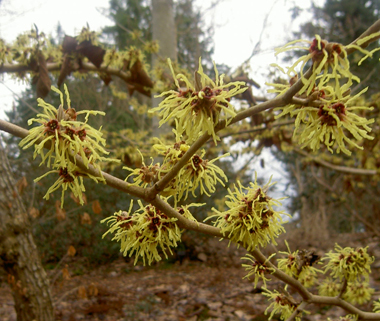
    Witch hazel is one of my favourite shrubs and I am hoping to introduce it to my pavement garden this winter.  When unrestricted its crooked, apple tree-like branches grow to 4 – 6 inches in diameter and the whole shrub can reach around 12 feet in height.  However it can also do well in small spaces, such as large pots or pavement gardens (geveltuinen). It grows best in moisture retentive, acid to neutral soil and is adapted to living in light shade.  Witch hazel is also tolerant of polluted city air and its unusual yellow October flowers make it a good option for the urban herbologist.

    The leaves and bark of Witch hazel are very useful.  They taste bitter, containing tannic and gallic acids as well as a volatile oil.  Its effects are  astringent, tonic and sedative so preparations of Hamamelis virginiana are often used to treat internal and external bleeding.  The most well known uses of this herb are for treating piles, bruises and inflammatory swellings but it is sometimes used for diarrhoea, dysentery and mucous discharges.  Please be aware that using Witch hazel internally should only be done under expert guidance.  Due to its astringent effect, Witch hazel distilled extract (available cheaply from many chemists) makes a great skin toner.  I used it as a teenager, it works well and I think it smells great.  These days I use it mostly for treating bruises.

    Chips of dried Hamamelis virginiana bark can be obtained from herbal suppliers.  You may find this beautiful shrub in local parks, hedgerows and areas of woodland.  It is also a fairly popular garden shrub due to the unusual winter flowers.  Apparently it is very difficult to propagate Witch hazel by cuttings and the edible seeds (if you can find them as they are dispersed far and wide by explosion) can take over a year to germinate.  I am hoping to take a winter cutting from a friend’s plant very soon.  I’d be very interested to hear from anyone who has been successful in this.

    Witch hazel can be used in many ways;

    • Tea (made from the leaves and young twigs or bark, fresh or dried) can be applied directly to piles or dabbed onto bruised or inflamed areas of skin.  This also makes a milder skin toner than the distilled extract, often good for acne, oily skin and shrinking bags under the eyes.
    • Tincture, best made from the bark.
    • Fluid extract, if you can squeeze the juice out, can be included in ointments to calm varicose veins.
    • Distilled extract, easily obtained from chemists, great for dabbing onto bruises, insect stings and bites, applied very quickly as a compress for burst varicose veins – which are life threatening and need immediate medical attention. Can be applied to intact varicose veins as a soaked lint bandage, wrapped gently around the area loose enough to allow the blood to flow unrestricted.
    • Powdered bark, if you can make it then this can be applied to piles when combined in a cream or paste.

    New Moon Intentions

    Happy 2011!  May this year bring you whatever you need at just the right time.

    New Year resolutions don’t work well for me, a year is a long time wherein my will power for certain things slowly ebbs and flows. In the past, whenever I have attempted New Year resolutions, I have inevitably floundered within a few weeks, causing me disappointment and eventual failure to meet those well meant intentions.  I know that I am not alone in this character trait and last year was so pleased to read about a different way to meet personal targets.  Robin Rose Bennett writes about New Moon intentions in her beautiful book, I find the method very natural to work with and it has already helped me to make some positive changes.  Here’s how the idea goes….

    • On the eve of a New Moon I privately write out what I intend to work on during that moon cycle (about 29 days).  It could be something like eating less chocolate, or trying to use more fresh herbs in cooking.  When writing out the intention I try to make it a positive, achievable, present tense affirmation, such as: “I eat fresh herbs three times a week” or “I eat one chunk of chocolate a day.”
    • I keep the paper somewhere private but where I can easily reach it each evening. Each evening I take a look at it and perhaps light a candle for a short time to heighten my awareness of the intention, reminding myself of why I want to work on this particular intention.  It also helps to use that time to imagine/daydream/visualise how it feels to have achieved the intention.  I do this each night until the subsequent Full Moon, that’s about two weeks after the New Moon.
    • I then burn the piece of paper, perhaps with the candle I have used to heighten my awareness and let my affirmations free, allowing them to manifest in whatever way is most appropriate at that time.
    • For the rest of that moon cycle I try to keep to my intentions but I don’t focus on it as much as previously.  I just let it happen.
    • When the next New Moon arrives I think about how successful or otherwise I have been in meeting that target and adjust my affirmation for the next moon cycle accordingly.  So perhaps my next affirmation will be: “I eat one chunk of chocolate every week” or “I eat fresh herbs four times a week.”

    In this way I find it possible to move steadily towards my goals, to adjust my expectations when needed and to feel positive about steps forward, even when they are not as great as I had initially hoped for.

    The next New Moon will be Tuesday 4th January, the subsequent Full Moon will be Wednesday 19th January followed by a New Moon on Thursday 3rd February.

    Holly and Ivy (NL:Hulst en Klimop)

    Not being a great one for tinsel and baubals, I generally opt for some sprigs of holly and ivy when decorating my home for the Yuletide festivities.  So I thought it was time to have a quick look at the herbal lore and uses attributed to these beautiful evergreen plants.

    Holly (Ilex aquifolium)
    Boughs made from the glossy leaves and scarlet berries of Holly have been used to decorate homes at the winter festivals of Yuletide and Saturnalia, since ancient times.  Early Christians are thought to have adopted the practice, to deck churches with evergreen boughs, from their contemporary Pagan cousins.  Ancient Romans believed that Holly could protect their homes from poison, lightening and witchcraft.  It’s not difficult to understand why, given the spiky, defensive structure of many holly leaves.  Planting holly bushes close to homes was thought to infer this protection.

    The leaves, berries and bark of Holly have been employed in herbal remedies over the years.  The berries quickly cause vomiting (they were used a purgative) but the leaves (of several Ilex varieties) have long been used as a tea substitute in Germany and Brazil. The leaves have been thought to help with catarrh, smallpox and pleurisy.  They contain a bitter alkaloid called Ilicin which promotes perspiration. Traditionally Holly leaves have  been used to treat intermittent fevers and rheumatism.  The berries, when dried and powdered are astringent and have been used traditionally to stop bleeding.

    Gathering holly for medicinal purposes is best done in May and June, at about noon time when they are dry of dew.  Gathering holly for decorative purposes should be done with respect for the plant, taking just a little, without harm.  I like to return the holly to the foot of the plant I have cut it from, when I take my decorations down.  It feels much more respectful to do this and hopefully the plant will benefit a little as the dried branches slowly rot down.  Holly can be found growing in hedgerows, as specimens in gardens and within woodlands.  There is plenty growing in central Amsterdam.

    Ivy (Hedera helix)
    Glossy, beautiful, angular Ivy grows easily in pots and makes a great addition to balconies.  It sticks so well to walls, with its amazing vertical fibre support system, that it will easily pull the mortar out from between brickwork if the plant is pulled off.  However Ivy is said to be one of the only plants that keeps walls dry, it’s leaves acting as a protective and beautiful curtain. The fibres become true roots when they meet water, until then they help ivy to attach firmly to the most unlikely surfaces.

    Ivy is favoured by many birds for nesting and its berries provide a rich source of nectar for bees.  Ivy has the amazing ability to transform itself in many ways when it reaches unrestricted light, such as at the tops of trees or walls.  It then produces softer looking, ovate leaves and bunches of pretty flowers on a strong bush like structure.

    There is some much lore associated with ivy.  Like Holly, Ivy has been used to decorate homes since ancient Pagan times.  Poets’ wreaths are made from ivy leaves, as is the wreath of Bacchus.  It was thought that gently boiling bruised ivy leaves in wine would remove the wines powers of intoxication.  Perhaps the alcohol simply boiled away? Perhaps not.  Ivy has long been a sign of fidelity and was given to newly weds in ancient Greece.

    One of the few traditional medicinal uses for Ivy was as relief for sunburn.  Soft ivy twigs, when boiled in butter were thought to produce a useful remedy.  I think I will stick with Aloe vera for now but the ivy remedy could be worth experimenting with.