Category Archives: Herbs

Funded River of Herbs Course!

The Dutch Ministry of Economic Affairs, Agriculture and Innovation is currently offering a limited number of grants (vouchers) to environmental volunteers who want to follow workshops/trainings in the area of nature and landscape management. If you want to learn how to participate in the River of Herbs project then this could be you!

River of Herbs is an innovative urban green initiative which aims to:

Increase the amount of edible and medicinal herbs growing in urban spaces.
Fill dull spaces with beautiful flowering herbs
Help urban wildlife
Increase food security
Encourage community participation in the care of urban spaces.

I have put together a River of Herbs training course, which you can sign up for and if you apply quickly the package will be totally covered by the available grants. My training course (worth 125Euro per person) falls way below the 1000 Euro maximum voucher request per applicant. I want this project to make a positive impact on the city so I’d love as many people as possible to get involved.

The deadline for applications to the Ministry is November 9th. But if you are interested in this you should contact me immediately so I can group you with others and make the application.

River of Herbs Training Package:
5 practical meetings (each 2 hours and on Sundays, in Amsterdam) covering the following topics, each time we meet. This training will give you the skills you need to confidently set up Urban Herb Meadows, keep them going, use them safely and involve others in the project too.

1. Ethical Urban Seed Collection and Storage
2. Identifying Spaces (tiny and large) for Urban Herb Meadows
3. Preparing, Planting & Caring for Urban Herb Meadows
4. Community Involvement with River of Herbs (sharing, helping, sharing)
5. Harvesting and Safely Using Plant Material from Urban Herb Meadows
6. Internet Mapping of Urban herb Meadow Locations and Blogging
7. Being run by Lynn Shore, each session will also include:
– an Urban Herb Walk
– printed info about the medicinal and edible properties of suitable herbs for the project
– the opportunity to stay in touch via my Urban Herbology Facebook group – a slice of cake now and then!

Please let me know straight away if this is interesting to you. lynn.shore@gmail.com

Dates for the training to be fixed in the next few days but all will be on Sundays, starting in January, to give more people the chance to participate and get this project really flowing through the city!!

365 Frankendael day 163

I met Youko and one of her friends, in the park today and she asked me about herbs which will be available at the end of October.

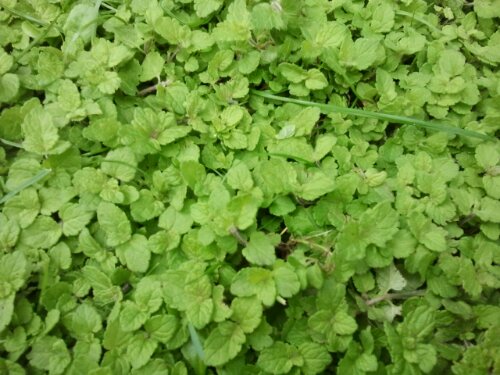
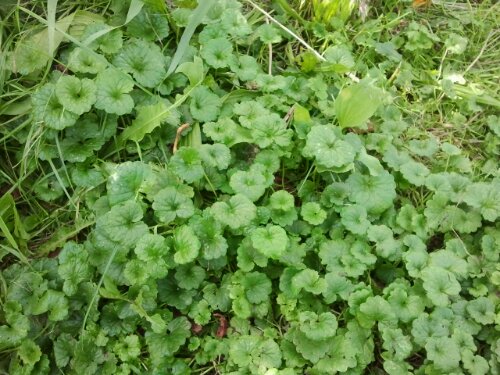
Here is one which will be around because it’s an evergreen herb. Ground Ivy (Glechoma hederacae) is not closely related to tree and wall climbing common Ivy (Hedera helix) but it does like to grow in semi shaded areas. I found this beautiful patch close to the Hugo de Vrieslaan bridge exit of the park (inside). It tastes minty, makes a good digestive tea and I sometimes like it with chocolate or potatoes.

image

Burdock (Arctium lappa) may still be looking good then but will be way past it’s best. Today it’s looking OK, if a little nibbled by something.

image

Another herb which will still be very useful for the forager’s plate, come the end of October, is Dandelion (Taraxacum officinale). It’s in the middle of Ground ivy in this photo. If the leaves are looking less than appetising, chase down and dig up the taproot. Give it a good scrub at home and use it’s medicinal energy reserves to fuel yourself. Dandelion is often used as a cleansing, strengthening liver tonic and is a well loved vegetable in several European countries. It can be used as a coffee substitute, as a roasted (bitter) vegetable in it’s own right or can be usefully grated into other food to as a bitter dimension. Dandelion is thought of as a weed by most so is unlikely to be missed. But if you begin whipping out the roots from clean locations for your pot, please ensure that you spread every dandelion clock you see around town, next summer! An interesting way of cooking the flowers (they may still spring up through the autumn) is mentioned here.

image

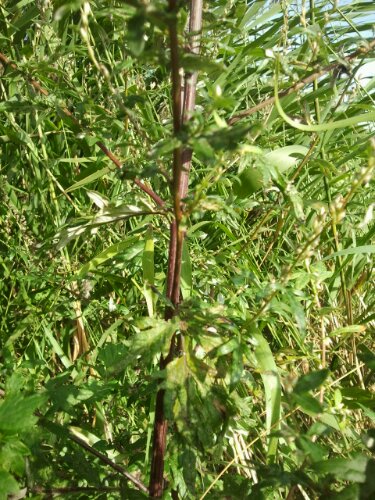
I also found plenty of Mugwort (Atermisia vulgaris) today, it’s still in good shape for picking and drying leaves to use through winter.

365 Frankendael day 157

image

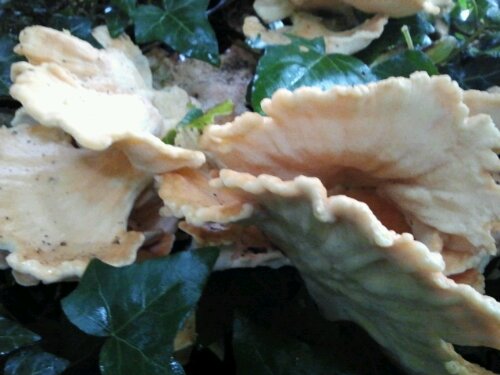
I harvested three tiny prices of that fungus which I found a couple of days ago. I have checked it’s identity in the woods, at home in books, online with reliable sites and as there is nothing nasty I could confuse it with, I felt happy to cook a little. The photograph above is a little washed out but below you’ll see I’ve placed my test harvest against the photo in one of my mushroom books. What a beautiful colour!

image

It is Chicken of the Woods (Laetiporus sulphureus) and boy does it taste good, simply fried in a little ghee! It does taste quite similar to chicken, it is meaty in texture too. If it sits well in my stomach, I’ll be harvesting some more tomorrow. This isn’t going to turn into a fungus foraging blog, I don’t have enough experience of them and it’s so easy to go disastrously wrong, but if I find more interesting autumn fungi I’ll certainly post them here.

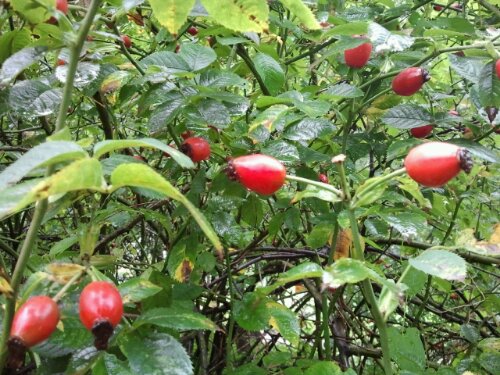
Rosehips (Rosa spp.) continue to ripen.
image

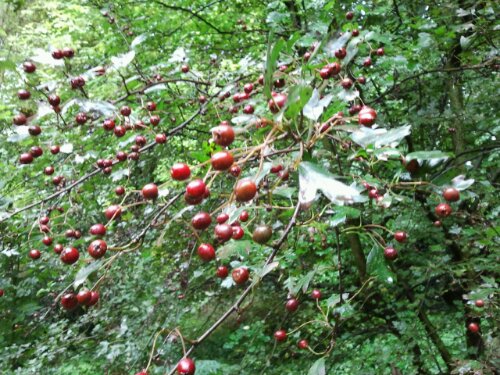
As do Haws on the Hawthorn (Crataegus monogyna) shrubs and trees.

image

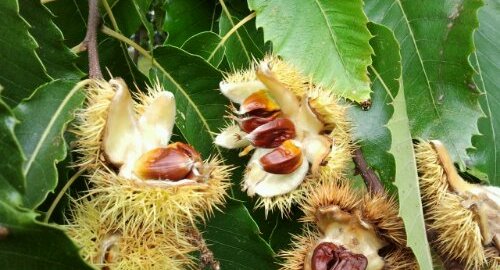
I got all excited to see thousands of fallen Sweet chestnuts, at the front if Huis Frankendael but they are to small to do anything much with. Hopefully they have been shed to help the tree focus on building up carb’s in the rest.

image

It’s still possible to harvest as much as you like of invasive alien Himalayan Balsam. The flowers have a nice taste, quite mild and like lettuce. I heard of someone using the stems as drinking straws recently. That could be interesting too.

image

I think these are the sought after roots of Cat‘s Tails, dredged up in the current canal clearance operation. They don’t look very appetising in that must soup though.

image

And lastly, Feverfew having a brilliant second flower flush. So bitter and do linked in traditional medicine to the treatment of migraine.

image

Danish Hawthorn recipes and simple Haw Honey Syrup

image

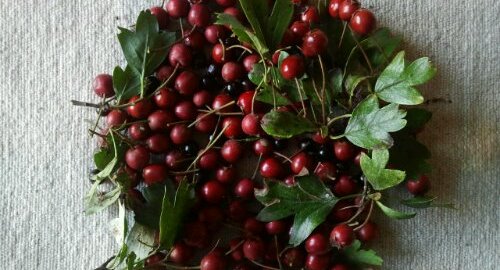
Some time ago Amalie and Daniel joined me for a herb walk alongside Park Frankendael. One of the plants which was in bloom at the time was Hawthorn (Crataegus monogyna). Amalie knew the berries from Denmark and kindly sent me some recipes to try and share. Hawthorn is in fruit right now, it is a common hedgerow plant and the berries (well “pomes” actually but they look like berries) are edible raw or cooked. Most of each fruit is seed, these need to be strained out of any recipe unless you’d like blunt teeth.

Here are the two recipes from Amalie, plus one I have been experimenting with, which doesn’t need sugar. I also posted a Hawthorn Elixir recipe a short while ago which may be interesting.

Hawthorn puree and juice
1 liter of hawthorn berries
300 grams of sugar
Water

Mash the berries into a puree.
Add the sugar and heat to about 70°C (hot, steamy but not boiling). Strain out the seeds.

The puree can be used for various things including the making of Hawthorn juice, by diluting in water (1 part puree to 10 parts water).

Hawthorn with apples and prunes
½ liter hawthorn berry juice (see above)
750 grams of apples, peeled, cored and quartered
100 grams of prunes, roughly chopped
Sugar (as much as you like to taste)

Cook apples and prunes in the hawthorn juice until the apples turn to pulp and the prunes are swollen, soft and succulent. Then add the sugar to taste. If you like, you can add a bit of melatin with pectin, to thicken it all up.
This can be stored in sterile canning jars or eaten straight away.

image

Haw & Honey Syrup
1. Spread your Hawthorn berry (Haws) out in your kitchen for a while to give any bug residents time to relocate. (dry Haws can also be used but they’ll need to simmer for much longer in step 4, to soften them up)
2. Clean your Haws in fresh water.
3. Place them in a small saucepan and almost cover them with just boiled water.
4. Bring to the boil and simmer for just a couple of minutes, to soften everything up a little.
5. Remove from the heat and slow to cool enough to handle.
6. Strain and push out the juice/mush through a standard kitchen sieve. Get out as much as possible. Squidge it with your fingers and a widen spoon. Combine the mush with the water that was used to simmer.
7. When the juice had cooled to being warm but not hot, stir in a nice big dollop of good quality runny honey.
8. Give it all a good stir and chance to combine before storing in a pressure safe glass bottle or jar (like an old flip bung Grolsch bottle).

image

Use as a tasty winter tonic, straight or mixed. Hawthorn is best known as a gentle heart tonic, for the emotions and the circulatory system.

365 Frankendael day 150

Thank you to the group of Urban Herbies who joined me For the Elder Workshop today. We harvested Elderberries, Elder leaves and Elder branches. We learned about and concocted Elderberry syrup and numerous other Elder based remedies. I had a lot of fun with you all, and the plants!

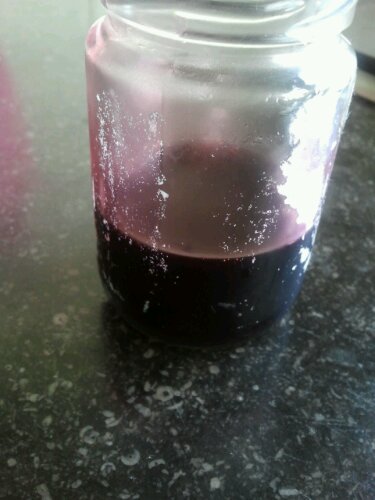
I was so busy enjoying the time that I forgot to take an Elder photo so here’s one of the syrup that we made together, from freshly pressed Elderberry juice and honey… It’s a clean but scrappy looking jam jar. That doesn’t matter as my portion of the syrup will be wolfed down very quickly!

As well as Elderberries, there are heaps of ripe Hawthorn berries in the city hedgerows at present. I did remember to take a photo of one such tree. It’s time to try out the Hawthorn recipes, kindly sent to me by one of the Amstel walkers earlier this year.

Here’s a link to the recipe for the Banana bread I baked for the workshop. I added a finely chopped 20cm Ginger plant leaf and I forgot to add the dates. All fine though!

Here’s a link to that information about recent scientific research supporting the use of Ghee and Honey impregnated wound dressings for serious wound recovery.

Thanks Nathaniel and Jade for sharing with us how the Native Americans revere their local Elder species. Here’s a link with a little information about that (at the end). Here’s a link with lots of information about Elder, particularly the US growing species. Not much about the indigenous people but lots of useful stuff.

Here’s a link to one of my mentors: Glennie Kindred in Britain. She wrote the hand sewn books I showed you today. We looked at the one called Sacred Tree in which Glennie lays out her interpretation of the Tree Ogham.

As we talked about honey, Katja shared her latest concoction – fresh ginger infused honey with lemon juice. Yum! I’ll be trying that very soon and will post some photos to brighten up the autumn. Maybe Katja has a photo of hers already?

Cindy, I don’t think you took your portion of ointment and certainly not the syrup. I also forgot to give you the Kombucha so let me know when you have time to collect them.

Thanks again everyone. See you again soon! xx

365 Frankendael day 149

I’ve been busy preparing for the Elder workshop tomorrow and enjoyed a little walk in the park looking for ingredients for ghee based Elder ointment.  Elder leaves are very medicinal but contain a chemical which, when digested by the human body, turns into cyanide so it’s obviously not a good idea to eat it.  The ripe berries and flowers don’t contain this chemical although the seeds within the berries do.  Here are the herbs in my ointment, plus a couple of other plants which are also looking and tasting great at the moment…

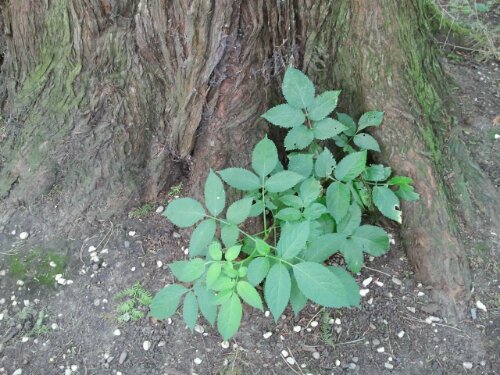
Chickweed (Stellaria media)

Elder (Sambucus nigra) growing close to the base of an old Cedar. Here’s a lovely Elderberry syrup recipe, from Mountain rose herbs, which uses honey for sweetness but doesn’t heat the honey – good news and unusual!

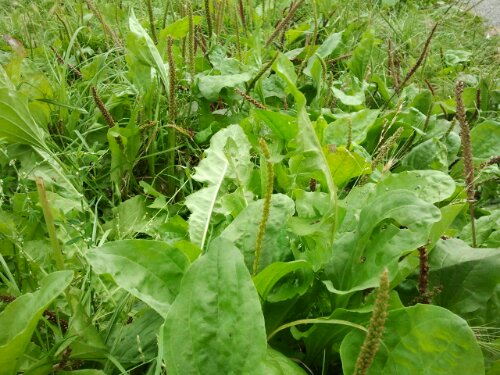
Dandelion (Taraxacum officinalis agg.)  making a stand for itself in a field of Plantain (Plantago major)

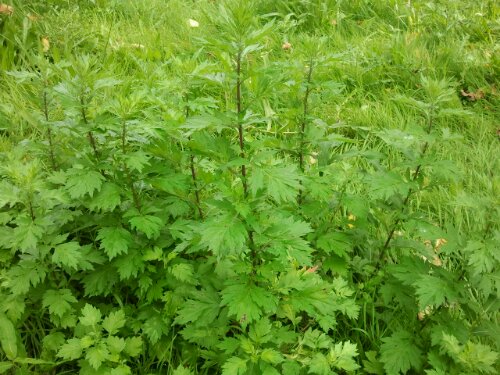
Mugwort (Artemisia vulgaris)

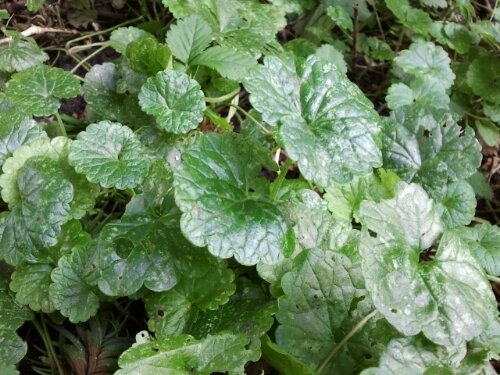
Ground Ivy (Glechoma hederacaea)

365 Frankendael day 148

I had a great time today, taking two group on street herb walks, from the OTOPIA festival on the Overtoom. We found lots of herbs in pavement cracks, in intended pavement gardens, tended ones and in curbs. A few plants were around which I didn’t know the names of. Here they are:

Heath speedwell (Veronica officinalis) was creeping around a large grassland area halfway up Willeminastraat and Eerste Helmersstraat.
image

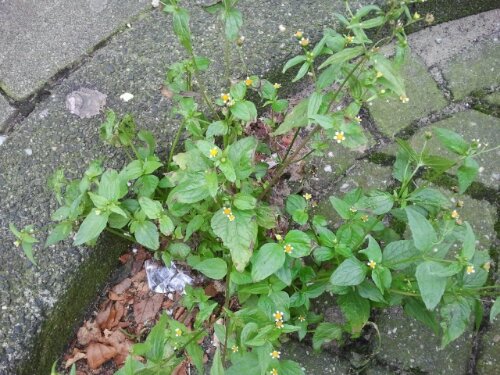
Gallant soldier (Galinsoga parviflora).
image

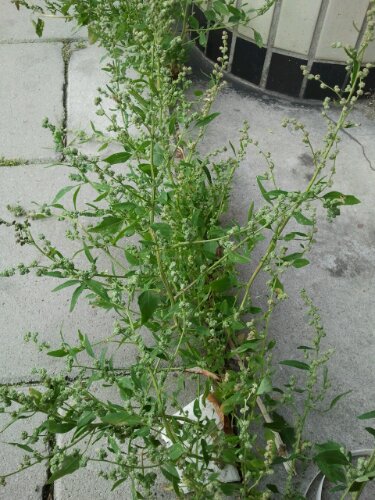
The plant that looked like Fat Hen (Chenopodium album) but had so many flowers on some examples that it was hard to tell, definitely was edible Fat Hen.

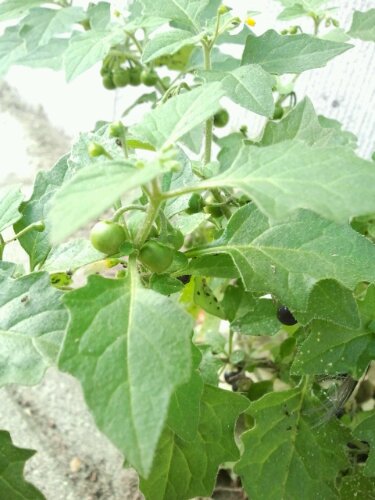
I didn’t take a photo of the Fat Hen today but here’s one of poisonous
Black nightshade. We found heaps of it on today’s walks.

image

The Wild Rocket that was growing at the entrance of OT301 appears to be the perennial species so I hope Cathy will be in luck with the sample she took home.
image

The nettle which the second group found, which wasn’t the regular Stinging nettle (Urtica dioica) was Small nettle, an annual, as suspected and both edible and medicinal.

There were two others which I’m still looking up. Will post an update, when I find the names. Here they are, maybe you can help me out with the names?
image
image

Thanks to everyone who joined the walks and thank you to Femke and Tarje for organising today’s festival and inviting me to take part in this way.

365 Frankendael day 146

In case you haven’t noticed, city nut foraging season is upon us.

I passed by Oosterpark today and noticed a middle aged chap, ferreting around in the undergrowth at one corner of the park, with his young son calling directions to him from outside of the fence. Ah ha Hazelnuts!, I thought and I was so not disappointed when I dived into the same bushes!

During a five minute squirrel-style frenzy, in the soil and dry leaves, I managed to amass a few dozen prime city Hazelnuts (Nl: Hazelaar, Corylus avellana) Delighted, is an understatement! Spurred on by my success, i took a quick tram ride home and sped to a copse of Hazel and Beech at the bottom end of Pythagorasstraat. That spot is a local’s favourite; There is a well trodden path into the copse and a scarcity of nuts but none the less, I didn’t go home empty handed! Later today, I’ll probably toast them all, add some to a hor chocolate and add the rest to Frank’s muesli tub. They should last a couple of weeks in that.

If you’ve never toasted Hazelnuts yourself, and if you like the taste of chocolate, then I implore you to have a go. Buy some from Odin or your local grocery store or better still, get outside and forage a handful yourself. Lear how to identify the tree and get hunting beneath them and I the branches. Green and brown hazelnuts are just fine but the free ones need to be used almost instantly whereas the others should keep up to a year, if stored properly.

How to toast hazelnuts
1. Once dusted off a little, crack them open and discard the shells (return them to the forage spot if possible). Some shells may be empty – hedge blanks. It’s a pity if you find only those.
2. Spread the nuts on a baking tray and give them just a glance of olive oil. To do this you can pour a little into a corner of the tray and toss them all around until they glisten or brush them with a little oil.
3. Set in an oven which has been preheated to about 180°C, leave them to cook for about ten minutes.
3. Remove from the oven (as with all nuts, watch out for explosions, maybe cover with a clean tea-towel as you maneuver them from the oven. Let them cool before using or eating.

The smell in your kitchen should be sweetly, nuttily, mouthwatering after that short time and if you are anything like me, I doubt that many of the toasted nuts will actually make it to a muesli bowl. Lots of recipes make good use of Hazelnuts, both savory and sweet. I think that in combination with chocolate they are at there best. So for me that could mean simply smashing a toasted nut and crumbling it over a hot chocolate or to garnish a chocolate dessert. Or it could mean incorporating it into a dish. Nut roasts are a good way to use up heaps of nuts but I rarely have heaps and I like them to last a while rather than being wolfed down in one sitting. Sprinkled over a bowl of homemade pumpkin soup is another easy way to incorporate them.

You can also make Hazelnut milk for the fresh nuts, as described in the River Cottage Handbook no. 7 Hedgerow, by John Wright (see books page). Soak a handful of shelled fresh nuts in water overnight, rinse and blitz in a liquidiser with about 400ml water or skimmed milk. Strain through a cheesecloth or similar.

Workshop: Growing Exotic Herbs

image

I’m running a workshop with Suzanne of City Plot (an urban farming collective), this October. Well show you how to cheaply spice up your house plant collection with unusual, tasty and useful exotic herbs such as Ginger, Papaya and Tamarind. What better way to increase your homegrown herb supplies, create a talking point and cut down on food miles!

Suzanne will teach you how to grow the plants from scratch and how to maintain them whilst I’ll show you how to use the exotics to make home remedies and tasty food items.

image

Join us:
Sunday October 14th,
11.00am-1.00pm
Proef restaurant
(garden/inside depending on weather),
Westerpark, Amsterdam.
Cost (including all materials) €25
Max 10 places

Currently 4 places left.

You are welcome to book with me directly, with
Cityplot directly or via the Meetup group.

We’ve chosen this venue because the organic restaurant garden is planted and maintained by Cityplot. It’s a very interesting and inspiring place for city gardeners!

image

Booking requires pre payment which is totally refundable if you cancel up to 24 hours before the event. If you cancel later than that and we find a replacement, you’ll also receive a full refund.

We very much hope to see you there!