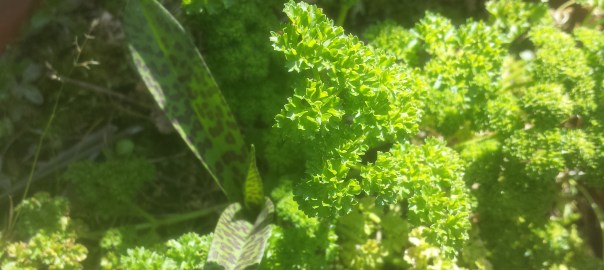
My latest find is a succulent crop of English Chamomile leaves and parsley.
Parsley and mystery speckled plant.
Growing amongst it is a speckled plant which I don’t know. Any idea what it is? The leaves are rubbery and almost orchid like. A few of these have popped up in my rooftop planters amongst the perennial herbs. I am looking forward to seeing the flowers and identifying the plant.
Here is a very familiar plant – Holly (Ilex aquifolium) currently in flower. The whole plant is well known for being poisonous, especially to children and yet in small quantities it has been long used as a tea and effervescent a coffee substitute. I’ve found several recipes over the years for tea and infused wine from Holly leaves but always wonder if the plant has been muddled with Barberis aquifolium for those recipes.
Photo credit – Peter Warnock.
This is certainly not a plant to be considered for regular consumption but those flowers are stunning and I’m more tempted to add one or two of those to a recipe, than the leaves. If you have experience of using Holly, I’d love to hear about it. In the meantime, let’s leave it for the bees.
Today, more beautiful photos from the challengers. We now are a group of 12, if you would like to join please do!
Photo credit – Tanya Godden. Cardamine pratensis.
From Tanya in Devon, UK, delicate Lady’s smock (Cardamine pratensis). Yes, it is edible but no we don’t harvest it because it is a wild flower and what a pretty one. It is a close relative of Hairy bitter cress (Cardamine hirsuta) and it shares the same peppery flavour. I planted this next to my little garden pond last year – that’s about the only way to be able to harvest it – grow your own.
Photo credit – Hannah McDonald. Bluebell and dandelion
From Hannah in Amsterdam, another lovely sketch of poisonous bluebells and edible dandelion.
Photo credit – Peter Warnock. Choysia.
From Peter in Belfast, beautiful Choysia flowers. Stunning blooms which are not edible. So another plant to raise the spirits as we see them rather than thinking of ways to eat them.
Photo credit – Elodie den Otter. Japanese knotweed.
Elodie in Badhoevendorp, has been cooking up foraged Japanese knotweed at home.
Pollinators certainly benefit from pavement gardens such as this one which is full with yellow broom and purple wallflower blossom. As mentioned yesterday, clean wallflowers are edible and broom flowers are too. I like to infuse them in honey. Here’s a useful summary of the plants uses and note of its toxicity.
Here are a couple of gorgeous photos from our friend Peter in Belfast. The more I see of that city, the more I want to visit!
Firstly, Fumitory, Earth smoke. This plant has many historical uses. It can cause gastric distress in some people and is generally associated as a laxative, cleanser, aid in healing psoriasis, eczema and dermatitis. To me, it’s all about cleansing and preparing the way for fresh things to come. It makes a nice tincture and a couple of those tiny flowers sprinkled on food are very pleasant. But only when I find a hope swathe of the plant. Fumitory is a pretty plant friend from the poppy family as you’ll notice by examining the leaves. Quite a special appearance and texture.
Photo credit: Peter Warnock
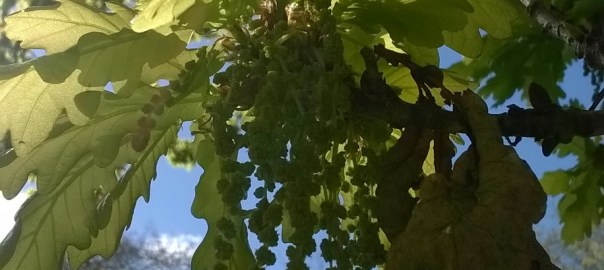
Second, young oak leaves and flower clusters. So rarely noticed or foraged but far tastier than mature acorns! Peter makes Oak flower essence – a great use for the plant. My partner visited central Spain recently and brought me back a packet of rather delicious acorn candies. A thoughtful gift! Something to recreate in Belfast perhaps Peter?
This was the closest I could get to orange flowers today as I wandered the Amsterdam King’s Day street market. Perennial wallflowers look bright and cheerful and are edible (depending upon their location of course). They belong to the cabbage family (Brassicacea).
So, what have the challengers been finding? Here’s another lovely plant record from Hannah McDonald showing hollyhock, rosemary and plantain.
Day 5. Had a lovely morning in Park Frankendael, weeding sycamore seedlings and cow parsley from the orchards. Found the hostas looking beautiful and gathered cleavers, wild garlic, ground ivy and lemonbalm with one of my past apprentices.
Then it hailed and was cold so we drank hot chocolate.
Tomorrow is King’s Day so I really should hunt for some orange flowers.
At the moment, my phone is over loaded with photos from challengers and won’t do what I want. I’ll add some to this post later…
Here are some lovely images from my foraging challengers. I’m so impressed by their efforts!
Image and photo credit: Hannah McDonald
Hannah (who is working on illustrations for my books!) has been sketching her finds whilst wandering Amsterdam.
Peter is currently trying to ID this mustard type brassica.
Photo credit: Peter Warnock
And Elodie has been considering the edibility rating of thistle…
Photo credit: Elodie den Otter
Dana has found a herb she has known about since childhood (not for eating) – greater celandine / stinkende gouw – with the yellow flowers. It is a traditional topical remedy for several skin complaints.
Photo credit: Dana Marin
Is great to see people branching out from the usual foraging favourites!
I was at work today so took a lunchtime walk past lots of green spaces. Here’s some purple deadnettle growing opposite the Amsterdam Hilton.
Have just noticed that this is my 600th blog post on Urban Herbology – Thank you for reading it!
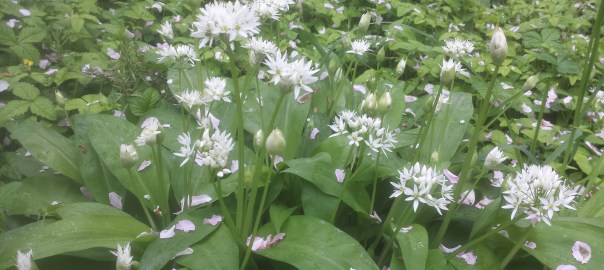
A friend and I harvested quite a lot of daslook / wild garlic (Allium ursinum) today in Amsterdam. This plant is on the Netherlands endangered plant list but it grows like a weed in some parts of Amsterdam and is frequently foraged. One of the reasons for my running the River of Herbs orchards in Park Frankendael, is to have a place where ethical foragers can carefully harvest this plant, legally without getting into awkward situations.
We were sprinkled with cherry blossom confetti as we harvested. A beautiful experience! If you would like to help out at the orchards sometimes and learn more about herbs, let me know. We are there (almost) every Wednesday morning – year round.
And what did the challengers get up to today? I’ll update with some of their day 3 foraging challenge plants and photos later today…
So, they have reported back to me with notes and photos of Japanese knotweed, dandelion, mugwort, motherwort, daslook, spring/Himalayan balsam, valerian, winter purslane, cherry blossom, stinging nettle and more. Here is a beautiful photo from Carol Poye, of Claytonia perfoliata (winter purslane / postelein).
Photo credit – Carol Poye
I love the taste of this plant and never cease to be amazed by it’s appearance. Just look at the leaf shape and how the flowers seem to emerge from their centre. What a special plant. I am not surprised that this is grown as a crop salad in the Netherlands.
Here is a substantial patch of Japanese knotweed which Ann Doherty photographed. What a sour tasting edible stunner this is and yet what a brute it can be!
Photo credit – Ann Doherty
I remember looking at an old house for sale in Somerset, many years ago and Jap. knotweed was growing into that house through one meter thick stone walls and a thick concrete floor. That house had stood looking like a Midsommer Murder’s location for centuries (it was very pretty) but Japanese knotweed brought it to it’s knees. The plant is native to Japan where it is apparently kept in balance by other local plants. But here in Europe, it does not have such competition so quickly spreads, smothers other plants and finds barriers such as concrete little challenge to penetrate. I have long found it rather worrying to have this plant growing all over the place here in Amsterdam. For years it has been spreading here and the costly related problems in countries such as Canada and the UK are well known, yet little has been done about it here. I wrote a post about it in 2012 – take a look at the healthy knotweed specimen in the Hortus Botanicus! I guess that the green managers of Amsterdam felt that a balance of nature would arise and that the problems abroad were perhaps exaggerated. Having seen them first hand, I find it all rather worrying.
Finally, there is a new local map of the spreading invader, restaurants are starting to serve it, there is mention in gardening magazines but I find this recent awareness raising all rather late in the day. The plant continues to grow in great robust smothering swathes throughout Amsterdam parks and elsewhere. It erodes the waterway banks, penetrates so deeply and widely into the soil. The smallest flinter, on a trowel or spade, in boot treads etc will cheerfully regrow. Of course, all plants have a value but I would like Japanese knotweed to stay away from my building and from the beautiful biodiversity of Amsterdam. If you find it and fancy a taste, be totally sure not to leave any part of the plant hanging around. Cleanly cut the part you want (young and tender shoots are best), prepare it and any left overs should be burned. Amsterdam household waste heads off to the municipal incinerators, that’s the best route for Japanese knotweed. Don’t leave left overs, trimmings etc in your compost heap or worm bin. Here’s a simple recipe which I made up for the plant in 2012. I haven’t really eaten it since writing that post. The taste was good but perhaps thoughts of that crumbling cottage spoiled my appetite.
So with Japanese knotweed in mind, let’s journey on to day 4…
So it’s day 2 and the photos are now flooding in from my challengers. Thank you so much for your enthusiasm!
They have been finding hog weed, ramsons, old beech nuts, violets, yellow dead nettle, poisonous euphorbia, strawberry, dandelion, dock, wood sorrel, elderflower and the list goes on and on and on! So many plants to find and ways to use them.
My favourite challenger-find of the day was from Peter in Northern Ireland. He’s been finding Fleabane running wild in the streets of hours home town! I’ve no experience of this plant but he tells me that it has a high choline content which can provide a great boost for the memory and can be very helpful to those who are involved with dreamwork. The Latin name is Conyza canadensis. Peter has also noticed that some of the dogs seek it out for a nibble, perhaps using the plant keep themselves free of parasites such as fleas. Fabulous! I want to find some tomorrow! Not that I have fleas or anything but I am very intrigued.
My favourite personal find of the day was this little Wormwood seedling, toughing it out in a pavement crank opposite my house. What a beauty! We have a vigorous pavement clearing council here in Amsterdam oost and this plant may not survive much longer in that spot so I have rehomed it on my balcony…
Artemisia absinthum.
Happy foraging challengers. See you again tomorrow ☺
My 30 day foraging challenge is underway and already I’ve received lots of lovely photos from people who have signed up for the challenge in the Netherlands, Northern Ireland and England. Am looking forward to receiving more!
Burdock, daisy, wild garlic, chickweed, hawthorn leaf, dandelion, cherry blossom, garlic mustard, ground elder, rose leaf, mugwort, honeysuckle, red valerian, rosemary, violet and far more have been found. Also a couple of poisonous plants (dog’s mercury and cow parsley) – equally important to know about!
My harvest of the day: three Japanese rose buds and young leaves, collected en route home after a swimming lesson. I’ll add them to my tea mix when dry.
If you would like to join my 30 day challenge, it’s not too late! Simply send me a message and I’ll begin sending you an email a day and answering your questions.








 Urban Herbology