Last November I gave a talk at the TEDxYouth@AICS event called Edible Cities. It is now on YouTube…
Category Archives: Projects

River of Herbs @ Pakhuis de Zwijger
Are you are interested in:
Growing edible & medicinal herbs in public spaces,
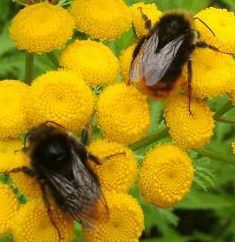
Encouraging pollinating insects into the city,
Increasing Urban Food Security,
Creating a community food forest,
Learning and sharing gardening skills,
Creating an edible wildlife corridor through Amsterdam, by planting tiny unused pockets of land?
Then please come along to the River of Herbs Amsterdam launch meeting at Pakhuis de Zwijger on Monday 3rd February, 7-10pm.
Free entry – All welcome.
Full details available on the River of Herbs website. If you think you will be coming along, please let me know so that we have a better idea of numbers. It’s on the events page, Facebook and my meetup site. I set up the River of Herbs project in 2012, to encourage people to grow herbs and help wildlife. That’s why I mention it here.
If you are interested but can’t come along to the launch, don’t be shy, get in touch and let me know what you are planning to do or are doing already. Whether you plant a tiny plantpot with daisies, or a geveltuin with herb seeds, or a row of tree pits with rainbow shades of herbs or whatever else – everything you do makes a difference!
Bifurcated Carrots
BifurcatedCarrots.eu is all about seed saving: Why we should do it. Who is doing it already. And how we can do it. It’s run from Amsterdam by Patrick Wiebe and Steph Mandel who seem to be as passionate as me about increasing food security. They keep us up to date on the attempts of government and certain corporations to regulate the plants which we can grow and they publish a list of where interesting seeds to swap/sell are available around the world. It’s a very useful blog to follow.
You can watch Patrick, giving part of a workshop on seed saving at the Educational Gardens at Sloterdijkermeer Volkstuin complex, on this video. The River of Herbs demo plot is in the same garden and gets a nice mention.
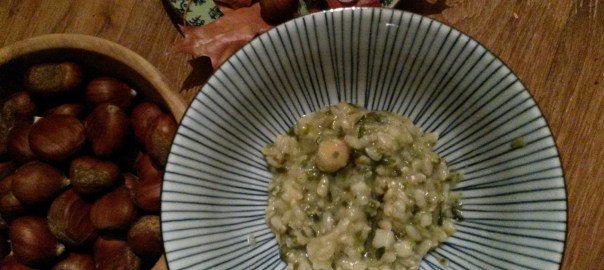
Sweet Chestnut & Parsnip Risotto
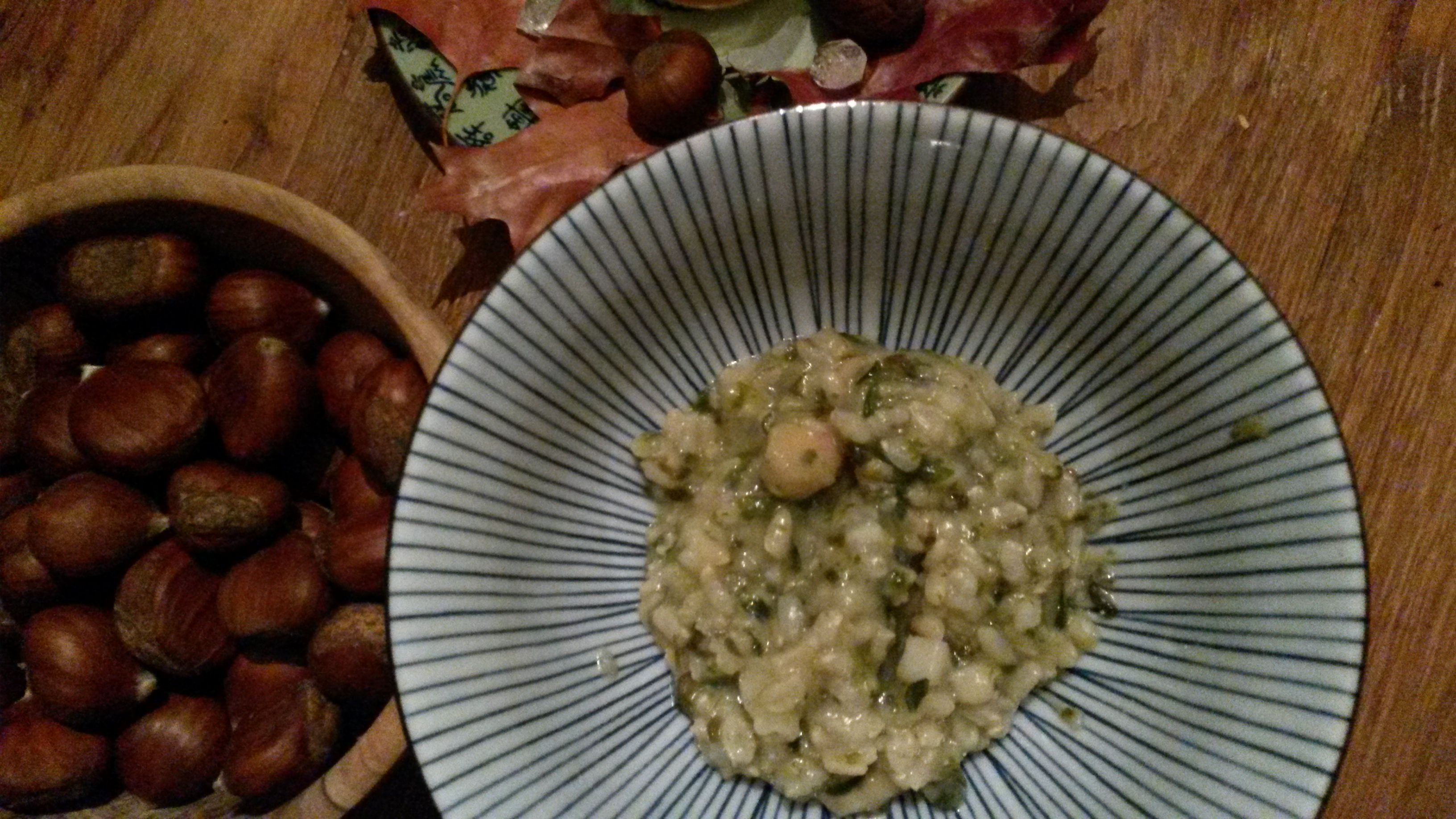
I learned on Saturday, from one of my Willow apprenticeship group, that many Japanese cooks like to peel Sweet Chestnuts when raw and add them to rice whilst it cooks. So today I tried it out and wow – what a sensation this cooking combination can create! I intended to take a huge portion of this risotto into work for tomorrow’s lunch. Umm, there is now only about half a portion left so must think again about lunch. This risotto uses sweet parsnips, sweet chestnuts and rice which is naturally on the sweet side. The other ingredients are savoury and the result is sweet savoury. Never again will I cook sweet chestnuts without thinking of rice first. These sweet chestnuts came to me as a gift – foraged in the east of The Netherlands – unfortunately I have not found them of this quality in Amsterdam, though I’m sure they exist!
So here is my latest wildfood recipe for…
Sweet Chestnut and Parsnip Risotto
(makes about 2 main dish sized portions)
1 cup risotto rice – I used wholegrain (non risotto rice will do, it just won’t become so creamy)
1 small onion, finely chopped
Oil or butter
Parsley, sprig finely chopped
1 large parsnip, finely chopped
1/2 organic chicken or vegetable stock cube or 1/2 cup of good stock added in place of hot water
1/2 organic chicken or vegetable stock cube or 1/2 cup of good stock added in place of hot water
6 -8 fresh sweet chestnuts, shell and skin peeled, then the creamy nut broken into rough pieces.
Seaweed – I used 1 frond of Dulse or equivalent, finely chopped.
A little Spinach, finely chopped (seasonally available local leaves would also have worked very well, e.g. Dandelion, Ground Elder)
Method
1. Gently fry the onion in a heavy based pan and when translucent add the dry, unwashed risotto rice.
2. Fry the rice in the onion, very gently, for a minute or so.
2. Fry the rice in the onion, very gently, for a minute or so.
3. Add 1 cup of boiling hot water. Stir to prevent it sticking to base of pan and simmer steadily with the pan lid on.
4. Continue to stir breifly whenever you think about it.
4. Continue to stir breifly whenever you think about it.
5. Add the other ingredients to the pan and stir every now and again.
6. Add more hot water, cup at a time whenever you see the rice absorb the cooking water and the dish thickens up considerably.
7. Simmer and add water in this way until the rice is translucent and thoroughly cooked through.

Autumn Street Treats and Tricks
The past few weeks have seen a bounty of free street food falling from trees in Amsterdam. I’ve been enjoying Hazelnuts, Hawthorn berries & Sloes (plucked rather than fallen) and Sweet chestnuts – all absolutely delicious when prepared! The nuts and fruit are still there for the taking in many places but if you have trouble identifying these, keep your eyes open for fallen orange Gingko fruit, falling to the ground from mature female trees. See here how to harvest, prep and eat them and feel free to join me for a quick lunchtime forage in Oud Zuid, over the next couple of weeks.

Here above is Hawthorn (Crataegus monogyna) (NL: Eenstijlige meidoorn) in berry. This one is in a hedgerow of Frankendael park. I have mostly been cooking them like this:
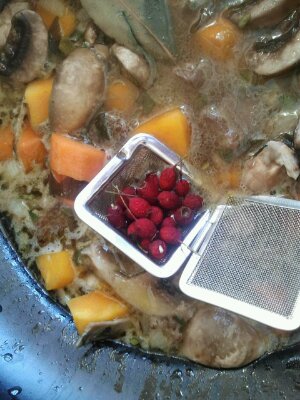
I infuse them into casseroles, using a stainless steel tea infuser. It gives a mild boost to the food and avoids me having to deal with the inedible pips. Ripe Haws taste a rather similar to bruised apples. Taste aside, they are reported to have many health benefits.
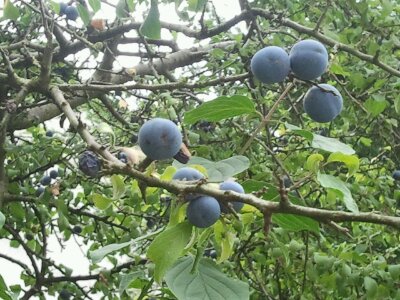
These are plump plum-like edible fruit which look similar to Sloes (which come from the well known Blackthorn tree (Prunus spinosa) (NL:Sleedoorn)). This shrub is growing in the hedgerow of a local playground and it looks more like a Bullace than a Blackthorn. The fruit are larger and the leaves larger and slightly more smooth. Whatever their exact identity, they are of the Prunus species and they tasted good when ripe.
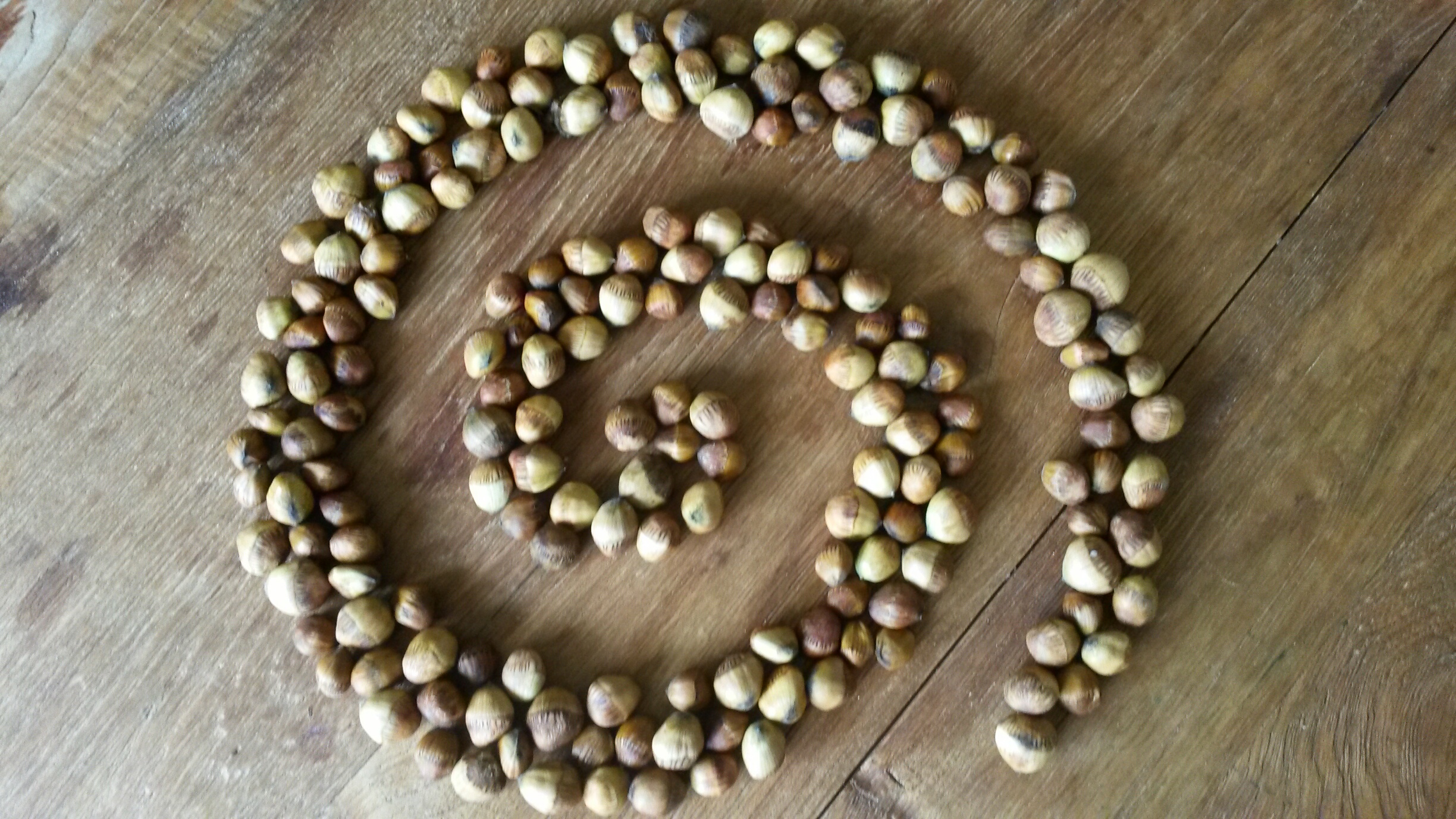
Turkish Hazelnuts (Corylus colurna) (NL: Boomhazelaar). Larger nuts than the usual multistemmed Hazel (and I haven’t had a blank yet, unlike with the others). I’ve been harvesting lots this year from Pythagorasstraat in Amsterdam Oost Watergraafsmeer. This tree species is used commonly as a street tree in cities, it is very tolerant of harsh growing conditions and doesn’t grow those multiple stems so can be kept easily under control in treepits.

What a wonderful gift from the Amsterdam town planners!


If you are lucky and find some on the ground either within or popped out from these extravagant nut cases, take them home and give them a good wash before drying the surface of the nuts and then get cracking! You can use them straight away as a snack, roast them (when the shell is off) or blend them to make a nut milk, pesto etc. How about mixing them with some cocoa or carob powder and honey to create some choc/carob nut spread? Yum!
And now for the deadly tricks…
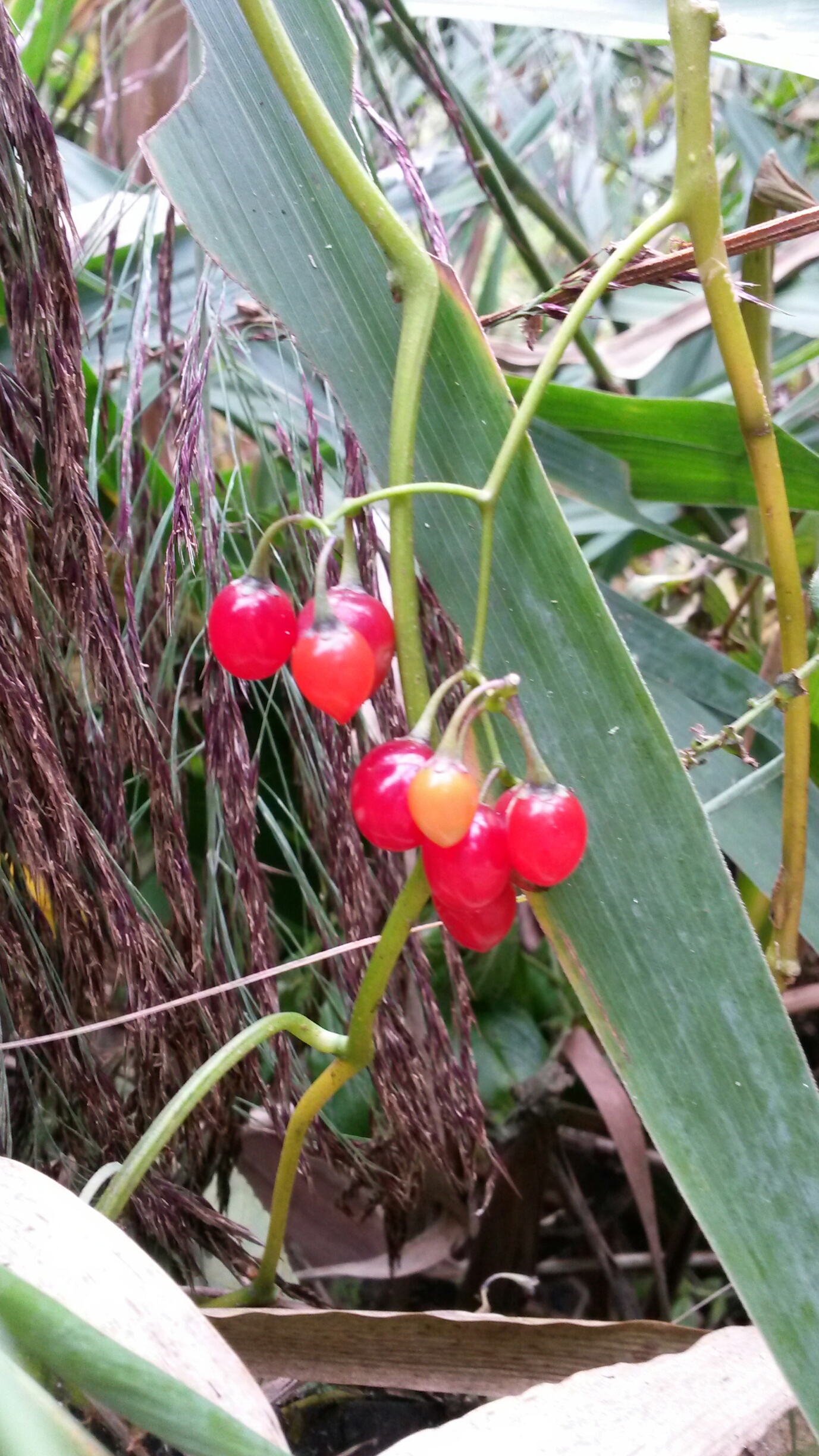
These pretty tiny tomato like berries are the fruits of poisonous Bittersweet (Solanum dulcamara) (NL: Bitterzoet). Please note that in the US there is another plant called Bittersweet which is quite unrelated. The one in my photograph here above is a member of the Nightshade family and I wasn’t able to get a decent shot of the leaves but they resemble a potato leaf rather than the long blade seen next to the berries (see the link for a clearer idea and better still, look in a good field guide!)

A female Yew tree (Taxus baccata) NL: Venijnboom, laden with beautiful red fruit. The soft slimey flesh is actually edible BUT the seed within each red fruit is deadly poisonous.

Another red and poisonous autumn beauty, Fly agaric toadstool (Amanita muscaria) (NL: Vleigenzwam). It is also psychoactive. These two were growing in Park Frankendael last week. There seem to been quite a flush of them across northern Europe recently.
Edible Cities TEDxYouth@AICS

I love the spirit of TED, where ordinary people stand in front of an audience and speak about Technological, Entertainment and Design ideas that are worth spreading. I’ve watched some great talks in recent years and each has taught me something, has made me think slightly differently and has spurred me on to do what I know is right. Amsterdam International Community School will host a TEDxYouth event in November and I am so excited to be speaking there. The title I have given my talk is Edible Cities. I am totally buzzing with ideas but as I prepare my 15 minute talk, I’d like to hear your thoughts about what I should say to the audience of predominantly 16-18 year olds. I am hoping that your thoughts will help calm me down and focus my thoughts to less than a million!
If you don’t know TEDx, then perhaps take a look at these videos to wet your whistle..
Vicki Robin – Relational Eating (TEDx Seattle)
Pam Wathurst – How we can eat our landscapes (TED Salon London)
http://embed.ted.com/talks/pam_warhurst_how_we_can_eat_our_landscapes.html
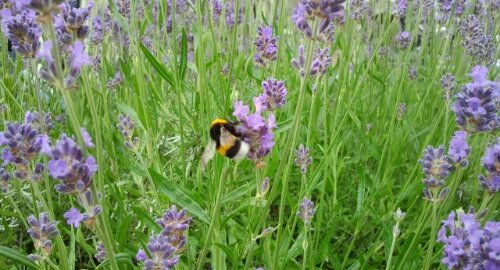
River of Herbs 2014 Course
UPDATE (19/09/2013): This course is now full. If you would like to be on the waiting list then please let me know – Lynn.
Sign up for the next free River of Herbs course!
Newcomers are welcome and also those who attended the previous course.
This course will cover all the material that we worked on in 2013 but will be based at set locations along the River of Herbs Amsterdam edible/wildlife corridor. Participants will help to create the corridor whilst learning green skills.
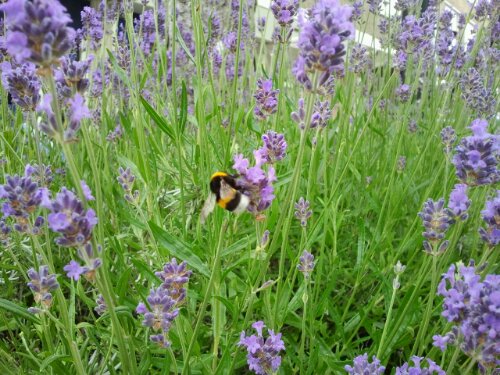
River of Herbs Amsterdam Wildlife Corridor
We are currently planning an ambitious River of Herbs corridor, running from the A10/Middenweg intersection up to De Hortus Botanicus then onward through Amsterdam Centrum and finally out to De Baarsjes in Amsterdam West. The River of Herbs corridor will be made up of tree pits, geveltuinen (pavement gardens) and small unused spaces, all planted by volunteers with edible/medicinal herbs which are useful to pollinating insects and people. The Amsterdam River of Herbs will also include the transformation of a public orchard in Park Frankendael into a community Food Forest. The River of Herbs edible/wildlife corridor is being created by the collaboration of Urban Herbology (based in Amsterdam Oost), FoAM and City Plot Amsterdam (both based in Amsterdam West). Groups of local people are being helped to plan, plant and maintain small urban herb meadows, for the benefit of people and pollinators.
Who is this course for?
Anyone who wants to learn how to grow herbs safely in disused urban spaces & how to help pollinating insects.
Dates 2014:
Four Monday afternoons 13.30 – 15.30
February 10th
March 10th
May 12th
June (day tbc)
You will learn how to:
- Identify and prepare unused spaces for growing useful perennial, biennial and annual herbs.
- Sow suitable seeds and plant cuttings, roots etc. in these places. Choosing for location, wildlife, food or medicine.
- Tend the developing Urban Herb Meadows.
- Map the locations of these Herb Meadows.
- Harvest some of the herbs without compromising their usefulness to pollinators such as bees, hoverflies and butterflies.
- Teach others how to grow and use these herbs.
- Create and manage an urban River of Herbs.
The first group of River of Herbs volunteers completed the 2013 training course. Those who showed that they can plan, plant and maintain an urban herb meadow are now able to train other groups of volunteers, using the River of Herbs materials. You can see some of the sites that the first group worked on, using our map.

You will receive:
Four 2 hour sessions of hands-on urban green training.
Course book – an updated and condensed version of the 2013 River of Herbs booklets.
Ongoing support – we have an active Facebook group and can be contacted by email or telephone.
Green skills experience and work reference – for those who complete the course and can show their skills.
The 2014 course is being run by Lynn Shore from UrbanHerbology.org.
Plants and tools are provided – you are welcome to bring along more if you like.
Cost:
Free to participants (value 250 Euro per person)
All costs will be completely covered by Groen en Doen vouchers. River of Herbs will organise this for applicants. If you want to join this course you must simply contact us and we will organise the funding. The funds generated by the vouchers will be used for the River of Herbs corridor project. Groen en Doen vouchers are offered to enable green skills training for volunteers.

Number of places:
12.
Please apply if you are seriously interested in helping us plan, plant and maintain the River of Herbs Amsterdam wildlife corridor. This is a very exciting and worthwhile project which needs a whole community effort to make it work. Be part of it!
Apply:
Please contact us directly – riverofherbs@gmail.com
UPDATE (19/09/2013): This course is now full. If you would like to be on the waiting list then please let me know – Lynn.

Early Autumn Calm
It has been a busy summer full of events, group walks, a Permaculture Design Course, writing, interviews and a lovely holiday in France. Now it is time to slow down, take stock and take a closer look at some of the plants ripening for harvest around me here in Amsterdam.

Rosehips, of all shapes and sizes are redening, softening and just asking to be added to honey and pies (when the itchy seeds have been scooped out of course). These rough roses are amongst the first to ripen and amongst the most flavourful.

Wild Rocket, Ijburg pavement. This beautiful spicy specimen is currently forming hundreds of tiny seeds – just right for saving and planting closer to home in clean locations. Yesterday I filled a plant pot and sowed some of these seeds, hoping for more deep winter fresh herbal food. Rocket is often available mid winter and is packed with flavour and nutrients.
Sloes, forming on a playground Blackthorn shrub. Some of these are now infusing in a small jar of Genever, in time for some Yuletide cheer.
Packets of River of Herbs 2013 seedmix. I gave out some of these at the Children’s Pizza and Flevopark walk recently. They are full of locally harvested herb seeds. Lots of things are planned for the River of Herbs soon. Please keep in touch about your urban herb meadows and other projects.

Coming up
I have two more walks planned for this month, at the Magneet Festival. Then in October, an Exotic Herbs workshop with Suzanne of City Plot and in November a dinner talk at the Lloyd Hotel for Steinbesser experimental gastronomy. If you are interested in attending any of these then please get in touch.
Apprenticeship
A few people have asked when my next apprenticeship group will begin. The next group is planned to begin in Spring 2014. It will run on Mondays and anyone interested is very welcome to contact me from now on. Here is a link to the syllabus (it needs a little updating but it should give you the idea of what I intend to cover on the course).

Sandy Edibles at Magneet Festival

Here is a taster of the edible and amazing plants which can be found at the sandy Magneet Festival site, in Amsterdam Oost. This is Evening Primrose (Oenothera sp.) NL: Teunisbloem, a useful and tasty plant.

I was asked to lead a foraging walk each weekend, throughout the duration of the month long festival, by the Mobiation Project. This is their home, the Mobi-01. They slowly move around vacant spaces of Amsterdam, living sustainably, in this self made residence. The Mobiators were asked to run the Green Zone of the Magneet Festival this year and have organised a great selection of workshops and events. You can learn how to make solar dryers, solar heaters and many other things from the Green Zone this year. It is really inspiring and well worth a visit. Here’s their Facebook link.

So each Sunday that the festival is on, I’m giving free guided walks at 4pm, from Mobi-01 in the Green Zone. I’m showing interested people what can be found growing in the sand. At first glance there is not much of green interest but if you look closely you will find treats such as…
Mugwort (Artemisia vulgaris) NL: Bijvoet

Wild Rocket (Diplotaxis tenuifolia) NL: Wilde Rucola

We found many other edible plant species growing in the sand. Burdock (Arctium lappa) NL: Grote Klit. was the biggest surprise for me, I haven’t found it in such a pure sand location previously.

Next week I’ll be taking along some local edible plant seeds and wild flower seedbombs, to plant during the walk. It would be great to see a few other plant species find their feet in this unusual site.
Rose petal and Mugwort Elixir

This morning was an Oak Apprenticeship meeting and this afternoon, a walking-cooking magazine interview. Mugwort (Artemisia vulgaris) was a welcome participant at both gatherings. This common urban herb offers a plethora of uses and is currently flowering here in Amsterdam.
Mugwort has a strong aromatic taste and is not the easiest herb to eat raw. The leaves are full of a strong fibre which is almost impossible to chew through when eaten raw. These fibres are used to prepare the Moxa of Chinese Traditional Medicine. In summary Mugwort is a warming herb, a women’s ally, encouraging menstruation, may ease period pains and is a warm soother or muscle tension and pain. It makes a simple and useful infused muscle rub oil and even simpler, a foot soak, when infused in water. The tea is unusual to some but is tasty and not unpalatable. It can be used to deter insects. A protective herb. This is the abundant urban herb of dreams, scrying and prophecy. Seek it out in flower, to enjoy the peak of it’s spiritual powers. In bud and in flower, it is also easier to prepare for cooking (although this is not the best time to harvest for cooking). You can simply push the little flowers from the stems and sprinkle them into cooking.
Mugwort is in the Asteraceae family. It is sister to Wormwood (Artemisia absinthum), Southernwood (Artemisia abrotanum) and Tarragon (Artemisia dracunculus) to name but a few. Mugwort is thought to unsafe during pregnancy and should only be used in small culinary quantities, watching for sensitivities, by others. Here’s a link regarding some known side effects and drug interactions.
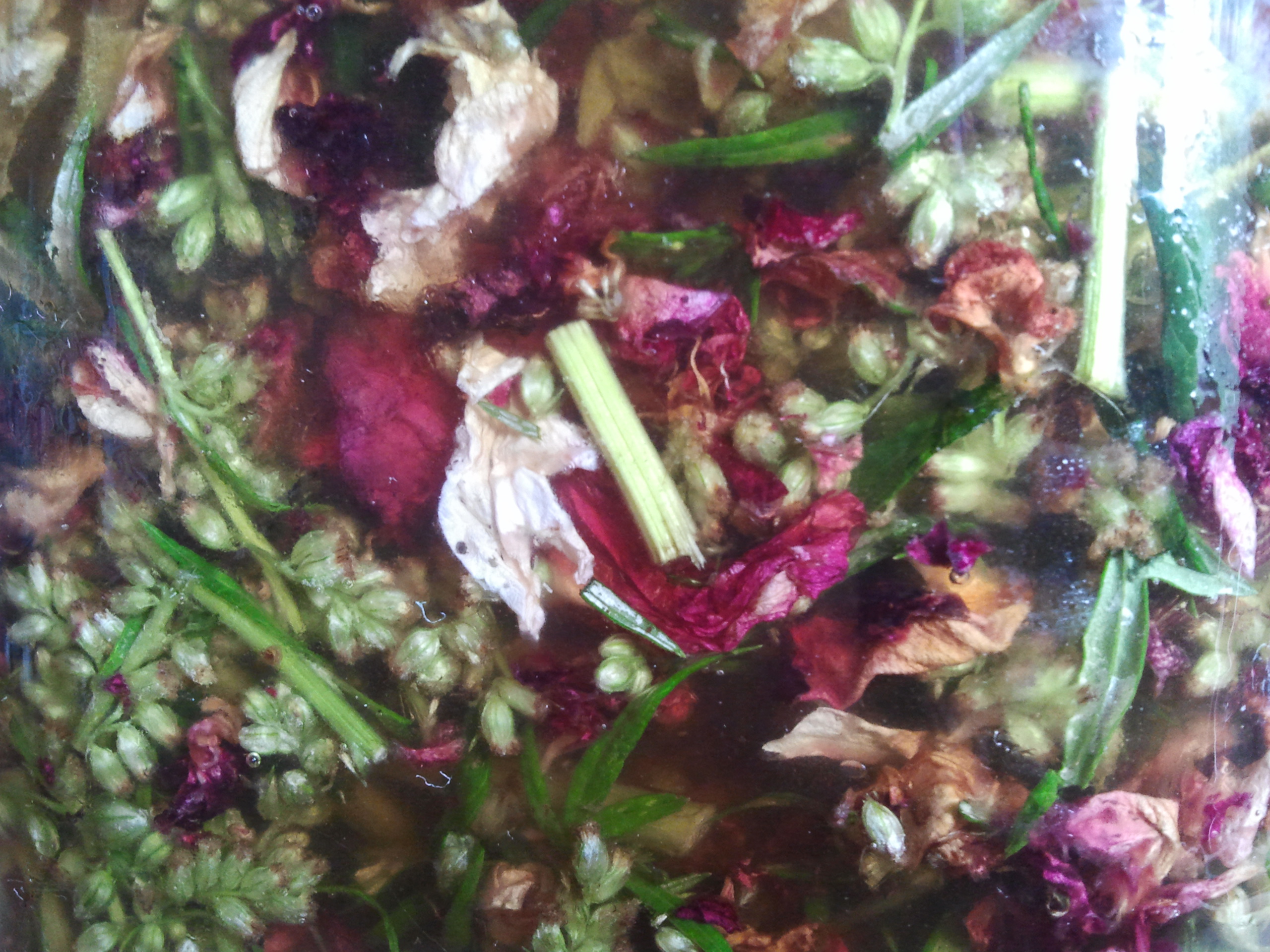
Today I harvested plenty flowering tops of Mugwort and used them to make tea and a simple savoury dish. I then hung some on my willow rack to dry for out of season use and made the rest into this delicious elixir…
Mugwort and Rose petal Elixir
1. Harvest a few flowering tops of Mugwort, gather about the same amount of clean, unsprayed Rose petals (I used dried purple petals today, from Jacob Hooy). Lay out any fresh herbs for a while to allow resident bugs to crawl safely away.
2. Chop the Mugwort and if necessary, separate the rose petals from their flowers (if using fresh roses).
3. Place the prepared herbs in a suitable clean glass jar, where they will take up approximately half the space.
4. Cover the herbs with runny honey.
5. Use a chopstick to distribute the honey more evenly over the herbs.
6. Now fill the remainder of the jar with Brandy (or another strong spirit of your choice).
7. Cover the jar with a well-fitting lid, label and leave the contents to infuse for four to six weeks or more.
8. Strain, bottle and label the resulting Elixir.
9. Use in very small quantities, as an occasional alcoholic, heart and spirit warming elixir.

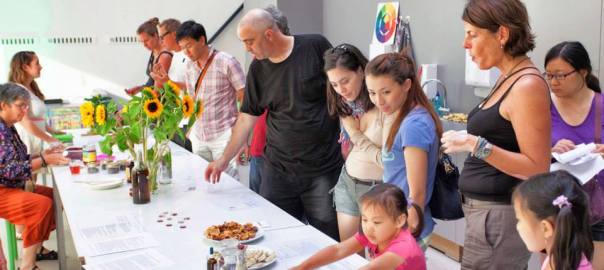
You will have a chance to taste this Elixir at the second of my Friday Nights at the Van Gogh Museum, on 30th August. The honey for making the preparations at these events, was generously donated by deTraay and the dried herbs by Jacob Hooy. If you have Facebook or not, check out this link to see Van Gogh Museum photos from the event on Friday 2nd August – it was a lot of fun! More information about the plants and where they will go here.
 Urban Herbology