All posts by Lynn

Unknown's avatar

About Lynn

Learning

Danish Hawthorn recipes and simple Haw Honey Syrup

image

Some time ago Amalie and Daniel joined me for a herb walk alongside Park Frankendael. One of the plants which was in bloom at the time was Hawthorn (Crataegus monogyna). Amalie knew the berries from Denmark and kindly sent me some recipes to try and share. Hawthorn is in fruit right now, it is a common hedgerow plant and the berries (well “pomes” actually but they look like berries) are edible raw or cooked. Most of each fruit is seed, these need to be strained out of any recipe unless you’d like blunt teeth.

Here are the two recipes from Amalie, plus one I have been experimenting with, which doesn’t need sugar. I also posted a Hawthorn Elixir recipe a short while ago which may be interesting.

Hawthorn puree and juice
1 liter of hawthorn berries
300 grams of sugar
Water

Mash the berries into a puree.
Add the sugar and heat to about 70°C (hot, steamy but not boiling). Strain out the seeds.

The puree can be used for various things including the making of Hawthorn juice, by diluting in water (1 part puree to 10 parts water).

Hawthorn with apples and prunes
½ liter hawthorn berry juice (see above)
750 grams of apples, peeled, cored and quartered
100 grams of prunes, roughly chopped
Sugar (as much as you like to taste)

Cook apples and prunes in the hawthorn juice until the apples turn to pulp and the prunes are swollen, soft and succulent. Then add the sugar to taste. If you like, you can add a bit of melatin with pectin, to thicken it all up.
This can be stored in sterile canning jars or eaten straight away.

image

Haw & Honey Syrup
1. Spread your Hawthorn berry (Haws) out in your kitchen for a while to give any bug residents time to relocate. (dry Haws can also be used but they’ll need to simmer for much longer in step 4, to soften them up)
2. Clean your Haws in fresh water.
3. Place them in a small saucepan and almost cover them with just boiled water.
4. Bring to the boil and simmer for just a couple of minutes, to soften everything up a little.
5. Remove from the heat and slow to cool enough to handle.
6. Strain and push out the juice/mush through a standard kitchen sieve. Get out as much as possible. Squidge it with your fingers and a widen spoon. Combine the mush with the water that was used to simmer.
7. When the juice had cooled to being warm but not hot, stir in a nice big dollop of good quality runny honey.
8. Give it all a good stir and chance to combine before storing in a pressure safe glass bottle or jar (like an old flip bung Grolsch bottle).

image

Use as a tasty winter tonic, straight or mixed. Hawthorn is best known as a gentle heart tonic, for the emotions and the circulatory system.

365 Frankendael day 154

image

Just one photo today, of Gallant Soldiers (Galinsoga parviflora, NL Kaal knopkruid) in a crack at the local garage (where we took our car to get the golfball hailstone dents taken out). I certainly would advise anyone against harvesting from such a location, as it’s sure to be polluted but it certainly is a nice example of this edible plant. Gallant Soldiers seems to be everywhere at the moment so if you develop a taste for it, you certainly won’t go hungry.

It was apparently brought to the UK Kew Gardens from Peru, in 1798 and made a very successful break for freedom. It has since become a garden weed throughout Europe and much effort is put into weeding it out. However it is edible and tasty, it’s used to spice up a particular potato & chicken soup called Ajiaco, in Colombia and I intend to try it out this weekend. The only problem for me being that each time I see it, it’s growing in quite dirty locations. It’s obviously quite a survivor! Here’s a recipe which seems to be fairly authentic, although it does use stock cubes. The herb they name as Guascas is Gallant Soldiers.

As I was searching for more uses of the plant I found this treasure trove of a website. Scroll through the list of herbs to find out African uses. Gallant soldiers is apparently a known wound herb in Kenya. Pound the leaves and stem, squeeze the juice onto the wound.

365 Frankendael day 153

image

I bought a few more lovely storage Kilner bottles, from a shop around the corner if my house today. On the way from it, I found a street full of well tended hollyhock plants, with this years flower stems removed and the first year plants, which should flower next summer, taking over the plots. Such a useful city herb.

image

Here is another wonderful herb, seen less often in the city, Hops (Humulus lupulus), growing up and over the front fence of the NH Tropen Hotel. What a wonderful choice of herb. Perfect for a good night’s sleep. Now is a good time to gather the seed heads, they are used to stuff dream pillows and make numerous remedies.

image

At the bases of the same fence other plants have crept in. this one looks like Hazel. I didn’t notice any nuts.

Throat lozenges are child’s play

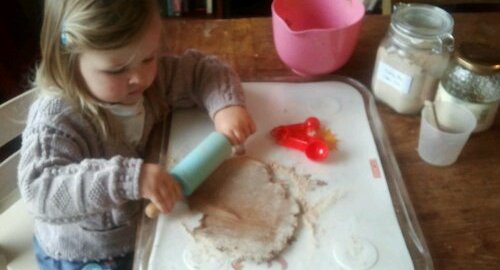
A perfect herbal activity for a drizzly morning when you have to stay inside for some reason – making Honey and Slippery Elm Throat Lozenges! My daughter and I, really love eating these first thing in the morning, or at any time when we have signs of a cold, sore throat or any other excuse.

Here she is, happily making her own lozenges. Not sure if it was the end result she was most happy about, or being able to eat the mixture…

We covered this recipe during the Herbs and Honey Workshop in August. They are super-simple to make. You’ll need to obtain slippery elm powder (Ulmus fulva) from a herbal supplier. I beleive that Jacob Hooy sell it in town, otherwise it can be ordered online. Or if you are desperate for just a cup or it and you live in Amsterdam, I’ll sell you some of my stock. Slippery Elm is a useful food supplement which is very soothing to the intestines and can be made into a nourishing and easily digested gruel, especially good for those recovering from illness. I often add a heaped teaspoon of the powder to my porridge in the morning.

Here’s a brief method of how to make
Honey and Slippery Elm Throat Lozenges

1. Place 1 cup Slippery Elm powder in a large mixing bowl and if desired, add a teaspoon of extra herb powders (marshmallow root and horehound are my favorites) or of licquorice tincture, to enhance the throat soothing action.
2. Use a wooden spoon or spatula to work in about 6 dripping tablespoons of good quality runny honey. You are looking for a very thick paste/dough consistency. It’s easier to add more honey to get this right, than to add more powder if you make it too runny at first.
3. Roll out the dough on a Slippery Elm powdered surface.
4. Cut the dough into tiny shapes or roll it into fine sausages and then nip off small lozenge shapes or the dough. I like to make tiny pyramids from the dough, my daughter prefers the shapes.
5. Place in an airtight container and toss them in a little more slippery elm powder, to prevent them sticking together.
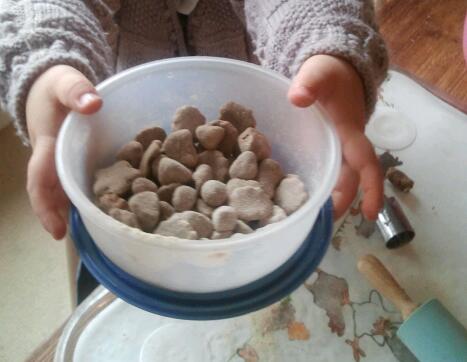
6. Store in the container, in a cool and dry place for up to ten years. They are unlikely to remain uneaten for that long.

365 Frankendael day 152

image

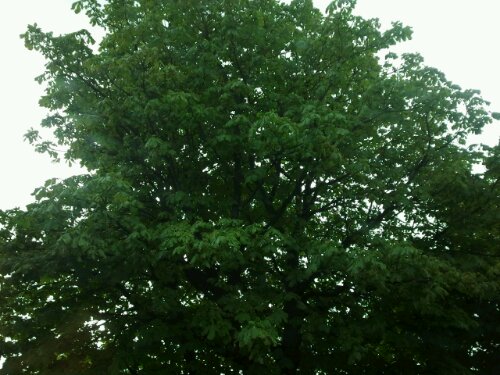
Today has been quite wet, will at least when I have had any free time. So I didn’t take many photos. Something that caught my eye was a row of Horse Chestnut trees, in front of Amstel station, with no conkers forming. This struck me as I’d because the enormous Horse Chestnut in the middle of my school is loaded with apple sized young Conkers. Not that they are edible, they do make useful medicine though. Will have to check whether there are male and females…

image

And here’s a photo of the enduring nettles and lime tree leaves at the front of Huis Frankendael.

365 Frankendael day 151

A beautiful double rainbow, formed over Amsterdam this evening. Not that you can eat it but the sight certainly can feed the soul.

image

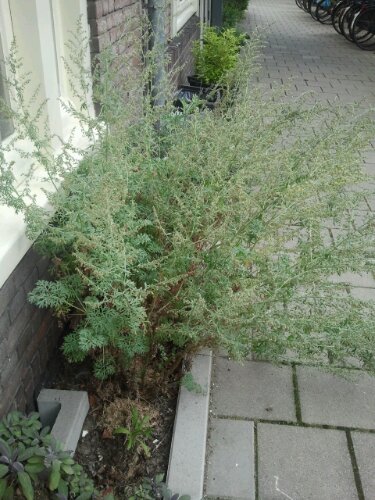
As for todays herbs; an update really, on how the pavement garden Wormwood (Artemisia absinthium) is getting along. Here it is today, exploding with tiny flowers onto the pavement – it needs a trim.

image

And here is one of it’s offspring, planted in the nearby treepit. I hope that the main plant manages to set seed, all down the street again next year.

image

Wormwood is useful for many things. I included it in a cooling and healing skin ointment this week.

365 Frankendael day 150

Thank you to the group of Urban Herbies who joined me For the Elder Workshop today. We harvested Elderberries, Elder leaves and Elder branches. We learned about and concocted Elderberry syrup and numerous other Elder based remedies. I had a lot of fun with you all, and the plants!

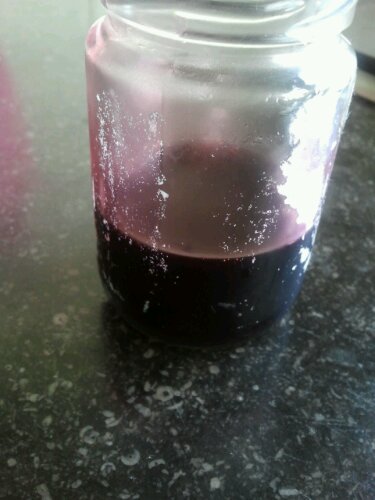
I was so busy enjoying the time that I forgot to take an Elder photo so here’s one of the syrup that we made together, from freshly pressed Elderberry juice and honey… It’s a clean but scrappy looking jam jar. That doesn’t matter as my portion of the syrup will be wolfed down very quickly!

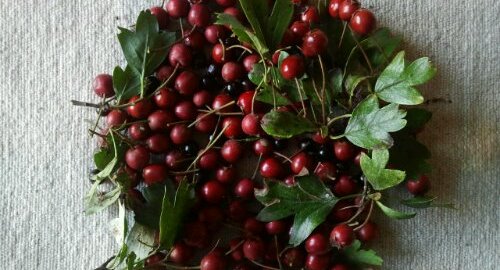
As well as Elderberries, there are heaps of ripe Hawthorn berries in the city hedgerows at present. I did remember to take a photo of one such tree. It’s time to try out the Hawthorn recipes, kindly sent to me by one of the Amstel walkers earlier this year.

Here’s a link to the recipe for the Banana bread I baked for the workshop. I added a finely chopped 20cm Ginger plant leaf and I forgot to add the dates. All fine though!

Here’s a link to that information about recent scientific research supporting the use of Ghee and Honey impregnated wound dressings for serious wound recovery.

Thanks Nathaniel and Jade for sharing with us how the Native Americans revere their local Elder species. Here’s a link with a little information about that (at the end). Here’s a link with lots of information about Elder, particularly the US growing species. Not much about the indigenous people but lots of useful stuff.

Here’s a link to one of my mentors: Glennie Kindred in Britain. She wrote the hand sewn books I showed you today. We looked at the one called Sacred Tree in which Glennie lays out her interpretation of the Tree Ogham.

As we talked about honey, Katja shared her latest concoction – fresh ginger infused honey with lemon juice. Yum! I’ll be trying that very soon and will post some photos to brighten up the autumn. Maybe Katja has a photo of hers already?

Cindy, I don’t think you took your portion of ointment and certainly not the syrup. I also forgot to give you the Kombucha so let me know when you have time to collect them.

Thanks again everyone. See you again soon! xx

365 Frankendael day 149

I’ve been busy preparing for the Elder workshop tomorrow and enjoyed a little walk in the park looking for ingredients for ghee based Elder ointment.  Elder leaves are very medicinal but contain a chemical which, when digested by the human body, turns into cyanide so it’s obviously not a good idea to eat it.  The ripe berries and flowers don’t contain this chemical although the seeds within the berries do.  Here are the herbs in my ointment, plus a couple of other plants which are also looking and tasting great at the moment…

Chickweed (Stellaria media)

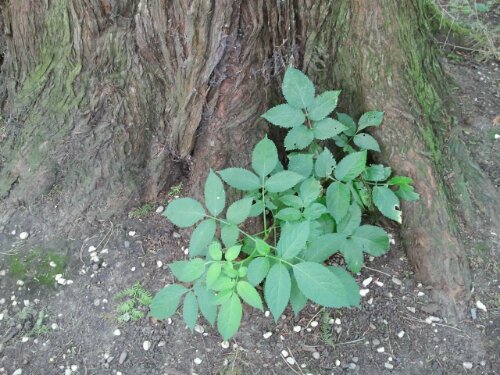
Elder (Sambucus nigra) growing close to the base of an old Cedar. Here’s a lovely Elderberry syrup recipe, from Mountain rose herbs, which uses honey for sweetness but doesn’t heat the honey – good news and unusual!

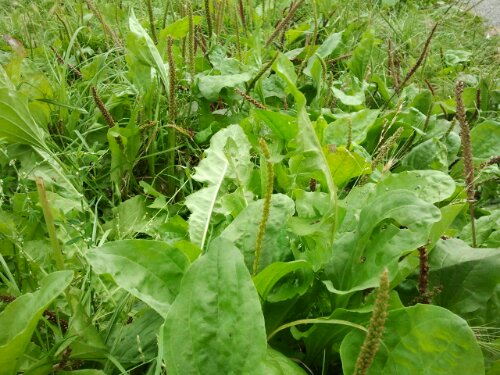
Dandelion (Taraxacum officinalis agg.)  making a stand for itself in a field of Plantain (Plantago major)

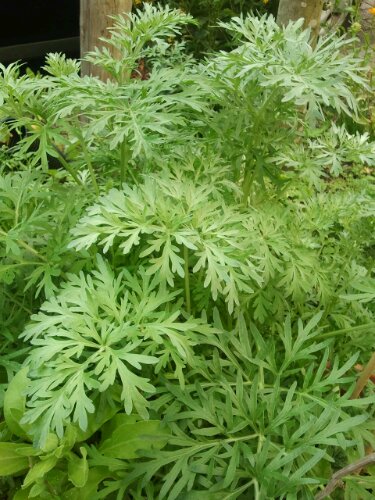
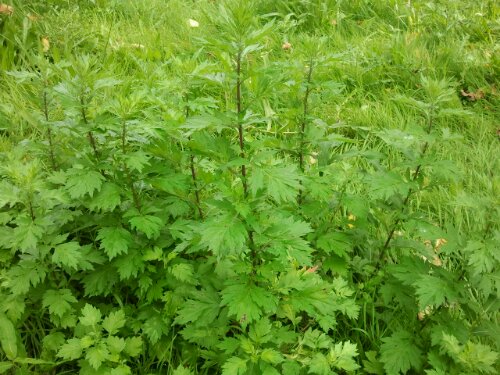
Mugwort (Artemisia vulgaris)

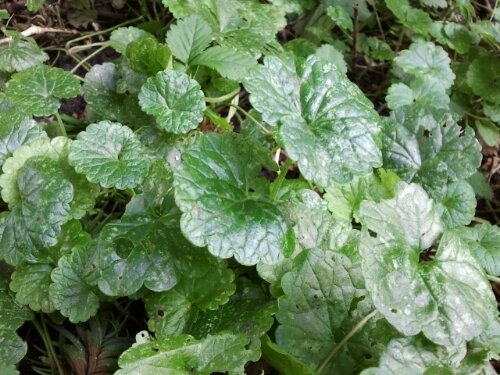
Ground Ivy (Glechoma hederacaea)

365 Frankendael day 148

I had a great time today, taking two group on street herb walks, from the OTOPIA festival on the Overtoom. We found lots of herbs in pavement cracks, in intended pavement gardens, tended ones and in curbs. A few plants were around which I didn’t know the names of. Here they are:

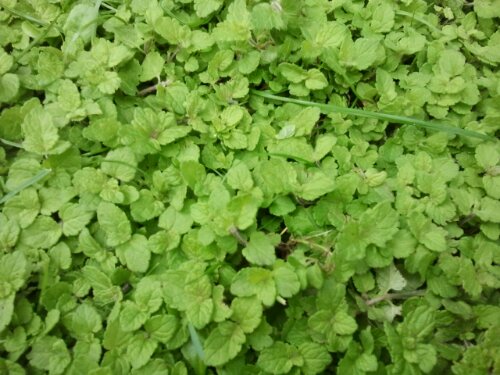
Heath speedwell (Veronica officinalis) was creeping around a large grassland area halfway up Willeminastraat and Eerste Helmersstraat.
image

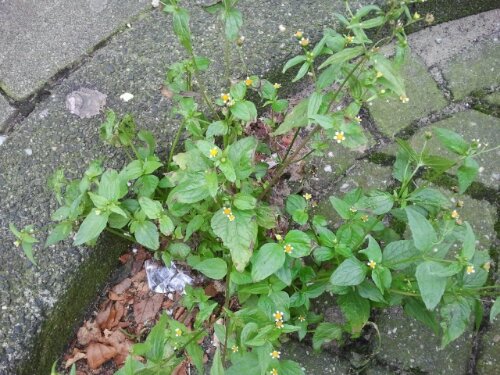
Gallant soldier (Galinsoga parviflora).
image

The plant that looked like Fat Hen (Chenopodium album) but had so many flowers on some examples that it was hard to tell, definitely was edible Fat Hen.

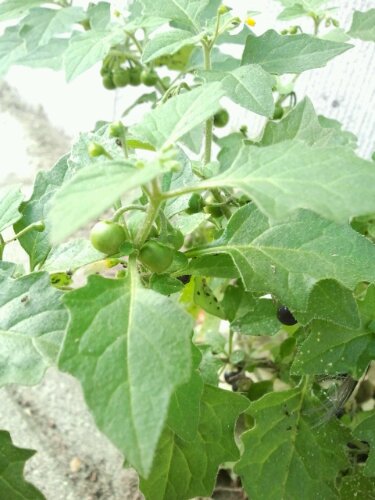
I didn’t take a photo of the Fat Hen today but here’s one of poisonous
Black nightshade. We found heaps of it on today’s walks.

image

The Wild Rocket that was growing at the entrance of OT301 appears to be the perennial species so I hope Cathy will be in luck with the sample she took home.
image

The nettle which the second group found, which wasn’t the regular Stinging nettle (Urtica dioica) was Small nettle, an annual, as suspected and both edible and medicinal.

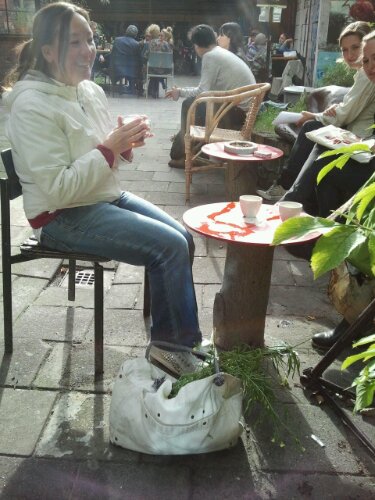
There were two others which I’m still looking up. Will post an update, when I find the names. Here they are, maybe you can help me out with the names?
image
image

Thanks to everyone who joined the walks and thank you to Femke and Tarje for organising today’s festival and inviting me to take part in this way.

365 Frankendael day 147

image

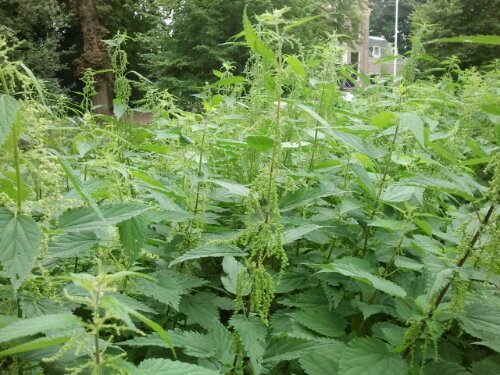
Here’s a beautiful patch of Stinging Nettle (Urtica dioica, NL: Brandnetel) detouring at the front of Frankendael huis. If you like idea of harvesting to dry and store or to cook and freeze, then now is the time. Preferably choose nettle without flowering tops but both are edible.

image

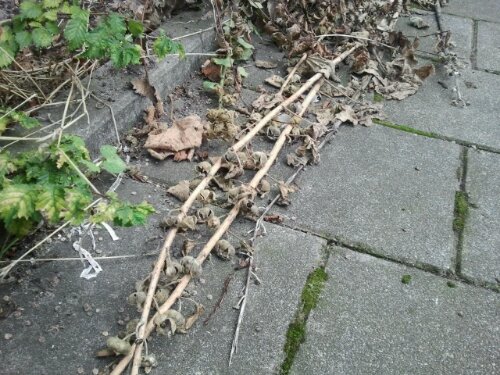
Here is a bundle of discarded dry Hollyhock flower spikes. These are in Oud Zuid, close to my workplace but you’ll probably spot a similar scene all over town. Each individual seed head is packed with about 20 seeds. It’s a great herb to grow in small spaces such as tree pits and outside of houses.