Category Archives: Foraging

Sunday 15th July 2012 – Urban Herbology Walk – Park Frankendael


Maybe it will be hot, maybe not but whatever the weather there will be lots of herbs around in Amsterdam, on July 15th. To help more people appreciate some of the edible, medicinal and interesting herbs, growing within the city, I’m offering another Urban Herbology Walk, on Sunday 15th July 2012, from the main gates of Frankendael Park.

The walk will start at 11am and every one interested in finding out about wild herbs, which can be found in central Amsterdam, is welcome to subscribe.

My previous walks have been great fun to organise and very well received.  We will take a relaxed look at the bounty of summer herbs to be found in and around the park. The walk will last about 90 minutes and will probably end at the lovely cafe/restaurant Merkelbach, situated just inside the main entrance of the park.

Cost per participant will be €8. Maximum 12 places. Previous walks have been oversubscribed so if you wish to join me you must contact me beforehand. Please email Lynn.Shore@gmail.com or call me on 0627 596930.

During the walk you will…
Receive a useful handout, to refer to after the walk
Learn how to find and identify some safe, useful, local herbs,
Learn how to harvest with respect for the environment,
Learn how to use herbs safely in several different ways,
Receive some tasty Urban Herbal recipes.

And of course you will get the chance to meet other folk who like to know a little more about what’s growing beneath and above them!  If it sounds interesting to you then please contact me.

I really hope to meet you on 15th July!

Thank you! 365 Frankendael day 49

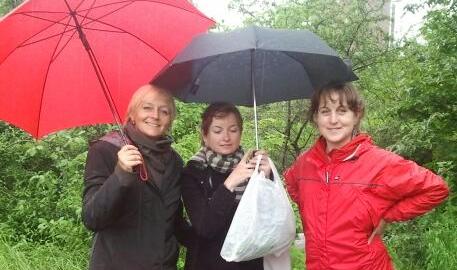
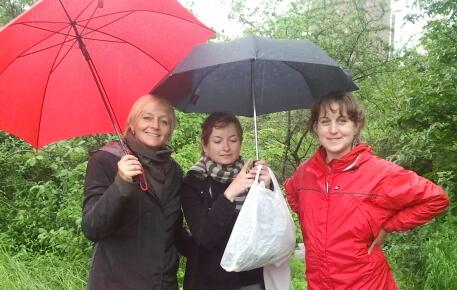
Thank you to the wonderful Urban Herbies who joined me in Frankendael this morning! Another lovely group joined me for a guided walk around some plant rich areas of the park. We found lots of beautiful herbs and raised an eyebrow or two as we picked Lime leaves from one of the trees lining the main walkway. This was the last guided walk I’ll be doing for a while. I plan to offer another on a Sunday in July and my forthcoming Mugwort field workshop (also at Frankendael), on Monday 18th June has a couple of spaces available. If you are interested please contact me and start collecting your pesto jars! Also on the 20th June, Midsummer’s Day, a group of us will be gathering Lime for lunch and a tea. Keep an eye on my Events page for further details.

The Lime tree (Tilia vulgaris) in this photo is just by the main entrance. I noticed this beginning of a leaf spur as I sat waiting for the walkers to arrive. Lime has a fascinating ability to send out such leaf spurs, directly from the truck. It is quite handy from a foraging point of view, these leaves are often within reach on trees with otherwise inaccessible leaf canopies.

Next, the developing seed pods and remaining flowers of Scullcap (Sculletaria altissima) How quickly this amazing woodland plant moves through its flowering process!

Next is a clear photo of developing Hawthorn berries (Crataegus monogyna). I have been learning more about ways to use these (when bright red and ripe) in cooking. The ripe berries will be mainly filled with seed but the fruit encompassing that is useful and quite tasty. A modern classic foraging recipe is to make hawthorn leather from the fruit. I have tried it before and found it imensely fussy and time consuming. I then forgot to eat the leather before it turned mouldy – so all in all a big waste of berries and time! This year thanks to Amalie Bang, who came on one of my recent walks, I’ll be trying to make Danish style Hawthorn juice which can then be used in different ways to make tasty foods. I can’t wait for this year’s harvest!

Many other herbs around today but it’s time to put my feet up and start thinking about the Mugwort workshop…

365 Frankendael day 48

Here is a very tasty and edible salad herb which I hardly ever use but is quite easy to find in Amsterdam and many other cities. It is called Shepherds purse (Capsella bursa-pastoris) and is well adapted to grow alongside roads, paths, grassy and waste areas. You can only really see the seed pods on the long flower stem in this photo, it is mixed in with another plant (White mustard). I found this patch alongside the Vomar entrance of Park Frankendael, right beside a path. It is very easy to identify, with it’s signature heart shaped seed pouches. The leaves quite slim and plain looking but are peppery tasting and are very good when picked young and added to a mixed salad. It has been found to be high in Vitamins C and K and has many stoic applications.


Next today is a mixture of mature (and thus not to tasty) Plantain (Plantago major) leaves and White mustard. These were growing alongside the Shepherds purse. So all in all the potential for quite a tasty salad, from this small green patch of land between the park and road.

Foraging in De Baarsjes

My thanks to Olia, Robin and Elodie, for inviting me over for a lunchtime forage, in a beautiful wild patch of De Baarsjes! We found lots of super edibles including Mugwort, Garlic Mustard, Plantain, Elderflower, Lime, Hops, Rosebay Willowherb, Wild Strawberry, Cinquefoil, Cats tail, Ground Elder and more.

We brewed up a flask of Elderflower tea as we walked and shared it, as we munched on homemade bread and just plucked herbs, here close to Metro 50 station de Vlugtlaan.

Olia & Robin joined my last herb walk from Amstel Station and they are based at a fantastic creative centre called Novel. Also Elodie, my friend and frequent foraging buddy.

What a great lunch!

365 Frankendael day 47


Firstly today, fragrant and edible flowers of the urban prolific Rosa rugosa. It is much used by urban landscapers and I think, underused by urban foragers. To be used as any other rose, ensure they are clean and unsprayed as ever.

Next is Cleavers (Galium aparine), still looking fresh and cleansing in the Volkstuin area of Frankendael.


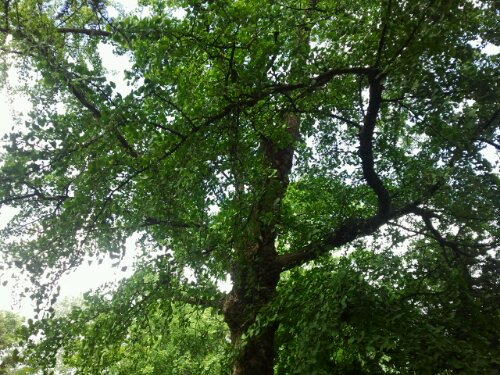
Here is a mature Ginkgo biloba tree which I hadn’t noticed until today. Recently I learned that in some parts of the world it is illegal to plant female Ginkgos because the smell of their fruit is so obnoxious! Perhaps this one is a male? Either way, the leaves will be ripe for the picking and eating or tea making in a few months. There are a great many Ginkgos in Amsterdam.


Above is a small Ladies mantle (Alchemilla) plant. This is a bitter and very useful herb. I grow several on my roof and sometimes eat the flowers as a garnish. The leaves are good as a bitter tea and can be used to make a good breast toning oil. That is one of their traditional uses.


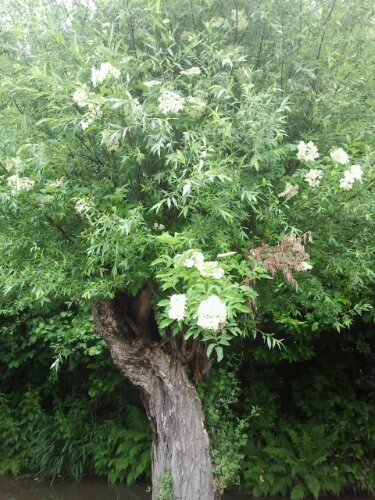
Lastly today, another coppiced Willow living in apparent intimate harmony with a different plant species. This time the lodger USA flowering Elder (Sambucus nigra). Two great herbs together!

365 Frankendael day 46

I’ve been preparing for the next Urban Herbology walk today so here are several photos and not much chat…


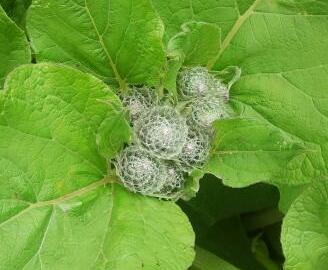
Developing cobweb-spirally Burdock flowers.


The Middenweg Poison Hemlock (Conium maculatum) continues to grow despite being reported to the council. Apparently it’s not a risk to the public because it is growing in the green strip… It is now wider than my bike, well over 2m tall and (although less than before I pruned it) still overhangs the pavement. I shall snip off the flower heads before the seeds set. A deadly beauty.


Greater Celendine, with seed pods developing well.


Comfrey (Symphytum uplandicum), still growing, still flowering – everywhere in the park!


Skullcap (Sculletaria altissima) in the woods. Flowers development very quickly moving up the stalk, sowing be visible for much longer.


The flowers of wild Sage (Salvia officinalis).


On the edge of the rhododendron planted section, I found this shady patch of tasty Pelargonium, Garlic Mustard and also Stinging Nettle and Cleavers, just out of shot.


Lastly, frothy flowers of Hedge Bedstraw.

Urban Herb Love


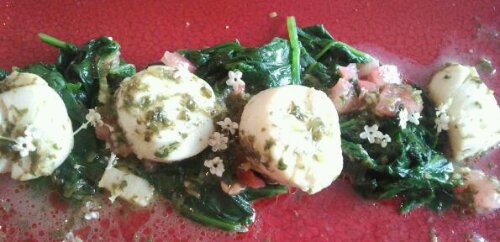
Yesterday was our seventh anniversary, here is what we cooked: Scallops, marinated in the juice of half a lime, a sprig of fresh coriander leaves, finely chopped and a small nugget of fresh ginger, squeezed. After cooking in the marinade, the scallops and sauce were laid on wilted spinach and Elderflowers were sprinkled on top.

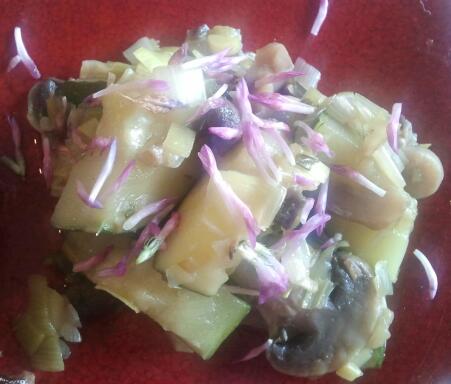
Next came grilled lamb cutlets served with a caprese salad and most importantly, Mugwort vegetables. The taste of a top of almost flowering Mugwort (Artemisia vulgaris) infused into mixed vegetables, as they cooked in one of my magical cast iron pots. It was served sprinkled with detached individual Red Clover flowers. Mugwort (Cronewort, Artemisia vulgaris, NL: Bijvoet)  is extremely tasty and aromatic when cooked in this gentle way. Just a splash of olive oil, finely chopped leeks softened then chopped aubergine and courgette added to the pan. Lid on and simmer gently for ten minutes or so.

Umm, now that’s Urban Herb Love!

365 Frankendael day 43

Today I have had a closer look at two herbs which I spotted earlier this week. A Member of the Potentilla genus, a Mint and also graceful Angelica.

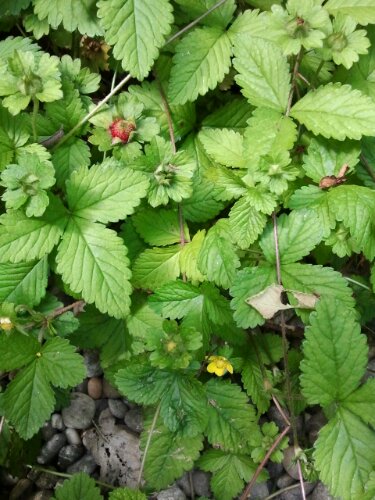
Firstly the pretty Strawberry look-a-like Potentilla. You may remember that my cat ate the last sample I brought home. Today, I had a closer look at a sample leaf, flower and stem, before he had a chance to devour it. And of course I had a good look at it in the park itself. It appears to be Potentilla anglica. It has yellow petals, so is definitely not the white flowering Strawberry (Fragaria vesca) or edible (but not so tast) Mock Strawberry (Potentilla sterilis). It creeps along the ground by use of runners and the trifoliate leaves have tiny hairs on the undersides of the ribs and veins. The leaves all arise in clusters, at intervals from those runners. Creeping Cinquefoil (Potentilla reptans) is very similar but doesn’t have trifoliate leaves. Some of the flowers have already set fruit, with seeds on the outside just like strawberry. This is shown in the photo below.

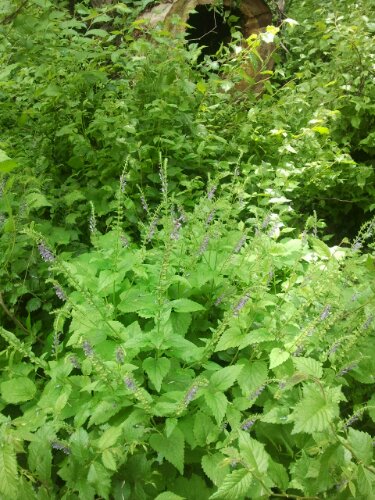
Next up is the mystery Mint, growing in one of Frankendael’s woodland ponds. It is difficult to tell for sure, which member of the Mint genus this is because it is not in flower yet. I will keep an eye on it as the summer arrives but currently suspect that it is Water mint (Mentha aquatica). It is clearly a Labiate, having square stems and opposite leaves without stipules. This Mint is downy, certainly smells of mint and the leaves are between 1.5 and 4cm long with blunt tips and teeth. It is also growing well in water. There are more factors to help decide which Mint this really is but for now, that’s the best my trusty Field Guide and I can do.

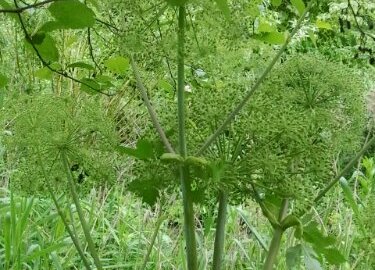
Lastly today, majestic Angelica (Angelica archangelica). Lynne Dunston from the Meetup group sent me a gorgeous photo of an Angelica which she spotted on a visit yesterday (I’ll post that separately). It reminded me to come and check on the enormous sister plant in Frankendael today (photo shown here). Seeds are now developing well on its Pom Pom like flowerhead. I was reading a lot about this plant a few days ago and although I won’t be touching it at all, this biennial can be made to act as a perennial by simply cutting it almost to the ground before it sets seed. It then is forced to have another go at seed production next year. It also has a multitude of quite fascinating, historic medicinal and culinary uses. Whole communities in Southern France, at least, relied on this plant for their wealth. I’d love to test out some of the recipes and ideas I read about but this wonderful lone specimen, just has to be enjoyed by as many woodland walkers as possible.

365 Frankendael day 42

Today a post about one plant, my favourite, Elder (Sambucus nigra).

This wonderful ancient healing plant, which has been steeped in mysticism and folklore for millennia, is producing flowers that cheer up almost every hedgerow in town, right now.

Where you find one Elder shrub, you are likely to find others close by. It springs up in the most unexpected places and is a true survivor. It has bumpy, brittle, crooked branches, smelly leaves and phenomenal frothy flower heads, stacked all over the plant. They remind me of small terraces, tilting in almost the same direction, all over the shrub.

This photo shows one of many Elder shrubs, along the Hugo de Vrieslaan hedgerow which provides a boundary for Park Frankendael. Now the flowers are mature and plentiful.

I’ve talked about this plant quite a lot previously, Google Elderflower recipes and you may be amazed by how many people like to eat this flower. Remember to avoid eating the leaves amd twigs, they will likely make you ill. I was refreshing my knowledge of the plant this evening by reading Wild Man Steve Brill’s book, Edible and Medicinal Plants. He talks about an American cousin of our local Sambucus nigra, called Sambucus canadensis and I was surprised to learn that the stems and leaves can sometimes yield cyanide, when a bitter alkaloid and glycoside within them change. So definitely parts of Elder to avoid in your diet!

One piece of Elder history I want to mention today, is how ancient Christians were irritated or threatened by the Elder Mother cult in Europe. The Elder mother was/is said to live within the Elder bush. You should ask her permission to harvest from her tree, should never burn her, should never chop her down, without asking her to leave. Ancient Europeans revered the Elder, welcoming and encouraging it to grow near their homes. the Elder mother protected homes from fire and lightning, kept your cattle safe and of course provided simple medicine for your whole family. This folklore helped to make the shrub commonly available for all manner of uses. In an attempt to rid communities of their attachment to the Elder Mother, the plant became embedded in the most negative ways, within Christian stories. Judas was said to have hanged himself from an Elder and Christ was said to have been nailed to an Elder cross. But of course this couldn’t be true due to the brittle nature of the tree. The tree was also much associated with witchcraft and yet was also said to protect you from witches. It seems that everyone had something to say about this shrub which points to it having had many uses.

I’ll be harvesting some more Elderflowers tomorrow, probably to be broken up and sprinkled into a light batter, some to be added to general cooking (we had it on baked fish last week, very good and interesting), some to make a face wash and some to be dried for use as a fever remedy when needed. I also fancy making some Elder leaf infused oil this weekend, for external use in an ointment. It is often useful on bruises, sprains and chilblains.

Love Elder and she will love you back, but be gentle with her and ask (and listen) when you’d like to take some of her gifts. She has many, many gifts and is not to be overlooked or underestimated.