Vrijwilligers gezocht: Voor het wekelijkse tuinonderhoud van de Stijltuin bij Huize Frankendael
Houdt u van tuinieren en wilt u deel uitmaken van een vrijwilligersteam dat zich inzet om van de Stijltuin bij Huize Frankendael een mooie, rustige en inspirerende plek te maken?
Lynn Shore en Tamara Last (die Engels en Nederlands spreken) zijn op zoek naar enthousiaste en toegewijde vrijwilligers om deze bekende tuin te helpen onderhouden en verbeteren. We zullen voornamelijk in de Stijltuin zelf werken en ook de bosgebieden ernaast netjes houden – alles in lijn met de elegantie en het erfgoed van de locatie.
Wanneer: Maandag 09:30 – 14:00 uur, het hele jaar door. (Vanaf maandag 2 juni)
Wat doen we? Algemeen tuinonderhoud onder leiding van Lynn en Tamara. In het eerste jaar bestaat dit voornamelijk uit onkruid wieden en het verplaatsen van planten om gaten in de borders op te vullen. We zullen nieuwe planten kweken uit zaad en stekken. De prioriteit ligt bij het verbeteren van de esthetiek. Lynn en Tamara werken samen met de Vrienden van Frankendael aan een beplantingsplan dat past bij de tijd van Huize Frankendael. Zodat we straks een stijltuin hebben die prachtig aansluit bij de locatie en een genot is voor alle bezoekers.
Wie zoeken we? Enthousiaste mensen, bij voorkeur met enige tuinervaring, maar de wil om te leren en de inzet om de stijltuin weer mooi te maken door regelmatig deel te nemen, vinden we belangrijker.
Waar: De Stijltuin ligt direct achter Huize Frankendael, waar Restaurant Merkelbach gevestigd is – net binnen de hoofdingang van Park Frankendael, in de Watergraafmeer (Amsterdam Oost). Adres: Middenweg 72, 1097 BS Amsterdam.
Als dit u aanspreekt, neem dan contact op met Lynn (lynn.shore@gmail.com) om uw interesse kenbaar te maken.
We kijken ernaar uit om samen iets heel bijzonders te laten groeien!
Volunteers Wanted: For the weekly garden maintenance of the Stijltuin at Huize Frankendael
Do you love gardening and would you like to be part of a team of volunteers who are committed to making the Stijltuin at Huize Frankendael a beautiful, peaceful and inspiring place?
Lynn Shore and Tamara Last (who speak English and Dutch) are looking for enthusiastic and dedicated volunteers to help maintain and improve this well-known garden. We will mainly work in the Stijltuin itself and also keep the woodland areas next to it tidy – all in keeping with the elegance and heritage of the location.
When: Monday 09:30 – 14:00, all year round. (From Monday 2nd June)
What do we do? General garden maintenance led by Lynn and Tamara. In the first year this will mainly consist of weeding and moving plants to fill in gaps in the borders. We will grow new plants from seed and cuttings. The priority is to improve the aesthetics. Lynn and Tamara are working with the Friends of Frankendael on a planting plan that fits the time of Huize Frankendael. So that we will soon have a style garden that fits in beautifully with the location and is a pleasure for all visitors.
Who are we looking for? Enthusiastic people, preferably with some gardening experience, but the will to learn and the commitment to make the style garden beautiful again by participating regularly, we find more important.
Where: The Stijltuin is located directly behind Huize Frankendael, which is the home of Restaurant Merkelbach – Just inside the main entrance of Park Frankendael, in the Watergraafmeer area of Amsterdam Oost. Address: Middenweg 72, 1097 BS Amsterdam.
If this appeals to you, please contact Lynn (lynn.shore@gmail.com) to express your interest.
We look forward to growing something very special together!
Would you like to know which edible and medicinal plantsare possible to find in Amsterdam in the middle of winter? Want to know how to supplement your diet for free from local plants? How to make simple remedies and first aid treatments from them? And would you like to know about the local poisonous plants? Great! Then, join me for a walk in Park Frankendael and let me show you what’s around, even in the colder part of the year; Learn how to identify delicious and nutritious plants, how to ethically harvest them, and how to use them.
January Walks – Choose from: Sunday 12th January 11.00 – 12.30 – Park Frankendael (Full – Contact to join the Waiting List) €15 per person and Wednesday 22nd January 10.00 – 11.30 – Park Frankendael €15 per person
The walks will start and end at the same location, near the bike racks closest to Huize Frankendael/Restaurant Merkelbach. We will walk in the woods, alongside water, on grass and other areas of the park – including the foraging gardens. The walk will go ahead in all weather except storms, so dress for it 🙂 You will receive a handout to help you remember the plants and uses afterward and we will drink herbal tea from herbal finds. If you want to forage, please bring along a small paper or cotton bag to take home some herbs and seeds. The walk is gentle and fairly slow, the paths are mostly natural, of woodchip or soil. There is a public toilet in the park. Come prepared to connect simply with urban nature.
Who am I? My name is Lynn Shore, I have been teaching urban foraging and self-sufficiency skills, in Amsterdam for over 14 years and have been running a city foraging garden for the past 10 years. I am a fully qualified herbalist and a proud member of the Association of Foragers. Over the years, I have led walks for large and small groups (including Greenpeace), work with top bartenders, restaurants, eco-friendly businesses, and community groups. This coming April I will take part in a research project where I will live only on foraged food for the month to study the effects on the body. My Master of Public Health degree specialised in Urban Food Security and all of my work aims to connect city people with nature – to improve health, wellbeing and the environment. I am passionate about this and love teaching others how to do it. This walk is in English – I also speak Dutch.
Booking Information Payment is by bank transfer to account NL41 SNSB 0705 8981 99 (LM Shore). Payment is required to secure your booking. Please Email urban.herbology.lynn@gmail.com to book or in case of questions.
Cancellation Policy Payments are fully refundable up to 24 hours before the event. If you need to cancel after that time (so less than 24 hours before the event start time) a refund can only be made if we can fill your place with someone else.
Perhaps you would like to try this recipe. It’s really simple and needs only three ingredients: honey, apple cider vinegar and hawthorn berries (haws).
Gather a handful of ripe haws (be sure you gather the correct herb), check them for bugs and damage before washing then clean. Dry off on a cloth. Select the best haws, when surface dry, and add to a small, clean and dry glass jar. Now smother them in honey. Poke gently with a chopstick to help the honey spread between the haws. Add more honey, ensuring the jar is two-thirds full with berries and honey. Now fill the rest of the space in the jar with vinegar. Poke around some more, with the chopstick, to help the honey and vinegar to mix. Seal the jar, label, and store in a cool dark place for several weeks. Then strain and bottle the resulting Hawthorn oxymel.
This oxymel can be diluted with water to make a refreshing drink, or taken by the spoonful to help soothe sore throats.
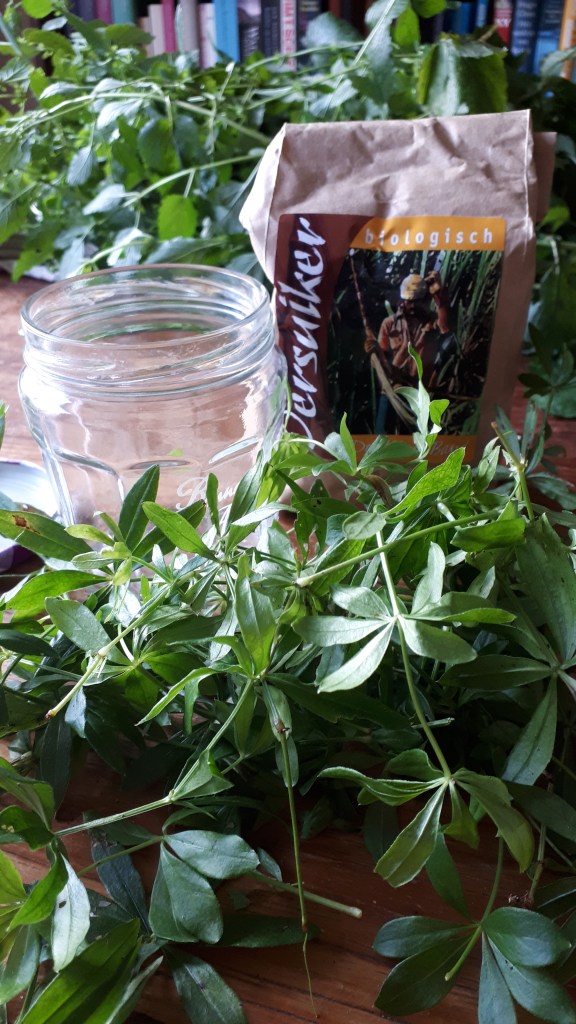
Several herbs can provide a sweet aromatic scent, similar to vanilla. One is Sweet Woodruff (Gallium odoratum) which is used in the simple recipe that I have just added to the Feast section of the Urban Herbology Apprenticeship course. If you would like a sneak peek at the recipe, hop on over to my SubStack (Weaving a Magical Life).
Each year, I get approached by a small handful of inspiring students who want to spend some internship time with me. Learning about their studies is always enlightening but usually, I need to say no to their requests. Not because of their ideas and motivation, but because I lack the time these enthusiastic students deserve.
Last year, Neleah Moureau, from HAS green academy of Den Bosch, contacted me. She wanted to conduct herb-related research as part of her Horticulture and Business Management course. Aeroponics, an innovative growing system where nutrient-rich water is sprayed onto plant roots, was the topic of Neleah’s research. With the right setup, and without soil, aeroponics can offer optimal light, temperature, moisture, and micronutrients to a wide variety of interesting plants. Neleah wanted to know if aeroponics could be a viable solution for the lack of prime herb growing space in urban settings. I was intrigued. Perhaps this could be an energy-efficient way to grow herbs in tiny urban spaces. Could aeroponics reduce the need for soil, transport, and the heavy water tanks of hydroponics I have seen in Amsterdam? Maybe this type of system could improve the life of city pot plants, by replacing some of that depleted store-bought compost I see them struggling in. And just possibly, aeroponics could provide an alternative for what most urban herbalists lack and long for; a fertile garden in which to grow their supplies.
Seeing the potential in this concept, and wanting to know the answer to her research question, I said yes and Neleah promptly joined me as a regular volunteer. We met at the foraging orchards in Amsterdam Oost. Hidden within an Amsterdam park, the herb orchards are rich in local edible and medicinal herbs; a place where those in the know learn about herbs, and forage without being disturbed. I have run the orchards for the past ten years, in a way that supports local wildlife, people, and plants. Neleah took part in our low-intervention herb-growing, helped catalog the plants, and worked on her main research question back at the college campus.
So how do aeroponics work? The plants are set up in “plugs” which stabilize the plants in the absence of soil. Their roots hang naked beneath, periodically sprayed with aeroponics substrate. That is water enriched with organic fertilizer. The composition is fine-tuned to satisfy the known needs of the target plants. Because the spraying happens in a sealed system both evaporation of water, and fertilizer run-off don’t happen. The system can be made from repurposed materials and root spraying can be timed and controlled using solar-powered apparatus.
Neleah chose an easy-to-grow popular medicinal herb – Pot Marigold (Calendula officinalis). She found that it has significant commercial value here in Europe and of course, has many therapeutic uses. She wanted to compare how Calendula performed in pots of soil or an aeroponics system. Lighting, CO2, and temperature were kept the same for both sets of plants. By the end of Neleah’s research, the outcome was clear (and little surprise to the volunteer gardeners); although everything these plants are thought to need can be provided by aeroponics, the Pot Marigold plants did far better in soil. Plants grown with aeroponics, at least in this experiment, were a poor version of what they could have been. The soil-grown plants had more flowers, bigger flowers, more foliage, and richer colour, and were more appealing to herbalists and wildlife.
Soil So what exactly was lacking from the aeroponic setup, to cause such a difference? I am sure that it was the ecosystem of the soil itself. Most plant roots have not evolved unclothed, dangling in a nutrient-rich mist (although air plants such as Tillandsia spp. have). In nature, roots spread out to anchor the plant and to capture watery resources. The plugs in Neleah’s system took over the anchorage role, and the spray delivered nutrient-rich water but what else is in soil?
Naturally, plant roots are surrounded by and penetrated by an almost invisible ecosystem. It lives on, in, and between the non-living particles of soil. Soil is a complex living community. When examined with a lens, grains of sand, clay, and stone are visible in the soil. Those grains are the inorganic components of soil, they are not living but lifeforms and water in the soil, gradually break them down. Within tiny pores in the grains and on their surface, life cycles relentlessly. Fragments of decaying plants, tiny bugs, and maybe even the fungi and bacteria which connect it all up, can be found. With the bare eye, worms, ants and beetles can be seen, all helping move things around and shake things up.
Soil is not simply a mix of NPK a few trace elements and water, it is a complex ecosystem that we can hardly begin to understand. Soil is magical, a place of constant transformation, alchemy beneath our feet! For me, there is no substitute for real soil, that stuff made from molehills, compost, leaf litter, and more; that stuff teaming with lifeforms. That is what plant roots need to be surrounded by. Without it, I don’t see how the magic of plant growth can occur. And what use is a herb if not a magical plant?
I wonder how far aeroponics will go. Solutions for small urban growing spaces are certainly needed and I hope that in time, aeroponics will incorporate plant pro- and pre-biotics, as well as the usual nutrients. Neleah’s work has opened my eyes to the soil-less growing of herbs, and I look forward to seeing where it goes. But in the necessary striving for solutions, I hope we don’t lose sight of the life of the soil.
May plant roots of the future be stylishly clothed in the ecosystem they belong to, one of cycling life, death, microbes, and magic.
It is nettle time! Learn how to identify, ethically harvest, craft, eat, grow, use and generally make the most of locally growing nettles, so Stinging nettles (Urtica species) and several Deadnettles (some of the Lamiaceae family), with Livvy de Graaf, assisted by Lynn Shore. Lynn is a professional foraging teacher (member Association of Foragers) and consulting herbalist. Livvy, is Dutch-British and has been harvesting and eating wild food for longer than she can remember. She is Lynn’s daughter and certainly knows her way around the woods and foraging orchards, where this event will take place. She looks forward to sharing some of her skills with you. The walk will be primarily in English.
Location We will be working mainly in the River of Herbs foraging gardens, which Lynn has run for over 10 years, so unusually will be able to dig up some of the stinging nettle roots, to plant elsewhere or for you to cook/preserve/process at home. Meeting at main entrance of Park Frankendael, closest to Middenweg 72, Amsterdam (Restaurant Merkelbach / Huize Frankendael).
Handout Written info and recipes will be provided. You will learn about and try different preparations made from the focus plants (including a cup of tea). You will then be able to make your own potions/creations at home, using what we forage together and the handout.
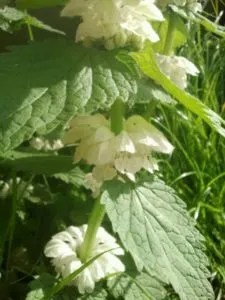
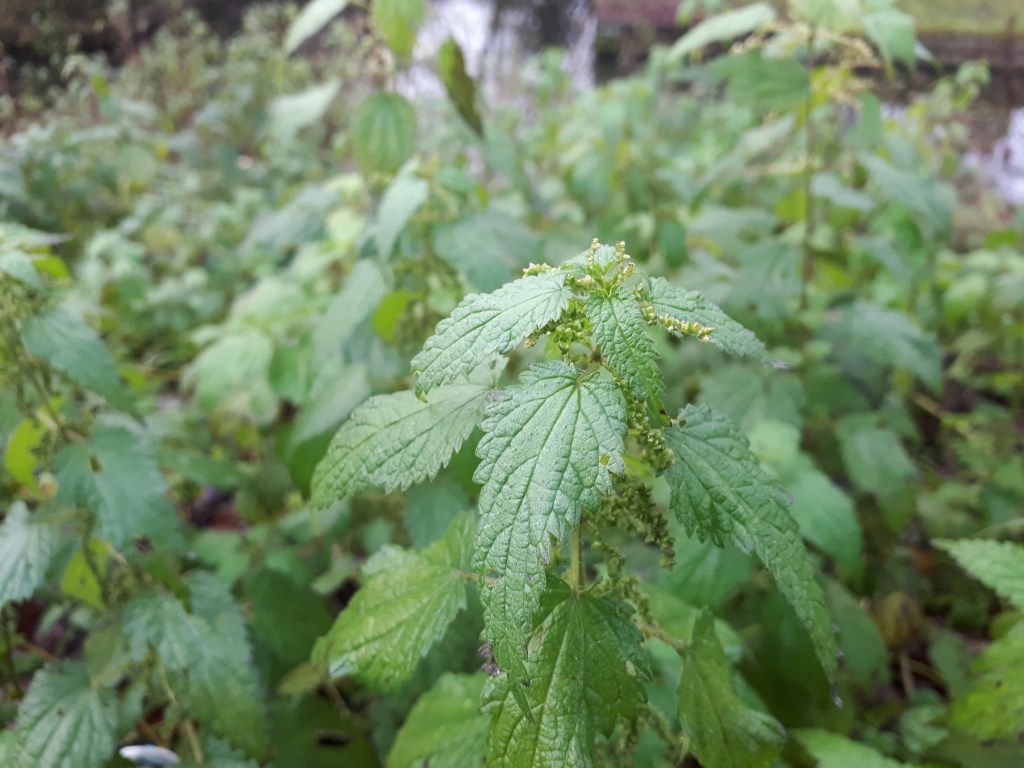
Who is Stinging nettle’s sister?Yellow deadnettleStinging nettle
The plants Different “nettles” are up and forageable in Amsterdam all through the year, but at this time the Stinging nettles are growing strongly, and different Deadnettles begin to flower. This is the best time to start using them in simple remedies and to enrich food. As you learn about Stinging nettles and Deadnettles, you will also meet some other amazing wild herbs that are around at the same time. For instance, wild garlic is also in full growth at this time, so you will be able to dig some of those bulbs up, from legal places, if you want that and have uses for them.
Please bring along cup/mug paper bag (grocery small bag to take the harvest home) pen/pencil to add to the notes. hand trowel / handschep (we will have a few to share if you don’t have one).
Booking €15 per person, paid in advance Please email to reserve your place and receive the bank details for pre-payment. Your place is secured when your payment has been received.
Cancellation policy 100% refund if cancellation more than 24 hours before event start time. Cancellation after that time (so less than 24 hours before the start time) can only be refunded if we can fill your place with another person.
Extra Date: Saturday17th February, 10.00 – 11.30, Park Frankendael. Amsterdam
This is an event for wild garlic lovers!
Learn how to identify, ethically harvest, craft, eat, grow, use and generally make the most of wild garlic (Allium ursinum) or Daslook, with Livvy de Graaf, assisted by Lynn Shore, professional foraging teacher and herbalist. Livvy, is Dutch-British and has been harvesting and eating wild food for longer than she can remember. She is Lynn’s daughter and certainly knows her way around the woods of Park Frankendael, where this walk will take place. She looks forward to sharing some of her skills with you.
We will be working mainly in the River of Herbs foraging gardens, so unusually, will be able to dig up some of the fresh wild garlic bulbs, to plant elsewhere or for you to cook/preserve at home.
Handout with wild garlic info. and recipes, and a cup of herb tea will be provided. You will learn about and try different preparations from sweet, sour, savoury to medicinal. And will be able to make your own potions/creations at home, using what we forage together and the handout.
Wild garlic emerging from the early spring soil, heralds the start of the main foraging season. As you learn about wild garlic, you will also learn to recognise other amazing wild herbs which are around at the same time.
Please bring along: drinking cup Paper bag (grocery small bag to take the harvest home) pen/pencil to add to the notes. hand trowel / handschep (I will have a couple to share if you forget or don’t have one).
Cost: 15 Euro per person – Payable in advance Please email urban.herbology.lynn@gmail.com and you will receive the bank details for payment. When payment is received your place is booked.
Cancellation Policy: If canceling, for any reason, 24 hours or more before the start of the event – Full refund. If canceling after that time (so less than 24 hours before the start time of the event) you will be refunded only if we have a replacement.
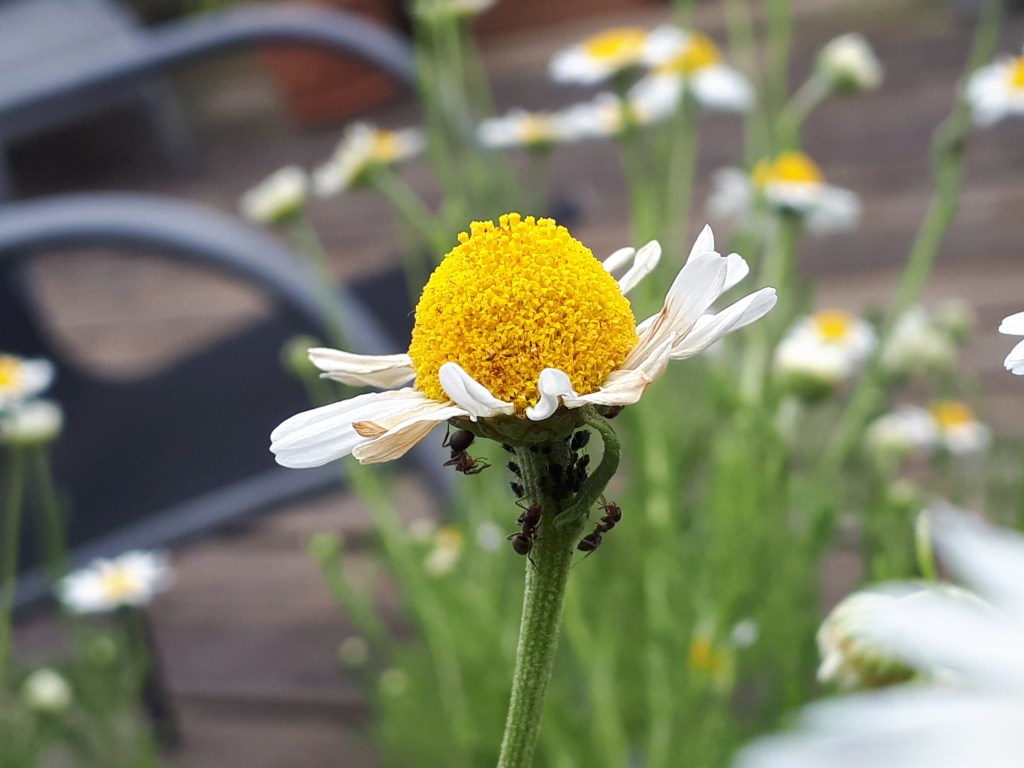
For about 15 years, generations of ants have been successfully maintaining a helpful aphid population on herb plants, in a couple of my roof terrace pots. I grow Chamomile and Valerian in the pots which the ants prefer; they seem less impressed with the other herbs that I grow.
At first, I battled the aphids, rehoming Ladybird larvae to the aphid-struck plants (ladybird larvae feed ferociously well on aphids) because I feared that they would suck my Chamomile and Valerian lovelies dry. But now we’re freinds and here’s why: Because those aphids and their ant farmers keep the little ecosystem in the plant pots just right. Just right, because the aphids poke and suck the Camomile and Valerian just enough to stay alive themselves and keep their 6-legged offspring healthy, whilst provoking the herbs to produce high levels of phytochemicals in an attempt to keep the insect population manageable. The protective phytochemicals make the flowers even more medicinal for me too. Btw, plants which don’t have to work to survive become soft in my opinion and far less robust and medicinal than I’d like. The ants protect the aphids by keeping them nestled under the flowers, and away from me when I dare to handle the plants for too long. That’s the only time they nip me. I find them very relaxed otherwise. Ants like to keep themselves to themselves. So the ants give the aphids shelter and protection and stop them from over harvesting the plants. Not sure exactly how, I guess by eating them or killing some aphid larvae (need to study this further).
If the aphids overharvested the herb sap, their own population would explode temporarily but the host plants would then whither from too much sap removal, the aphids would need to fly elsewhere and the ants would not get their food. How unfortunate. And I wouldn’t get my Chamomile or Valerian harvest.
So what do the ants get out of all this? Well they sup on aphid honeydew, aka aphid excrement. Can’t get enough of it but actually they are quite restrained. Honeydew is sweet and tasty stuff (like me, you may occasionally enjoy it on Lime tree leaves) packed with plant sugars and no doubt also herbal wonderfulness, from the aphids’ diet. And what do the Chamomile and Valerian plants gain from all these shenanigans? Well they thrive well enough to produce thousands of seeds each summer; hundreds of which land in my other plant pots, dozens of which make it to becoming new plants – Plants which are tough, medicinal and can be friends with aphids, ants and me.
I guess that was a long way of saying, when you next see a cluster of aphids under a flower, along with an ant wandering over them, take a closer look. Maybe you’re lucky enough to have insect farmers working magic in your plant pots or garden. Please don’t just squish them away; watch what’s happening and perhaps you’ll have better herbs and a more balanced garden ecosystem by just letting them do their thing.
Ate my first wild garlic leaf of the year, whilst leading an Urban Herbology Walk, this morning. It was delicious and I’m now filled with spring fever (and garlic breath ;).
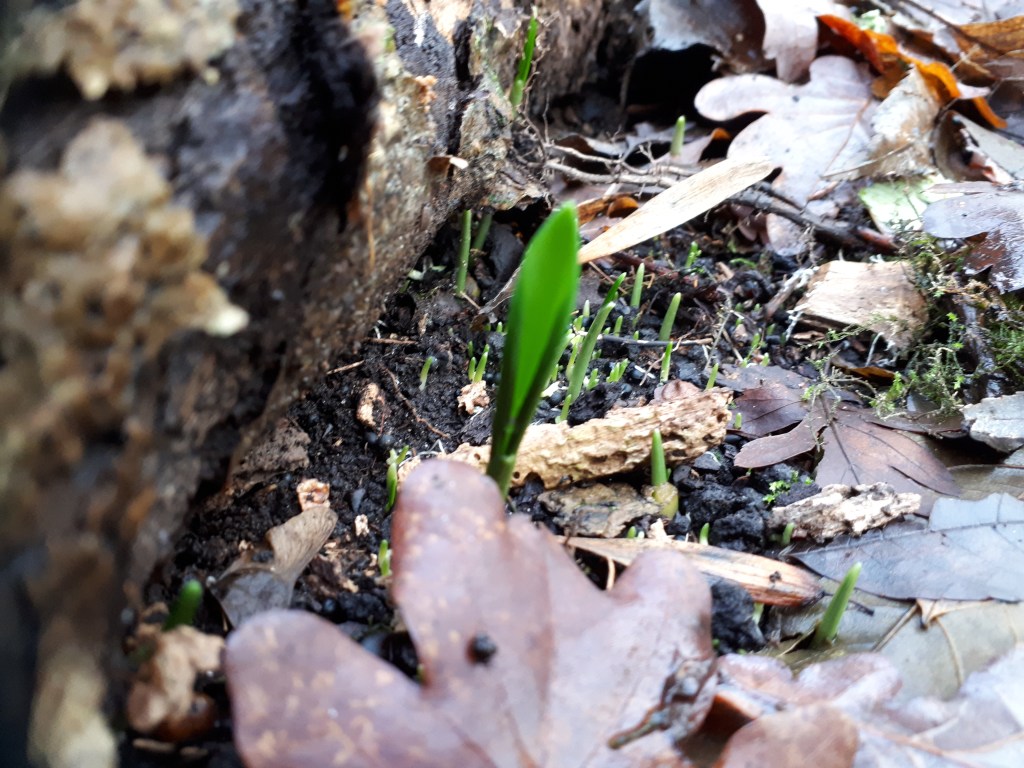
Wild garlic / Daslook / Allium ursinum is always to be found here in January, if you know where to look, but it’s a little ahead of normal. There are also lots of other bulbs pushing up, such as crocus and daffodil and you wouldn’t want to confuse those as they are not to be eaten.
My next public walk is February 9th (a Thursday) and I’ll set another date very soon for my Wild Garlic Workshop. Didn’t do it last year but feels good to offer it again soon.
So, today we all took home some oyster mushrooms and wild garlic bulbs, as well as a selection of edible leaves. Ground ivy and violet leaves being my favourites at present
I made an omelette of Oyster and Wood ear mushrooms, comté and brie. Hard to describe the experience in my body cells, which the wild garlic brings.
I could smell spring yesterday evening, cycling through town, didn’t dare mention it, but today it’s conclusive – Spring has Sprung! Well at least for foragers and those affected by Hazel pollen…
Please remember that you shouldn’t dig out any bulbs or roots, as a forager, unless it’s your garden (or the paths in the foraging orchards). If you’re determined to harvest so early, be sure that what you pick, stinks of garlic. And that you only take a little from a plant, so it can quickly bounce back and grow new leaves. Also keep your harvesting tidy and sharp, so it looks like you’ve never been there.
Happy foraging me hearties – May you be glowing with the chlorophyll, glutamyl peptides and sulfoxides of Allium ursinum, before too long!








 Urban Herbology