Category Archives: Herbs

Wholemeal Sage & Parmesan Crumpets

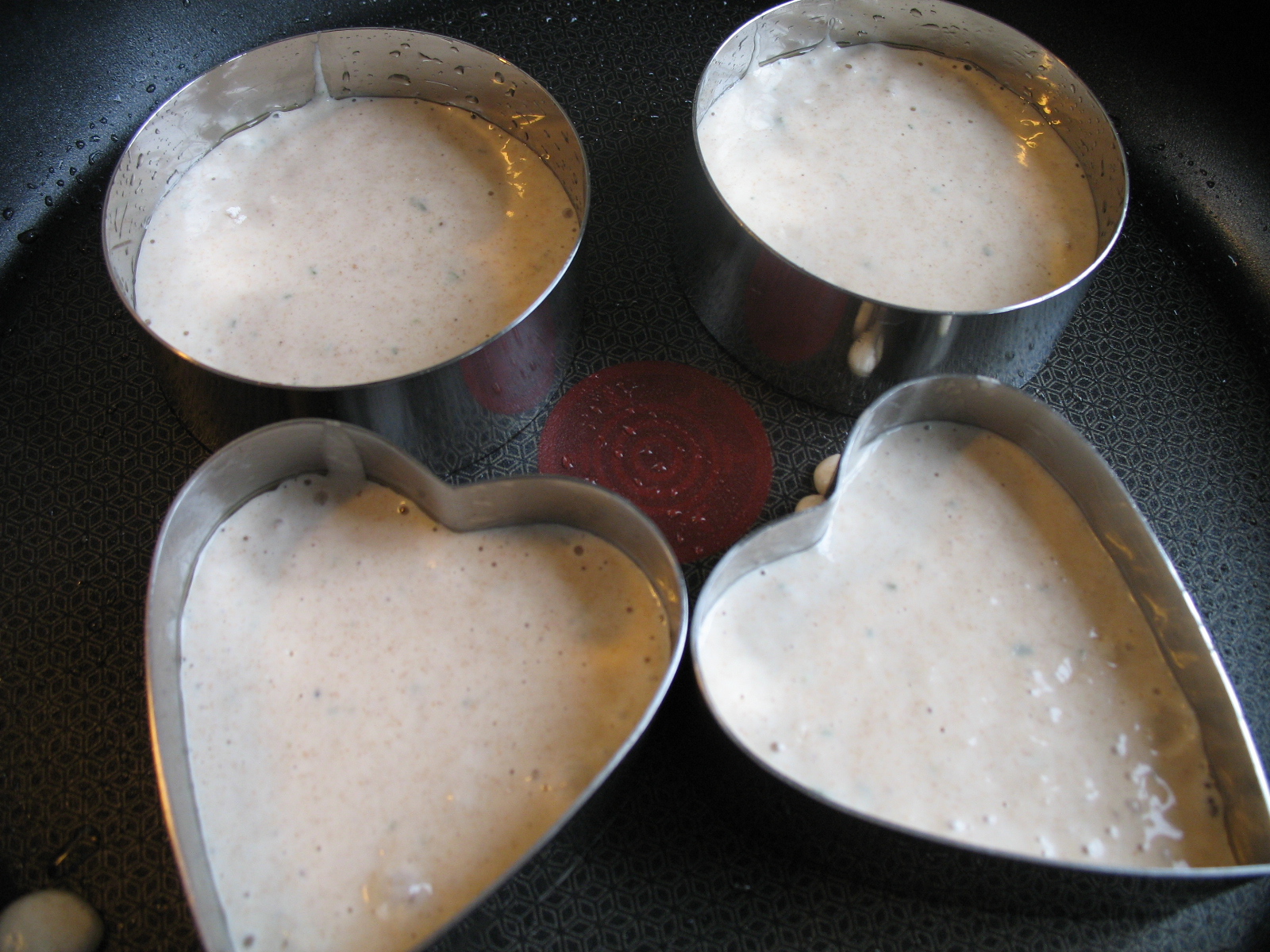
Crumpets (English muffins to Americans) are a delicious comfort food and should be served hot, topped with butter, honey, melted cheese or jam.  Usually crumpets are made with plain flour and are cooked in metal rings so that they become 2 – 3cm deep bread honeycombs.  I prefer to eat crumpets with a savoury topping so have created this sugar free recipe which includes fresh sage, Parmesan cheese and wholemeal flour.  Fresh sage (Salvia officinalis, NL: Salie) is readily available throughout the year, has many medicinal uses such as relieving cold symptoms and goes wonderfully well with Parmesan.

The crumpet batter can alternatively be poured from a tablespoon onto the cooking surface to make a thinner version, which is quicker to cook and could be called savoury Pikelets.  If you try this method cook the first side until the top appears to be dry, then flip them over and cook for a further minute or two.
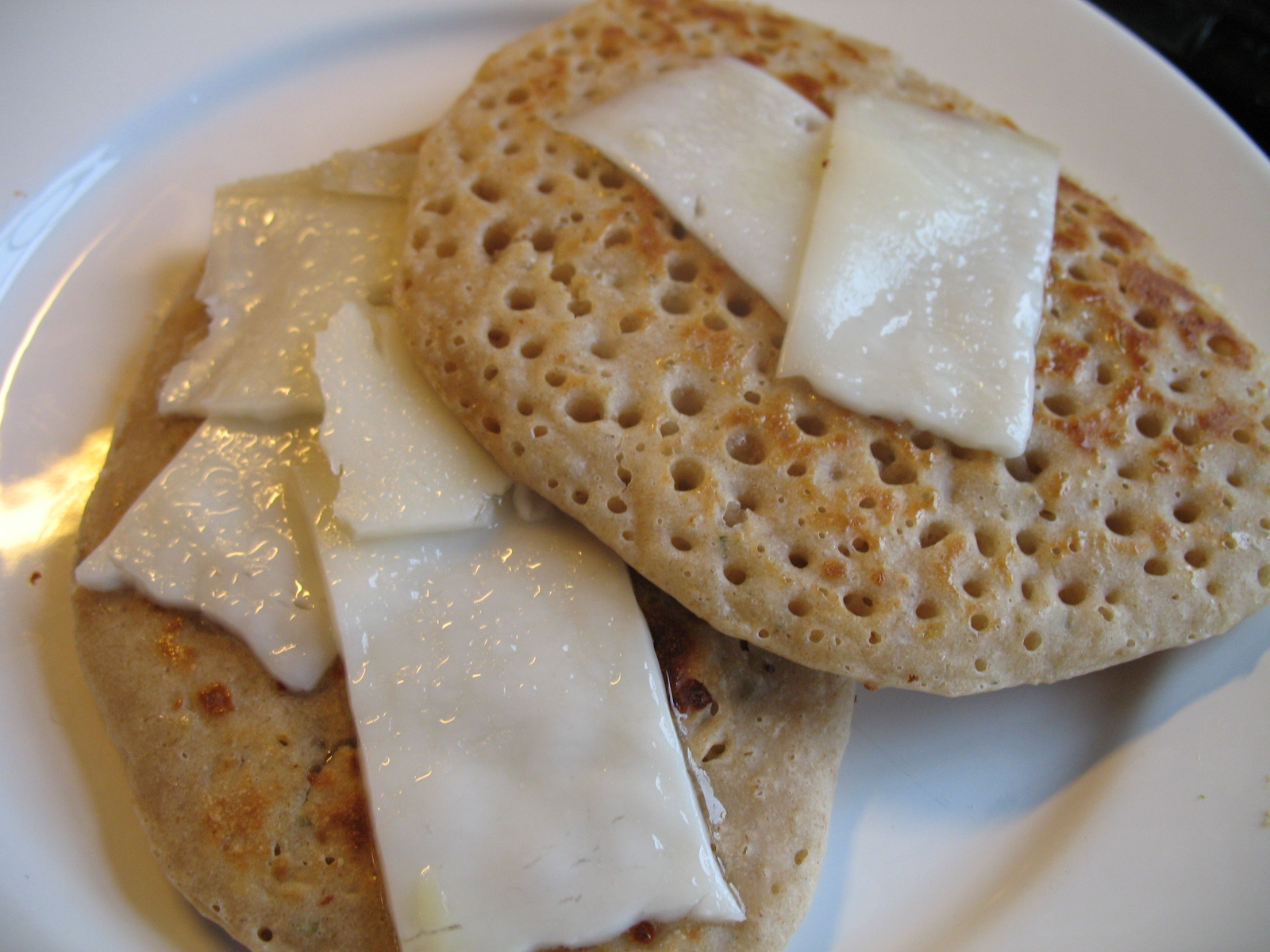
Wholemeal Sage and Parmesan Crumpets
(makes 16 – 18 with rings or 36+ if poured)

Ingredients
300ml milk
300ml water
425g strong wholemeal flour
45g freshly grated Parmesan cheese
1 tablespoon finely chopped fresh sage
1 1/2 teaspoons salt
2 teaspoons fast action dried yeast
(plus a frying pan or griddle, four metal biscuit cutters or small flan rings* and oil)

N.B. A bread maker may be used for steps 1 – 3. Simply add all ingredients to the bread pan with paddle attached and run the dough program straight away. Check after 1 hour and remove when you see the batter is full of bubbles.

  1. Warm the milk and water in a small saucepan, over a low heat.  Don’t let it get hot as that will kill the yeast which you will soon add, lukewarm is fine.
  2. Put the flour, chopped sage and Parmesan in a large mixing bowl and stir in the yeast and salt.
  3. Add the warm milk and water to the flour mixture, little by little as you stir, to form a smooth, thick batter.
  4. Cover the bowl with a clean tea towel or cling film and leave at room temperature for between 60 – 90 minutes, until the batter has expanded and is full of bubbles.
  5. Lightly oil the inside of the metal rings and the frying pan or griddle surface, then gently heat the pan/griddle.
  6. Place the rings on the griddle or frying pan and spoon about 1cm depth of batter into each ring.  N.B. The batter will further expand as it cooks so adding a greater depth will only result in overflowing rings or crumpets which are uncooked in the middle.
  7. Gently cook until the batter has bubbled and the top of the crumpets looks dry (about 5 – 8 minutes)
  8. Loosen the edges of the crumpets with a small sharp knife before removing the rings and turning the crumpets. Cook the other side until golden brown.
  9. Clean and re-oil the pan/griddle and rings before cooking the second and subsequent batches.

The crumpets can be reheated in a toaster or under a grill.  If your crumpets turn out too thick and are undercooked in the middle, you can slice them in half through the middle and finish them off under the grill.

*If you don’t have small flan rings or biscuit cutters you can easily use clean tuna cans or something similar.  Remove both ends with a can opener and use the can as a ring.

Saving Herb Seed

Buying seed is a recent thing.  Most gardeners used to routinely save seed from their best annual and biennial herbs and vegetables.  Seed saving is an easy and beneficial thing for Urban Herbologists to do, here’s why and how:

Why save herb seed?

  • It saves money and increases self sufficiency.
  • Saved seed is well adapted to your location. It has survived the local weather, soil type and pests.
  • You can save from plants with interesting characteristics.
  • Saved seed can be shared and swapped.
  • It increases plant variation, increasing the local gene pool and biodiversity.


How to save herb seed:

Plants use different methods to spread seed far and wide to new and favorable locations.  Most rely on the wind, animals, water, gravity or an explosive force to disperse their seeds.  The method your chosen herb uses will dictate how you should set about collecting its seed.

  • Sew your annual or biennial herbs as usual.
  • Select a few of the strongest plants for seed saving.  Use the other plants of that type for your herbal needs.
  • Grow the seed savers on to maturity. Allow them to flower and for their bare seeds or fruit to develop freely.
  • Mature the seed.  Allow it to ripen and dry on the plant as much as possible.
  • Collect the ripe fruit or seeds before they disperse naturally. This may involve:
    Shaking ripe, dry seed-pots into a paper bag (Nigella),
    Pulling dry seeds out of dead flower heads (Calendula),
    Cutting off dry seed heads (Allium),
    Cutting off ripe but unexploded pods (Legumes, pea family),
    Cutting off and into ripe fruit and scooping out the seeds (Rosa)
  • Clean the seeds. This may involve sorting or sieving seeds from plant debris or removing a soil covered outer layer (garlic).
  • Dry the seeds. Seed allowed to dry on the plant, in warm dry weather, may be enough. For better results also lay them on a sheet of kitchen roll or newspaper, in a dry room for a few days.  Seed collected from wet fruit needs extra care.  Super dry rice can be used to effectively suck moisture out of seeds. I’ll post an easy method for this later this week.
  • Pack and label your seeds when you are certain they are bone dry.  I use ordinary envelopes or small glass jars.  Label the name, date and where you collected the seeds from on the packet.
  • Store your seeds in a relatively cool, dry and dark place.  Some take storage further by freezing their seed, this can prolong their viability by several years, if done with very dry seed. My freezer is otherwise occupied.
  • Share and Grow on your saved seed.  Don’t forget to plant your seed the following year. It may keep for longer but reduce the risk of losing your seed stock by growing some of your saved seed and then repeating the cycle.  You are likely to save far more seed than you need so consider sharing or swapping seed with other Urban Herbologists.

If you are thinking of collecting and saving seeds from the wild please don’t. Wild annual herbs rely on seed dispersal for their survival.

Kew Millenium Seed Bank provides a wealth of information about why global seed saving is important and how they manage their collection.  The Real Seed Catalogue and similar organisations, can help by providing “real seed” to get you started.  Seed collected from the plants you grow from “real seed” will be viable and reliable, unlike that from many hybrid varieties often sold by the large seed companies.  Hybrids often yield sterile seed or nonuniform seed.

Ginger roots!

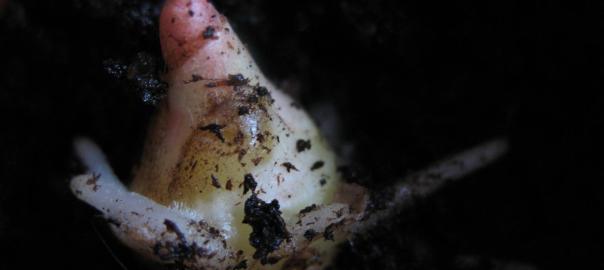
ginger-roots1There is life in my airing cupboard…  The ginger rhizome I wrote about on Monday has sprouted lots of strong roots, after just 4 days!  Each bud has started to look shoot-like, become slightly pink and sent out between 6 and 10 healthy roots.  I am delighted with this first attempt at growing one of my favourite exotic herbs.
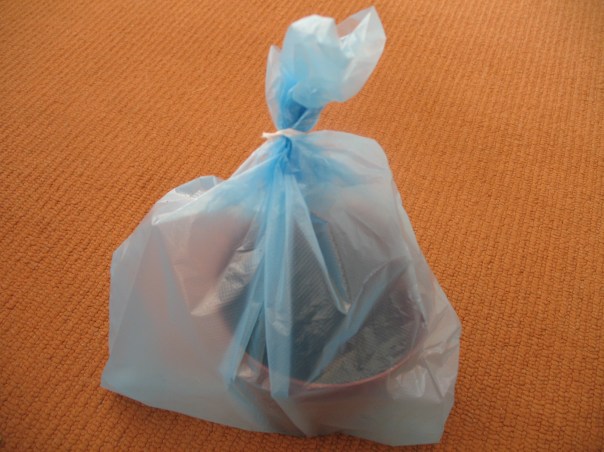
The pot is now in a bright but cooler room so I hope that it will continue to do well.  The soil has been moistened a little more and I shall leave the plastic bag on for a couple of days, to ease the transition from the toasty warm airing cupboard.  I have high hopes of honey, ginger and lemon using my ginger plant, ths winter.  Perhaps that’s a little ambitious!

Growing ginger (NL: Gember)

Have you ever tried to grow ginger (NL: gember)?

Ginger (Zingiber officinale) is a great herb to use in all seasons but I find it especially useful in the autumn and winter. It adds a gentle warmth to food, stokes up the digestive fire and stimulates the circulation.  It has been used medicinally since ancient times and is still employed for many ailments.  I love to add freshly grated, or powdered, ginger to a mug of hot lemon and honey, as a cold remedy. I also find ginger biscuits or chunks of crystallised ginger very helpful against nausea (though not against motion sickness).  It is also very tasty!

Ginger features strongly in the Ayurvedic system of medicine and it is quite common in parts of India to eat a little sliced ginger, soaked in lemon juice, before a meal or a little crystallised ginger afterwards.  I do find that this really helps me to digest a meal more effectively, especially a heavy meal.

ginger-in-pot

I found a forgotten piece of ginger (a rhizome) in my kitchen this weekend and was delighted to see that it had started to show signs of life. Three green tinged buds had started to form so I decided to help them along.  Jekka’s Complete Herb Book provides simple instructions about how to encourage fresh ginger to grow, so today potted it up and hope to add a healthy ginger plant to my indoor herb collection very soon.

ginger-in-plastic-bag

I cut the rhizome about 5cm below the first bud with a sharp knife and placed it in a small pot of moistened compost, with the buds facing upwards.  The buds are just covered in compost. I then placed the pot in a small plastic bag, and placed it in my airing cupboard.  Jekka recommends leaving the pot at 20 oC  and hopefully after around three weeks shoots will start to emerge.  I shall let you know how it goes.

Creamed Savory Jerusalem artichokes & Brussels sprouts

Jerusalem artichokes

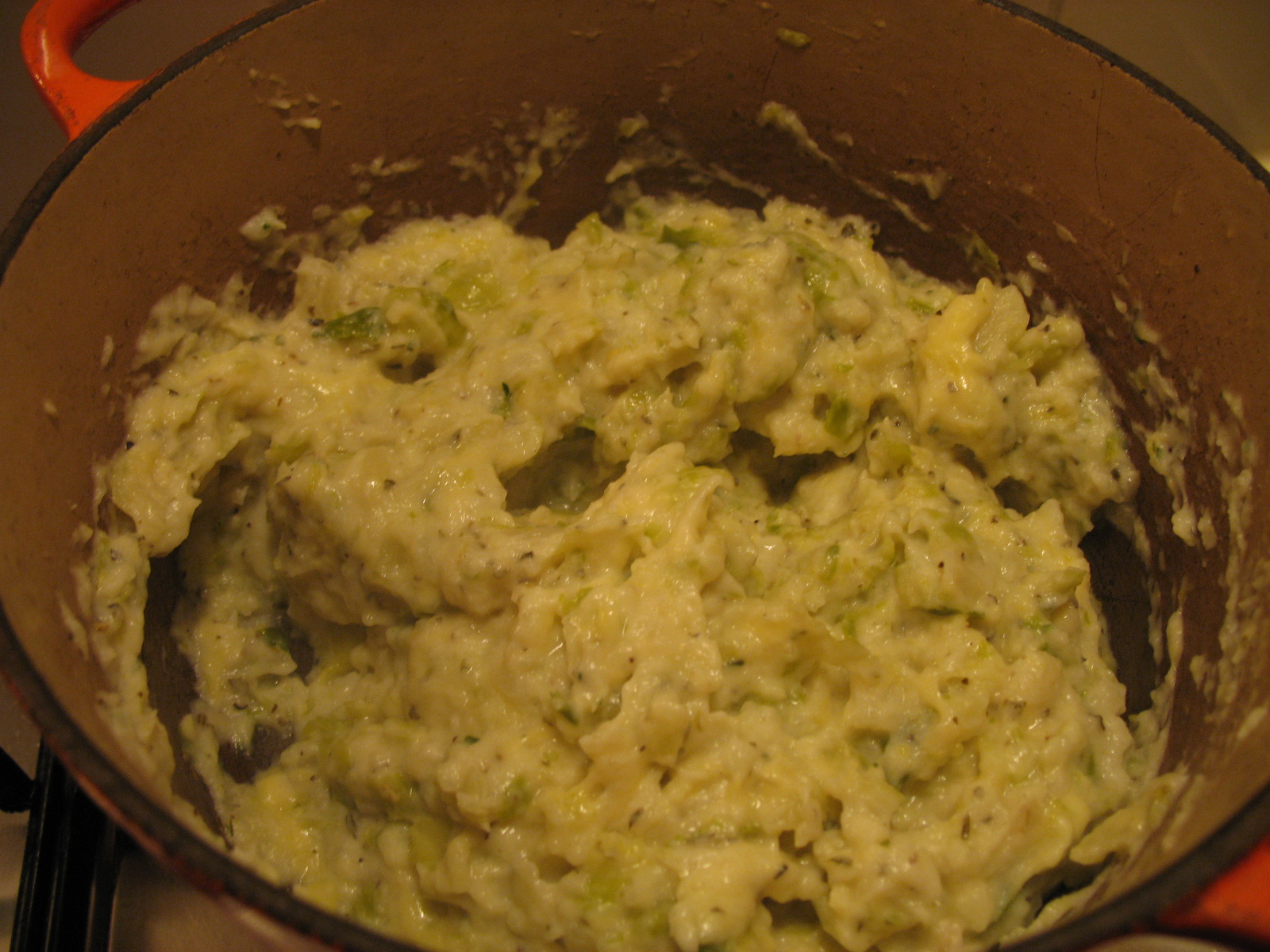
Yesterday, I was kindly given a half Kilo of Jerusalem artichokes by my friends at de Hortus Botanicus, Amsterdam. After seeking inspiration in The River Cottage Cookbook and Jekka’s Herb Cookbook, I concocted this simple and tasty recipe using fresh Winter Savory (the mystery herb I purchased in France recently) and dried Herbes de Provence.  We enjoyed it as an accompaniment to white fish, just a few hours after the Jerusalem artichokes were dug up.

You may well be thinking that this recipe will cause some unwelcome digestive effects!  Both Jerusalem artichokes and Brussels sprouts are currently in season but both have a reputation for causing flatulence.  However the addition of fresh Winter Savory (Satureja montana) aids and stimulates digestion, helping to prevent flatulence and it enhances the flavour to this side dish.  The Herbes de Provence mix I used also contains plenty of Winter Savory (26%).  The Dutch name for Winter Savory is Bonekruid, literally bean herb.  Perhaps this pertains to it’s ability to aid the digestion of legumes?  Jekka’s Herb Cookbook contains a recipe for broad beans with Summer Savory, I must try it.

Creamed Savory Jerusalem artichokes & sprouts

(Serves 3-4 as a side dish)

500g Jerusalem artichokes

Creamed Savory Jerusalem artichokes & Brussels sprouts

250g Brussels sprouts
4 tbsp creme fraiche
1 tsp finely chopped fresh Winter Savory
1 tsp dried Herbes de Provence
50g grated Cheddar cheese or Goudse jonge belegen cheese
Freshly ground salt and pepper to taste

  • Peel and roughly chop the Jerusalem artichokes and sprouts.  Simmer in a little water for about 5 minutes, until the sprouts have softened and the artichokes are thoroughly cooked.
  • Drain the vegetables before adding the dried herbs, chopped fresh herbs and creme fraiche.  Stir well and mash lightly.
  • Add the grated cheese before warming through on a low heat for a couple of minutes.
  • Add salt and pepper to taste, serve warm.

Wild rose (Wilde roos)

Rose is the plant of love, grown and used by women and men for millennia.  There is much folk and magical lore associated with the rose, I shall post about this another time.  Its petals can strengthen the heart and spirits and are found to have a cooling tonic effect on the female reproductive system. Rose hips are often used as a preventative tonic to strengthen the immune system and to aid those who are convalescing.

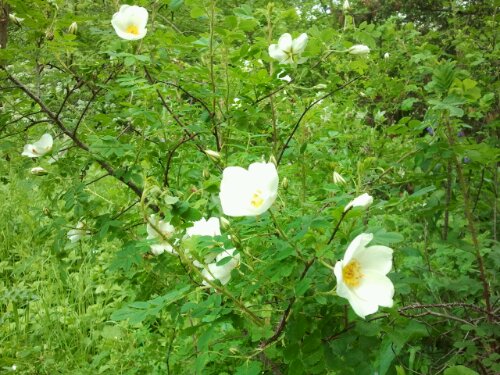
There are several species of wild rose in the UK: dog rose, Rosa canina; field rose, R. arvensis; sweet briar, R. rubiginosa; burnet rose, R. spinosissima and downy rose, R. villosaR. alpina and R. rugosa also grow wild in the Netherlands.  R. canina is probably the most familiar wild rose, with flask shaped hips shown here. Sweet briar is notable for the especially fragrant foliage. The hips of all roses are actually false fruit and the flowers of wild roses have only five petals, little scent and no nectar. Rose hips becomes softer and the dry calyx drops off later in the autumn, usually after the first frosts.  Hips are ready to harvest when they are a deep red (or purple with R. spinosissima) and can be pulled from the plant with little effort, without damaging the foliage.

Rose hips (NL: rozenbottels) are a particularly rich source of vitamin C and rose hip syrup was produced in quantity and rationed in the UK during WWII.  Roosvicee is a popular brand of rose hip based drink, here in the Netherlands.  Rose hip jam has traditionally been produced in Germany (Roosvicee also produce rose hip jam), rose hip soup is still popular in Sweden and a wine based on rose hips has traditionally been brewed in Sweden and Russia.

Rose hips are used medicinally in teas (1 – 2 tsp hips or 1/2 tsp powder in a 2 cup pot of water), infusions (steeped for up to 4 hours) and syrups.  Hips may be used fresh or dried. Once dried they can be ground into a powder.  Most recipes call for the removal of the hairy seeds by straining as they can be very irritating.

rosehip harvest
Rose hips from Rosa canina

Rose petals can also be used in a variety of ways such as; layering with grease-proof paper wrapped butter to impart their heavenly aroma into the fat, adding to bath water, eating in salads. I prefer heavily scented garden roses for these uses as I can’t bear to see the flowers removed from wild rose bushes (and they have little scent anyway).  Rose petal glycerite is also very simple to make but requires lots of petals.

These days I only have access to small quantities of rose hips and I prefer to make a good strong syrup from them, or a tea if I can only collect a few.  Here is a very simple traditional recipe for rose hip syrup which can be used for any quantity of hips.  I use this recipe whenever I collect a  cup or more of hips and it is beautiful, delicious and useful.  The colours and aromas of this recipe are always magical.  I have also included a raw syrup recipe, from Hedgerow Medicine, by Julie Bruton Seal & Matthew Seal.  I haven’t yet tried it, as I always want my syrup quickly, but it sounds interesting and is thought to have a higher vitamin C level than the boiled version.  Do let me know if you make it.

Traditional Rose Hip Syrup

  • Clean and sterilise your syrup bottles#.
  • Wash your harvested hips and remove any dry calyxes and stalks.
  • Measure the volume of your hips and boil them in half that volume of water.  Simmer for 20 minutes with lid on pan.
  • Turn off heat and use a fork to lightly mash up the hips into the liquid.
  • Allow the pulpy brew to cool to a manageable temperature.
  • Strain the brew (mashed hips and liquor) through a sterilised jelly bag or tea towel or muslin cloth, into a clean bowl.  Get as much juice out of the pulp as possible without squeezing the seeds through the jelly bag or cloth.
  • Rinse your saucepan.
  • Measure the volume of the extracted juice and return it to the clean saucepan.  Add half that volume of sugar and give it a little mix.
  • Bring the juice and sugar to the boil then simmer for 5 – 10 minutes, stirring regularly.
  • Pour the syrup into sterilised bottles, seal with a tight lid and label.

#A guide to how many bottles you will need – Yesterday I collected one and a half  cups of ripe hips.  This yielded about 150ml of syrup.

Raw Rose Hip Syrup

  • Clean and sterilise a wide mouth pickling jar (NL: available cheaply in Blokker)
  • Clean and prepare your rose hip harvest as above – then dry them off.
  • Gentle score the skin of each hip, a few times with a sharp knife.
  • Cover the bottom of your jar with a layer of caster sugar.  Then make layers of hips and sugar, so that all the spaces between the hips are filled with sugar.
  • Close up the jar and leave on a sunny windowsill for a couple of months or until the juice has been drawn out of the hips and liquified the sugar.
  • Strain off the liquid, bottle and store in the fridge.

Legal Disclaimer: The content of this website is not intended to replace conventional western medical treatment. Any suggestions made and all herbs listed are not intended to diagnose, treat,cure or prevent any disease, condition or symptom. Personal directions and use should be provided by a medical herbalist or other qualified healthcare practitioner with a specific formula for you. All material on this website is provided for general information purposes only and should not be considered medical advice or consultation. Always check with your personal physician when you have a question pertaining to your health and healthcare.


Warmth

Amsterdam is currently enjoying a warm start to October so it feels a little odd to be thinking about protecting herbs from frost damage but this weekend we removed the drip trays from the roof pots and had a look to see how much fresh produce might be expected over winter.

I’ve built up a collection of potted herbs on our roof and balcony, which can happily withstand Amsterdam winters. Herbs which don’t survive are not replaced and just a few are brought inside before the frosts.  Some survive by self-seeding, others are winter hardy evergreens and perennials. Water trays are removed in early autumn and a couple of pots are moved to more sheltered spots.  I don’t bother with insulation and only harvest lightly through the coldest months.  An occasional plant is lost when temperatures really plummet but overall this relaxed approach makes potted herb gardening much easier and cheaper.  Finding self-seeders such as nigella, rocket, borage and calendula in interesting places when spring arrives, is a pleasure that it also brings.

wild rocket leaves

Wild rocket (Diplotaxis muralis) is one of the few herbs I harvest in quantity from the roof come mid winter and it can still be sown from seed in October.  It tastes stronger, even more peppery, in winter and  I really like the warmth it adds to dishes.  Wild rocket self-seeds quite readily and is a hardy perennial.  Although at its best in summer, it goes on producing vitamin and sulphur rich leaves throughout the winter months.  After Patrick Whitefield recommended it during a 5 day permaculture course, I sewed a handful of seeds amongst other herbs and have had plenty to pick from ever since.

My friend Elodie uses wild rocket from sand dunes in summer, to make a great pesto.  I often use the leaves in salads and, at the very end of cooking, tear them into root vegetable soups.  I’d like to grow more herbs that can be eaten fresh throughout winter and would love to hear about any successes or suggestions you have.

Herbes de Provence

D’un Goût à l’Autre
Meal at D’un Goût à l’Autre.

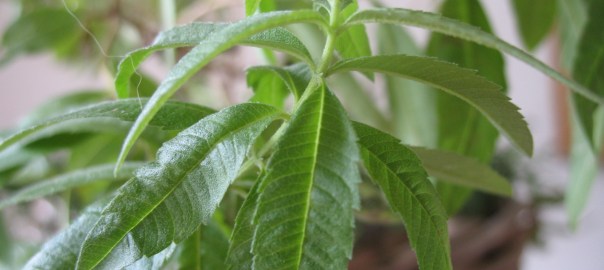
Nyons, in Drôme Provence, France is famous for award winning olives and delicious wines.  During my recent holiday there I enjoyed some great herby meals and bought two local specimens to add to the kitchen balcony. One restaurant stood out because of its use of local herbs. D’un Goût à l’Autre has several dishes on its menu which make an eye catching and delicious feature of fresh herbs.  Continue reading Herbes de Provence