Category Archives: Perennial herbs

Urban Herbal Planting Scheme in Amsterdam Oost

I was so pleased when I realised that the local council had commissioned simple herbs for the planting scheme at Christian Huygensplein in Oost Watergraafsmeer, Amsterdam.

About a year on, the herbs are looking great so I thought I’d share a photo. I hope you can see a Pine Tree trunk surrounded by thick Lavender and an Ivy plant climbing up the trunk.

Three practical herbs in an area which needed a little smartening up at the time. Mostly the planting, which had a lot of hot dry weather soon after it was completed, has faired well. It looks good, smells good and could be used for a multitude of remedies, should the need arise.

Thank you Amsterdam Oost! Now how about a few more nut trees?

Easy Dandelions


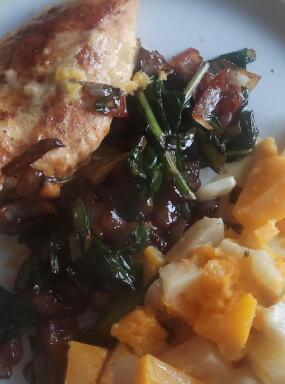
Here’s our dinner this evening.
Between us, as a side dish, we enjoyed the leaves of two large dandelions (Taraxacum officinale) picked from Ben & Riny’s garden a couple of hours ago.

After a good rinse, I roughly chopped the leaves and simply added them to the pan juices after frying chicken and eventually an onion. I added a slosh of the vegetable cooking water, from the celeriac and pumpkin you can also see in the photo. that just loosened things up a little and helped to stop the dandelion from frying. The result was very tasty indeed and rather healthy!

The root came up easily, from one of the plants so I’ll add that to a soup tomorrow.

365 Frankendael day 29

Hop (Humulus lupulus – what a latin name!) is entwined about a meter up last year’s dead stems today and looks far healthier and more vigorous than any cultivated Hop plant I have seen. I am really looking forward to seeing whether or not its flowers are as impressive.

Mugwort is growing beautifully on wasteland near a Frankendael bus stop. It is helpfully showing the silver underside of a few leaves in the breeze.

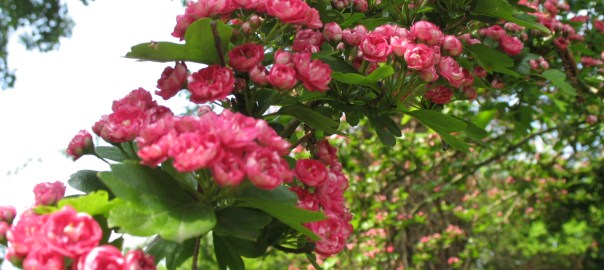
This member of the Hawthorn species reminds us clearly that Hawthorns are members of the Rose family.

Valerian officinale is almost ready to flower in wetter areas of the park.


And Agrimony plants are making themselves more obvious is some drier sunny areas.

Also today, towering Pink Purslane (Montia sibirica) is in flower. It looks similar in structure to Winter purslane (Montia perfoliata, which is low growing and currently growing like crazy along the Centuurbaan fence of Sarphatipark. Often called Miner’s Lettuce it tastes great!) However, Pink Purslane is said to have a nasty acrid aftertaste and should be avoided by foragers. It’s such a beautiful flower at this time of year that it’s good to know it tastes bad!

365 Frankendael day 25

Today, daisy, magnolia, pine cones and ribwort during an after work wander between the two Frankendael tram stops.

Daisy (Bellis perenis)has quite a number of historic uses. You can eat this herb as a salad or a pot herb but in places like Frankendael it’s highly likely that your harvest will have been quite heavily soiled or trampled. Have a look at the Uses section on the linked Wiki entry about this plant for details of how the Romans used its astringent qualities to assist soldiers.

Tasty Magnolia is still in flower here in Amsterdam. This photo is of a flower on a young tree within the park, so these particular flowers won’t be on my plate. There are plenty of other mature trees overhanging gardens and in public spots which you may be able to locate using boskoi. Before now I have collected leaves straight after a strong wind or shower. That’s a nice way to avoid upsetting anyone who thinks you are just spoiling the beautiful display by plucking blooms.

Above are a few Pinecones, found by my daughter, which I had completely forgotten could yield great food, in fact one of the least polluted and most nutritious- Pinenuts! And they are another harvest to acquire from fallen plant material rather than plucking. The tree these fell from is shown next…

I’m not sure of the species but I have already had a peak inside the cone and there are some tasty looking nuts within.

Lastly, trusty Plantago lanceolata, Ribwort. I harvested from several really juicy looking plants today, ready to make a foot oil tomorrow morning. The link above goes to day 2 of the 365 project where I gave further info and links about the plant.

Permapots – Perennial Herbs

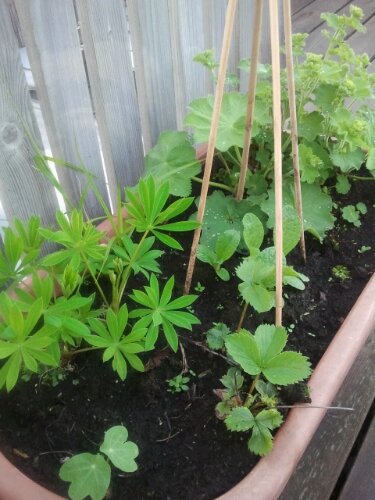
For several years now, I’ve been growing herbs on my roof terrace in what I call Permapots. Inspired by the first Permaculture course I attended, run by Patrick Whitefield at the Sustainability Centre, I began growing mixtures of perennial herbs in large planters.

Permaculture advocates low maintenance gardening of edibles by growing a mixture of perennials and annuals in a way that reduces the need for weeding, watering and feeding. My idea of the ideal Permaculture garden is one that is self-sustaining, produces a useful yield of food throughout the year, is pleasing to the eye and is in harmony with nature.

This is a tall order for a small roof garden but I thought it was worth a try. My Permapots have been going strong for 4 years now and have provided us with a nice variety of edibles and medicinals year round. We have enjoyed roof-grown Rocket at Christmas, occasional summer Strawberries, year round Yarrow and countless herbs for teas and various lotions and potions.

From time to time, I thin out the perennials and refresh useful annuals, such as Calendula and Nasturtium. but mostly I just leave the pots to do their thing and am grateful for whatever harvest we receive. Some plants have done well, some have disappeared and others have done phenomenally well.

Tips for Permapots…
Grow perennials suited to your environment.
Sew annuals which self seed readily.
Be prepared for change and some failures.
Plan for a low to moderate but varied yield.
Grow Lupins our clover in some pots and dig them in each season.
Thin out plants from time to time and share with your friends.

My favourite Permapot plants are…
Borage (self seeds readily)
Sorrel
Lady’s mantle
Lupin
Chives
Yarrow
Strawberry
Calendula (seeds are easy to collect & sew)
Nasturtian (seeds are easy to collect & sew)
Rocket
Marshmallow
Valerian

Permapots save money and effort as I don’t need to buy new plants each year and I am provided with baby plants to sell our give away.
Permapots allow for failure, if one plant does in bad weather there are always plenty of others to enjoy.
Permapots welcome unexpected guests – chickweed, hairy bitter cress and dandelion being the tastiest here.
Permapots don’t need much work.

365 Frankendael day 19

I’ve been walking in Frankendael with Elodie today, we found heaps of herbs, several new to us. If you’d like to join me for a herb walk there are a few spaces left for the Sunday May 27th Amstel to Frankendael walk. Here are some striking examples from today…
Solomon’s Seal looks rather like an enormous version of Lily of the Valley so I always steer clear of it. I have always thought of Lily of the valley as a poisonous plant so lethal that I shouldn’t even go near it. Upon reading about it last night I learned that it is called the herbalist’s Digitalis. It has a potent specific effect on heart muscles, causing them to open and fill more intensely and to raise blood pressure. It is thus lethal in even small doses and is not a herb of interest to me. However this arching beauty of the woods is very interesting. Solomon’s seal is used to make traditional remedies for many ailments, ranging from speeding muscle and bone healing, to menopausal symptoms, diabetes, acne and other skin afflictions. The native Americans reportedly ate it frequently.

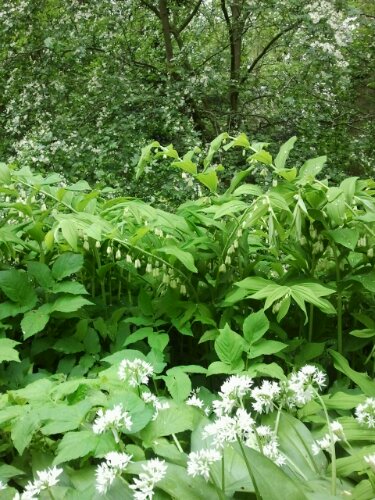
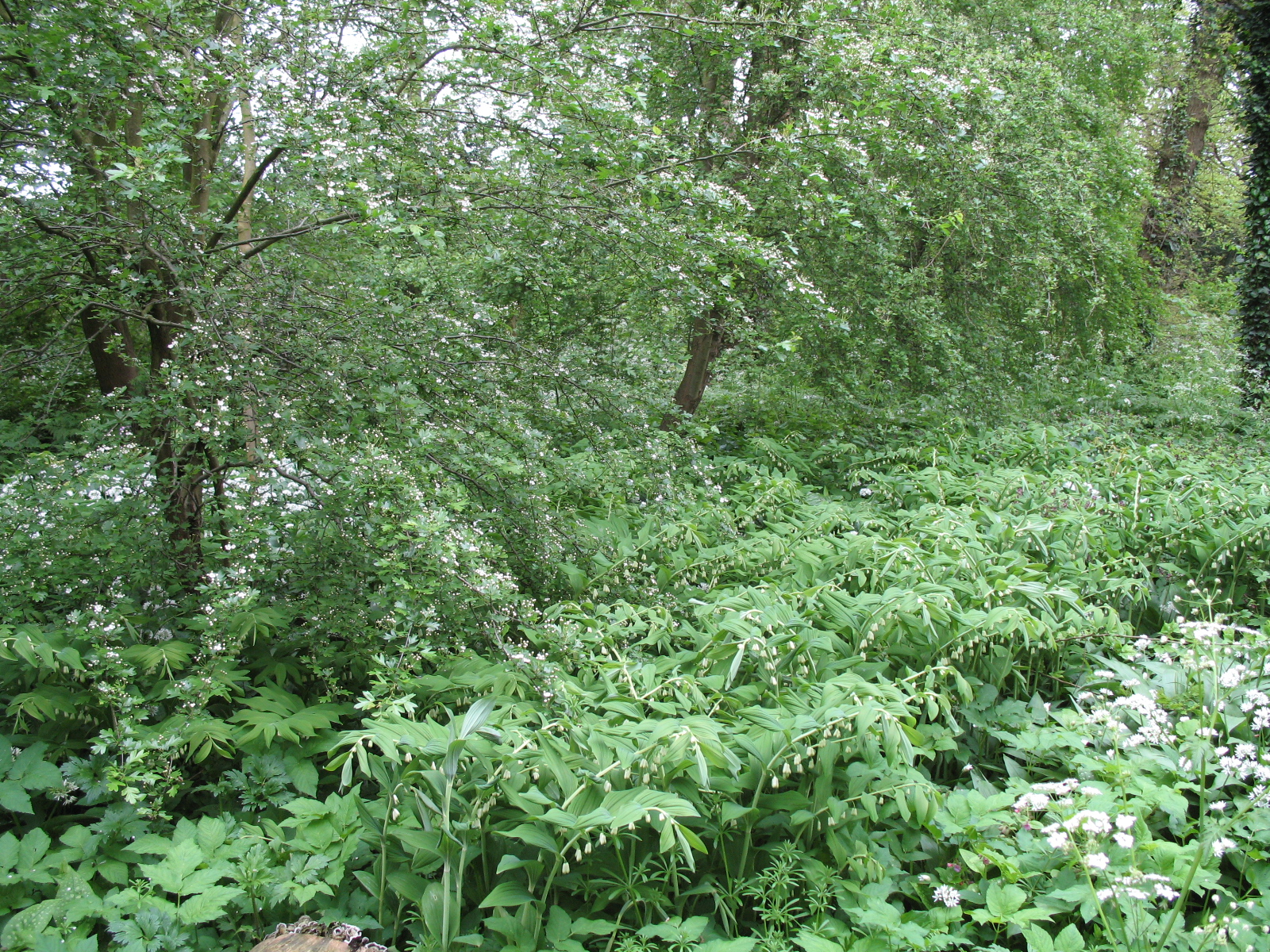
I was thrilled to turn a corner in the wood today and be greeted by this scene:

It is difficult for a photograph to do it justice – especially one of mine! Here is Hawthorn arching over a swathe of Solomon’s seal and Wild garlic, all three in flower at the same time.

Other herbs of note today…
Below, endangered Hoary Plantain (Plantago media). I first saw this herb last year and remember not really knowing what it was, although it was obviously some kind of plantain, but wanting to hide it and protect it from trampling feet! Of course I couldn’t and this plant is well adapted to living in well trodden locations. However, should you find it, especially in a week or two when it’s flower stalk will look like some sort of moth-plant hybrid, then please don’t touch it. I hope that this one has a chance to set seed.

Chicory foliage:

Yarrow (Achillea millefolium)

Endangered Greater burnet (Sanguisorba officinalis)

365 Frankendael day 15

Today a dusk walk through the woods. The Hawthorns of Frankendael are finally opening their flowers, Lily of the Valley flower stems (poisonous look alike of Ransoms) arch elegantly above their neighbours, Moorhen chicks shelter beneath Meadowsweet and beloved Motherwort is growing bigger and bolder by the minute.

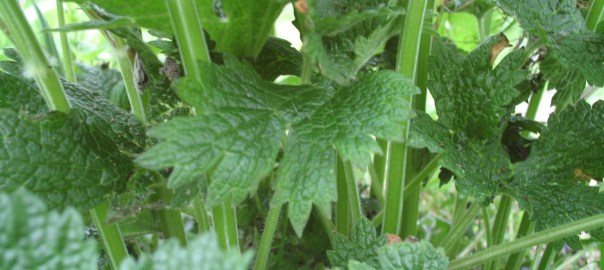
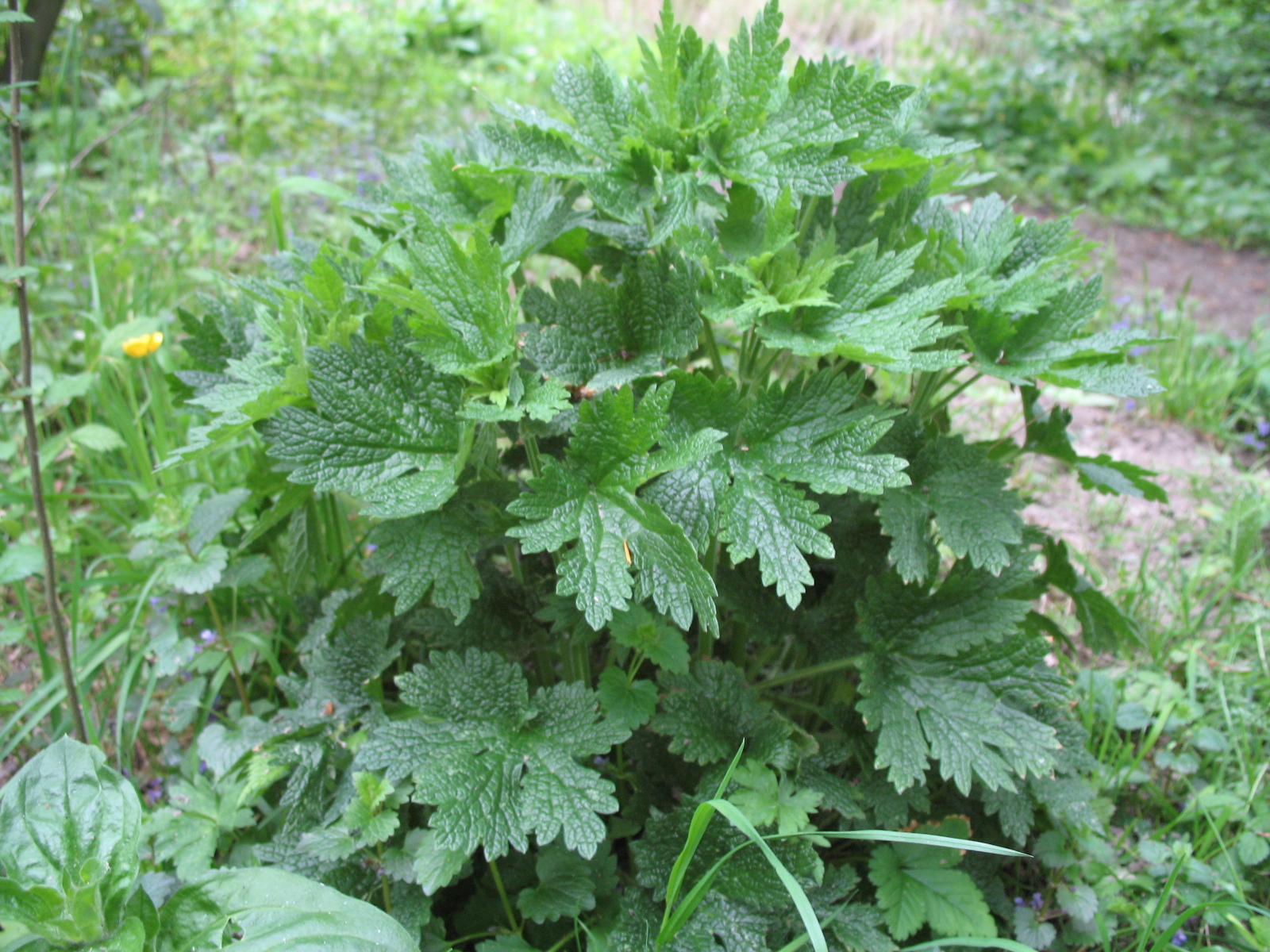
Motherwort is an extremely useful perennial herb which grows in compact clumps, rather like Mugwort but is a little more modest. Motherwort (Leonurus cardiaca, NL: ). Since learning about it through Susun Weed, I always have a bottle of tinctured Motherwort close to hand. This plant is a member of the Labiate family (mints) but tastes completely different to the mint most of us are used to. It has a very strong scent when you brush your hands up through the plant, has square stems, as with all Labiates. It is extremely bitter and distasteful when taken as a tea. All parts of the plant are medicinal. It has an age old reputation for its heart strengthening abilities and for its value in calming nerves, restlessness and irritability. It is an emmenagogue so shouldn’t be taken whilst pregnant, thought it has much value to women postpartum, to mothers in general and to women with period pain. The tincture is the easiest and most palatable way to take it.

Motherwort instills a feeling of groundedness. Ten drops of tincture, in a glass of water, can bring me back down to Earth in a few minutes when I feel the world is spinning out of control. Historically, Motherwort was used as a common treatment for heart problems such as palpitations and for fevers where the body & mind needed to be kept calm. It is now almost forgotten for such purposes but, thanks to our ancestors, many garden escapes have naturalised throughout Europe. This plant in Frankendael is possibly a garden escape from the old Landhuis. I am very pleased it is there.

365 Frankendael day 14

Meadowsweet (Filipendula ulmaria, NL: Moerasspirea) is a waterloving perennial herb which contains an active ingredient called Methyl salicyclate, which when taken in combination with tannins and mucilage within the plant can bring about stomach healing. In contrast, when methyl salicyclate is used alone (Aspirin) it causes stomach bleeding.  As with most herbs, it is the natural combination of chemicals which work so well together to bring about healing.

Here’s a link to an extract from a wonderful book called Hedgerow Medicine, by Julie Bruton-Seal and Matthew Seal.  It is one of my favourite and most consulted books.  This extract explains how to make a useful and tasty, Meadowsweet glycerite.  Meadowsweet is also traditionally associated with love, peace and harmony.  There is an old custom of tossing a Meadowsweet flowerhead into water if you are seeking the identity of a thief.  If it floats the thief is a woman, if it sinks it is a man.

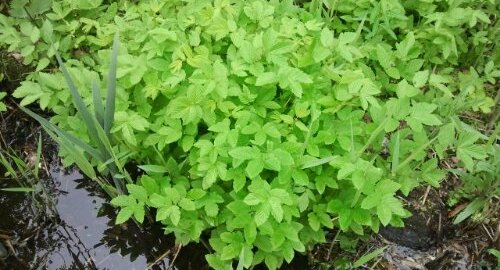
Meadowsweet will flower later in the year, from around midsummer.  The flowers produce a scent which is one of my favourites, a strong and heady sweet almondy aroma which really pleases my spirits.  As you can see in the photo. Meadowsweet can be found in the watery regions of Frankendael park.  It’s spikey leaves are difficult to miss as you walk across the modern wooden bridge, in the woodland area.

365 Frankendael day 12

Comfrey (Symphytum officinale, Symphytum uplandicum) is just coming into flower here in Amsterdam. It’s easy to identify now due to it’s broad, furry, fast growing leaves, it’s dropping purple or white flowers and it’s standout appearance as it towers over many neighbouring wild plants.

If you keep any plants, outside or in, I urge you to learn how to make the easiest liquid feed from nourishing Comfrey. If you don’t know about it’s deep and rapid healing effects on the body, I urge you to learn about them too and to keep some form of this plant in your herbal first aid kit.

Most of the Comfrey found wild and is gardens, descends from garden escapes of purple flowering, Russian Comfrey (S. uplandicum). It works just as well externally and as plant feed and its leaves don’t contain the toxins found in the roots and all parts of cream flowering, Wild Comfrey (S. officinale). The toxins are harmful when ingested. Because it’s hard to tell the two plants apart when they are not in flower, I suggest you always air on the side of caution and don’t use it internally. Today I photographed a white flowered Comfrey, the colour suggests it is Wild Comfrey but most plants in the park are purple flowering and the two are very interbred, so this may be a white flowering mutation of S. uplandicum. Either way, it is beautiful, useful and I will only use it externally or for my plants.

Comfrey can be applied directly as a poultice (for sprains for instance) made into a heat infused or a cold infused herbal oil which can be used for massage or blended with beeswax to make a healing salve. Worth mentioning, is that sometimes Comfrey may speed healing faster than you’d like, such as when infection is present in a wound. Ensure wounds are clean and healthy looking, not infected, when you begin using this herb. This will help to ensure the wound heals cleanly, a well as quickly. Comfrey also has a reputation as the herb to prevent or remove scars, both internally and externally by please remember my warning about internal use.

To make a superb and cheap liquid plant feed, simply immerse a couple of Comfrey leaves in water, in a bucket or similar. Leave it to ferment for a few weeks. You should see that the water becomes a dark and rich brew. Store this “Comfrey tea”in a suitable container and dilute well before feeding to your plants. A plastic bottle cap full, in a home watering can of water, should suffice. Use regularly, throughout the growing period, for pleasing results.

Here’s a link to an online Permaculture Magazine video article, about why we should all have a Comfrey plant on our patch. Be prepared, the video is ten minutes long and contain lots of info for people with vegetable gardens – If only! I don’t have space for one at home but I know where plenty grow! I hope you’ll have a look around and find some near your home also.

Comfrey is an essential herb to become well acquainted with, your plants will thank you and so will your body, when it needs to heal quickly.

Pea Dosa with Yoghurt & Fresh Mint

Dosa are Indian pancakes, traditionally made by soaking and then fermenting rice and black lentils, in a ratio of 2 parts rice: 1 part lentils. They are extremely tasty, popular and versatile. I recently read in Wild Fermentation that the lentils may be substituted by other dried legumes. So I have been trying dried peas, left over in my cupboard from the winter.

To be honest, I prefer this pea version to the traditional recipe so thought I’d share it. I also found it easier to blend the soaked rice and peas, than blending rice and lentils. It was less effort for my Kitchen Aid which is also a bonus.

To make pea dosa I follow my usual dosa recipe and simply substitute dried peas for lentils. The toppings are endless, today I used a mixture of fresh yoghurt, two finely chopped mint leaves from the balcony, a dribble of runny honey and some blueberries.

Mint is a great wake up call in the morning and extremely easy to grow in a pot. It’s probably better in a pot than anywhere else as this perennial is very invasive and if allowed, can take over a garden in no time.

Another great topping is mashed banana and yoghurt, with or without honey.

I hope you enjoy it! Do let me know if you try any other legumes in place of peas.