Category Archives: Wild herbs

365 Frankendael day 2


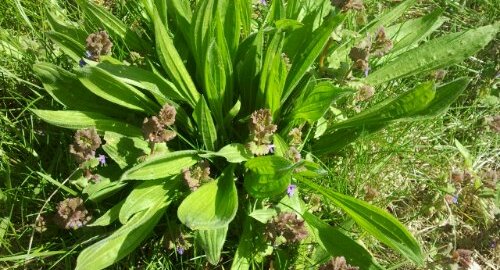
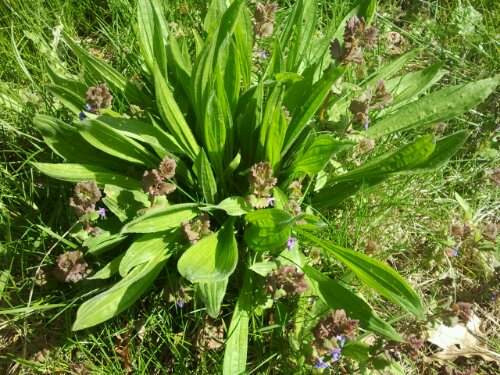
This photo shows the narrow form of Plantain, known as Ribwort, with Ground ivy flower stems growing up through it.

Ribwort (Plantago lanceolata), is a very useful first aid herb. It is part of the plant family to which Psyllium belongs and shares it’s usefulness as a soother of mucous membranes. Amongst other things, it can be used as a simple insert in shoes, to ease tired aching feet and can be rubbed on grazes and insect stings as it releives pain. It was previously recommended as a plant to be added to the seedmix for pastureland, it is a favorite of sheep. Ribwort contains lots of mucilage, easily released by chewing. For more simple uses see Susun Weed link.

Ground ivy (Glechoma hederacea) also known as groundsel or cat’s paw, was an age old remedy for stomach ailments, was used to clarify beer in the absence of hops, is useful for soothing chapped hands, tastes pungent and minty and is great raw or cooked. It is a favorite of birds and can apparently entice a rabbit to eat when is unwell and refuses all other food. Mrs Grieve’s Modern Herbal (from 1931) advises harvesting Groundsel along with Chickweed in the spring and summer, to dry and then feed to rabbits along with their straw in the winter.

The plant is a very successful annual, now renowned as a garden weed. Ground ivy, with its scalloped kidney shaped leaves, creeps across the ground, setting root at regular intervals and throwing up relatively tall flower stems (10 -20cm high) at this time of year. Today, purple ground ivy flowers looked stunning throughout the park. There are striking patches at the entrance closest to the garden centre and dotted throughout the less trampled grassland, notably next to the woodland area beside Frankendael Huis. This plant is definitely a must-try for foragers, provided you can find clean plants.

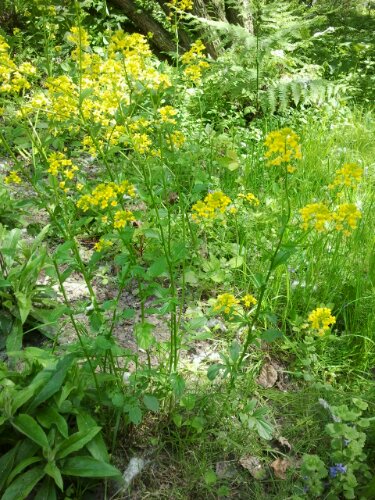
Lastly today, a photo of Marjoram (Origanum vulgare) which thrives in just a couple of spots in the park. I am always delighted when I see it in flower but at this time of year the plants are growing rapidly and the leaves are loaded with the aromatic oils, so prized by cooks.

365 Frankendael day 1

<img class="alignleft My new project to identify and document herbs in Amsterdam’s park Frankendael, every day for a year, began today. It’s quite damp and cold at present but many herbs are looking resplendent in Amsterdam. The parks give a good indication of biodiversity in the city as a whole. Here are a few photos of useful plants which are in full foliage or flower today, in Park Frankendael. They show Tansy (Tanacetum vulgare, a powerful emmenagogue) Purple Dead Nettle (Lamium purpureum, a salad and pot herb) and Comfrey (Symphytum uplandica). Hover over the photos for the names, if you are not sure which is which.
Some days I’ll be adding less photos and more information about the plants, other days will be more focused on photos. I’m really looking forward to watching the plants throughout the year, to sharing more ways to use them and find them on the streets and verges of Amsterdam and to improving my photography skills!
Several people have kindly offered to get involved with taking photos from time to time. There will be a little meeting on Sunday May 13th to share ideas.

Japanese knotweed, sweet sour yoghurt.

I so enjoyed harvesting, cooking and eating Japanese knotweed today, for the first time in my life.

I found several patches of the plant locally and harvested using a small knife, in much the same way as you would asparagus, except above the ground. The more mature stems were hollow, younger ones were very like asparagus within. Some had thin stems, some fat. I harvested young shoots, about 6 to 8 inches long, took them home, stripped away the leaves and thoroughly washed the stems before chopping them and boiling for 5 minutes in a little water.

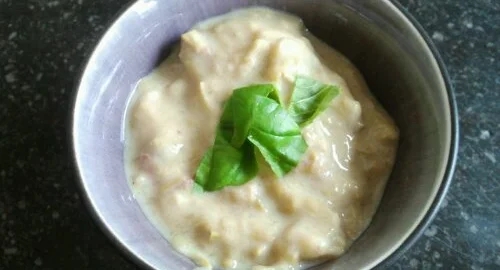
The taste was very rhubarby; tart, sour and in need of some sweet. Once cooled a little, I mashed the soft stewed stems with a little banana, homemade yoghurt, a dab of honey and a good pinch each of ground ginger and cinnamon. When combined to my liking, I served in a small bowl and garnished with torn basil leaves.

The outside of the knotweed was more fibrous than I had expected so next time, I shall either push the stewed stems through a fine sieve or pulverize them with a blender, before mixing with the other ingredients. Stringiness aside, this is a delicious dessert! Maida Silverwood’s book proposes freezing stewed knotweed and I shall certainly have a go at that, when I find more of it. I will also keep an eye on how the cut stems repair at my harvesting spot.


Please be aware of harvesting from clean untreated places (not the location shown above), the rules for rhizome disposal for this plant in your locality. In some countries it is a criminal offense to allow spread of the plant by careless disposal of the roots.

The roots were apparently used in ancient Chinese medicine for menstrual and post partum problems. It is certainly very astringent to taste and thus must have a drying, constricting effect on the body, at least to some extent.

I’ll do some research into the similarities with rhubarb and more historic medicinal uses. It is truly delicious and if you are a rhubarb fan I am quite certain you could also come to love Japanese knotweed.

Japanese knotweed

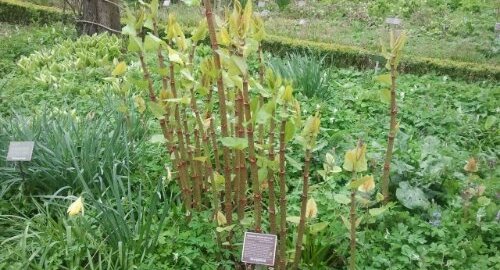
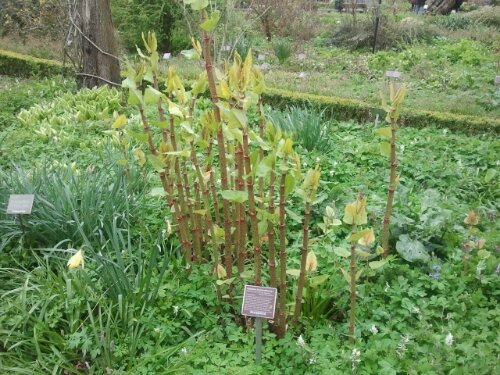
Japanese knotweed (polygonum cuspidatum) is an extremely invasive non-indigenous plant and gardeners who know it are generally distressed to find it on their patch. However, today I spotted this deliberately positioned specimen, growing happily in the Hortus Botanicus, Amsterdam. It’s even got an identification plate!

I once saw Japanese knotweed growing into a house which was being auctioned, yes into it, through the walls and under the floor! Needless to say, I didn’t make an offer to buy the place.

Seeing the plant reminded me that it is edible and apparently rather tasty too. According to the late Maida Silverman in her book, A City Herbal, it can be harvested and eaten in the same way as bamboo shoots, at this time of year. New York forager Steve Brill seems to like it, likening it’s taste to rhubarb. He also mentions it’s suitability as a companion plant, due to pesticide qualities. Personally, I don’t find the plant calls me to try it and I worry that by harvesting young shoots, the plant would further proliferate, in an attempt to survive. I hope I’m wrong because there is plenty of this plant growing in Amsterdam and I do love rhubarb crumble! What a great foraging plant this could be.

I’d love to hear from anyone who has tasted this plant. It is said to be quite tender, when cooked and to act as a gentle laxative. I’m also keen to know if harvesting, without pulling up the roots, would increase the plant’s chances of survival.

I wrote to Steve Brill about the harvesting issue. Here’s his reply…

On Apr 18, 2012 1:16 AM, “Steve Brill” wrote:
>
> Hi Lynn,
>
> Thanks for writing. As far as I can tell, it spreads wherever it can whether or not it’s harvested.
>
> Happy Foraging!
>

So knotweed crumble, here I come!

Coltsfoot: A look-a-like not to be coughed at

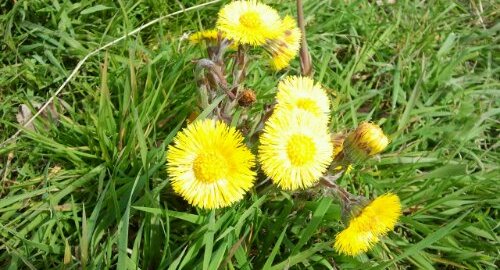
I found this cheerful looking Coltsfoot (NL: Klein hoefblad) plant in Frankendael a couple of days ago and thought it was time to look at some look-a-like plants which herbal foragers should be aware of.

Coltsfoot (Tussilago farfara) and Dandelion (Taraxacum officinale), which people often confuse it with, are both members of the same plant family (Asteraceae).  Both herbs are useful but Dandelion is generally the plant which herbal foragers are after. It is such a well known bitter herb and has earned an enduring place in the sophisticated kitchens of many cultures.  Coltsfoot flowers (if enough of them were to be gathered) can be used to make a traditional children’s cough remedy. However there are many who now avoid internal consumption of Coltsfoot, due to the discovery that it contains certain liver toxins called Pyrrolizidine alkaloids.

Many herbs contain small amounts of potentially harmful chemicals but when they are ingested as plant rather than separated chemical they tend to have a quite different effect on the body.  One tip for herbal foragers, who are concerned by toxicity, is that generally flowers contain less volatile and active ingredients than other parts of a plant.  Thus a flower remedy, made from Coltsfoot, should contain less alkaloids than one made from the leaves and roots.

Link to Susun Weed’s video, showing how to identify, harvest and make Coltsfoot honey cough remedy.

How to differentiate Coltsfoot from Dandelion:
1. The solid & scaley Coltsfoot stem is quite different to the smooth & hollow stem of Dandelion.
2. Both being members of the Asteraceae family, their flowers are similar but Coltsfoot flowers bloom on stems before the leaves have grown.  With Dandelion, the obvious, downward toothed leaves develop well before the flowers appear.

365 Frankendael

Many visitors to this site are interested in wild herbs and foraging. As you probably know, I do my foraging in the city of Amsterdam and am keen to encourage more of you to learn about the herbs around you. Often those I speak to are unaware that right here in Amsterdam, there are herbs to be foraged every single day of the year – if you know where to look.

From the New Moon in April 2012 I’ll be adding a little challenge to this site. I’m calling it 365 Frankendael because I live close to that beautiful Amsterdam park. I aim to post a photo and comment about herbs I have found in and around Park Frankendael, every day, for a year.

I’m sure to be away for some part of the year so will appeal for a little assistance when those times approach. If you’d like to help out then please contact me.

I hope you like the idea and will enjoy watching the herbal year in Frankendael unfold.

Ramsons are back on my plate!

They’ve been looking verdant and smelling great for weeks now but today was my first little ramsons harvest of the year. Just two leaves, plucked from a huge swathe of wild garlic, will be enough to set this evening’s meal alight. So that’s all I picked. I urge anyone thinking of foraging any plants, to abide by foraging rules and pick very sparingly. Only harvest what you know you will be able to use straight away.

Today I saw several ramson patches, on the edge of the lime avenue in park Frankendael, which were clearly recovering from careless picking. Leaves were torn, twisted and looked generally damaged. It’s saddening to see but more importantly it shows that many individuals don’t know how to harvest correctly and responsibly.

That’s the main reason I lead occasional herb walks in town. If you’d like to join at any time then please get in touch with me via email. I passionately believe that far more people should know the herbs around them and understand how to harvest if appropriate and use them safely. But unfortunately some foragers cause harm and I’d really like to help limit that.

There are many others herbs, currently looking ripe and perfect for use, here in Amsterdam. Nettle is just perfect at present, the new tips will be my next target for harvesting, destined for some home made pasta and a nourishing infusion. More on that next week.

Chickweed Amsterdam April 2012

Chickweed abounds!

Chickweed Amsterdam April 2012Chickweed makes a delicious and nutritious sandwich filling, it’s also plentiful, easily forage-able and available almost year round (it gets scorched and disappears at midsummer and has a slightly different form in mid winter but still tastes great).

It’s a popular medicinal herb, used as a tonic and for a multitude of ailments including skin complaints. It tastes fresh and peppery and it’s so successful that you are very likely to notice it as a”weed” in any plant pots or borders you may have. Birds love it, hence the name.

I took the photo this afternoon in my neighbourhood, the chickweed is growing in a city tree pit (aka dog latrine) so I won’t be harvesting this patch. But when I find chickweed on my balcony or in a nice clean area, I don’t hesitate to pick some for food.

If your not familiar with it use a good field guide for wild flowers to help with correct identification. Herbalist Susun Weed has lots of detailed information about this plentiful nourishing herb on her website.

As low impact lunch items go, I don’t think you can get much better than a weed which most people dig up and send for incineration here in town. If you haven’t already, please give it a try and let me know what you think.

Update:
Today I shared an exquisite meal at gastronomic restaurant Bord’deau in Amsterdam with my lovely and was delighted to find chickweed in one of the amuses! In the photo you will see a sprig of fresh chickweed nestling against beetroot and mustard ice cream. A perfect combination and what a great recipe that would be for the blog. The meal also included a sprig of what seemed to be rock samphire and many other seasonal herbs. Umm, no dinner required for me this evening.

May 21st – Urban Herbology Herb Walk

I’m pleased to announce another (and long overdue) Urban Herbology Wild Herb Walk in Amsterdam.  I’ll be running it on Monday 21st May 2012, from the main gates of Frankendael Park.  The walk will start at 11am and every one interested in finding out about wild herbs, which can be found in central Amsterdam, is welcome.

My previous walks have been great fun to organise and very well received.  We will take a relaxed look at the bounty of early summer herbs to be found in and around the park. The walk will last about 90 minutes and will probably end at the lovely cafe/restaurant Merkelbach, situated just inside the main entrance of the park. Cost per participant will be €8. Previous walks have been oversubscribed, it is essential that those wishing to join me book ahead. Please email Lynn.Shore@gmail.com or call me on 0627 596930.

During the walk I’ll share with you will…
Receive a useful handout, to refer to after the walk
Learn how to find and identify some safe, useful, local herbs,
Learn how to harvest with respect for the environment,
Learn how to use herbs safely in several different ways,
Receive some tastey Urban Herbal recipes.

And of course you will get the chance to meet other folk who like to know a little more about what’s growing beneath and above them!  If it sound interesting to you then please contact me.

Pembrokeshire Chamomile and Goji Berries

We have been away to Wales this summer; had a fabulous time visiting family and also an isolated barn in Pembrokeshire National Park.  There were too many wild herbs to mention them all and as I am just getting back into the swing of being connected to the world again here a couple of photos…

Behind this beautiful washed up crab is a shoreline variety of chamomile.  It smells wonderful and is much larger than the usual variety.
This is a very small part of an enormous goji berry hedge.  It grows to within a few metres of a windswept beach.