There will be an Urban Herbology Wild Herb Walk on Wednesday 2nd February 2011 at 13:00.
The walk will be in Frankendael Park, Amsterdam, starting at the main (old) gate. The plan is to take a relaxed look at which wild herbs are available at the moment, which will be ready soon and to share ideas about how to use them. A simple recipe sheet will be provided and €2 will be asked of attendees to help me cover the costs of this blog. Places will be limited. I have set up a new meetup.com group called Amsterdam Urban Herbologists so if you would like to attend you are invited to RSVP via http://www.meetup.com/Amsterdam-Urban-Herbologists/ as soon as possible. You will need to create a log-in for that site, if you don’t already have one. If it is too tricky and you would like to come along then please feel free to simply email me at lynn.shore@gmail.com or reply to this post.
I am really looking forward to seeing everyone on Imbolc (the first day of spring in the Pagan calendar) and having a relaxed look at some of the herbs which are currently available in the park.
Whilst walking around town today I noticed that Sweet Cicely (Sweet Chervil, Myrrhis odorata, NL: Roomse Kervel) is currently looking really strong and fresh. It is a member of the Apiaceae family and is quite easy to identify at this time of year because it is one of the few plants which survives above ground throughout the winter. It is useful as green leafy vegetable in its own right, the roots are also very tasty however if you are foraging, roots are not an option. Pulling Apiaceae roots destroys the whole plant. Sweet Cicely has a distinctly Anise flavour and smells rather like Lovage. It is packed with nutrients at a time when not many other leafy wild herbs are around and is found to be aromatic, stomachic, carminative and expectorant by herbalists.
Caution
Many members of the Apiaceae family (formerly called Umbelliferae family) are highly poisonous (e.g. Hemlock), others are edible and several have been cultivated such as parsley, coriander and carrot. Few members of the family are above ground right now but when foraging for Sweet Cicely, as ever, you should consult a good feild guide before deciding to pick. If in any doubt don’t pick or taste. Sweet Cicely makes a lovely, easy to grow pot plant and seeds are available through gardening suppliers.
Uses
If your reliable source of Sweet Cicely is unpolluted you may like to eat it raw, chopped into a salad. A simple tea can be made from the fresh leaves and stems, which is said to help releive indigestion and possibly help calm coughs. I prefer the following recipe from Denmark. I found it on a Danish Schnapps Recipe website which also contains some useful information about the herb and how to make the Schnapps from other parts of the plant, if you are using your own rather than foraged material.
Danish Sweet Cicely Schnapps
Put about 200ml chopped fresh Sweet Cicely leaves or stems into a clean glass jar.
Add 350ml vodka and seal with a well fitting lid.
Let the mixture steep/infuse at room temperature for 1 to 3 days.
Shake lightly and taste your infusion from time to time.
Strain and enjoy.
An alcoholic infusion can also be made using brandy. The vodka version apparently tastes rather like Greek Ouzo, I’m not sure if connoisseurs would agree.
Following on from my recent post about Elder, here’s how to make Elderflower tea.
It is very easy to make fresh Elderflower tea and there should be some Elder close to your home. When the shrub is in full bloom (May/June here in Western Europe) and on a warm dry day find an Elder away from polluting roads. Check you like the smell of the flowers, the scent of Elderflower varies from shrub to shrub and it is not always fragrant! Ask permission of the plant, in some way, to harvest flowers. Most countries have lots of folk lore about being especially respectful of the Elder and if you are not of the superstitious kind then do remember that Elder berries are important to wildlife later in the year – less flowers, less berries.
Select only healthy looking flower heads (umbels) which have creamy-yellow stamens as shown in the photo. Pick them carefully as they are very easily damaged, I tend to collect them into a paper bag to avoid squashing the umbels on the way home.
Don’t wash the umbels before use but do snip off any thick stemy parts and shake off any insects and unwanted bits. If possible return the insects and bits to the plant soon afterwards. After gently shaking, it helps to lay the umbels on some white paper for a few minutes. The tiny insects then tend to crawl out or at least may be easily spotted and removed.
Use one or two big umbels per cup of tea. You can use the actual flowers alone (although its a bit fiddly to separate them when fresh) or the entire umbels. I simply place whole umbels (sort of folded up) in a small tea pot, add boiled water, cover and infuse or 5 – 10 minutes. If making it in a cup, do cover with a saucer whilst it infuses.
If you would like to harvest Elder flowers to dry and store then collect them just before the shrubs are in full bloom (May/June). Harvest as above, lay out on paper to dry in a warm, well ventilated place. When thoroughly dry the little flowers can be rubbed off the umbels and stored in jam jars, in a dark place, for up to a year. You would use about 1 heaped teaspoon of dried herb per cup of tea.
It is well worth keeping some dried Elderflower in stock over the cold and flu months. Herbals generally recommend that it is freely taken for a few days during a cold or flu (up to 8 cups daily) and up to a few cups per day at other times. Refer to the post about Elder for a little more information about the properties and uses of this wonderful plant.
I like winter, it’s a good time to retreat into oneself and listen to what the darkness has to teach but I am always happy when I can see signs life reappearing in the plants around me. This week I can smell and see that happening as the sap starts to slowly rise in many plants. One of the most useful and familiar of herbs is certainly showing those signs at the moment. Elder (Sambucus nigra, NL:Vlier) is thankfully so common that there is most likely a modest specimen growing quite close to where you live. Perhaps you use it wisely already or perhaps you would recognise its flowers or berries.
I remember a very resilient old Elder which hung over my family’s driveway as a child. We didn’t know how to work with Elder at that time but the local birds evidently did. Each year our car would become covered with staining purple droppings as the birds gorged themselves on its ripe berries. The shrub was severely pruned each year to limit the damage and each year it bounced back, absolutely thriving in the clay soil and sunshine.
Elder has so many uses in traditional medicine that it is really worth getting to know. I shall post in detail about Elder one day soon, when I feel spring’s energies flowing through my own veins again. Until then I wanted to share with you one remedy which I used a few weeks ago with success.
Elder (in winter) for fever. Sambucus nigra is known, among other things, as a traditional fever remedy. It is effective at inducing perspiration which in turn lowers the bodies temperature yet is reputedly mild enough to be used for childhood fevers, when they are not extreme. Generally the flowers are used to treat fever and the berries to reduce the severity and longevity of cold and flu. Recently I felt a cold or flu creeping up on me and wanted to self treat with Elder however in late December neither fresh berries or flowers were available to me here in Amsterdam. A tea, using dried organic flowers from a healthfood shop, might have been an option but I wanted to experiment with a local Elder.
It is said that one should always ask permission of the Elder before harvesting from her so I sought out a strong Elder shrub in my nearby park and mentally asked to harvest enough material to treat myself. The bark and leaves of Elder also contain some of the fever reducing agents found in the flowers and berries.
I harvested a few healthy (and budding) young twigs and small branches (about 2 feet long in total and mostly second year growth).
I cleaned them a little with water and scraped the outer and inner bark from the branches and broke up the twigs which were too small to scrape. The remaining Elder material was kept aside.
The twigs and bark were placed in a small heavy pan.
I added about 700ml filtered and freshly boiled water to the pan and covered with a heavy lid.
This infusion was left at a fairly cool room temperature for 48 hours.
As time progressed I checked the infusion a few times and the smell of Elder became increasingly intense and the liquid became slightly gelatinous. It smelled fresh and tasted smooth, soothing and slightly sweet.
After 48 hours the infusion was strained and the spent plant material was kept aside with the unused material.
I drank the infusion over the following 4 hours, rested and wrapped up comfortably warm. I sweated more than usual and noticed a feeling of being cleansed and nourished. The threatening cold/flu came to nothing more than a few hours of feeling tired and hot with a slight headache. Of course this may or may not have been thanks to the Elder infusion but I will happily try it again when I feel a cold or flu trying to take hold.
The used Elder material was returned with thanks to the foot of the shrub from whence it came. One small branch was not used at all and is currently rooting easily in a vase of water on my kitchen windowsill. It has several healthy new leaves.
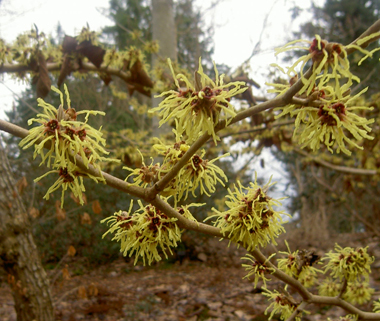
Witch hazel is one of my favourite shrubs and I am hoping to introduce it to my pavement garden this winter. When unrestricted its crooked, apple tree-like branches grow to 4 – 6 inches in diameter and the whole shrub can reach around 12 feet in height. However it can also do well in small spaces, such as large pots or pavement gardens (geveltuinen). It grows best in moisture retentive, acid to neutral soil and is adapted to living in light shade. Witch hazel is also tolerant of polluted city air and its unusual yellow October flowers make it a good option for the urban herbologist.
The leaves and bark of Witch hazel are very useful. They taste bitter, containing tannic and gallic acids as well as a volatile oil. Its effects are astringent, tonic and sedative so preparations of Hamamelis virginiana are often used to treat internal and external bleeding. The most well known uses of this herb are for treating piles, bruises and inflammatory swellings but it is sometimes used for diarrhoea, dysentery and mucous discharges. Please be aware that using Witch hazel internally should only be done under expert guidance. Due to its astringent effect, Witch hazel distilled extract (available cheaply from many chemists) makes a great skin toner. I used it as a teenager, it works well and I think it smells great. These days I use it mostly for treating bruises.
Chips of dried Hamamelis virginiana bark can be obtained from herbal suppliers. You may find this beautiful shrub in local parks, hedgerows and areas of woodland. It is also a fairly popular garden shrub due to the unusual winter flowers. Apparently it is very difficult to propagate Witch hazel by cuttings and the edible seeds (if you can find them as they are dispersed far and wide by explosion) can take over a year to germinate. I am hoping to take a winter cutting from a friend’s plant very soon. I’d be very interested to hear from anyone who has been successful in this.
Witch hazel can be used in many ways;
Tea (made from the leaves and young twigs or bark, fresh or dried) can be applied directly to piles or dabbed onto bruised or inflamed areas of skin. This also makes a milder skin toner than the distilled extract, often good for acne, oily skin and shrinking bags under the eyes.
Tincture, best made from the bark.
Fluid extract, if you can squeeze the juice out, can be included in ointments to calm varicose veins.
Distilled extract, easily obtained from chemists, great for dabbing onto bruises, insect stings and bites, applied very quickly as a compress for burst varicose veins – which are life threatening and need immediate medical attention. Can be applied to intact varicose veins as a soaked lint bandage, wrapped gently around the area loose enough to allow the blood to flow unrestricted.
Powdered bark, if you can make it then this can be applied to piles when combined in a cream or paste.
The first Urban Herbology Wild Herb Walk will take place on Friday 12th November. It will be in Frankendael Park, Amsterdam. I have emailed those who have already contacted me, with the meeting time and location. If you would also like to join us then please email me or send a reply to this post. I am really looking forward to seeing everyone and having a relaxed look at some of the herbs which are still available in the park.
I am organising a Wild Herb Walk in Amsterdam, this November. If you are interested in coming along, please contact me so I have an idea of the amount of interest.
This will be a relaxed walk, in an easily reached location, learning how to identify, gather and use some common medicinal and food herbs which grow wild in the city. Many beautiful, interesting and useful herbs are available at this time of year so why not join us, learn a little about them and get to know a few other UrbanHerbologists at the same time?
Further details will be posted soon. Please get in touch via email or in reply to this post if you are interested.
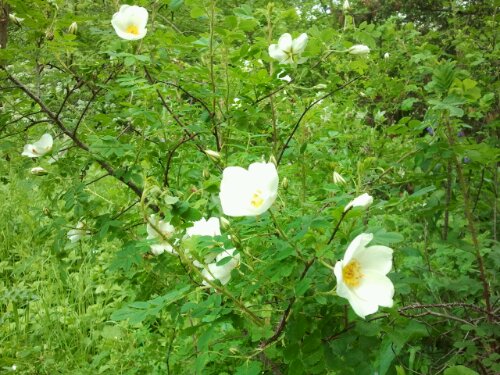
Rose is the plant of love, grown and used by women and men for millennia. There is much folk and magical lore associated with the rose, I shall post about this another time. Its petals can strengthen the heart and spirits and are found to have a cooling tonic effect on the female reproductive system. Rose hips are often used as a preventative tonic to strengthen the immune system and to aid those who are convalescing.
There are several species of wild rose in the UK: dog rose, Rosa canina; field rose, R. arvensis; sweet briar, R. rubiginosa; burnet rose, R. spinosissima and downy rose, R. villosa . R. alpina and R. rugosa also grow wild in the Netherlands. R. canina is probably the most familiar wild rose, with flask shaped hips shown here. Sweet briar is notable for the especially fragrant foliage. The hips of all roses are actually false fruit and the flowers of wild roses have only five petals, little scent and no nectar. Rose hips becomes softer and the dry calyx drops off later in the autumn, usually after the first frosts. Hips are ready to harvest when they are a deep red (or purple with R. spinosissima) and can be pulled from the plant with little effort, without damaging the foliage.
Rose hips (NL: rozenbottels) are a particularly rich source of vitamin C and rose hip syrup was produced in quantity and rationed in the UK during WWII. Roosvicee is a popular brand of rose hip based drink, here in the Netherlands. Rose hip jam has traditionally been produced in Germany (Roosvicee also produce rose hip jam), rose hip soup is still popular in Sweden and a wine based on rose hips has traditionally been brewed in Sweden and Russia.
Rose hips are used medicinally in teas (1 – 2 tsp hips or 1/2 tsp powder in a 2 cup pot of water), infusions (steeped for up to 4 hours) and syrups. Hips may be used fresh or dried. Once dried they can be ground into a powder. Most recipes call for the removal of the hairy seeds by straining as they can be very irritating.
Rose hips from Rosa canina
Rose petals can also be used in a variety of ways such as; layering with grease-proof paper wrapped butter to impart their heavenly aroma into the fat, adding to bath water, eating in salads. I prefer heavily scented garden roses for these uses as I can’t bear to see the flowers removed from wild rose bushes (and they have little scent anyway). Rose petal glycerite is also very simple to make but requires lots of petals.
These days I only have access to small quantities of rose hips and I prefer to make a good strong syrup from them, or a tea if I can only collect a few. Here is a very simple traditional recipe for rose hip syrup which can be used for any quantity of hips. I use this recipe whenever I collect a cup or more of hips and it is beautiful, delicious and useful. The colours and aromas of this recipe are always magical. I have also included a raw syrup recipe, from Hedgerow Medicine, by Julie Bruton Seal & Matthew Seal. I haven’t yet tried it, as I always want my syrup quickly, but it sounds interesting and is thought to have a higher vitamin C level than the boiled version. Do let me know if you make it.
Traditional Rose Hip Syrup
Clean and sterilise your syrup bottles#.
Wash your harvested hips and remove any dry calyxes and stalks.
Measure the volume of your hips and boil them in half that volume of water. Simmer for 20 minutes with lid on pan.
Turn off heat and use a fork to lightly mash up the hips into the liquid.
Allow the pulpy brew to cool to a manageable temperature.
Strain the brew (mashed hips and liquor) through a sterilised jelly bag or tea towel or muslin cloth, into a clean bowl. Get as much juice out of the pulp as possible without squeezing the seeds through the jelly bag or cloth.
Rinse your saucepan.
Measure the volume of the extracted juice and return it to the clean saucepan. Add half that volume of sugar and give it a little mix.
Bring the juice and sugar to the boil then simmer for 5 – 10 minutes, stirring regularly.
Pour the syrup into sterilised bottles, seal with a tight lid and label.
#A guide to how many bottles you will need – Yesterday I collected one and a half cups of ripe hips. This yielded about 150ml of syrup.
Raw Rose Hip Syrup
Clean and sterilise a wide mouth pickling jar (NL: available cheaply in Blokker)
Clean and prepare your rose hip harvest as above – then dry them off.
Gentle score the skin of each hip, a few times with a sharp knife.
Cover the bottom of your jar with a layer of caster sugar. Then make layers of hips and sugar, so that all the spaces between the hips are filled with sugar.
Close up the jar and leave on a sunny windowsill for a couple of months or until the juice has been drawn out of the hips and liquified the sugar.
Strain off the liquid, bottle and store in the fridge.
Legal Disclaimer: The content of this website is not intended to replace conventional western medical treatment. Any suggestions made and all herbs listed are not intended to diagnose, treat,cure or prevent any disease, condition or symptom. Personal directions and use should be provided by a medical herbalist or other qualified healthcare practitioner with a specific formula for you. All material on this website is provided for general information purposes only and should not be considered medical advice or consultation. Always check with your personal physician when you have a question pertaining to your health and healthcare.

 There will be an Urban Herbology Wild Herb Walk on Wednesday 2nd February 2011 at 13:00.





 Urban Herbology