I love the spirit of TED, where ordinary people stand in front of an audience and speak about Technological, Entertainment and Design ideas that are worth spreading. I’ve watched some great talks in recent years and each has taught me something, has made me think slightly differently and has spurred me on to do what I know is right. Amsterdam International Community School will host a TEDxYouth event in November and I am so excited to be speaking there. The title I have given my talk is Edible Cities. I am totally buzzing with ideas but as I prepare my 15 minute talk, I’d like to hear your thoughts about what I should say to the audience of predominantly 16-18 year olds. I am hoping that your thoughts will help calm me down and focus my thoughts to less than a million!
If you don’t know TEDx, then perhaps take a look at these videos to wet your whistle..
July saw the first Herbal Ferments Circle at Brouwerij t’Ij. A hearty group of us gathered on a sunny evening to swap stories, taste Meade, exchange Kombucha SCOBYs, herb plants, talk tempeh technique and generally have a good time.
Those summer evenings are gone but there is fruit on the local trees and the weather is getting witchy! This is a great time to brew interesting concoctions so I feel that another fermentation meeting is due. I’m thinking of a gathering on the evening of Thursday 31st October. But where should we meet?
Today, I finally emailed the distillery in Flevopark, to see if they could welcome us this autumn. But I fear we may have to wait until spring for that venue. So can you suggest another easy to reach Amsterdam venue? And would you like to join us? Restaurant Merkelbach is a favourite haunt of mine. It is on the edge of the Frankendael woods, so weather permitting we could also take a stroll in there and have a drink and chat in Merkelbach.
Please let me know what you think and your venue suggestions through the comments box here, via the Facebook group or by emailing me (lynn.shore@gmail.com). Please do the same if you would like to join the herbal ferments circle.
UPDATE (19/09/2013): This course is now full. If you would like to be on the waiting list then please let me know – Lynn.
Sign up for the next free River of Herbs course!
Newcomers are welcome and also those who attended the previous course.
This course will cover all the material that we worked on in 2013 but will be based at set locations along the River of Herbs Amsterdam edible/wildlife corridor. Participants will help to create the corridor whilst learning green skills.
River of Herbs Amsterdam Wildlife Corridor We are currently planning an ambitious River of Herbs corridor, running from the A10/Middenweg intersection up to De Hortus Botanicus then onward through Amsterdam Centrum and finally out to De Baarsjes in Amsterdam West. The River of Herbs corridor will be made up of tree pits, geveltuinen (pavement gardens) and small unused spaces, all planted by volunteers with edible/medicinal herbs which are useful to pollinating insects and people. The Amsterdam River of Herbs will also include the transformation of a public orchard in Park Frankendael into a community Food Forest. The River of Herbs edible/wildlife corridor is being created by the collaboration of Urban Herbology (based in Amsterdam Oost), FoAM and City Plot Amsterdam (both based in Amsterdam West). Groups of local people are being helped to plan, plant and maintain small urban herb meadows, for the benefit of people and pollinators.
Who is this course for?
Anyone who wants to learn how to grow herbs safely in disused urban spaces & how to help pollinating insects.
Dates 2014:
Four Monday afternoons 13.30 – 15.30
February 10th
March 10th
May 12th
June (day tbc)
You will learn how to:
Identify and prepare unused spaces for growing useful perennial, biennial and annual herbs.
Sow suitable seeds and plant cuttings, roots etc. in these places. Choosing for location, wildlife, food or medicine.
Harvest some of the herbs without compromising their usefulness to pollinators such as bees, hoverflies and butterflies.
Teach others how to grow and use these herbs.
Create and manage an urban River of Herbs.
The first group of River of Herbs volunteers completed the 2013 training course. Those who showed that they can plan, plant and maintain an urban herb meadow are now able to train other groups of volunteers, using the River of Herbs materials. You can see some of the sites that the first group worked on, using our map.
You will receive:
Four 2 hour sessions of hands-on urban green training.
Course book – an updated and condensed version of the 2013 River of Herbs booklets.
Ongoing support – we have an active Facebook group and can be contacted by email or telephone.
Green skills experience and work reference – for those who complete the course and can show their skills.
The 2014 course is being run by Lynn Shore from UrbanHerbology.org.
Plants and tools are provided – you are welcome to bring along more if you like.
Cost:
Free to participants (value 250 Euro per person) All costs will be completely covered by Groen en Doen vouchers. River of Herbs will organise this for applicants. If you want to join this course you must simply contact us and we will organise the funding. The funds generated by the vouchers will be used for the River of Herbs corridor project. Groen en Doen vouchers are offered to enable green skills training for volunteers.
Number of places:
12.
Please apply if you are seriously interested in helping us plan, plant and maintain the River of Herbs Amsterdam wildlife corridor. This is a very exciting and worthwhile project which needs a whole community effort to make it work. Be part of it!
Apply:
Please contact us directly – riverofherbs@gmail.com
UPDATE (19/09/2013): This course is now full. If you would like to be on the waiting list then please let me know – Lynn.
It has been a busy summer full of events, group walks, a Permaculture Design Course, writing, interviews and a lovely holiday in France. Now it is time to slow down, take stock and take a closer look at some of the plants ripening for harvest around me here in Amsterdam.
Rosehips, of all shapes and sizes are redening, softening and just asking to be added to honey and pies (when the itchy seeds have been scooped out of course). These rough roses are amongst the first to ripen and amongst the most flavourful.
Wild Rocket, Ijburg pavement. This beautiful spicy specimen is currently forming hundreds of tiny seeds – just right for saving and planting closer to home in clean locations. Yesterday I filled a plant pot and sowed some of these seeds, hoping for more deep winter fresh herbal food. Rocket is often available mid winter and is packed with flavour and nutrients.
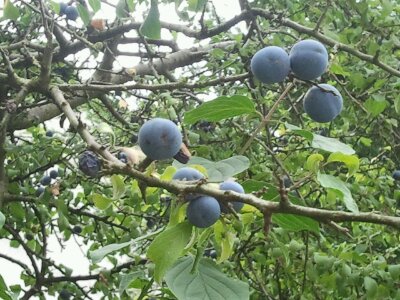
Sloes, forming on a playground Blackthorn shrub. Some of these are now infusing in a small jar of Genever, in time for some Yuletide cheer.
Packets of River of Herbs 2013 seedmix. I gave out some of these at the Children’s Pizza and Flevopark walk recently. They are full of locally harvested herb seeds. Lots of things are planned for the River of Herbs soon. Please keep in touch about your urban herb meadows and other projects.
Photo credit: Mara Pellizzari
Coming up
I have two more walks planned for this month, at the Magneet Festival. Then in October, an Exotic Herbs workshop with Suzanne of City Plot and in November a dinner talk at the Lloyd Hotel for Steinbesser experimental gastronomy. If you are interested in attending any of these then please get in touch.
Apprenticeship
A few people have asked when my next apprenticeship group will begin. The next group is planned to begin in Spring 2014. It will run on Mondays and anyone interested is very welcome to contact me from now on. Here is a link to the syllabus (it needs a little updating but it should give you the idea of what I intend to cover on the course).
Here is a taster of the edible and amazing plants which can be found at the sandy Magneet Festival site, in Amsterdam Oost. This is Evening Primrose (Oenothera sp.) NL: Teunisbloem, a useful and tasty plant.
I was asked to lead a foraging walk each weekend, throughout the duration of the month long festival, by the Mobiation Project. This is their home, the Mobi-01. They slowly move around vacant spaces of Amsterdam, living sustainably, in this self made residence. The Mobiators were asked to run the Green Zone of the Magneet Festival this year and have organised a great selection of workshops and events. You can learn how to make solar dryers, solar heaters and many other things from the Green Zone this year. It is really inspiring and well worth a visit. Here’s their Facebook link.
So each Sunday that the festival is on, I’m giving free guided walks at 4pm, from Mobi-01 in the Green Zone. I’m showing interested people what can be found growing in the sand. At first glance there is not much of green interest but if you look closely you will find treats such as…
We found many other edible plant species growing in the sand. Burdock (Arctium lappa) NL: Grote Klit. was the biggest surprise for me, I haven’t found it in such a pure sand location previously.
Next week I’ll be taking along some local edible plant seeds and wild flower seedbombs, to plant during the walk. It would be great to see a few other plant species find their feet in this unusual site.
This morning was an Oak Apprenticeship meeting and this afternoon, a walking-cooking magazine interview. Mugwort(Artemisia vulgaris) was a welcome participant at both gatherings. This common urban herb offers a plethora of uses and is currently flowering here in Amsterdam.
Mugwort has a strong aromatic taste and is not the easiest herb to eat raw. The leaves are full of a strong fibre which is almost impossible to chew through when eaten raw. These fibres are used to prepare the Moxa of Chinese Traditional Medicine. In summary Mugwort is a warming herb, a women’s ally, encouraging menstruation, may ease period pains and is a warm soother or muscle tension and pain. It makes a simple and useful infused muscle rub oil and even simpler, a foot soak, when infused in water. The tea is unusual to some but is tasty and not unpalatable. It can be used to deter insects. A protective herb. This is the abundant urban herb of dreams, scrying and prophecy. Seek it out in flower, to enjoy the peak of it’s spiritual powers. In bud and in flower, it is also easier to prepare for cooking (although this is not the best time to harvest for cooking). You can simply push the little flowers from the stems and sprinkle them into cooking.
Mugwort is in the Asteraceae family. It is sister to Wormwood (Artemisia absinthum), Southernwood (Artemisia abrotanum) and Tarragon (Artemisia dracunculus) to name but a few. Mugwort is thought to unsafe during pregnancy and should only be used in small culinary quantities, watching for sensitivities, by others. Here’s a link regarding some known side effects and drug interactions.
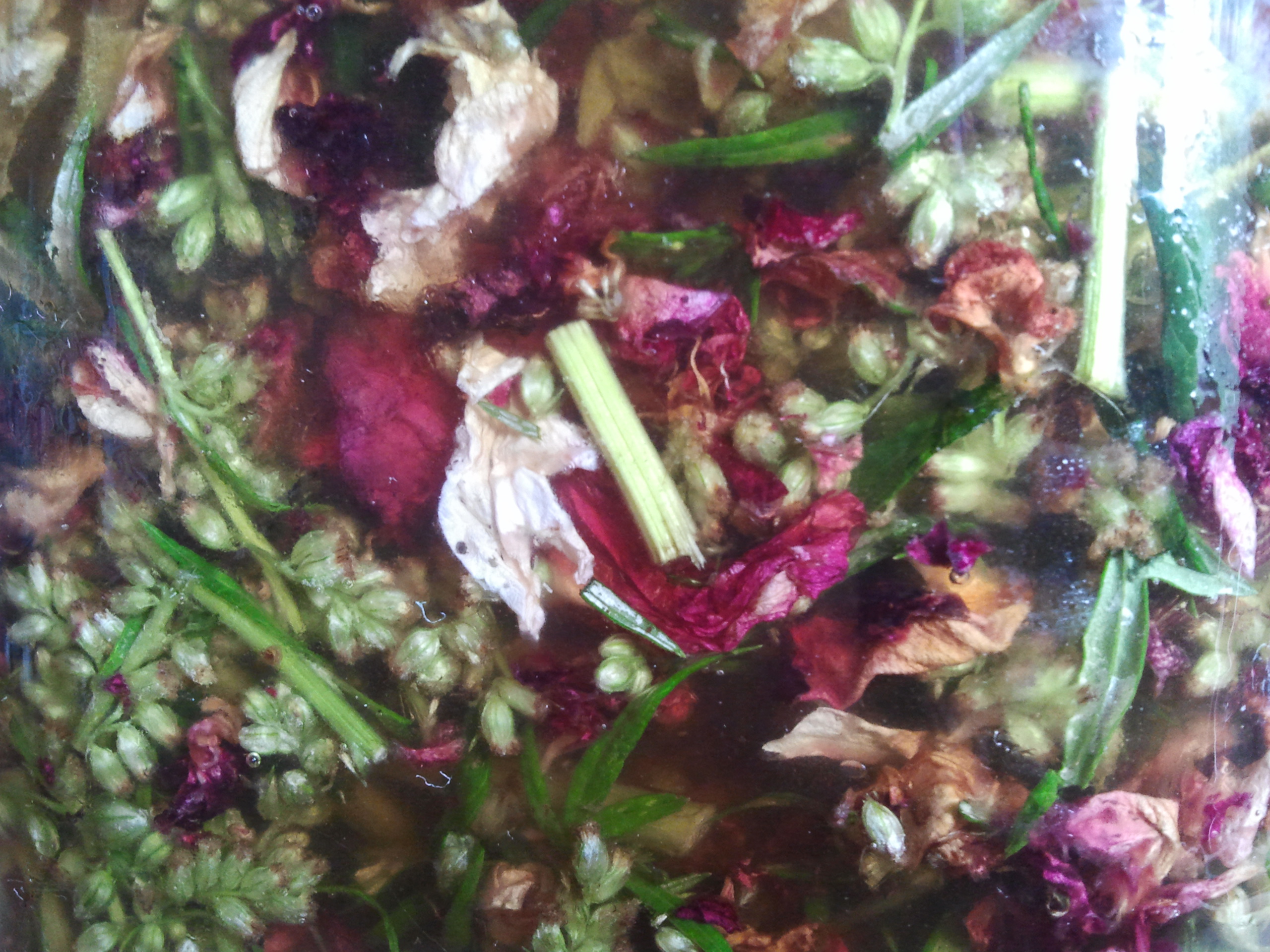
Today I harvested plenty flowering tops of Mugwort and used them to make tea and a simple savoury dish. I then hung some on my willow rack to dry for out of season use and made the rest into this delicious elixir…
Mugwort and Rose petal Elixir
1. Harvest a few flowering tops of Mugwort, gather about the same amount of clean, unsprayed Rose petals (I used dried purple petals today, from Jacob Hooy). Lay out any fresh herbs for a while to allow resident bugs to crawl safely away.
2. Chop the Mugwort and if necessary, separate the rose petals from their flowers (if using fresh roses).
3. Place the prepared herbs in a suitable clean glass jar, where they will take up approximately half the space.
4. Cover the herbs with runny honey.
5. Use a chopstick to distribute the honey more evenly over the herbs.
6. Now fill the remainder of the jar with Brandy (or another strong spirit of your choice).
7. Cover the jar with a well-fitting lid, label and leave the contents to infuse for four to six weeks or more.
8. Strain, bottle and label the resulting Elixir.
9. Use in very small quantities, as an occasional alcoholic, heart and spirit warming elixir.
Photo credit: Van Gogh Museum
You will have a chance to taste this Elixir at the second of my Friday Nights at the Van Gogh Museum, on 30th August. The honey for making the preparations at these events, was generously donated by deTraay and the dried herbs by Jacob Hooy. If you have Facebook or not, check out this link to see Van Gogh Museum photos from the event on Friday 2nd August – it was a lot of fun! More information about the plants and where they will go here.
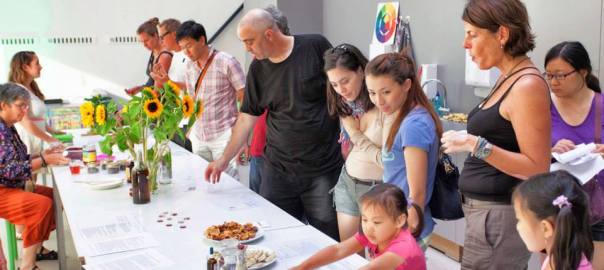
On the evenings of Friday 2nd and Friday 30th August, I’ll be inviting visitors of the Van Gogh Museum to learn about and taste some edible and mind altering plants, which Vincent van Gogh used. Myself and a few able assistants will be installed with a selection of his most inspiring plants, some snacks and drinks, in the Atelier (Workshop studio), just inside the main museum entrance. Join us to sample some urban foraged delights, to learn how to make your own Absinthe, herbal honeys and other interesting things. I’ll give a couple of 15 minute presentations about the Edible Flowers of Van Gogh (7:15 pm) and the Mind Altering Plants of Van Gogh (8:15 pm). The rest of the time will be devoted to teaching individual visitors how to find and use local plants. Entrance is free to Museumjaarkaart holders and for everyone else it’s the usual museum entrance price. I’m giving away a couple of tickets: Read on to find out how to enter the ticket competition…
Mind Altering Plants of Van Gogh
The use and abuse of Absinthe, by Van Gogh and his freinds, is well known. Wormwood, an endangered but easy to grow plant, is the key ingredient in the drink. We’ll let you sample an easy to make alternative with great taste and far more uses than Absinthe. There are other common plants which had a huge impact on the creativity (and possibly the early grave) of Van Gogh. I’ll talk about them in the second presentation and we will have some of the featured plants for you to see close up.
Edible Flowers of Van Gogh
Most of Van Gogh’s paintings feature plants and flowers of one kind or another. Although many were painted in a warmer climate, most grow here in the Netherlands and many can be foraged from our local parks and streets. The presentation about Van Gogh’s edible flowers will highlight some beautiful, tasty and useful plants which feature in his work. The plants chosen are easy to find in Amsterdam and are easy to use. You will also learn the foraging rules for harvesting safely, ethically and legally and how to get involved with other foragers.
Eat, Drink and be Merry!
My home is currently full of foraged-flower honeys, strange urban brews and drying bunches of edible plants, just waiting for you to taste them at these August events. You can find out how to make your own foraged treats, ask us questions about urban harvesting, watch the presentations or just hang around with the beautiful plants. As well as this part of the evenings, there will be music, video and other events going on throughout the museum. So please put the dates in your calander and come visit us at the Van Gogh museum, on the 2nd and 30th of August. And if you come along, remember to say hello!
Photo credit: Grainne Quinn
Free Ticket Competition
To enter the competition for free tickets, please email me (lynn.shore@gmail.com) with the answer to one or both of these questions:
For Friday 2nd August: Which plant is the main mind altering ingredient in Absinthe?
For Friday 30th August: How old was Vincent van Gogh when he died?
Winners from those replying correctly, will be chosen at random on Wednesday 31st July and Wednesday 28th August. So if you enter, keep an eye on your email. I’ll post the winners names here also. They will need to turn up to the event with valid ID at a specific entrance, to claim the ticket.
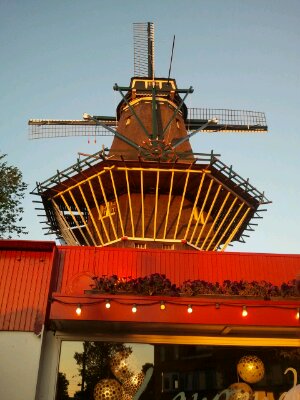
I had a great time last night, meeting a large bunch of Urban Herbies at Brouwerij t’Ij (the windmill brewery in Oost). We talked about making Mead from herbs, honey and water and also about brewing a strange microbial tea loving symbiosis called Kombucha. We also tasted my Rosehip and Lavender Mead, which I set up last November and virtually forgot about since then. It can’t have been too bad as the bottle is now empty! Looking back at my notes, I see that it also contained Peppermint.. Umm!
Several of the group went home with strange slimey icecube shaped SCOBYs. Here is the link to my post about how to brew Kombucha and what some people feel it is good for.
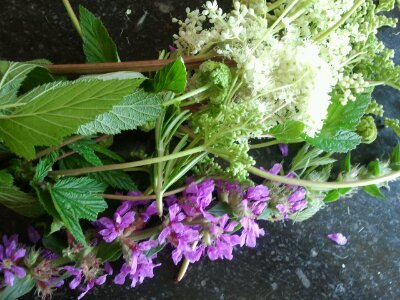
Now to the Mead! Inspired by fermenting comradeship, I took to the woods this morning and harvested some Meadowsweet (Filpendula ulminaria). You will see it looking pale cream and frothy in the photo above. It’s rather overexposed (sorry Grainne!) but I hope you get the idea. Now is the optimal time to harvest the flowering tops of this plant. If you are lucky and find it (canalsides, damp areas, lake edges etc), then as ever be thoughtful, and harvest only a tiny fraction of the plant. You don’t need much anyway for this recipe – in fact you don’t need any! I chose to add Meadowsweet today because the common English name of the plant is said to be linked to the delightful flavour it gives to Mead. I suspect that those frothy cream flowers are also home to many micrscopic yeasts, to get the mead fermentation off to a great start.
I also added one flowering top of Hyssop (Hyssopus officinalis) a beautiful tall waterside purple flowering Lamiaceae family member. This herb is catching my eye all over town at the moment and I fancied seeing how the flavour develops in my Mead. As I reached home from this forage, I just couldn’t resist snipping off a sprig of outrageously aromatic Rosemary (Rosemarinus officinalis) from my geveltuin (pavement garden). It is on top form at the moment, due to the long awaited summer heat.
So the three herbs chopped up and added to the Mead pot (it’s a simply a 2 Litre Fido pickling jar from Blokker with a tea towel and elastic band over the top). I only had a quarter jar of honey in the house today so I added that and about 2 jars of water to the mix. So now I have a handfull of fresh chopped herbs steeping in honey water. That is how mead begins. As things get going I’ll add more honey and more water but I look forward to seeing how this batch turns out.
Now we talked last night about getting wild yeast fermented Mead “going” by adding a tiny sprinkling of a culinary or winemaking yeast. I have a big packet of Champagne yeast somewhere at home, purchased from BrouwMarkt.nl (a great company in Almere which sells everything for home brewers). Unfortunately I can’t find the Champagne yeast at the moment so I have decided to stick with Sandor Ellix Katz truely wild fermented Mead method of stirring vigorously every time I pass by the Mead jar. This should aerate the mixture and where there is air, there is yeast, so things should get going of their own accord. I shall continue to do this until I notice a sort of froth at the top or some other change in the contents of the jar. Then I’ll move onto the next phase.
For phase two I’ll place the young mead in a 2 litre green glass demijohn with a water airlock and rubber bung to keep out other bugs. My demijohn and airlock are from Brouwmarkt. They are very well priced and extremely convenient for brewing in small spaces which may not be dark. That’s as far as my last experiment went. I then simply syphoned off a bottle full of the result yesterday evening to take along to the meeting. I should apparently have paid closer attention to it all and bottled the Mead when the bubbling ceased early this year and either drank it soon after or left it in the bottles to mature. No matter, the result was drinkable and I am keen to continue my experiments.
I’m mentally planning our next Herbal Ferments Circle for the Jenever Distillery at the top of Flevopark (near the end of tram 14). If you have been exprimenting with ferments, even if only mentally, then get in touch and perhaps join us next time. I’d love to hear what you have been making or planning, if you did come along last night or not! I’m now calling it a Fermentation Circle because we seem to make more than just one brew. Yesterday there was talk of Idly, Tempeh, Sourdough, Gingerbeer plants, Kefir and far more. It’s amazing what people get up to when they get the chance! For me the focus will mainly be on Mead because that is very exciting to me – so many herbal possibilities, so simple to make, so historic, so tasty and it relies on my favourite potion ingredient – honey.
Please join me on the evenings of Fridays 2nd and 30th August at the Van Gogh Museum, Amsterdam. Learn about the herbs of Van Gogh, which can be found, foraged and used today.
I am delighted to have been asked to teach visitors to the Museum’s Friday Nights programme, about edible urban herbs, on these two dates in August. Throughout each evening, I’ll be giving a couple of talks about plants which were important to Van Gogh and helped change the world of art. Many of his favourite plants may be found and eaten in Amsterdam today. You’ll learn where to find them and how to use them and grow them.
There will also be some urban herbal treats to sample, plants to examine close up, recipes to take home, a plant photo exhibition and opportunities to chat and learn more about urban herbology. In other parts of the museum there will be a jazz band and other interesting events.
My scheduled presentations will be about: Edible Flowers of Van Gogh Mind Altering Plants of Van Gogh
(Both presentations on each night).
So why not come along, have a chat and find out more!
Friday 2nd August and Friday 30th August
6.00 – 10.00pm
Van Gogh Museum,
Museumplein
Amsterdam
Entrance is free to Museumjaarkaart holders.
Usual entrance fee to others.
Elderflower infused honey: A great ingredient for home made Mead.
I love to drink a little Mead (fermented honey based drink) now and then but find that most available options in Amsterdam are quite expensive and are not as exciting as I know they could be. I bought a 75cl bottle of De TraayHeather Honey Mead, from Ecoplaza this week. It tasted good but it set me back a cool 15 Euro!
I would like to start a free Mead Circle as a way to encourage myself and others to brew their own, here in Amsterdam (and elsewhere, if they fancy joining by VoIP). Some other people must already be doing this close by and it would be great to hear from them.
Making mead is quite simple. It is simply the alcoholic fermentation of the sugars in honey water. The yeast can be captured from the air or can be inoculated from a known culture. It is likely to have been the first alcoholic beverage that humankind enjoyed as it is made quite naturally, when water and honey mix and sit for a while in a yeast rich atmosphere. It is less complex than the home brewing of wine but requires similar apparatus for reliable results. We have a great resource close to Amsterdam: Brouwmarkt.nl in Almere, which sells all the fermenting apparatus you could wish for and delivers for a reasonable price. Mead making is fun and allows you to experiment with all sorts of herbal flavours. I really want to start experimenting more with it and would love to occasionally meet for a chat and tasting session with some other like minded people. As ever, I am interested in experimenting in a very small kitchen. I don’t have space for massive vats of bubbling concoctions but I do have space for a 2 liter container for example and that is enough for making mead!
If you would like to join the Urban Herbology Mead Circle then please email me (lynn.shore@gmail.com) or post a comment here. Let me know when the best meeting times and areas are for you. When a small group has emerged, I will set a date and we can start meeting and sharing.
KOMBUCHA CIRCLE
The amazing world of SCOBY fermentation, in a 2 litre pickling jar from Blokker.
Years ago, I bought a 4cm x 4cm chunk of Kombucha SCOBY from a company in the UK (for 10 Pounds!). It arrived in a tiny package of Kombucha vinegar and I intrepidly set it up in a large jar of sweet green tea, nestled in a corner of a warm cupboard. Since then, that tiny SCOBY has provided me with gallons of tasty Kombucha drink and also useful Kombucha vinegar. The SCOBY is a symbiosis of a specific yeast and bacteria. They live in a sort of fermenting harmony, and their sole mission in life seems to be transforming the sugar in sweet tea into a mild effervescent very lightly alcoholic drink (resembling a green tea flavoured real Ginger beer). If you leave it to brew for longer it makes vinegar. A lot of people seem to like drinking real Kombucha. I receive a steady trickle of requests from people who want to exchange one of my SCOBYs for herbs, chocolate or other wonderful things! My original SCOBY quickly grew into what we call a Kombucha mother and she now doubles her size one a fortnight or so. When this happens she sheds another SCOBY and these can be shared with other people.
Many of the people who have received my baby SCOBYs, send me photos and questions about their development (or otherwise!). I would like to start a Kombucha Circle to help link up those people and so that we can meet once in a blue moon to share recipes, experiences and advice. Some of the people that I have met through Kombucha, live in other parts of the world. Anyone with an interest in Kombucha is welcome to join. we can try some VoIP time to help those in distant lands share with us here in Amsterdam.
If you would like to join the Urban Herbology Kombucha Circle then please email me (lynn.shore@gmail.com) or post a comment here. Let me know when the best meeting times and areas are for you. When a small group has emerged, I will set a date and we can start meeting and sharing.









 Urban Herbology