Category Archives: Foraging

Oregon grape, Berberis aquifolium

I was out walking in my Amsterdam neighborhood today and as usual noticed lots of Oregon grape (Berberis aquifolium) in landscaped areas. Every time I see this plant, I remember reading about how it is edible and in fact, a highly regarded herb. I have never used it but decided to learn and share a little about it today.

You can easily find out lots of information regarding this herb on the Internet or in books. It’s a herb with quite a history, being the state plant of Oregon. I find the most interesting facts are that:

1. It is a powerful liver stimulant and cleanser.
2. The roots are bright yellow and highly regarded by herbalists seeking a strong stimulant effect.
It doesn’t really sound like a herb for me because of this potency. Tonics tend to be much safer and more appropriate for adding to everyday meals.
3. It must be avoided by those who already tax their systems, for instance by eating lots of heavy meals.
4. The berries are black, obvious and plentiful when autumn arrives. They are very rich in vitamin c and have a very bitter taste.

I’ll be sampling the berries in autumn and will post more Oregon grape entries on Boskoi. I’m thinking of adding a handful to a Rumpot. It has obviously been an Amsterdam landscape architect’s favorite over the years consequently there are plenty of dense Oregon grape plantings in town.

Frankendael 365 – Get Involved

Meet on Monday 16th April, 2012, Frankendael Park if you would like to get involved!

I’m starting the 365 Frankendael project on 21st April 2012 and would love to meet anyone who fancies helping out by taking occasional photos and maybe identifying some herbs, which they notice in and around that park (or other places in Amsterdam, which I’ll also document on the blog).

I’m going to document herbs which are “in season” in Park Frankendael, every day for a year. The more photos and info I receive, the more useful the project should be for other people who like to forage here in Amsterdam or who simply like to know what is growing here.

This gathering is just to meet anyone who may like to get involved with the project, however infrequently. You don’t need anything more than a camera and ability to email me. I’m friendly and love talking about and looking at plants!

If you need more info or you can’t make it but want to get involved, then please send me an email.

I look forward to meeting you there!

I have set up a meetup.com group (with Jennie Akse) and that’s another way to contact me, if you prefer. Anyone can join the meetup group.

Coltsfoot: A look-a-like not to be coughed at

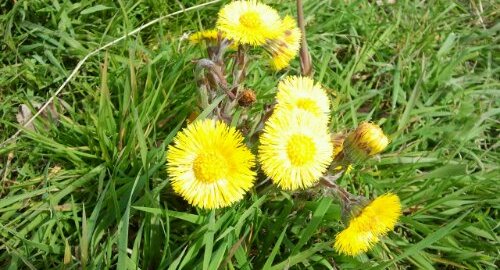
I found this cheerful looking Coltsfoot (NL: Klein hoefblad) plant in Frankendael a couple of days ago and thought it was time to look at some look-a-like plants which herbal foragers should be aware of.

Coltsfoot (Tussilago farfara) and Dandelion (Taraxacum officinale), which people often confuse it with, are both members of the same plant family (Asteraceae).  Both herbs are useful but Dandelion is generally the plant which herbal foragers are after. It is such a well known bitter herb and has earned an enduring place in the sophisticated kitchens of many cultures.  Coltsfoot flowers (if enough of them were to be gathered) can be used to make a traditional children’s cough remedy. However there are many who now avoid internal consumption of Coltsfoot, due to the discovery that it contains certain liver toxins called Pyrrolizidine alkaloids.

Many herbs contain small amounts of potentially harmful chemicals but when they are ingested as plant rather than separated chemical they tend to have a quite different effect on the body.  One tip for herbal foragers, who are concerned by toxicity, is that generally flowers contain less volatile and active ingredients than other parts of a plant.  Thus a flower remedy, made from Coltsfoot, should contain less alkaloids than one made from the leaves and roots.

Link to Susun Weed’s video, showing how to identify, harvest and make Coltsfoot honey cough remedy.

How to differentiate Coltsfoot from Dandelion:
1. The solid & scaley Coltsfoot stem is quite different to the smooth & hollow stem of Dandelion.
2. Both being members of the Asteraceae family, their flowers are similar but Coltsfoot flowers bloom on stems before the leaves have grown.  With Dandelion, the obvious, downward toothed leaves develop well before the flowers appear.

365 Frankendael

Many visitors to this site are interested in wild herbs and foraging. As you probably know, I do my foraging in the city of Amsterdam and am keen to encourage more of you to learn about the herbs around you. Often those I speak to are unaware that right here in Amsterdam, there are herbs to be foraged every single day of the year – if you know where to look.

From the New Moon in April 2012 I’ll be adding a little challenge to this site. I’m calling it 365 Frankendael because I live close to that beautiful Amsterdam park. I aim to post a photo and comment about herbs I have found in and around Park Frankendael, every day, for a year.

I’m sure to be away for some part of the year so will appeal for a little assistance when those times approach. If you’d like to help out then please contact me.

I hope you like the idea and will enjoy watching the herbal year in Frankendael unfold.

Hairy bittercress – A free lunch


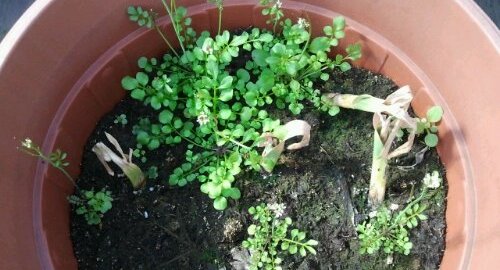
I did a spot of roof gardening this morning and was very pleased to find this herb growing in a neglected plant pot. It’s thought of as weed by most and yet it’s providing at least two services here; covering lots of surface soil thus acting as a green mulch and also it’s soon to be part of my food!  Hairy bittercress (Cardamine hirsuta) spreads readily by seed and is very successful at monopolising open ground. According to Wikipedia it can be quite a nuisance in lawns, in fact there are many articles on the internet dedicated to eradicating this plant. What a waste, it tastes so good and I’d prefer a useful mixed “weed” lawn to a monoculture of grass any day! It’s very welcome in my plant pots, I’d also say it’s non-invasive in this situation as it’s very easy to pull out completely when you need to.

Hairy bitter cress is part of the brassica/mustard family and is often confused with chickweed. Although it’s habit of growing out like a star from it’s base, it’s flowers and of course the hairs, are quite different from chickweed. Both are annuals. In any case, confusing it with chickweed may be a good way to get to know it. Both are useful and nutritious, full of vitamins and minerals, tasting peppery and great additions to salad.

I’ll let these come on for a few more days in the plant pot before harvesting the strongest plants and rehousing the others.

Ramsons are back on my plate!

They’ve been looking verdant and smelling great for weeks now but today was my first little ramsons harvest of the year. Just two leaves, plucked from a huge swathe of wild garlic, will be enough to set this evening’s meal alight. So that’s all I picked. I urge anyone thinking of foraging any plants, to abide by foraging rules and pick very sparingly. Only harvest what you know you will be able to use straight away.

Today I saw several ramson patches, on the edge of the lime avenue in park Frankendael, which were clearly recovering from careless picking. Leaves were torn, twisted and looked generally damaged. It’s saddening to see but more importantly it shows that many individuals don’t know how to harvest correctly and responsibly.

That’s the main reason I lead occasional herb walks in town. If you’d like to join at any time then please get in touch with me via email. I passionately believe that far more people should know the herbs around them and understand how to harvest if appropriate and use them safely. But unfortunately some foragers cause harm and I’d really like to help limit that.

There are many others herbs, currently looking ripe and perfect for use, here in Amsterdam. Nettle is just perfect at present, the new tips will be my next target for harvesting, destined for some home made pasta and a nourishing infusion. More on that next week.

Chickweed Amsterdam April 2012

Chickweed abounds!

Chickweed Amsterdam April 2012Chickweed makes a delicious and nutritious sandwich filling, it’s also plentiful, easily forage-able and available almost year round (it gets scorched and disappears at midsummer and has a slightly different form in mid winter but still tastes great).

It’s a popular medicinal herb, used as a tonic and for a multitude of ailments including skin complaints. It tastes fresh and peppery and it’s so successful that you are very likely to notice it as a”weed” in any plant pots or borders you may have. Birds love it, hence the name.

I took the photo this afternoon in my neighbourhood, the chickweed is growing in a city tree pit (aka dog latrine) so I won’t be harvesting this patch. But when I find chickweed on my balcony or in a nice clean area, I don’t hesitate to pick some for food.

If your not familiar with it use a good field guide for wild flowers to help with correct identification. Herbalist Susun Weed has lots of detailed information about this plentiful nourishing herb on her website.

As low impact lunch items go, I don’t think you can get much better than a weed which most people dig up and send for incineration here in town. If you haven’t already, please give it a try and let me know what you think.

Update:
Today I shared an exquisite meal at gastronomic restaurant Bord’deau in Amsterdam with my lovely and was delighted to find chickweed in one of the amuses! In the photo you will see a sprig of fresh chickweed nestling against beetroot and mustard ice cream. A perfect combination and what a great recipe that would be for the blog. The meal also included a sprig of what seemed to be rock samphire and many other seasonal herbs. Umm, no dinner required for me this evening.

May 21st – Urban Herbology Herb Walk

I’m pleased to announce another (and long overdue) Urban Herbology Wild Herb Walk in Amsterdam.  I’ll be running it on Monday 21st May 2012, from the main gates of Frankendael Park.  The walk will start at 11am and every one interested in finding out about wild herbs, which can be found in central Amsterdam, is welcome.

My previous walks have been great fun to organise and very well received.  We will take a relaxed look at the bounty of early summer herbs to be found in and around the park. The walk will last about 90 minutes and will probably end at the lovely cafe/restaurant Merkelbach, situated just inside the main entrance of the park. Cost per participant will be €8. Previous walks have been oversubscribed, it is essential that those wishing to join me book ahead. Please email Lynn.Shore@gmail.com or call me on 0627 596930.

During the walk I’ll share with you will…
Receive a useful handout, to refer to after the walk
Learn how to find and identify some safe, useful, local herbs,
Learn how to harvest with respect for the environment,
Learn how to use herbs safely in several different ways,
Receive some tastey Urban Herbal recipes.

And of course you will get the chance to meet other folk who like to know a little more about what’s growing beneath and above them!  If it sound interesting to you then please contact me.

Hallowe’en in the Park

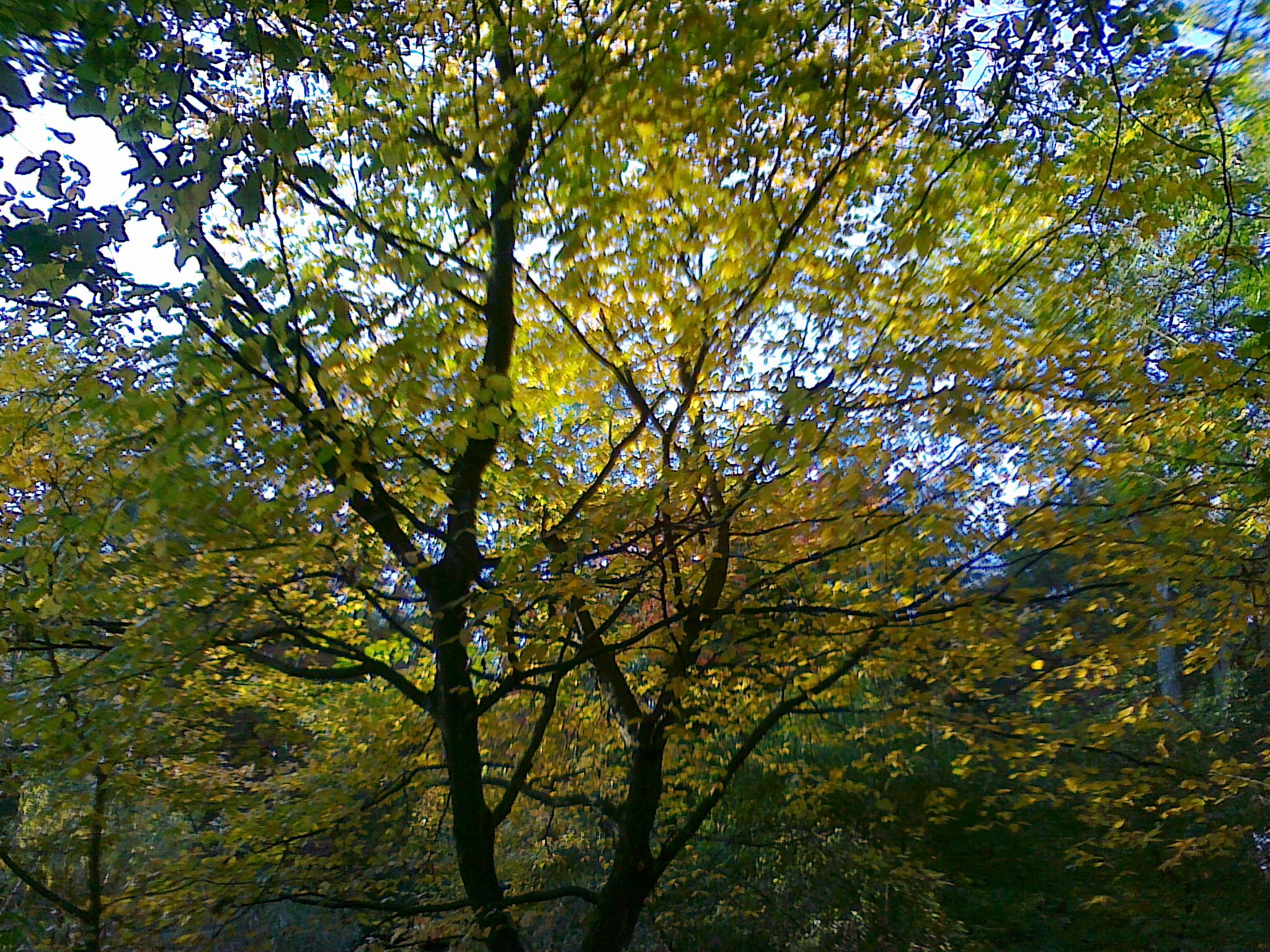
I took a walk through Frankendael Park’s woodland today, to connect with nature a little more this Hallowe’en.  What a breathtakingly beautiful day it turned out to be and how delighted I was to find so many reminders of what Hallowe’en or Samhain is really about.

Samhain marks the time in the pagan calendar when the “veil between the worlds” is said to be thinnest.  Meaning that it’s the time when it is thought that the dead and the living are most able to communicate with each other.  Hence the spooky associations most people have with Hallowe’en.  I prefer to think of this date as a time to say goodbye to those who have departed during the previous year, remember those from years gone by and to look at how the old and new live alongside each other, learning from each other and leaning on each other.

So my sunny Samhain walk in Frankendael helped me reflect on this as I took in some of the sounds, smells, tastes, images and feelings aroused by the plants and animals.

Here are a few photos of herbs which stood out today, old and new, living and dead, cohabiting and helping each other…

By the way, I am turning off all comment options for my posts.  Spammers are an interesting group and they are overwhelming my email account with nonsense.  So if you have genuine comments please find my email address and send me a message 🙂

Lime leaves & flowers – sandwiches, scented water and drying (NL:Linden, Tilia)

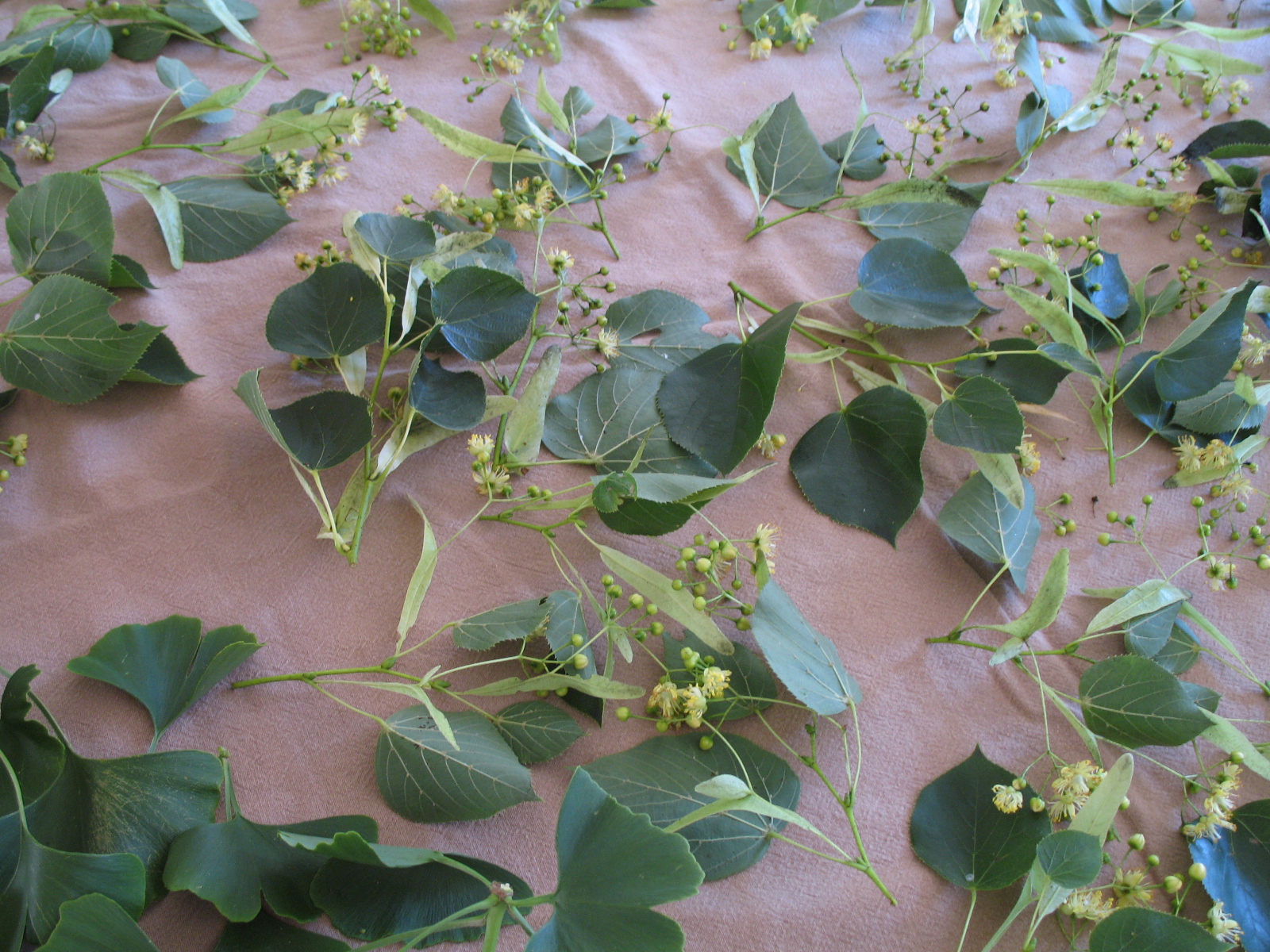
Yesterday I walked to a local public garden and harvested a carrier bag full of leaf and blossom sprigs from Lime/Linden (Tilia) trees.  These trees smell great at the moment. Whole neighbourhoods are perfumed by Lime flowers, loaded with nectar to attract hoards of bees.

If you pluck clean a clean lime flower from a tree in a safe location, you may like to eat it directly. They taste sweet and aromatic with a hint of bitter tannin. The aroma which will fill your mouth, nose and mind is uniquely delicious and has been highly prized, by many cultures, for centuries.  Lime flowers will quickly release a little glutinous, sweet mucilage as you chew.  More details about properties of this amazing tree in the main post on Lime.

So with limited space and time…
How to dry tree leaves and flowers.

  1. Once home, lay out the harvest on a light surface and discard any rough, diseased or otherwise unhealthy looking leaves, flowers or sprigs.
  2. Allow time for bugs to escape and find them a new home if they seem lost.
  3. My harvest was partly covered in a dried black film – originating from greenfly droppings in the canopy – so I then used scissors to separate the flowers from the leaves.  99% of the flowers were unaffected.
  4. Gently but thoroughly wash any dirt or film from the leaves, using cold water.  If you wash the flowers you will loose the valuable nectar and pollen.
    (It was very difficult to remove the black film from some parts so I discarded these and added them to my balcony pots as a mulch)
  5. Dry the leaves with a clean tea towel or muslin.
  6. Lay out the leaves and flowers separately to dry, on clean paper, cloths or trays.
    (I spread my harvest out on my dining room table, with a clean, absorbent, cotton table cloth beneath.  The room used needs to be well ventilated and fairly warm to facilitate good drying)
    This could be done in a very cool oven, I prefer to save electricity and let time do the drying.
  7. Turn the harvest from time to time to allow all surfaces to dry.
  8. If necessary, when the herbs feel dry to touch, move them to a more convenient drying area.
  9. Keep checking and shifting the herbs around to facilitate drying, for as long as it takes them to become completely brittle.
    (The flowers will dry much more quickly than the leaves, which could take 3 weeks)
  10. Inspect again for mould, unhealthy looking herbs.
  11. Store in glass airtight containers.Uses:
    Lots of information is given in the main Lime post but here are couple of others…

    • I couldn’t wait to use some of my harvest so I made Lime leaf, blossom and Amsterdam honey sandwiches for lunch.
    • I also added a few flowers to my cold water bottle this morning.  The water tasted and smelt very fragrant after about an hour.  It tasted far better than any shop bought, flavoured water and had the added benefit of a few cooling, gooey flowers to chew on during my 30 degree Dutch class.  The flowers would also look very pretty in a decanter of dinner table water.
    • Lime is magical – if you have the chance, give it a try!