Vrijwilligers gezocht: Voor het wekelijkse tuinonderhoud van de Stijltuin bij Huize Frankendael
Houdt u van tuinieren en wilt u deel uitmaken van een vrijwilligersteam dat zich inzet om van de Stijltuin bij Huize Frankendael een mooie, rustige en inspirerende plek te maken?
Lynn Shore en Tamara Last (die Engels en Nederlands spreken) zijn op zoek naar enthousiaste en toegewijde vrijwilligers om deze bekende tuin te helpen onderhouden en verbeteren. We zullen voornamelijk in de Stijltuin zelf werken en ook de bosgebieden ernaast netjes houden – alles in lijn met de elegantie en het erfgoed van de locatie.
Wanneer: Maandag 09:30 – 14:00 uur, het hele jaar door. (Vanaf maandag 2 juni)
Wat doen we? Algemeen tuinonderhoud onder leiding van Lynn en Tamara. In het eerste jaar bestaat dit voornamelijk uit onkruid wieden en het verplaatsen van planten om gaten in de borders op te vullen. We zullen nieuwe planten kweken uit zaad en stekken. De prioriteit ligt bij het verbeteren van de esthetiek. Lynn en Tamara werken samen met de Vrienden van Frankendael aan een beplantingsplan dat past bij de tijd van Huize Frankendael. Zodat we straks een stijltuin hebben die prachtig aansluit bij de locatie en een genot is voor alle bezoekers.
Wie zoeken we? Enthousiaste mensen, bij voorkeur met enige tuinervaring, maar de wil om te leren en de inzet om de stijltuin weer mooi te maken door regelmatig deel te nemen, vinden we belangrijker.
Waar: De Stijltuin ligt direct achter Huize Frankendael, waar Restaurant Merkelbach gevestigd is – net binnen de hoofdingang van Park Frankendael, in de Watergraafmeer (Amsterdam Oost). Adres: Middenweg 72, 1097 BS Amsterdam.
Als dit u aanspreekt, neem dan contact op met Lynn (lynn.shore@gmail.com) om uw interesse kenbaar te maken.
We kijken ernaar uit om samen iets heel bijzonders te laten groeien!
Volunteers Wanted: For the weekly garden maintenance of the Stijltuin at Huize Frankendael
Do you love gardening and would you like to be part of a team of volunteers who are committed to making the Stijltuin at Huize Frankendael a beautiful, peaceful and inspiring place?
Lynn Shore and Tamara Last (who speak English and Dutch) are looking for enthusiastic and dedicated volunteers to help maintain and improve this well-known garden. We will mainly work in the Stijltuin itself and also keep the woodland areas next to it tidy – all in keeping with the elegance and heritage of the location.
When: Monday 09:30 – 14:00, all year round. (From Monday 2nd June)
What do we do? General garden maintenance led by Lynn and Tamara. In the first year this will mainly consist of weeding and moving plants to fill in gaps in the borders. We will grow new plants from seed and cuttings. The priority is to improve the aesthetics. Lynn and Tamara are working with the Friends of Frankendael on a planting plan that fits the time of Huize Frankendael. So that we will soon have a style garden that fits in beautifully with the location and is a pleasure for all visitors.
Who are we looking for? Enthusiastic people, preferably with some gardening experience, but the will to learn and the commitment to make the style garden beautiful again by participating regularly, we find more important.
Where: The Stijltuin is located directly behind Huize Frankendael, which is the home of Restaurant Merkelbach – Just inside the main entrance of Park Frankendael, in the Watergraafmeer area of Amsterdam Oost. Address: Middenweg 72, 1097 BS Amsterdam.
If this appeals to you, please contact Lynn (lynn.shore@gmail.com) to express your interest.
We look forward to growing something very special together!
Each year, I get approached by a small handful of inspiring students who want to spend some internship time with me. Learning about their studies is always enlightening but usually, I need to say no to their requests. Not because of their ideas and motivation, but because I lack the time these enthusiastic students deserve.
Last year, Neleah Moureau, from HAS green academy of Den Bosch, contacted me. She wanted to conduct herb-related research as part of her Horticulture and Business Management course. Aeroponics, an innovative growing system where nutrient-rich water is sprayed onto plant roots, was the topic of Neleah’s research. With the right setup, and without soil, aeroponics can offer optimal light, temperature, moisture, and micronutrients to a wide variety of interesting plants. Neleah wanted to know if aeroponics could be a viable solution for the lack of prime herb growing space in urban settings. I was intrigued. Perhaps this could be an energy-efficient way to grow herbs in tiny urban spaces. Could aeroponics reduce the need for soil, transport, and the heavy water tanks of hydroponics I have seen in Amsterdam? Maybe this type of system could improve the life of city pot plants, by replacing some of that depleted store-bought compost I see them struggling in. And just possibly, aeroponics could provide an alternative for what most urban herbalists lack and long for; a fertile garden in which to grow their supplies.
Seeing the potential in this concept, and wanting to know the answer to her research question, I said yes and Neleah promptly joined me as a regular volunteer. We met at the foraging orchards in Amsterdam Oost. Hidden within an Amsterdam park, the herb orchards are rich in local edible and medicinal herbs; a place where those in the know learn about herbs, and forage without being disturbed. I have run the orchards for the past ten years, in a way that supports local wildlife, people, and plants. Neleah took part in our low-intervention herb-growing, helped catalog the plants, and worked on her main research question back at the college campus.
So how do aeroponics work? The plants are set up in “plugs” which stabilize the plants in the absence of soil. Their roots hang naked beneath, periodically sprayed with aeroponics substrate. That is water enriched with organic fertilizer. The composition is fine-tuned to satisfy the known needs of the target plants. Because the spraying happens in a sealed system both evaporation of water, and fertilizer run-off don’t happen. The system can be made from repurposed materials and root spraying can be timed and controlled using solar-powered apparatus.
Neleah chose an easy-to-grow popular medicinal herb – Pot Marigold (Calendula officinalis). She found that it has significant commercial value here in Europe and of course, has many therapeutic uses. She wanted to compare how Calendula performed in pots of soil or an aeroponics system. Lighting, CO2, and temperature were kept the same for both sets of plants. By the end of Neleah’s research, the outcome was clear (and little surprise to the volunteer gardeners); although everything these plants are thought to need can be provided by aeroponics, the Pot Marigold plants did far better in soil. Plants grown with aeroponics, at least in this experiment, were a poor version of what they could have been. The soil-grown plants had more flowers, bigger flowers, more foliage, and richer colour, and were more appealing to herbalists and wildlife.
Soil So what exactly was lacking from the aeroponic setup, to cause such a difference? I am sure that it was the ecosystem of the soil itself. Most plant roots have not evolved unclothed, dangling in a nutrient-rich mist (although air plants such as Tillandsia spp. have). In nature, roots spread out to anchor the plant and to capture watery resources. The plugs in Neleah’s system took over the anchorage role, and the spray delivered nutrient-rich water but what else is in soil?
Naturally, plant roots are surrounded by and penetrated by an almost invisible ecosystem. It lives on, in, and between the non-living particles of soil. Soil is a complex living community. When examined with a lens, grains of sand, clay, and stone are visible in the soil. Those grains are the inorganic components of soil, they are not living but lifeforms and water in the soil, gradually break them down. Within tiny pores in the grains and on their surface, life cycles relentlessly. Fragments of decaying plants, tiny bugs, and maybe even the fungi and bacteria which connect it all up, can be found. With the bare eye, worms, ants and beetles can be seen, all helping move things around and shake things up.
Soil is not simply a mix of NPK a few trace elements and water, it is a complex ecosystem that we can hardly begin to understand. Soil is magical, a place of constant transformation, alchemy beneath our feet! For me, there is no substitute for real soil, that stuff made from molehills, compost, leaf litter, and more; that stuff teaming with lifeforms. That is what plant roots need to be surrounded by. Without it, I don’t see how the magic of plant growth can occur. And what use is a herb if not a magical plant?
I wonder how far aeroponics will go. Solutions for small urban growing spaces are certainly needed and I hope that in time, aeroponics will incorporate plant pro- and pre-biotics, as well as the usual nutrients. Neleah’s work has opened my eyes to the soil-less growing of herbs, and I look forward to seeing where it goes. But in the necessary striving for solutions, I hope we don’t lose sight of the life of the soil.
May plant roots of the future be stylishly clothed in the ecosystem they belong to, one of cycling life, death, microbes, and magic.
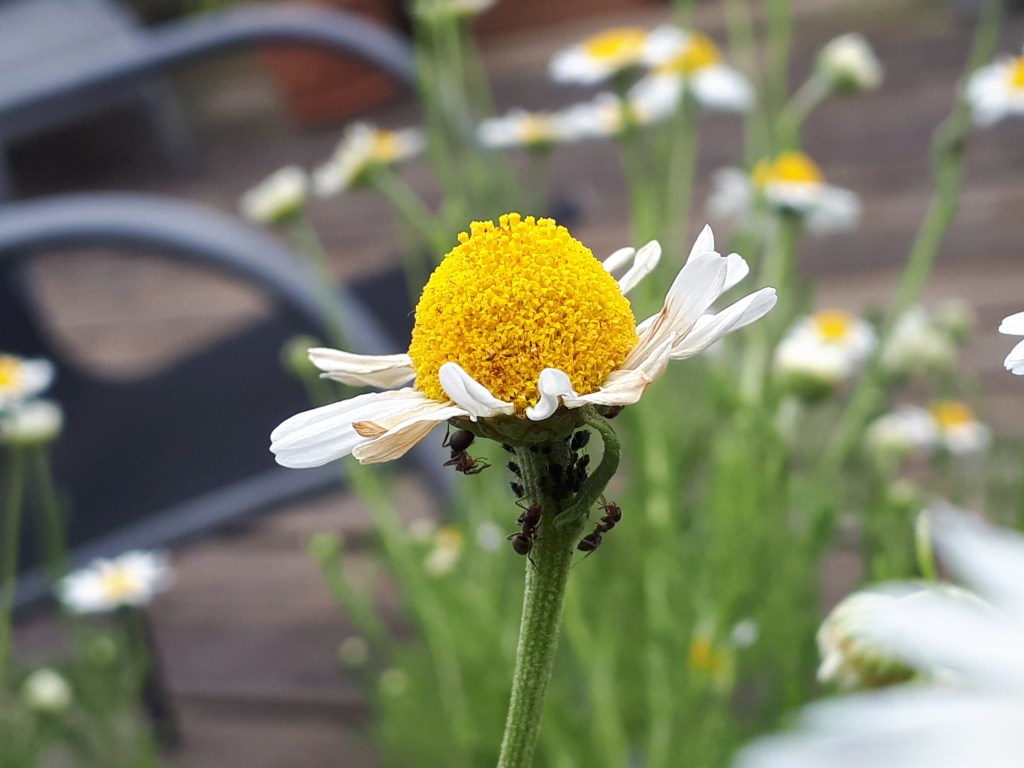
For about 15 years, generations of ants have been successfully maintaining a helpful aphid population on herb plants, in a couple of my roof terrace pots. I grow Chamomile and Valerian in the pots which the ants prefer; they seem less impressed with the other herbs that I grow.
At first, I battled the aphids, rehoming Ladybird larvae to the aphid-struck plants (ladybird larvae feed ferociously well on aphids) because I feared that they would suck my Chamomile and Valerian lovelies dry. But now we’re freinds and here’s why: Because those aphids and their ant farmers keep the little ecosystem in the plant pots just right. Just right, because the aphids poke and suck the Camomile and Valerian just enough to stay alive themselves and keep their 6-legged offspring healthy, whilst provoking the herbs to produce high levels of phytochemicals in an attempt to keep the insect population manageable. The protective phytochemicals make the flowers even more medicinal for me too. Btw, plants which don’t have to work to survive become soft in my opinion and far less robust and medicinal than I’d like. The ants protect the aphids by keeping them nestled under the flowers, and away from me when I dare to handle the plants for too long. That’s the only time they nip me. I find them very relaxed otherwise. Ants like to keep themselves to themselves. So the ants give the aphids shelter and protection and stop them from over harvesting the plants. Not sure exactly how, I guess by eating them or killing some aphid larvae (need to study this further).
If the aphids overharvested the herb sap, their own population would explode temporarily but the host plants would then whither from too much sap removal, the aphids would need to fly elsewhere and the ants would not get their food. How unfortunate. And I wouldn’t get my Chamomile or Valerian harvest.
So what do the ants get out of all this? Well they sup on aphid honeydew, aka aphid excrement. Can’t get enough of it but actually they are quite restrained. Honeydew is sweet and tasty stuff (like me, you may occasionally enjoy it on Lime tree leaves) packed with plant sugars and no doubt also herbal wonderfulness, from the aphids’ diet. And what do the Chamomile and Valerian plants gain from all these shenanigans? Well they thrive well enough to produce thousands of seeds each summer; hundreds of which land in my other plant pots, dozens of which make it to becoming new plants – Plants which are tough, medicinal and can be friends with aphids, ants and me.
I guess that was a long way of saying, when you next see a cluster of aphids under a flower, along with an ant wandering over them, take a closer look. Maybe you’re lucky enough to have insect farmers working magic in your plant pots or garden. Please don’t just squish them away; watch what’s happening and perhaps you’ll have better herbs and a more balanced garden ecosystem by just letting them do their thing.
Turkey tail rainbows growing in the orchards, among the wild garlic
Thursday 21st April Herbalists Without Borders – Gardening & Harvesting Morning 09.30 – 11.00 At the River of Herbs Orchards, in Park Frankendael (Behind Huize Frankendael – Middenweg 72, 1097 BS Amsterdam) We will be pruning the Elder shrubs, first harvest of the stinging nettle and more wild garlic harvesting. Loads of other herbs looking great at the moment so we will see what we have time for. Herbalists Without Borders remedies are the destination for the nettle tops today and the wild garlic. Donations in effort, money or oil/vodka/jenever etc welcome but just bring yourself to join in, if possible. Come join me if you would like to – bring gardening gloves (not essential but handy) and a pair of secateurs if you have them (again not essential) and maybe a mug and flask of warm drink. Call or Whatsapp me if you can’t find it – 0627596930
The next organized gardening morning at the herb orchards, in Park Frankendael will be this coming Thursday 10th March (10.00 – 12.00).
Light gardening, tidying up, some pruning to be done, and fallen twigs. No experience necessary!
The intention is to spruce it all up a little and may be able to begin some light-harvesting for Herbalists Without Borders remedies. We need to leave the major tree work to the gemeente so will stay away from the area where the tall tree fell during the storm (nettle orchard).
Come join me if you would like to – bring gardening gloves (not essential but handy) and a pair of secateurs if you have them (again not essential) and maybe a mug and flask of warm drink. If you need more information, email me or send a what’s app (0627596930).
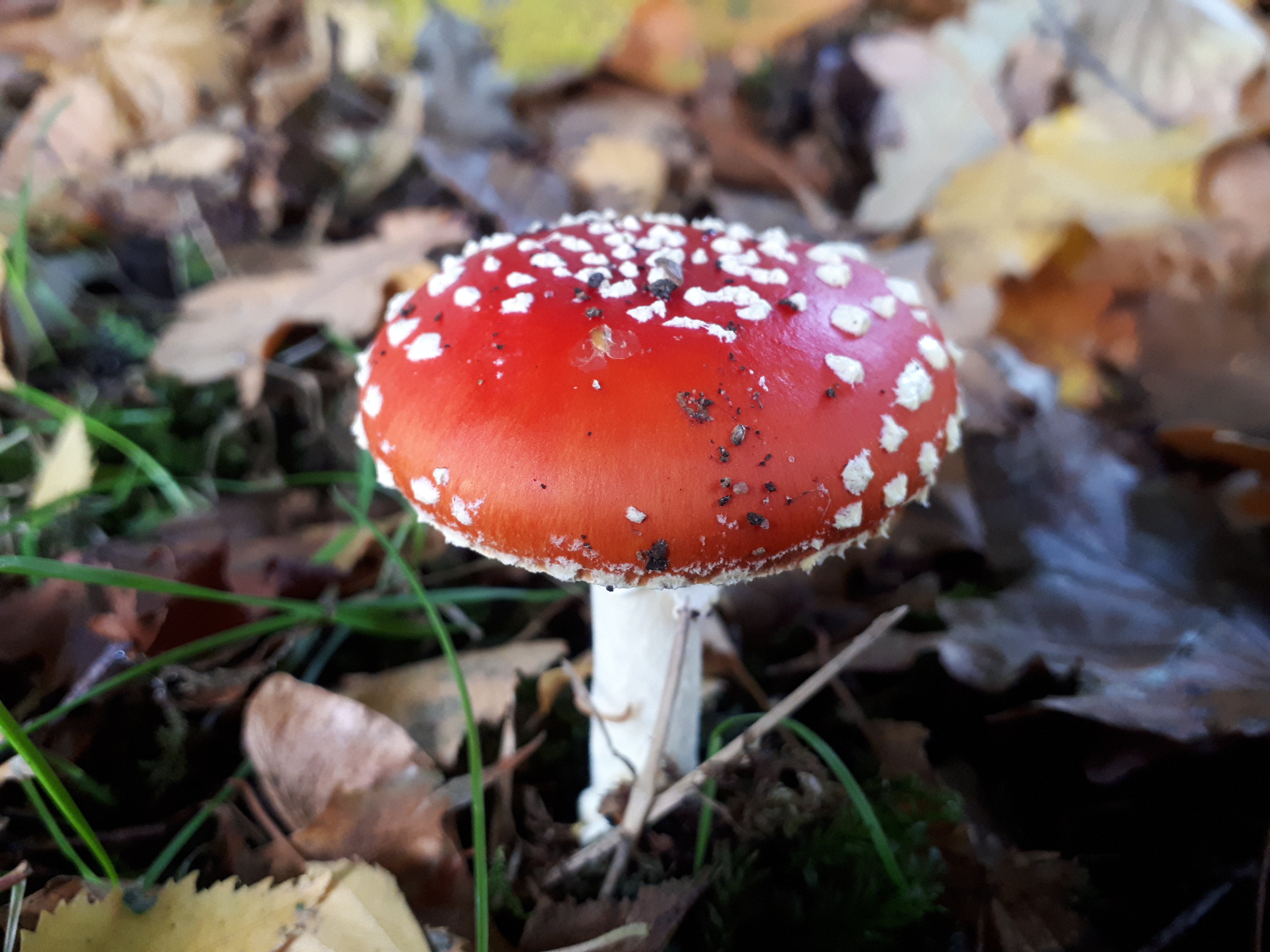
A few photos from recent days. Recognize anything there? Any idea of what’s edible and what’s poisonous? This is a beautiful time of year and there is plenty to do in nature, whether that be watching it change or transforming parts of it into foods and medicines. Most important of all, I think, is to actually get out and enjoy it!
Reflection It is time to take stock. Time to dig deep and reflect on what’s going well, what’s going less well and what to work on next. I did a lot of thinking about my garden (volkstuin) today. I’ve been quite down about it recently because each time I’ve visited, there’s been very little opportunity to actually work with the plants in the way required, to keep it manageable. Since the start of the whole COVID business, the garden has been getting too out of control for my liking. It is still a wonderful wildlife haven and I love to retreat there but a lot of work needs to be done to make it into the incredible herb garden that it should be.
Grapes at the volkstuin 2020
Everything seems to thrive there. The soil is peat-rich and moist making it a nourishing place for all. Valerian, meadowsweet, sweetwoodruff, lovage and gypsy wort are a few of my favourites there. However, the trees are also nourished so much by the location that their sprawling canopies now give little space for light to hit the ground. Less light breaking through means less healthy ground herbs, so I need to take action before the whole garden becomes a woodland. Woodland is great of course, in fact it is fabulous but I would like to continue growing a wide variety of interesting moisture and sun loving herbs in the main part of the garden, rather than only woodland herbs. There is space enough for those at the entrance of the garden. The intention is for lots of people can learn from these special plants and for them to thrive and be periodically harvested from and used as food and medicine, benefiting those who help with their care.
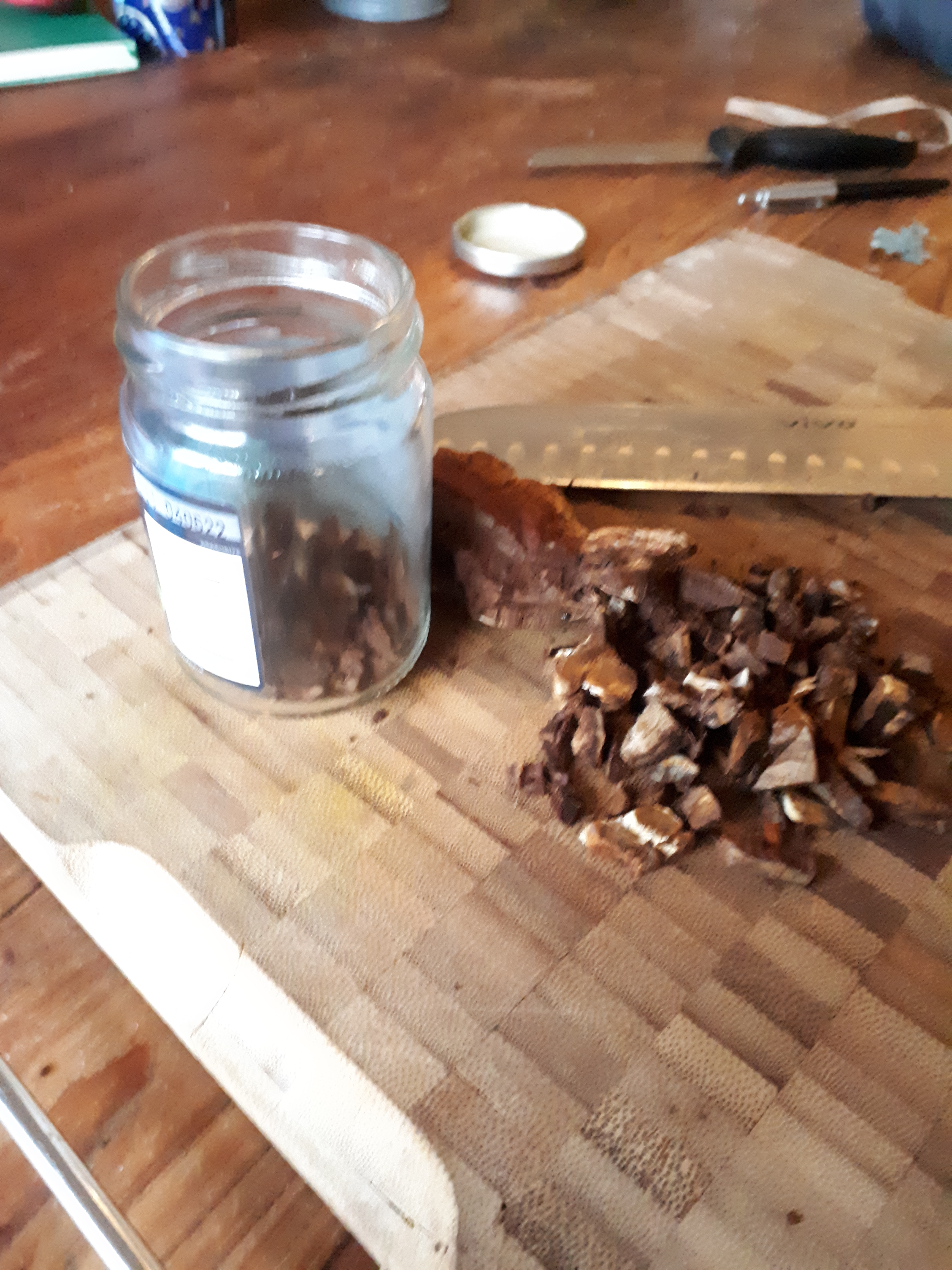
Blackberry root harvested at Samhain
Winter Work Days Over the winter, I will be hosting a number of work days at my garden. The idea to bring the garden back up to scratch through winter, to allow light back in so that the herbs can flourish again come spring. If you would like to join me to do some energetic branch cutting, or lay some woodchip paths or prune back the elders, hazels, willows, apple and plum, then you are most welcome to join me! Maybe we will be moving the Fish herb – NL Moerasanemoon (Houttuynia cordata) or Selfheal that so loves to self seed between the terrace slabs or maybe there will be some pulling up of Brambles to utilise their roots, or keeping stinging nettle in a suitable corner or pruning back the Grapevine. And the Daylillies! The list goes on and on. Always something to do and something to learn about! Some great plants will be moved around at times and when there are too many they will be shared. Of course, I will brew up herb tea and soup to keep us going but do bring some bread if you need something more substantial.
Day lily at the Volkstuin
I have a wooden summer house in the garden and that has a woodburner, so we can get warm and shelter when needed. The loo will not be functional in the midwinter so the winter bucket arrangement will come into action when needed [Sorry, that’s probably too much information but better that you realize this fact beforehand!]
Spring and Summer Harvest Then there will also be gardening days in the garden during the spring and summer, when the leaf and flower harvest can be reaped, plants will be propagated and sunny times in the garden can be enjoyed. I manage the garden along Permaculture principles, in case you are wondering. So in a nutshell that means that yes, it is certainly organic and nature takes the lead. Autumn will bring other treats, and there is always something to do and help with. I hope that this will build into a really mutually supportive gardening community, centered around the herb garden.
Herbal volkstuin – Mid- spring – Sweet woodruff, Wild garlic, Potentilla and Herb Robert
Herb knowledge It is so important to share herbal knowledge and I very much hope that this helps to encourage more herb gardening and love of herbs. Because my head is always full of thoughts about herbs, you will surely learn quite a lot about them, whilst we garden together but the objective here is to learn through doing.
Dates and location I will set some dates and advertise them here and then stick to those dates unless we have storms. The volkstuin is in Schellingwoude, Amsterdam Noord. Would you like to join in on making the garden a beautiful productive herb garden so that it can benefit far more people? If so, please get in touch with me! lynn.shore@gmail.com.
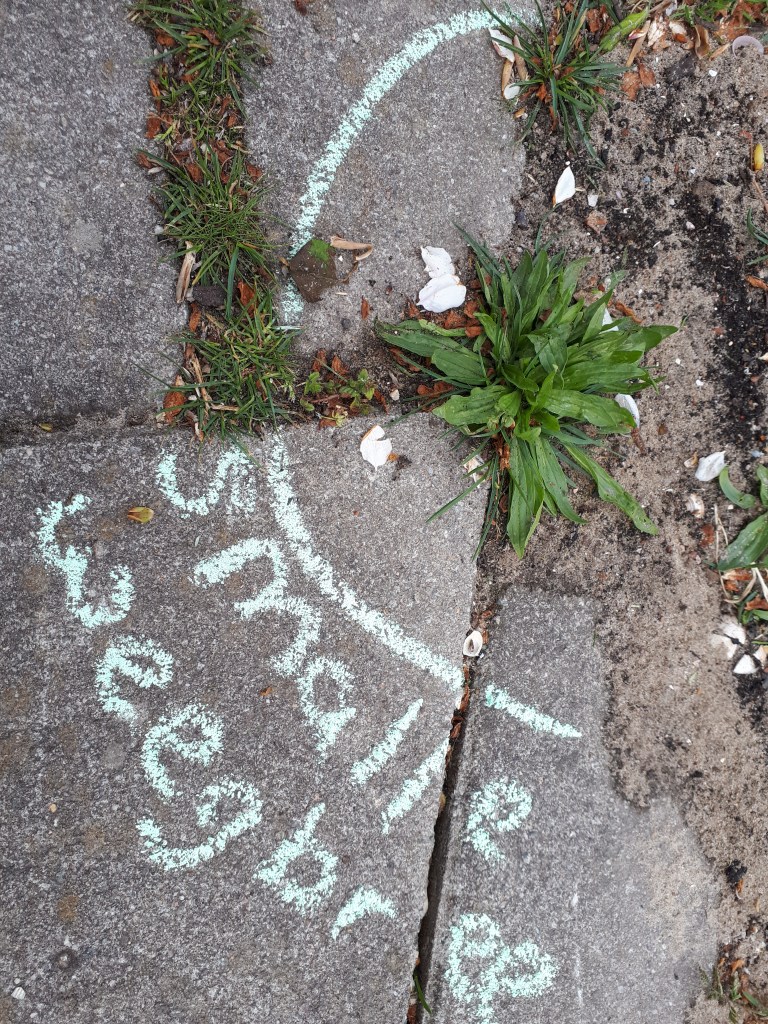
Lately, a few friends and family have nudged me about this botanical street chalking that’s going on in Europe right now.
Ann from City Plot gave me a nudge last night which has proved the final straw – it’s clearly time that we start to join in the fun!
Anyone in?
Here are a couple that we did today across town…
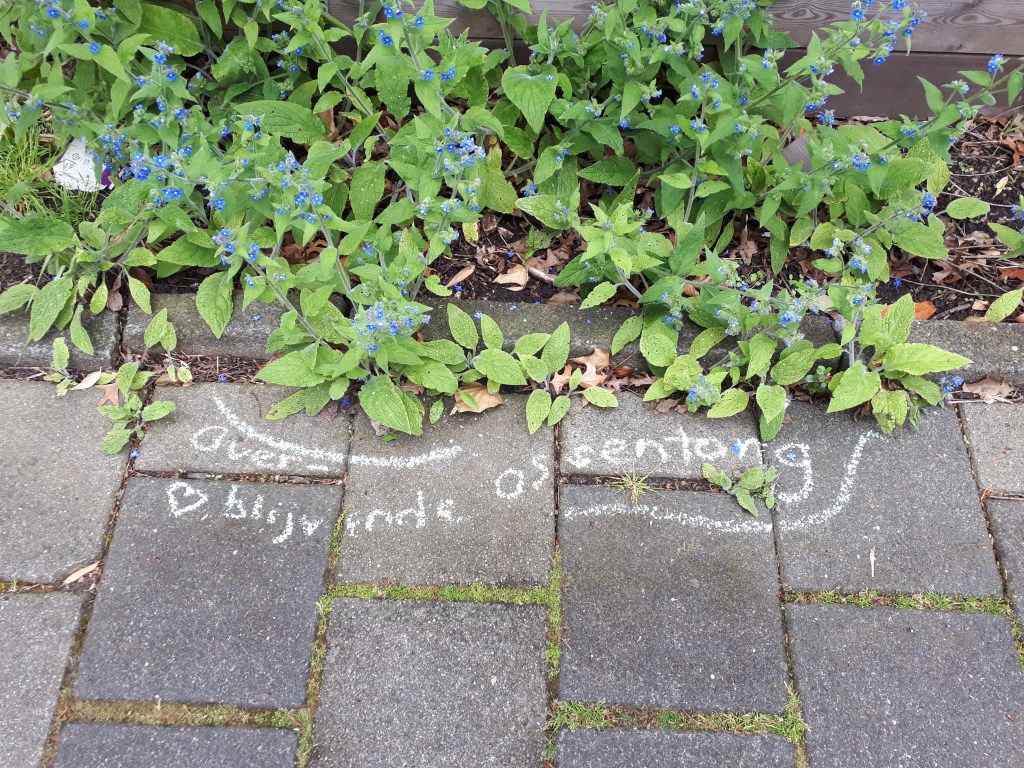
Green alkanet (Pentaglottis sempervirens)
Nothing like a name tag to help people realise what’s growing under their noses as they walk around the streets.
Smalle weegree (Plantago lanceolata) Ribwort
Many of us know the value of the plants which most people call weeds. We are passionate about people realising what can be done with plants growing around them and looking after the plants which naturally grow in forgotten spaces.
Grote weegree (Plantago major) Plantain
Mostly, we won’t want to harvest or forage from pavements but those urban herbs and veggies can be a source of free seed, cuttings, starter plants and teaching plants.
Lindenboom (Tilia sp.) Lime tree
Here’s a Greater celandine which I pulled from a pavement crack last week and now grows on my roof for a home remedy and teaching plant. The yellow sap inside has several uses.
It you’re not sure of the name of the plant, feel free to send me a clear photo by What’s app or email and I’ll send you the plant name. 06 275 969 30 urban.herbology.lynn@gmail.com
I’d love to see your labelled plants too and will happily post some photos here, and on the Urban Herbology FaceBook page.
I had a pavement garden put in by the city council, beneath our Amsterdam apartment, soon after we moved here 13 years ago. Such pavement gardens are narrow strips, right up against the buildings, were the pavers get lifted and removed, making the sand beneath available as a planting area for residents. You need to draw up a plan and get written permission from your neighbours, when you request a new one – It was quite exciting I can tell you. Well, my neighbours approved my idea and after the council workers set it up for me, I poured in a couple of bags of compost and planted it up with Rosemary (Rosmarinus officinalis), Purple Sage (Salvia officinalis ‘Purpurascens’), Rue (Ruta graveolens)and Lavender (Lavendula augustifolia). Everything in there grew really well, even though the little plot faces full south, is under a bay window and gets little rain. It was a lovely, simple Mediterranean herb garden. The herbs were resplendent and many neighbours would snip off a little Rosemary through the growing season, to add to their cooking. That shrub was enormous and very healthy.
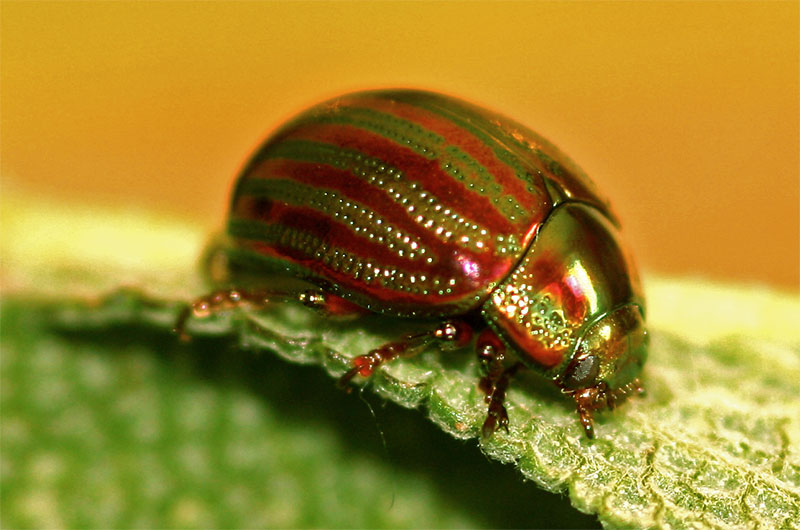
Then last year, things started to go rather pear-shaped in the geveltuin. The mature Rosemary had some damage. More than a little damage, in fact it looked decidedly nibbled all over. Only a few flowers pushed through and the plant looked increasingly bedraggled. We also noticed very pretty, metallic striped beetles on the Rosemary sometimes. Often, when we brushed against the shrub, some of them would shoot off and bounce off the pavings making a characteristic crackling sound. We didn’t realize back then but our Mediterranean herb garden was under attack by the Rosemary Beetle (Chrysolina americana).
This week, enough was enough. The Rosemary looked barely alive and as neighbourhood Rosemary bushes were starting to really bush out with lush deep green new shoots, our looked downright grey. To make matters worse, the Purple Sage was almost gone, the Rue totally desiccated and the Lavender was a shadow of its former self. The beetles were more plentiful than before and my herb garden was no more.
Know your enemy I read up on the Rosemary beetle and planned my counter attack; Hard pruning, taking a few insurance cuttings, enriching the soil and removing the thick blanket of dead leaves (which I was building up beneath the shrubs, out of laziness really). Finally a good drenching with water.
Part way through the pruning operation
Operation Revamp As you can see in the video, I shook out the shrubs onto a bright blanket, placing tumbling beetles and larvae in a glass jar which became enormously interesting to local kids. We had about 30 bugs in there by the end. The leaf layer was totally cleared and I hard pruned all of the shrubs. The Rue had to go, sadly as I loved it and few people seem to grow it these days. However, I was delighted to find that it had spawned a few babies, growing between paving slabs so I hope they will make it in the newly prepared plot. My daughter and I scoured the geveltuin and surrounding area for more beetles and larvae before giving the remaining plants a really good watering and then enriching the soil slightly with a bucketful of spent compost (which I collect from my old rooftop pots). Later, I added a couple of lupin seedlings which I had on the roof, a few radish and beetroot seeds, some potted tulips from the kitchen balcony and some self-seeded Lemon balm, which was growing across the street in the gutter. A cheap and cheerful geveltuin makeover! The project took a few hours and I am satisfied with the result.
Prevention It took me a couple of years to give in to the fact that these pin-stripe armored beetles were beautifully munching through my herb garden and that I was providing them with perfect overwintering conditions. From now on, I intend to keep the plot more open and airy, more species rich and attractive to predatory and pollinating bugs and I will water the plants regularly, especially when they appear to be under pressure. I also plan to place a bird nesting box on the street tree across the pavement and will feed the plants with comfrey & nettle tea, when the mood strikes me.
In the hope that I can help others to spot Rosemary beetle and deal with it more quickly, I made a short video, which you can see here. My daughter and I had fun editing this one so we hope that you find it useful.
Squish or Release? So what happened to the collected beetles and larvae in the glass jar? Well, I did squish one on the pavement in frustration, the day before the clean up operation and I felt really bad about it. Killing them didn’t feel right at all and I knew well that these bugs were here for a while and I had allowed them to get out of control. I needed to help nature to restore beetle balance. After a chat with a gardening friend, I decided that the best solution was release these little beasts into a more bio-diverse area, away from aromatic herbs and where natural predators could feast on them or they had a chance to escape and live among other species of insects. This morning, we took them to a grassy area, close to water and let them go.
Have you got a beetle problem? If so, how are you dealing with it? What would you have done with the captured beetles? Do you have other herby-pesty problems and can you think of better ways for people to keep their herbs healthy? Do let me know as I would love to hear!
One thing that I really miss when I am at school all week, is a long, relaxed, morning walk. I really need to start weaving more walks into my work week schedule. In any case, I certainly can’t complain as I am now on school holiday for a couple of weeks so started with a leisurely walk today. Taking in the air, sights and plants as I wander for 5km or more through Amsterdam east, is a great way to start the day.
This morning, my walk took in a long stretch of the Weespertrekvaart. On one side, a cycle path, sport fields, allotments and Amsteldorp (with plenty of Christmas lights at the moment). On the other, a mix of new villas, tower blocks, boats, businesses and the old Bijlmerbajes prison buildings. In between, a wide stretch of canal which a few ducks, gulls and a morning rowing team were enjoying. Between the canal and the cycle path is a footpath and parts of it are edged with reeds and wild herbs.
At this time of year there is a lot of green to be found in Amsterdam but due to midwinter’s reduced light and temperatures, most plants are not in flower or in good shape for foraging. At this time of year, it’s best to look but not touch, unless you find a big area of something quite special which is clearly loving the reduced competition for light, which midwinter also brings.
This Malva patch caught my eye. Not only is the plant quite prolific in places along the footpath, but here and there it can be found in flower. Plants are much easier to identify when in flower so this is great for foragers. Even if you don’t fancy foraging during midwinter, it is a great time to build your knowledge – of plant ID and where the plants like to grow.
Yesterday in school, one of the classes ran an assembly about different foods eaten to celebrate Christmas around the world. One mention really caught my attention – Malva Cake in South Africa! Malva – in a cake – what a great idea!
I tend to eat malva leaves, of all sorts, in salads or I cook them gently and eat in savoury dishes. They can be chopped up into a tasty falafel mix, fried, stuffed, cooked like spinach and then sprinkled with feta type cheese. The options are endless (so long as you are sure to wash dust off as they can be quite hairy). Marshmallow (Althaea officinalis) is in the malva family, so is the Lime tree (Tilia spp) and they have ever so unctuous leaves. The malva in this photo looks like Common mallow (Malva sylvestris) to me. In my experience, it has less unctuous leaves than lime and marshmallow but they are mild tasting, very palatable and quite abundant in the greener parts of Amsterdam. More importantly, Common mallow is neither endangered here in The Netherlands (the Marshmallow plant is) nor is it out of reach (as Lime tree leaves certainly are in winter). So I became more and more pleased with this find on the footpath edge. One of my favourite Amsterdam plants is Hollyhock. That is also in the Malvaceae family and the leaves look quite similar to Common mallow. And while I think of it, some other Malvaceae members are cacao, cotton, durian and okra. This family of plants has high economic importance around the world.
Found these cacao pods growing from the trunk of a Theobroma cacao tree in Costa Rica (2016).
Malva cake sounds great to me and also brings to mind the big packets of dried Malva leaves sold by my local Turkish supermarket (Yakhlaf on Javastraat). I googled recipes for malva cake and was a little disappointed that most contained no malva at all and looked distinctly similar to sticky toffee pudding. I found one reference to a Dutch cake with malva in the name but no actual malva in the recipe. So I am now on the hunt for a recipe which contains enough malva leaf to make a delicious unctuous cake – and preferably without carb-rich flour (as I am trying to avoid carbs). If you know of a recipe, I would love to hear! In the meantime, I will start experimenting with almond flour and malva leaves.
Do you have any uses for Malva leaves which you would like to share? If so please let me know in the post comments or through my contact page. Malva leaves seem to be very widely used in other parts of the world and right now, they are looking good in both Turkish supermarkets and winter footpath edges here in Amsterdam.
Forage lightly and happily, my friends!
Next Urban Herbology walk in Amsterdam – Tomorrow! 21st December. Check out my meetup group or What’s app me on 0627596930 if you would like to join the Winter Solstice walk.
My Online+ Apprenticeship course is open to newcomers for just 5 more days (until end of 25th December). Then it will be closed to new members until Imbolc (February 1st 2020). For more information see here or contact me.













 Urban Herbology