Weaving a Magical Life in Urban Spaces By Lynn Shore
Available for Preorder Now
Published by Aeon Books | Launching October 2025 Paperback | 300 pages | ISBN: 9781801521888 Illustrations by Hannah MacDonald
About the Book
A beautifully illustrated handbook for urban witches that combines green witchcraft with city life.
Rich with herbal and esoteric wisdom, this delightful and thoughtful guide provides an essential basis for magical practitioners living in cities to connect with nature, magic and community.
This book is for urbanites who want nature and magic in their lives. Written by an experienced herbalist, who eats street weeds, talks to crows, casts spells, and brews potions; this book shows how to walk a magical path while riding the waves of urban life.
Divided into three sections, The Green City Witch covers the lifestyle, knowledge, and techniques of real witches who love nature and city life. The lifestyle section covers how to work sustainably, grow roots in new towns, align with the seasons, and forage; all within city limits. The urban nature section contains an extensive directory that details how to engage with fascinating lifeforms that thrive in city buildings, streets, and parks. From spider plants to knotweed, and parakeets to earthworms, the plant, animal, and bug lore entries offer magical symbolism, folklore, foraging or care advice, and practical ways to weave them into daily life. The techniques section explains how to achieve magical goals with rituals, sigils, spells and charms, blood magic, shapeshifting, and divination, all with local, natural, sustainable materials.
The Green City Witch is an invaluable resource for beginners and experienced magical practitioners alike, who wish to embrace the endless magical potential and gifts of urban nature.
Preorder Offer – 20% Off!
Be among the first to get a copy of The Green City Witch by preordering now. From now until the official launch at the end of October, Aeon Books is offering a 20% discount on all preorders via their website.
If you’re outside the UK, the book will also be available through major retailers and online bookstores closer to publication. You can bookmark or preorder through the following links:
Other regions: Search your local bookstore or online shop using ISBN 9781801521888
Book Details
Publisher
Aeon Books
Publication Date
October 2025
Cover
Paperback
Pages
400
Size
152mm x 229mm
Catalogue No
95368
ISBN-13
9781801521888
Launch Event
Official Book Launch: Saturday 25th October 2025 Black Moon Botanica– Amsterdam Store Spiegelgracht 30-H 1017 JS, Amsterdam The Netherlands (18:30 – 20:00)
Sign up below to stay informed about events, updates, and exclusive extras. Subscribe for Updates
About the author
Lynn Shore is a herbalist, educator, and green witch. Born in Bristol, study, and work led her to several UK towns and cities. In 2004 she settled in Amsterdam and founded Urban Herbology which connects city people with nature through walks and courses. She also runs a community herb orchard, where locals, plants, and wildlife grow together. Lynn and her family live in a plant and book-filled apartment. Most often out gardening, foraging, or concocting strange brews; helping others find peace in nature is her mission.
About the illustrator
Hannah McDonald is a British artist and author, living in Amsterdam. She explores visual narratives that create space for emotional exchange between audience, artwork and artist, to enhance a deeper connection to each other and the natural world.
It’s just six days into the WildBiome Project month, and already my relationship with food feels transformed. I find myself eating far less than usual, not because of restriction, but because wild food satisfies in a different way – deeply, viscerally.
The WildBiome Project is a citizen science research initiative, organised by Mo Wilde and her daughter Caitlin, it brings together over 100 forager participants who are shifting their diets to primarily foraged and wild foods. The University of Bradford (UK) is working with the project, and explores how a need to live on ancient wild, local, famine foods might impact the health of modern humans. We’re tracking our health throughout, with start and end testing of gut microbiome, blood markers, and biometrics. We all keep a daily log of everything that we eat and drink. I am also tracking daily shifts in my mental and physical health.
There’s a stark difference between the wild greens and meats I’m eating now, and the shop-bought versions I’ve relied on in the past. Vegetables grown for mass production are often bred for size and uniformity, but in the process they’ve lost something essential: flavour, and likely nutrition too. In contrast, wild foods are packed with intensity – smaller, perhaps, but potent, rich, and alive.
The act of collecting all of my green food myself has also changed my experience entirely. There’s an intimacy that forms when you forage – a kind of sacred attention. I know this week but this week I’ve found myself spending more time with each ingredient, observing where it comes from, how it grows, how it feels to pluck it from the earth or the tree. This relationship is further deepened when it comes to wild meat.
This week I prepared and ate wild meat – deer shoulder, and duck breast. Both being lean, nuanced in taste, with far less fat than farmed meat. I could sense the creatures in the process, which brought a kind of ceremonial reverence to the act. From the moment of deciding to cook them to the careful seasoning with wild herbs, I gave full attention. I wanted nothing to be wasted. Even as a previous vegetarian, who’s long considered herself a very thoughtful consumer, this experience felt markedly different. The sterility of supermarket meat – even the organic kind – is incomparable to the energy that remains in wild flesh.
I visited my father-in-law during the week, a drive that winds through mile upon mile of Dutch farmland. The landscape is functional, but stark: wide-open fields of monoculture grasses, scattered blue feed containers, massive sheds filled with chickens. You hardly see a tree sometimes, let alone biodiversity. It’s efficient – but eerily empty. In contrast, the wilder parts of the landscape – the wetlands, reedbeds, patches of woodland – teem with life: deer, wild boar, rabbits, geese.
I deeply respect farmers and all they endure. This isn’t about blame or judgement. But it’s hard not to notice how skewed our system is – how difficult it is for most city folk like me to access ethically sourced wild meat. And, how disconnected most of us are from the life that sustains us. Imagine a landscape where more people ate far less meat, but what little they did eat came from the land itself – wild, respected, shared.
I’m also learning to appreciate the value of modern food preservation. My little freezer is now filled two-thirds with wild food – a security blanket of sorts. But I’m also aware of how vulnerable it is. A power cut, due to cable laying or drain repairs in my area, could erase all that effort. So I’m thinking ahead. I have plenty of dried foraged herbs, and locally harvested nuts (those thanks to a more forward planning friend) but I’m lacking wild pickles, dried mushroom and more – I’ll definitely remedy this for next year.
This autumn, I plan to forage more rosehips, blackberries, and nuts. I’ll dry mushrooms and grind them into powder, press roots and greens into pastes and condiments, collect grass seeds to winnow and cook, and build a pantry that doesn’t depend so heavily on electricity. These preserved foods will support not just me, but my family – Frank and Livvy already enjoy wild foods integrated into our regular meals. But I want to go further: I want wild food to be abundant and delicious enough that they can choose whole meals from it, not just flavour boosts.
I’ve also been shifting away from wheat. I already use organic spelt, which feels gentler on my gut, but I’m now using chestnut and acorn flours – rich, earthy, and gluten-free. They won’t replace everything, but they open up new textures and tastes. And they are available from Amsterdam street trees. A more feral kind of baking.
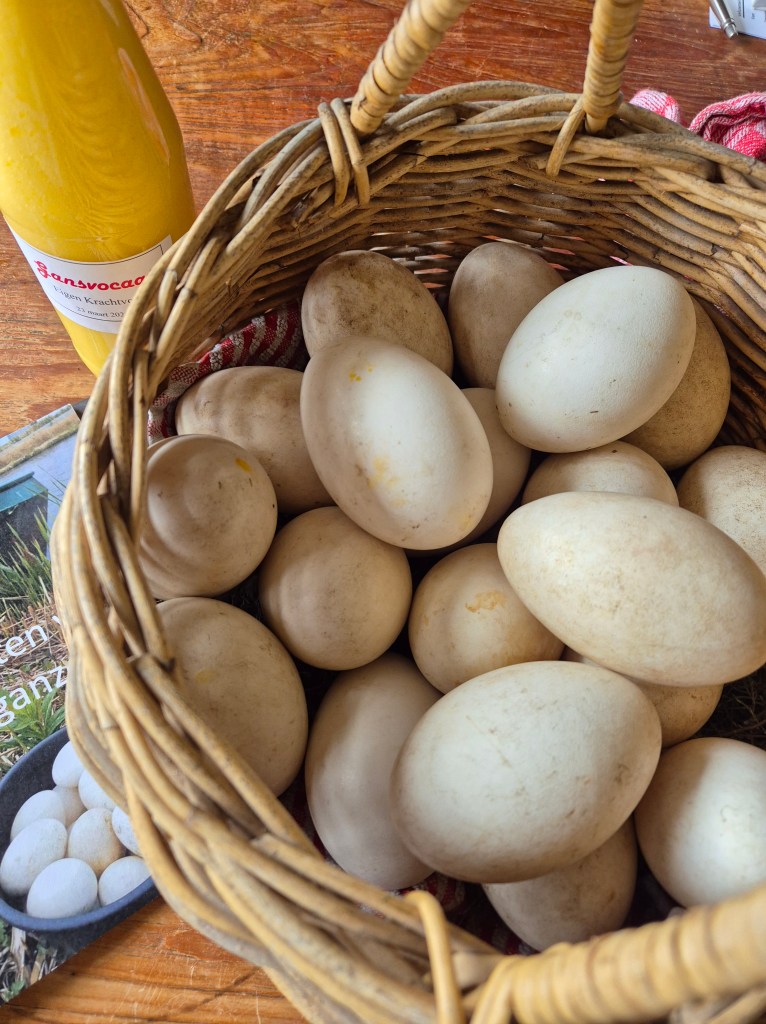
One final joy this week: goose eggs. I’ve been fortunate to connect with a group licensed to collect them (Eigenkracht voer) – part of an effort to manage populations in a wetland area close to Schiphol airport. Rather than shooting or gassing, they use a more humane method: nest-emptying. They carefully remove eggs from accessible nests by boat, leaving one or two in each nest. The process is regulated, seasonal, and animal-conscious. Goose egg collecting was in season until the end of March, and I was able to get a basketful – they’re the equivalent of two chicken eggs each, and utterly delicious.
There are still three weeks to go on this WildBiome journey, but I’m already planning beyond. I won’t continue eating 100% wild – not while I live in the heart of Amsterdam, surrounded by incredible global cuisine that I still want to enjoy occasionally. But I will rebuild my pantry. I want the backbone of my diet to be wild, local, environmentally sound, and deeply nourishing. A way of participating in the land I live on, not just consuming from it.
This isn’t about perfection. It’s about connection. It’s about weaving food, place, and life together – one meal at a time.
Here’s a short Urban Herbology post from 9 years ago, about how to make a little harvest of wild garlic go a long way. Click on View Original Post, to open up and see some of the benefits of this herb and a simple way to use it over several weeks. I hope it helps you. If you want to learn lots more about wild garlic, I run workshops about the plant, throughout the season. The next one is on Sunday 6th March 2022. Details are on the events page.
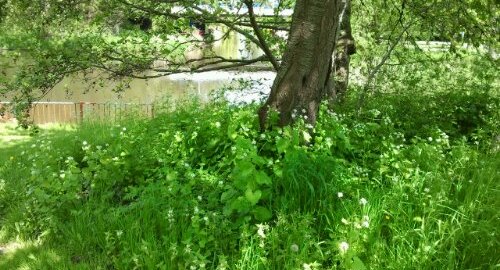
The woodland floor in Frankendael Park is carpeted with flowering snowdrops and the emerging leaves of Ramsons (wild garlic, Allium ursinum). I’m sure snowdrops have their uses but when you find them, Ramsons are an urban herb forager’s dream. All parts of the plant are edible and very useful, though the leaves and flowers are all you should use. The bulbs should be left alone and only pick a leaf or two from any plant. They taste truly delicious – if you like the taste of garlic! They taste best, by far, before the pretty white flowers open and can be eaten from early spring, when the first leaves emerge from the soil.
Ramsons have similar properties to Garlic but are milder in all respects. They are also more tolerable to those you have difficulty digesting other members of the onions family.
I went for a walk and forage in the Orchards of Park Frankendael this morning and made some recordings for you. Next time, I will hold my phone the other way so that it records a wider frame but for now, I hope that you can at least enjoy some of the blossoms and bees!
So there we have it, about 30 minutes of my ramblings in the orchards. We saw quite a few plants today but there are hundreds more to find. Let me know what you would like to see next time!
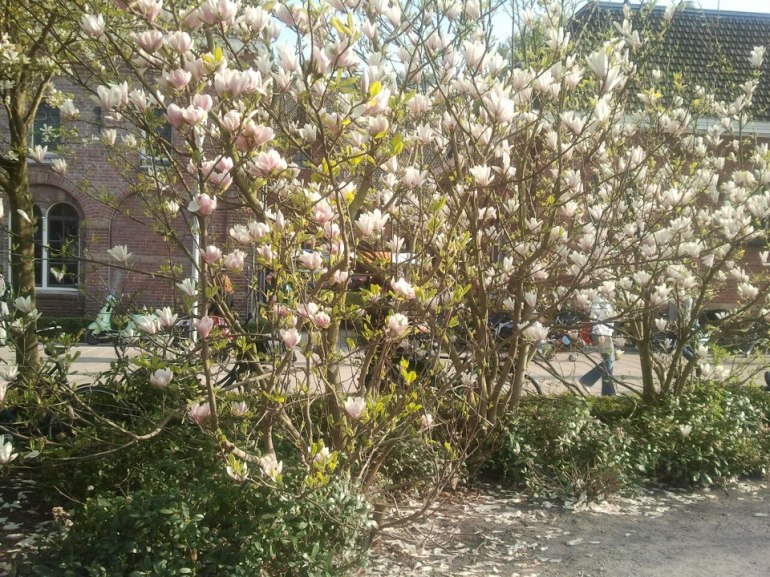
Magnolia is a tree which I fall in love with again, every year. Everything about it enthralls me. From the graceful angles of the branches, the bark, exotic blooms to the glossy evergreen leaves. A huge magnolia in bloom is a show stopper. One such tree arches quietly over the terrace behind Huize Frankendael, in Amsterdam east. Hundreds of visitors must walk beneath it without giving the tree much thought, until in March or April it explodes into bloom. There is no other tree that I would rather sit beneath and gaze up through than that magnificent magnolia in spring!
Edible and Medicinal Magnolia Petals The flowers of Magnolia trees are edible and medicinal. In traditional chinese medicine, Magnolia flowers are known as Xin yi hua and are associated with the lung and stomach meridians. I enjoy eating them fresh plucked each year and happily report that they taste fragrant and spicy. I can also report that when I eat Magnolia petal, my sinuses become clear, quite like magic.
Imagine a slightly rubbery super sized rose petal which clears the sinuses a little, when you bite into it and you are getting close to the mouth feel and flavour of a magnolia petal. I like them very much and because a little goes a long way with these large petals, I can certainly recommend them to other urban herb lovers. As you may know, via my apprenticeship and walks, I teach how to harvest interesting herbs in towns and cities, in a safe and ethical way. This entails taking only a little, leaving no trace and really make the most of the harvest. Do contact me if you would like to know more – This is my passion!
Medicinal Bark Fairly recent research suggests that Magnolia bark extract can help with oral health, stress reduction and several other disorders. In traditional medicine it is reportedly used as an antibacterial, anti-inflammatory, anticancer agent, in the treatment of Alzheimer disease, depression, diabetes, and menopause. All Magnolia species varieties are considered to possess the same medicinal qualities and there are apparently no known side effects – although we know that someone somewhere, could be allergic to the plant, so please be cautious. Magnolia Bark Extract is widely available for sale and Magnolia bark is an ingredient in many traditional Chinese medicines including Hsiao-cheng-chi-tang, Wuu-Ji-San, Heii-san, Shimpi-to, Hangekouboku-to, Masinin-gan, Sai-boku-to, Syosaiko-to, Irei-to and Goshaku-san.
Japanese traditional medicine also prizes both the bark and flowers of Magnolia. Bark harvesting is not something suggested for the urban forager because it certainly leaves a trace and it is certainly not ethical.
Magnolias in Westerpark
Stealthy Petal Plucking When harvesting from perhaps the most beautiful of city trees, one would perhaps look both foolish and anti-social to pluck entire flowers. So I suggest that you don’t. Instead, I recommend that when stumbling upon a prime Magnolia specimen in bloom, and feeling the urge to eat it, you do the following:
1. After checking for unwanted observers, wander nonchalantly up to the tree. Are the blossoms within your reach? If not move on to another. 2. If so, reach up as if to smell the fragrance of a prime bloom, pull it gently to your nose with one hand, whilst deftly plucking a single petal from its base, with the other hand whilst simultaneously inhaling the spicy aroma. 3. Tuck the plucked petal in your pocket as you gently release the bloom with your other hand. 4. Move along to another flower, as if to compare its scent with the previous bloom. Repeat steps 1 to 3 until you have harvested three or four petals.
A magnolia flower can miss one petal without much issue. If two or more petals are plucked from one bloom, evidence of foraging shows and that is not the plan. So one petal from a flower, move to another, one more petal and so on. When you have three or four petals, you are done. That is enough to make something very tasty and useful and you will have increased your stealth foraging skills..
Untouched – Delicious
Favourite Trees I tend to forage a handful of petals each year, from 6 favourite Magnolias which are dotted around east Amsterdam. They are all growing in public spaces so stealth foraging is required. I don’t harvest from them if other people are around because apart from it just looks silly. I also limit myself to plucking a petal from two flowers per tree. I first wrote about my love of Magnolia petals on 2012. Since then urban foraging has increased in popularity so I also am careful to only pluck from Magnolias which seem not to have been visited by other foragers.
Magnolia Petal Recipes Things that I like to do with a precious handful of magnolia petals. I hope that you have a go and let me know how you get on in the comments.
Magnolia Petal Pickle They can be pickled, old English style by simply filling a small jar with fresh petals and then completely filling the jar again with rice wine vinegar or apple cider vinegar with a little salt and sugar to balance the flavours. I don’t add sugar or salt so I guess my version is simply Magnolia petal vinegar – I don’t mind because it tastes good 🙂
Fermented Magnolia Petals You may like to ferment them using a little salt and water, in the style of Sandor Katz. I prefer to lay them in my handy small Japanese vegetable press. I then sprinkle with a pinch of salt and apply the gentle but consistent pressure of the Japanese press for about 3 hours. This produces a very light ferment and it draws out some of the water from the petals (which tastes good too). You can leave the pressure for a lot longer if you prefer, winding the contraption every few hours to ensure the petals are in fact under a little pressure and to encourage the process.
Magnolia Petal Honey When I first tasted a Magnolia petal and felt its clearing effect on my sinuses, I decided to transfer the petals’ properties to honey. This is soooo simple to make. It creates something which my family and friends find delicious and I hope you will too. If the honey turns you off, try Agave syrup. It works very well but in my experience is less spreadable (being rather runny).
Magnolia petals infusing in honey
How to Make Magnolia Petal Honey (or use Agave syrup) 1. Gather your petals. 2. I rarely wash magnolia petals because I only harvest clean looking ones, which are from way above the ground but unsoiled by birds. You may like to wash yours. If so, then dry them off. 3. Tear the clean, surface dry petals into a sterile small glass jar. I use dishwasher cleaned pesto jars for this sort of thing. 4. Covered completely with runny honey. Use a chop stick or knitting needle to loosen trapped air bubbles. You may need to release the air and top up with honey several times. The jar should be filled to the brim with honey. The air bubbles won’t all leave the honey but prodding with chopsticks, helps them to escape and thus reduces the risk of contamination. 5. When no more air bubbles are escaping and no more honey needs to be added, close the jar tightly with its lid. 6. The constituents of the petals will infuse into the honey over the following days and weeks but the honey will take on a delicious Magnolia aroma and taste within a few hours. 7. Eat in any honey way (smear on bread, add to smoothies, mix with a little vinegar for an elixir, etc) you choose or take a teaspoon now and them to help soothe anxiety, sore throats or respiratory congestion. I don’t bother to strain this honey as I like the petal crunch. You could strain after 6 weeks if you preferred. It seems a waste of those petals though.
Please note that the herbal honey may start to ferment after a while, due to the high water content in the petals. Keep an eye on the jar, if it starts to bubble, the lid must be loosened to avoid pressure building up and the glass jar exploding. Storing it in a cool dark location will help to preserve its shelf life. Eating it all up will also avoid the problem 🙂
I hope that you get a taste for Magnolia petals this year and have a try at infusing them in honey, agave syrup, vinegar, vodka or olive oil. This herb is so beautiful, so giving and so tasty – it would be a pity to miss the fun completely wouldn’t it? I was looking at my favourite Magnolia at twilight this evening. It will open its blooms very soon and I will be waiting and thanking it for every petal.
Do you like it? Please do add a comment about your magnolia experiences at the foot of the page or fill in the contact form. I would love to hear how you get on with magnolia and what else you are keen to learn about!
Learn Urban Herbology If you want to learn more about foraging and using herbs in towns and cities, take a look at my apprenticeship course. I have helped hundreds of wonderful people learn about Urban Herbology over the years and I would love to help you on your journey!
This workshop is open to my apprentices (from my online/blended course and past apprenticeship groups).
Early spring is a great time to forage, craft and plan new growth for the year ahead. This workshop is a chance to share time together, explore urban nature, talk over issues and build Herbology crafting skills.
Cost €50
We’ll meet at my home (in Amsterdam Watergraafsmeer, near Park Frankendael) and then work inside and out. Light lunch, infusions and teas provided.
Please email me as soon as possible to book your place.
If you would like to join the workshop, you must be a past or present student of my apprenticeship course (either on the full course or studying module by module).
A few years ago I challenged myself to blog every day for a year about the edible plants which I find in Amsterdam. I loved the experience! Now, I want to challenge you!
The 365 Frankendael project taught me a lot and helped to spread the word about ethical urban foraging. It was a nourishing experience on many levels.
My 30 day challenge is to encourage you to find something edible growing in your town, city, suburb or village every day.
Take a photo or make a quick sketch.
Find out a little about the plant.
Maybe try to do something useful with it.
Tell me about it.
I’ll support you as much as possible by answering enquiries about the plants you find and by suggesting how they can be used. I’ll also send you a little inspirational email each day (only if you’d like that). No pressure, no requirement to eat the plants or even pick them but a lot of encouragement to find out more about the edible plants which grow around you.
Because there’s a waiting list, for the Monday 21st May walk, I would also like to offer an extra UrbanHerb Walk the weekend after:
Sunday 27th May 2012,
Amstel to Frankendael Herb Walk,
11.00 – 12. 30,
€8 per person,
Includes comprehensive handout,
Booking essential.
You will learn about local wild herbs, along the route from Amstel Station to (and within) Park Frankendael.
You will learn:
How to identify local culinary and medicinal herbs,
How some people use them,
Related herbal folklore and
How to harvest & use them with safety and the environment in mind.
The walk will take about 90 minutes and will go ahead come rain or shine. We will look at herbs growing alongside roads, buildings, in woodland, hedgerows and parkland.
The date I have chosen is also Puur Maarkt in Frankendael, so you will be able to check out the cheap herb stall, local & organic produce and perhaps Restaurant De Kas or Restaurant Merkelbach, after the walk if you like.
Please contact me via lynn.shore@gmail.com, if you would like to book a place or would like further information.








 Urban Herbology