Today is drizzly and cool; the same temperature as last Christmas Day. Umm, a far cry from the heat of a week ago. So today’s photos look as though I took them at dusk but in fact they were taken at about 2pm.
I have had another one of my bird spotter moments. I identified a plant from the park which looked pretty when I found it, but not spectacular. It wasn’t one that I recognised, although I was drawn to it and wanted to know it. I took a little part of the plant home from my walk yesterday and used my books and the Internet to identify it. Today I went out and photographed it along with some other June beauties:
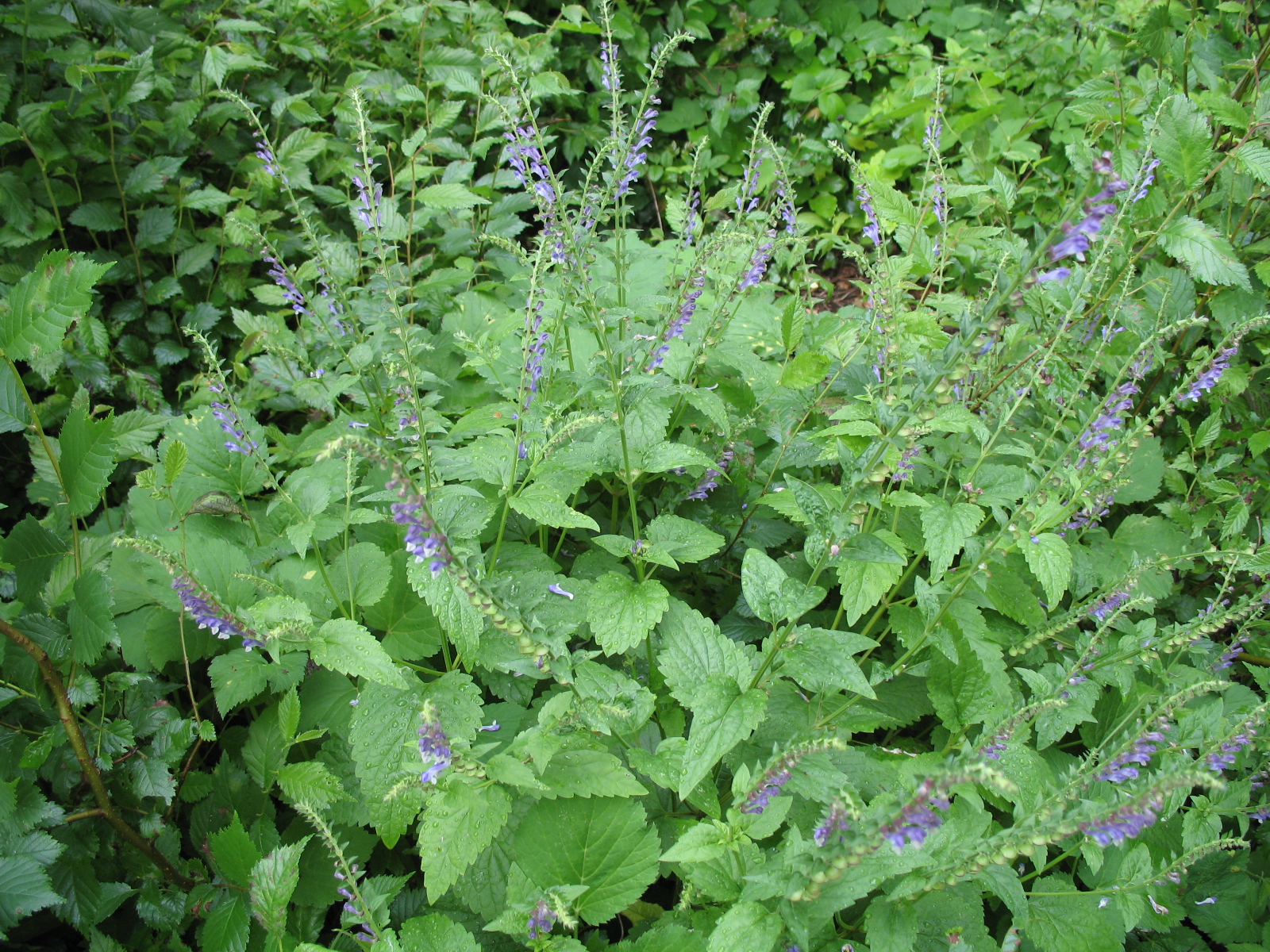
Above is the plant I am so excited about – Skullcap. It has pairs for slender, hooked Labiate flowers, running down adjacent corners of quite long flower stems. The flowers are a lovely deep mauve on the upper lip and contrasting white on the lower lip. This two tone flower is not obvious until you get right up close to it. The plant is clearly a member of the Labiates, not only due to the flowers but also because it has square stems and leaves coming off the stem in opposite pairs. The leaves taste strongly bitter, they taste amazing actually, of strong Scullcap tincture, the type I use at home quite regularly for pain relief and relaxation. I especially love this herb and have been using it for some years with great success, since beginning study with Susun Weed. It gives subtle releif to pain, especially pain in the head and it brings on sleep when it is needed. I am so happy to have stumbled upon this beautiful herb in Park Frankendael as I not seen it (or at least noticed it) growing wild before, I only knew it from books and bottles. All members of the Scullcap family contain the active ingredient and this is quite volatile thus the plant should be tinctured in situ.
There are many Scullcaps and all have the same active constituents. Most likely, this one is Sculletaria altissima, Tall Skullcap, Glidkruid in Dutch. It is labelled as Tros Glidkruid (Sculletaria columnae) in the herb garden of the park but I am not convinced. The flowers are very similar but the underlip of this Frankendael plant is definitely white, throughout, it doesn’t blend from white to mauve at all, there is clear definition.
Above is flowering Scrophularia nodosa, Common Figwort, NL: Helmkruid. A very strangely scented Labiate, which Claud Biemans helped me identify a few weeks ago. I still need to do some proper research into its internal and external uses but it certainly has many historic applications, such as being used to relieve skin eruptions and swelling for painful joints. It is prolific in some parts of this park.
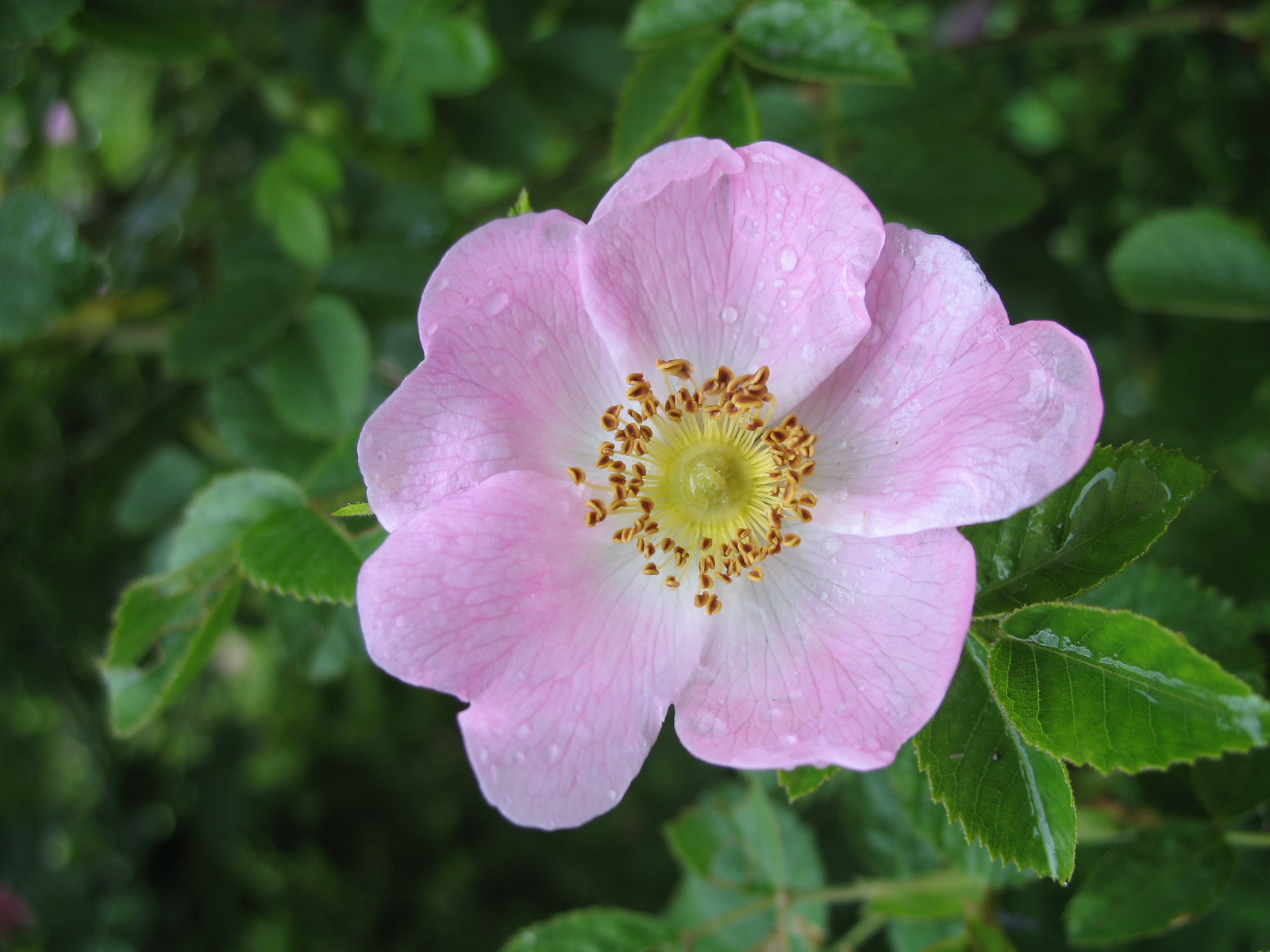
Next today, Wild Roses. It has rained today and the scent of Rose, close to these bushes is extraordinary. If you haven’t been outside to smell Roses after light rain then try it! I’ve mentioned Rose many times before. They are tasty and have many uses. These are both most likely to be Rosa canina, Dog Rose and how beautiful they are! But one of them could possibly be Rosa rubiginosa, Sweet Briar, it certainly smells good enough to be that. I will have a better look at the defining parts another day. For today I simply enjoyed them.
Here is Pellitory Parietaria sp., Glaskruid in Dutch. Another useful herb to learn more about as it is again prolific in arts of Frankendael.
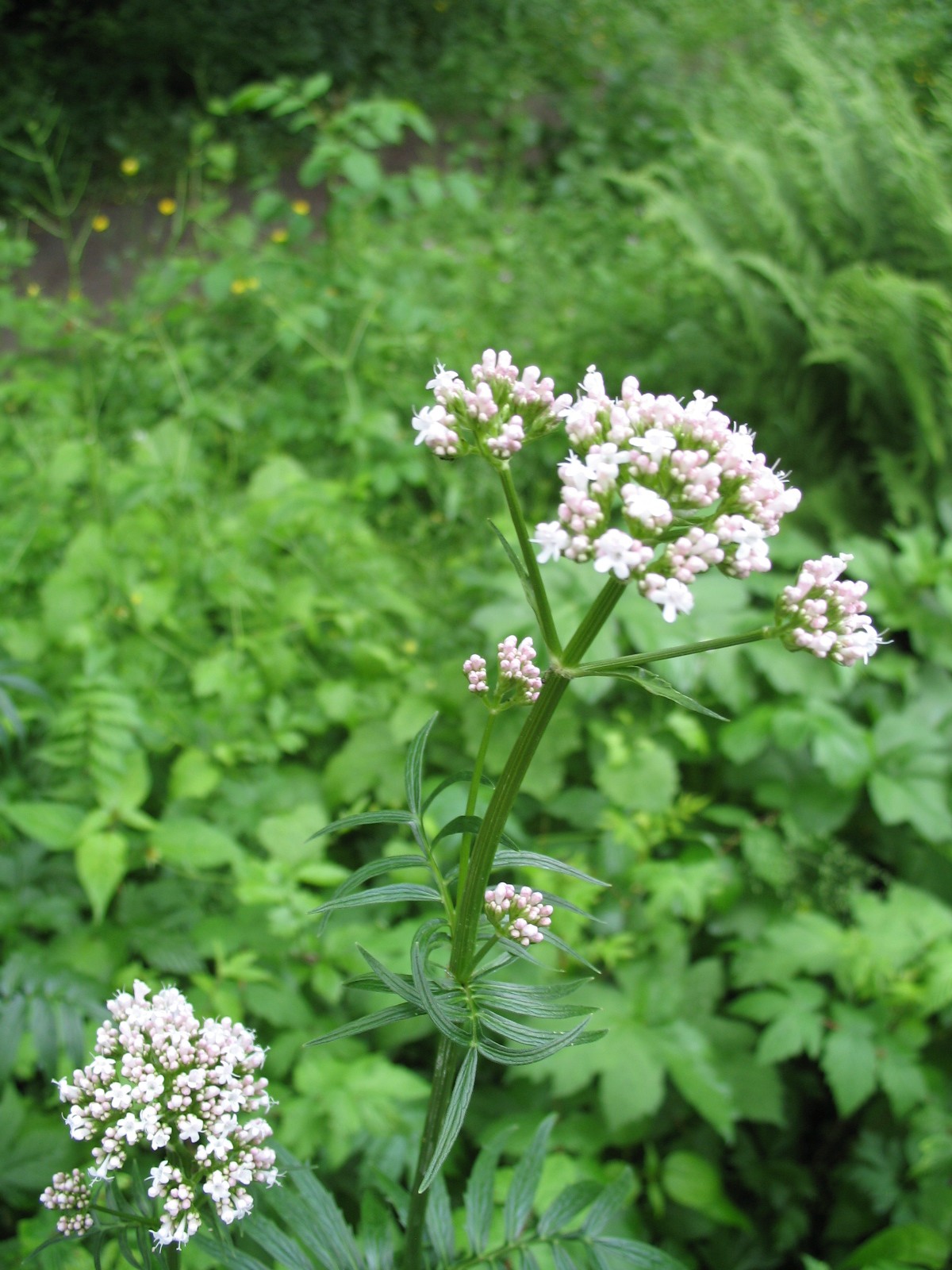
Lastly today gorgeous Valerian flowers, on the edge of the main woodland pond.
They smell great, they look great and they are very useful if you need to relax.
Once a month a chance to learn in detail about a different common urban herb from either Jennie (who I run the meetup group with) or me, Lynn.
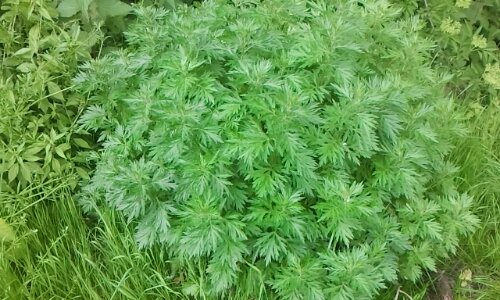
Part one is about Mugwort (Artemisia vulgaris). An amazingly mystical, powerful and yet underused plant, usually found in neglected places. Cronewort, the Dreamherb, is a great herb to learn crafting techniques on, such as how to make an infusion, oil, tincture, dream pillow and more. I will take this session in Park Frankendael on Monday 18th June 2012. 10.30 – 12.00.
In this short and sweet field workshop, you will make (or prepare for) all of those things and learn about the properties, habitat, folk and medicinal history and up to date uses of the plant. You will take home a bag full of little herbal preparations and knowledge of how to do it time and time again with everyday materials.
We will try to run each monthly Herb by Herb workshop near the New Moon and the days of the week will vary. You are welcome to attend all, some or none of the series! Most materials will be provided. You’ll receive a simple pack list when you subscribe. Cost of the workshop is €10.
Please contact me by email or through the meetup group if you are interested in joining this workshop.
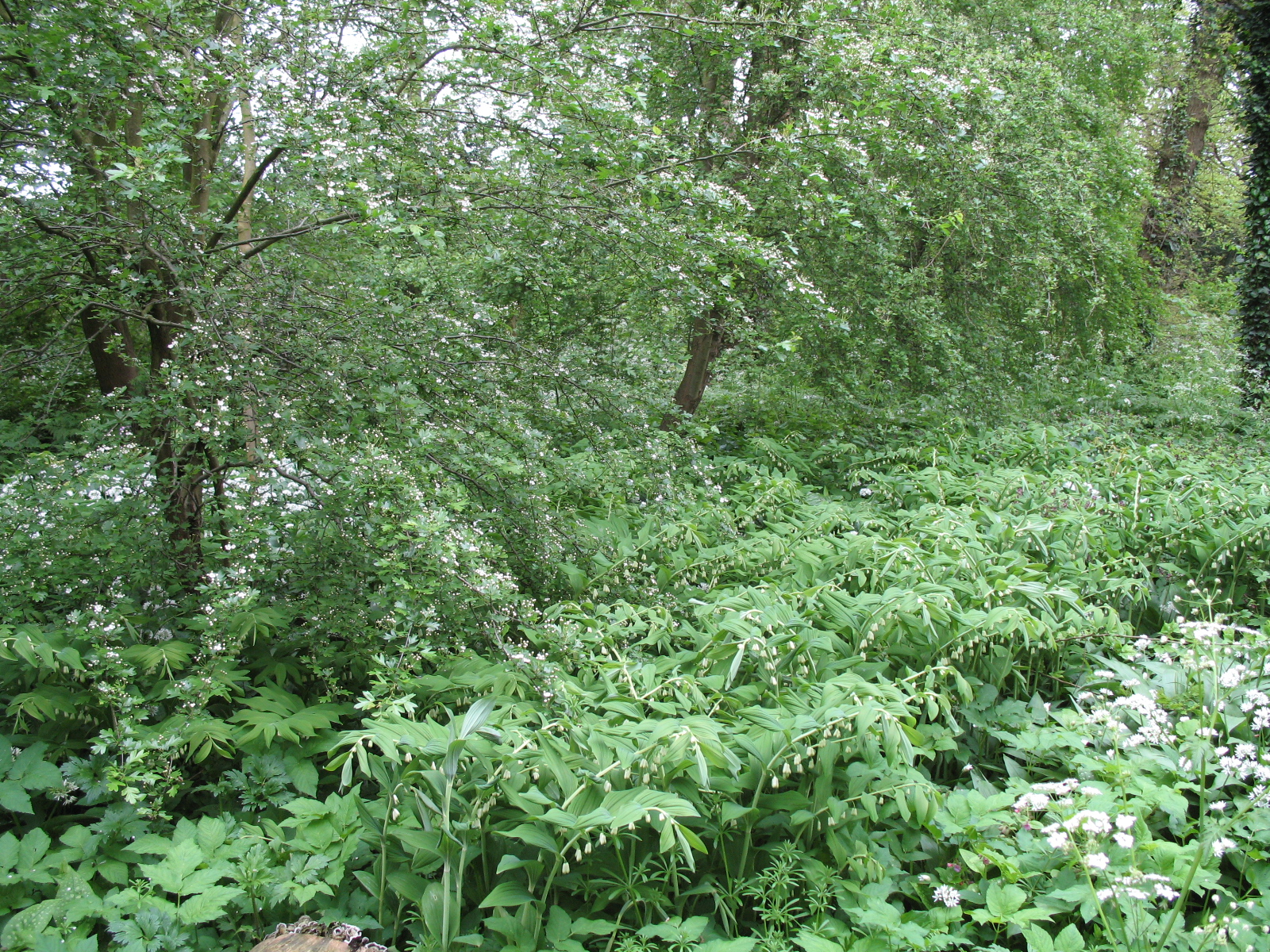
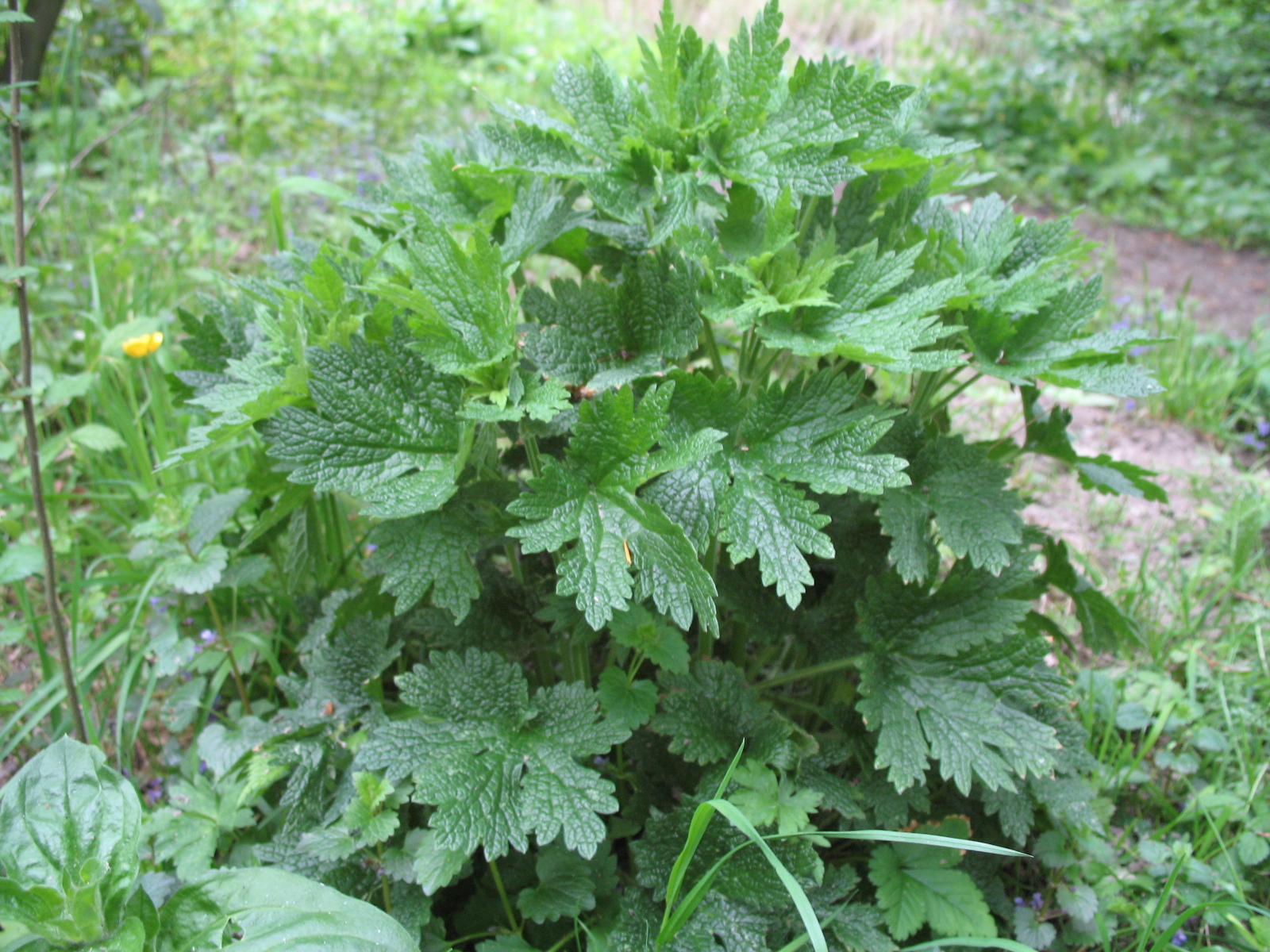
Today a dusk walk through the woods. The Hawthorns of Frankendael are finally opening their flowers, Lily of the Valley flower stems (poisonous look alike of Ransoms) arch elegantly above their neighbours, Moorhen chicks shelter beneath Meadowsweet and beloved Motherwort is growing bigger and bolder by the minute.
Motherwort is an extremely useful perennial herb which grows in compact clumps, rather like Mugwort but is a little more modest. Motherwort (Leonurus cardiaca, NL: ). Since learning about it through Susun Weed, I always have a bottle of tinctured Motherwort close to hand. This plant is a member of the Labiate family (mints) but tastes completely different to the mint most of us are used to. It has a very strong scent when you brush your hands up through the plant, has square stems, as with all Labiates. It is extremely bitter and distasteful when taken as a tea. All parts of the plant are medicinal. It has an age old reputation for its heart strengthening abilities and for its value in calming nerves, restlessness and irritability. It is an emmenagogue so shouldn’t be taken whilst pregnant, thought it has much value to women postpartum, to mothers in general and to women with period pain. The tincture is the easiest and most palatable way to take it.
Motherwort instills a feeling of groundedness. Ten drops of tincture, in a glass of water, can bring me back down to Earth in a few minutes when I feel the world is spinning out of control. Historically, Motherwort was used as a common treatment for heart problems such as palpitations and for fevers where the body & mind needed to be kept calm. It is now almost forgotten for such purposes but, thanks to our ancestors, many garden escapes have naturalised throughout Europe. This plant in Frankendael is possibly a garden escape from the old Landhuis. I am very pleased it is there.
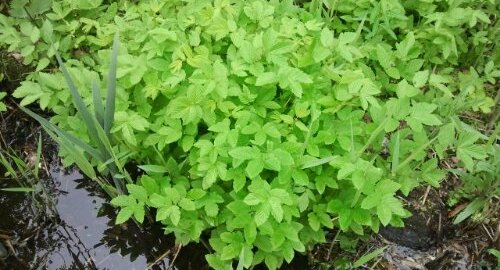
Meadowsweet (Filipendula ulmaria, NL: Moerasspirea) is a waterloving perennial herb which contains an active ingredient called Methyl salicyclate, which when taken in combination with tannins and mucilage within the plant can bring about stomach healing. In contrast, when methyl salicyclate is used alone (Aspirin) it causes stomach bleeding. As with most herbs, it is the natural combination of chemicals which work so well together to bring about healing.
Here’s a link to an extract from a wonderful book called Hedgerow Medicine, by Julie Bruton-Seal and Matthew Seal. It is one of my favourite and most consulted books. This extract explains how to make a useful and tasty, Meadowsweet glycerite. Meadowsweet is also traditionally associated with love, peace and harmony. There is an old custom of tossing a Meadowsweet flowerhead into water if you are seeking the identity of a thief. If it floats the thief is a woman, if it sinks it is a man.
Meadowsweet will flower later in the year, from around midsummer. The flowers produce a scent which is one of my favourites, a strong and heady sweet almondy aroma which really pleases my spirits. As you can see in the photo. Meadowsweet can be found in the watery regions of Frankendael park. It’s spikey leaves are difficult to miss as you walk across the modern wooden bridge, in the woodland area.
Here’s a Mayday Hawthorn bough, happily still attached to it’s tree! I’m sure that last Mayday the Hawthorns of Frankendael had opened their flowers by now. They certainly haven’t today and the weather is still not exactly encouraging the plants to grow as they could. None the less Hawthorn looks beautiful at the moment is most trees I see are loaded with green buds, ready to explode into a froth of white/pink blossom. Hawthorn is a spiky, irregularly shaped shrub or small tree which is easy to spot in hedgerows around town. It has unique, small, deeply lobed leaves, a froth of flowers around this time of year and bright red berries come autumn. It is long associated with heart medicine and Mayday country frolics.
Hawthorn is a renowned tonic for the circulatory system. The leaves, berries and flowers can be used to treat angina and several other heart conditions – obviously under the guidance of an experienced medical practitioner as heart disease is always a serious and often life threatening, condition. Hawthorn can be used as a preventative tonic, to guard against future heart problems. It can lower blood pressure, help dissolve cholesterol and calcium deposits.
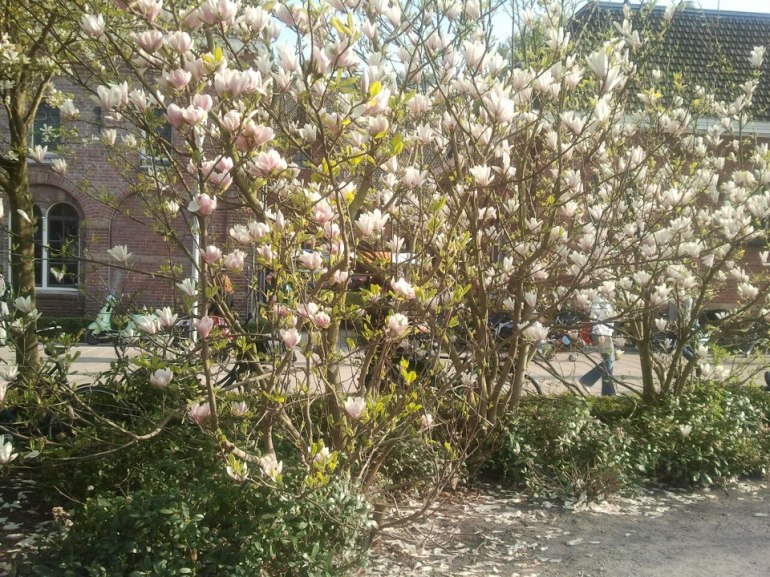
Magnolia is a tree which I fall in love with again, every year. Everything about it enthralls me. From the graceful angles of the branches, the bark, exotic blooms to the glossy evergreen leaves. A huge magnolia in bloom is a show stopper. One such tree arches quietly over the terrace behind Huize Frankendael, in Amsterdam east. Hundreds of visitors must walk beneath it without giving the tree much thought, until in March or April it explodes into bloom. There is no other tree that I would rather sit beneath and gaze up through than that magnificent magnolia in spring!
Edible and Medicinal Magnolia Petals
The flowers of Magnolia trees are edible and medicinal. In Traditional Chinese Medicine, Magnolia flowers are known as Xin yi hua and are associated with the lung and stomach meridians. I enjoy eating them fresh plucked each year and happily report that they taste fragrant and spicy. I can also report that when I eat Magnolia petal, my sinuses become clear, quite like magic.
Imagine a slightly rubbery super sized rose petal which clears the sinuses a little, when you bite into it and you are getting close to the mouth feel and flavour of a magnolia petal. I like them very much and because a little goes a long way with these large petals, I can certainly recommend them to other urban herb lovers. As you may know, via my Apprenticeshipand walks, I teach how to harvest interesting herbs in towns and cities, in a safe and ethical way. This entails taking only a little, leaving no trace and really make the most of the harvest. Do contact me if you would like to know more – This is my passion!
Medicinal Bark
Fairly recent research suggests that Magnolia bark extract can help with oral health, stress reduction and several other disorders. In traditional medicine it is reportedly used as an antibacterial, anti-inflammatory, anticancer agent, in the treatment of Alzheimer disease, depression, diabetes, and menopause. All Magnolia species varieties are considered to possess the same medicinal qualities and there are apparently no known side effects – although we know that someone somewhere, could be allergic to the plant, so please be cautious. Magnolia Bark Extract is widely available for sale and Magnolia bark is an ingredient in many traditional Chinese medicines including Hsiao-cheng-chi-tang, Wuu-Ji-San, Heii-san, Shimpi-to, Hangekouboku-to, Masinin-gan, Sai-boku-to, Syosaiko-to, Irei-to and Goshaku-san.
Japanese traditional medicine also prizes both the bark and flowers of Magnolia. Bark harvesting is not something suggested for the urban forager because it certainly leaves a trace and it is certainly not ethical.
Magnolias in Westerpark
Stealthy Petal Plucking
When harvesting from perhaps the most beautiful of city trees, one would perhaps look both foolish and anti-social to pluck entire flowers. So I suggest that you don’t. Instead, I recommend that when stumbling upon a prime Magnolia specimen in bloom, and feeling the urge to eat it, you do the following:
1. After checking for unwanted observers, wander nonchalantly up to the tree. Are the blossoms within your reach? If not move on to another.
2. If so, reach up as if to smell the fragrance of a prime bloom, pull it gently to your nose with one hand, whilst deftly plucking a single petal from its base, with the other hand whilst simultaneously inhaling the spicy aroma.
3. Tuck the plucked petal in your pocket as you gently release the bloom with your other hand.
4. Move along to another flower, as if to compare its scent with the previous bloom. Repeat steps 1 to 3 until you have harvested three or four petals.
A magnolia flower can miss one petal without much issue. If two or more petals are plucked from one bloom, evidence of foraging shows and that is not the plan. So one petal from a flower, move to another, one more petal and so on. When you have three or four petals, you are done. That is enough to make something very tasty and useful and you will have increased your stealth foraging skills..
Untouched – Delicious
Favourite Trees
I tend to forage a handful of petals each year, from 6 favourite Magnolias which are dotted around east Amsterdam. They are all growing in public spaces so stealth foraging is required. I don’t harvest from them if other people are around because apart from it just looks silly. I also limit myself to plucking a petal from two flowers per tree. I first wrote about my love of Magnolia petals on 2012. Since then urban foraging has increased in popularity so I also am careful to only pluck from Magnolias which seem not to have been visited by other foragers.
Magnolia Petal Recipes
Things that I like to do with a precious handful of magnolia petals. I hope that you have a go and let me know how you get on in the comments.
Magnolia Petal Pickle
They can be pickled, old English style by simply filling a small jar with fresh petals and then completely filling the jar again with rice wine vinegar or apple cider vinegar with a little salt and sugar to balance the flavours. I don’t add sugar or salt so I guess my version is simply Magnolia petal vinegar – I don’t mind because it tastes good 🙂
Fermented Magnolia Petals
You may like to ferment them using a little salt and water, in the style of Sandor Katz.
I prefer to lay them in my handy small Japanese vegetable press. I then sprinkle with a pinch of salt and apply the gentle but consistent pressure of the Japanese press for about 3 hours. This produces a very light ferment and it draws out some of the water from the petals (which tastes good too). You can leave the pressure for a lot longer if you prefer, winding the contraption every few hours to ensure the petals are in fact under a little pressure and to encourage the process.
Magnolia Petal Honey When I first tasted a Magnolia petal and felt its clearing effect on my sinuses, I decided to transfer the petals’ properties to honey. This is soooo simple to make. It creates something which my family and friends find delicious and I hope you will too. If the honey turns you off, try Agave syrup. It works very well but in my experience is less spreadable (being rather runny).
Magnolia petals infusing in honey
How to Make Magnolia Petal Honey (or use Agave syrup)
1. Gather your petals.
2. I rarely wash magnolia petals because I only harvest clean looking ones, which are from way above the ground but unsoiled by birds. You may like to wash yours. If so, then dry them off.
3. Tear the clean, surface dry petals into a sterile small glass jar. I use dishwasher cleaned pesto jars for this sort of thing.
4. Covered completely with runny honey. Use a chop stick or knitting needle to loosen trapped air bubbles. You may need to release the air and top up with honey several times. The jar should be filled to the brim with honey. The air bubbles won’t all leave the honey but prodding with chopsticks, helps them to escape and thus reduces the risk of contamination.
5. When no more air bubbles are escaping and no more honey needs to be added, close the jar tightly with its lid.
6. The constituents of the petals will infuse into the honey over the following days and weeks but the honey will take on a delicious Magnolia aroma and taste within a few hours.
7. Eat in any honey way (smear on bread, add to smoothies, mix with a little vinegar for an elixir, etc) you choose or take a teaspoon now and them to help soothe anxiety, sore throats or respiratory congestion. I don’t bother to strain this honey as I like the petal crunch. You could strain after 6 weeks if you preferred. It seems a waste of those petals though.
Please note that the herbal honey may start to ferment after a while, due to the high water content in the petals. Keep an eye on the jar, if it starts to bubble, the lid must be loosened to avoid pressure building up and the glass jar exploding. Storing it in a cool dark location will help to preserve its shelf life. Eating it all up will also avoid the problem 🙂
I hope that you get a taste for Magnolia petals this year and have a try at infusing them in honey, agave syrup, vinegar, vodka or olive oil. This herb is so beautiful, so giving and so tasty – it would be a pity to miss the fun completely wouldn’t it? I was looking at my favourite Magnolia at twilight this evening. It will open its blooms very soon and I will be waiting and thanking it for every petal.
Do you like it?
Please do add a comment about your magnolia experiences at the foot of the page or fill in the contact form. I would love to hear how you get on with magnolia and what else you are keen to learn about!
Urban Herbology Online Apprenticeship
If you want to learn more about foraging and using herbs in towns and cities, take a look at my Apprenticeship Course. I have helped hundreds of wonderful people learn about Urban Herbology over the years and I would love to help you on your journey!
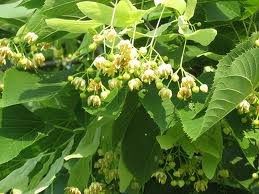
City bees are dizzy with happiness at present. The sweet perfume of Lime (NL:Linden, Tilia spp.) trees fills the air in many streets and parks, attracting bees from far and wide. This tree looks wonderful, can grow to a stately height, is great for wildlife and it’s flowers are used to make the best herb tea and honey on Earth (well, I think so anyway!). The Lime tree is able to calm our nerves and bring us happiness.
The tree is easily identified. It has a classic tree shape, if allowed to grow unchecked, has large heart-shaped and sharply toothed leaves which are smooth above. Lime flowers hang yellowish-white from the trees from Midsummer to July, not necessarily all over the tree. There are often burrs on the handsome trunks.
Uses
Linden flower tea is very popular here in the Netherlands and across the continent. Lime grows abundantly in the UK yet is less widely used. The French prize the herb tea made from Linden flowers above most others and call it Tilleul. It was used traditionally in Europe to treat nervous disorders such as hysteria, nervous vomiting and palpitations brought about by stress.
Linden honey has been highly prized for generations, has a heavenly taste and carries many of the properties of the tree.
Lime wood is excellent for minutely detailed carving and turning, being close grained, strong, durable and unattractive to woodworm.
Lime bark has been traditionally used in Europe to make baskets and fishing nets.
The sap is plentiful in spring and has a high sugar content. It can be tapped in the same as Maple and Birch.
The leaves can also be made into a tea/infusion whereupon they yield an extremely thick (mucilaginous) and cooling drink. They also make a simple and tasty sandwich filling.
It is found by many to be helpful for coughs, colds, fevers, headaches, inflammation, as a diaretic, general tonic, to calm the gut and to soothe nerves.
In general this herb is thought of as soothing, relaxing and promoting feelings of happiness.
Narcotic intoxication:
Lime blossom is easy to harvest, dry and use but as with all herbs, it should be treated with great respect. Harvest when in full bloom and all should be well but beware that Lime blossom tea can produce a mild, non addictive intoxication. Flowers left on the tree too long before harvesting are said to have a more intoxicating effect. The mildly intoxicating effect of appropriatly harvested Lime makes many of us feel happy. It also makes Lime extremely valuable to those seeking to enter a state of trance and other magical journeying.
On a spiritual level, Lime is renowned as a tree herb which can help relieve grief and induce feelings of vibrancy and youthfulness. To appreciate these qualities it is said that you should carry a small bag, filled with dried Lime leaves, or that you place them under your pillow.
How to harvest Lime/Linden.
Harvest from mature Lime trees, in as clean and unpolluted an area as is possible.
Choose a dry day, preferably before it becomes too hot and after the dew has dried.
Snip off young healthy sprigs, containing blossoms and a few leaves, from branches which you can reach easily.
Respect the trees and harvest sparingly.
Spread the harvest out on a clean dry surface, preferably on trays so air can circulate easily.
Leave in a warm, well ventilated place for 2 – 3 weeks, until the sprigs are thoroughly dry and brittle.
Store in sterilised airtight containers.
How to make Linden/Lime tea and infusion. You can make Linden tea by simply steeping a sprig of fresh Lime in a cup of boiling hot water for as long as desired for taste. Or you can use a teaspoon full of dried crushed herb per cup.
To make an infusion place about 5 tablespoons of crushed dried herb in a pot or jar which holds about 500ml of water (you could scale this up to suit the size of your container). Add 500ml boiling water and leave with a tightly fitting lid and without heat, for between 4 and 8 hours (preferably overnight). Then strain, separately retaining both the herb and infusion. The infusion should be good for 24 hours if refrigerated. Return the “used” herb material to the pot and add about 300ml of boiling water. Simmer gently, for up to 2 hours, after which a very mucilaginous fluid should be obtained. Again this should be good for about 24 hours if refrigerated.
There is just enough time remaining to make a simple Midsummer Schnapps, to help celebrate the summer solstice on 21st June. In Scandinavian countries, where the midnight sun arrives to delight at midsummer, Schnapps is a key ingredient of many celebrations. There are several recipes available for Midsummer Schnapps, here’s one which I like. Ideally it is made a month or so before midsummer, allowing time for the properties of star anise and juniper berries to infuse into the vodka, but St John’s wort will infuse far quicker. Just a few days are required to get a reasonable colour, pleasant flavour and sunny properties from this herb, into the liquor.
St. John’s wort is renowned for helping people through periods of depression. Capsules of the herb can have unpleasant side effects and may interact with some drugs so beware if you are taking any medication. The tincture (and the Schnapps is a weak tincture) is more likely to leave you feeling sunny and calm. St John’s wort blooms on midsummer’s day, it is full of sunshine in so many respects, making it perfect for this drink. I have not tried it but apparently the flower buds may be frozen for later use. This recipe calls for buds which are fully developed but not yet opened, thus pick them before midsummer’s day. The plant is full of a red oil, particularly at midsummer so use a good field guide to check you have the real thing and tear a petal to see if it “bleeds” red oil, showing it to be ripe for picking.
Recipe for Midsummer Schnapps
Pick St John’s wort flower buds before noon or before the sun becomes too hot, leave sepals on the plant or strip them from harvested flowers. They do not add a good flavour to the schnapps.
Pick only black, fully ripened Juniper berries (or buy them dried and crush before use). Blue and green Juniper berries do not taste pleasant. If necessary wash and carefully dry the flower buds and berries with paper towels before use.
Use wholes, fresh or dried star anise pods.
Add about 3/4 cup of St John’s Wort flower buds, 45 – 55 Juniper berries and 10 Star anise pods to a clean glass jar with tighly fitting lid (preferably sterilised in dishwasher or low oven).
Add enough unflavoured vodka (40% alcohol / 80 proof ) to cover the berries, pods and flowers.
Secure the lid and leave in a room temperature, dark place for anywhere between 3 days and a month. (As mentioned above, the St John’s wort will impart it’s properties in just a few days, the berries and pods require much longer but you should get a pleasant Schnapps after a few days).
Shake the jar gently every few days.
When you are ready, strain and filter your infusion into a clean (preferably sterile) glass bottle or jar with a tight-fitting lid.
So, get your flower garlands and schnapps ready and enjoy the summer solstice!
I while ago I posted about the benefits of Cleavers and how to use the herb, including how to extract the juice using a cloth. Here’s a slightly high tech (and faster) method which I used this afternoon…
Firstly, please remember the foraging/picking rules and only harvest and use if you are 100% confident you have correctly identified the plant. Woodruff (Galium odoratum) looks like Cleavers but is tougher and grows low on the ground (it doesn’t climb). It can be used to infuse foods with a vanilla-type flavour. Beware of Madder (Rubia tinctorum) which looks more like Sweet Woodruff than Cleavers, but sometimes gets confused. That is used for dying fibres and should not be eaten. Here’s a useful post about the tiny seedlings of Cleavers (in January)
(12/1/25 – Today’s walkers – It was so lovely to meet you! I hope you find Cleavers – We didn’t see the little seedlings today but soon you will notice them, then the plants will grow up and tall. Let me know how you get on with your foraging 🙂
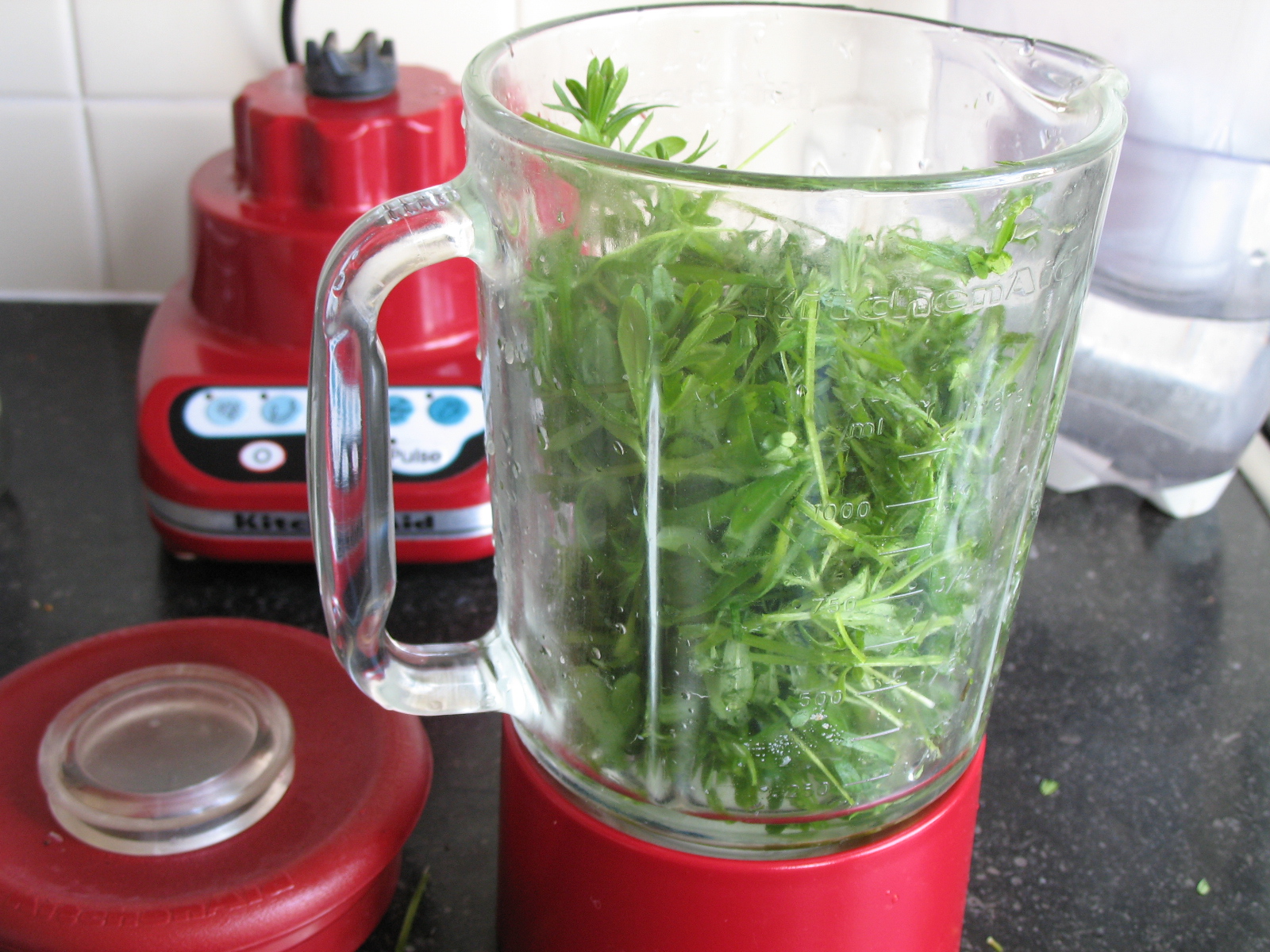
Wash and drain a good handful of freshly picked cleavers
Remove any unhealthy looking stems, rooty/yellowy ends, grass, other material etc
If the cleavers seem very wet from washing perhaps blot dry with a clean tea towel.
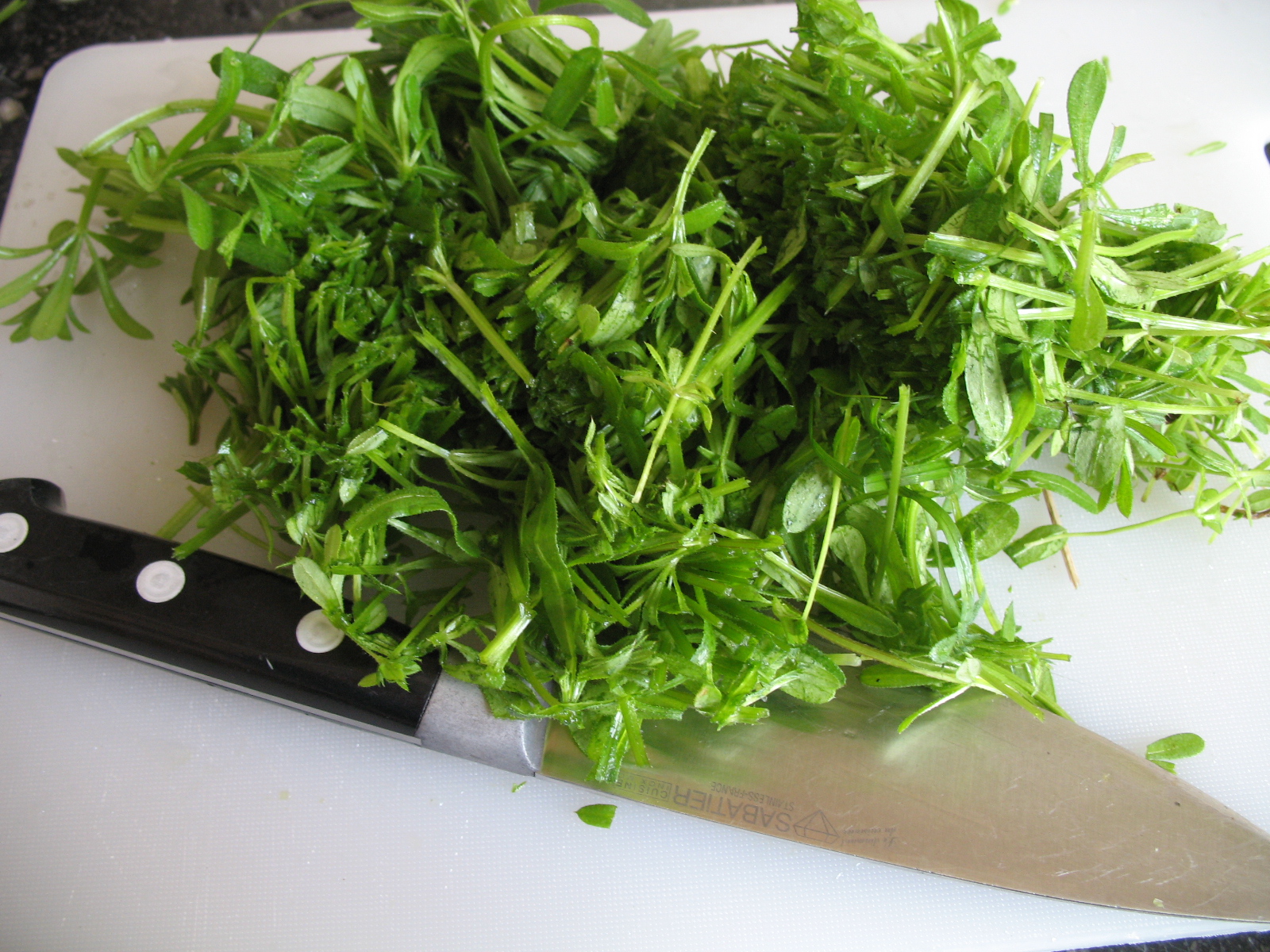
Roughly chop the stems.
Add a little clean water to the blender, perhaps enough to half cover the blades. This is just to prevent clogging. Then add the cleavers.
Blend use the chopping setting, or pulse on full power, until it seems to be nicely pulverised.
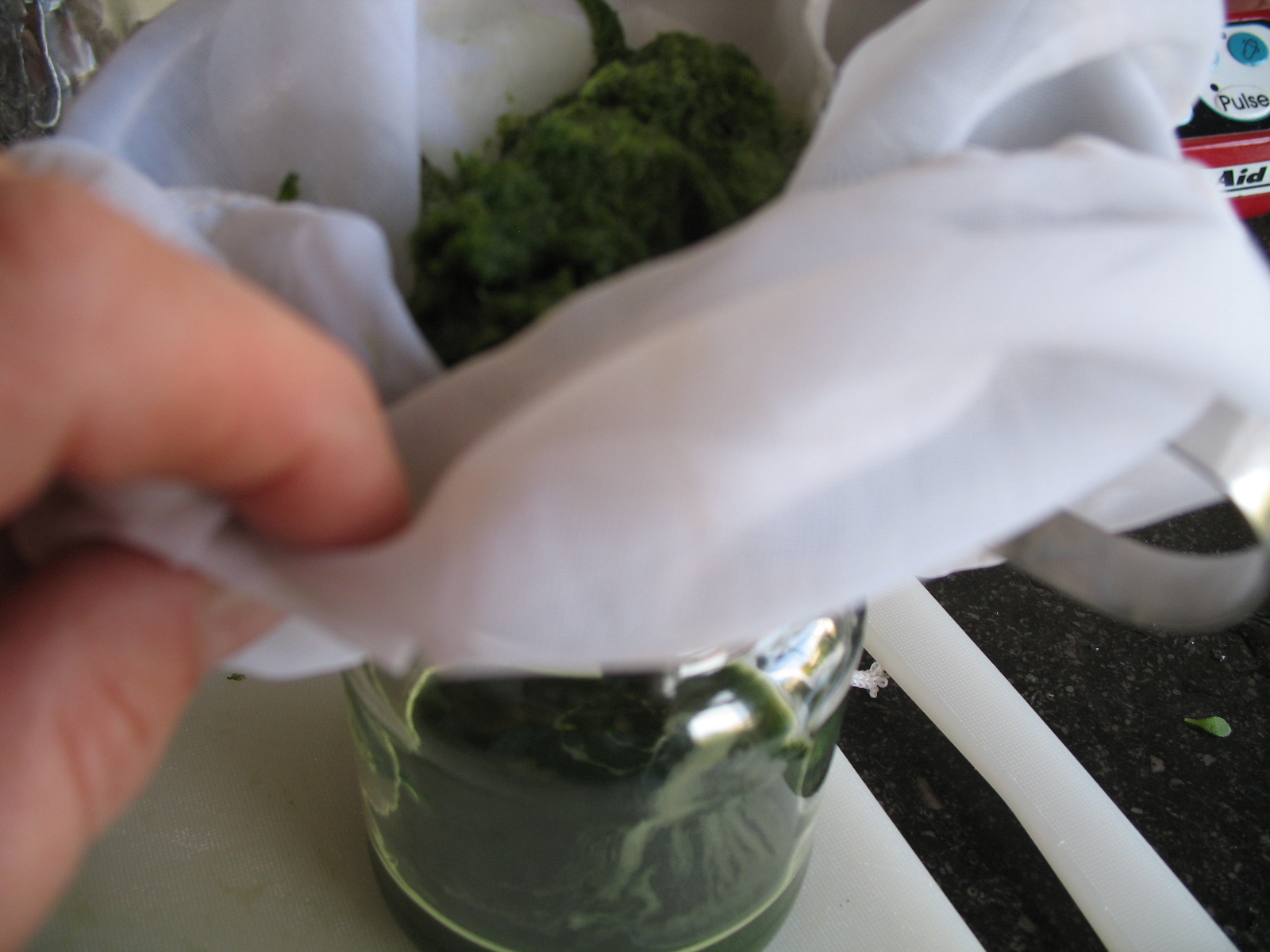
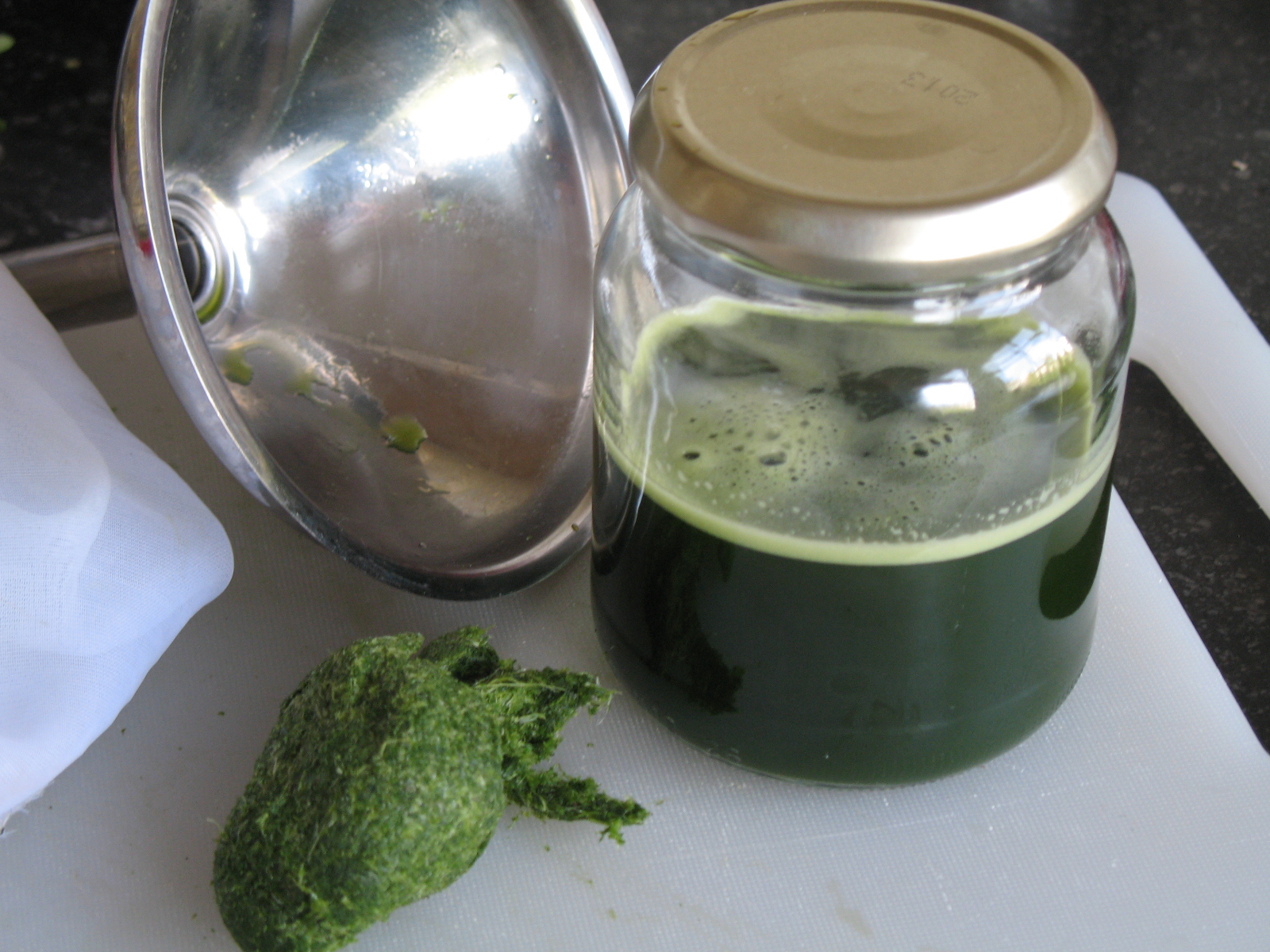
Strain through a jelly bag, muslin or clean tea towel, into your collection jar. I also used a funnel to make collection easier but this is optional.
The juice should run out quickly.
Finally wring out any remaining juice through the jelly bag/muslin/tea towel
Compost or return to the earth, the remaining pulp. This afternoon I used it to help mulch a balcony herb pot.
Store the juice refrigerated in an air tight, sterile container. Remember to label the jar and lid clearly. It should keep in a fridge for a few days but if you notice anything unusual, such as discoloration, changed smell or taste then pour it onto soil and start again.
Generally the dose for cleavers juice is 1tsp up to three times daily as a tonic.
Start with a very small amount when you try something new and if you notice any negative reaction then stop using and water your plants with it. That said, this is generally thought of as a safe, nourishing and cleansing tonic which has been used in many countries, as a folk remedy for many many years.
A handful of cleavers yielded about 200ml of juice today. I plant to freeze some in an ice cube tray this evening as 200ml is more than enough for me to use as a tonic over the coming days.
I love nettles and I love making fresh pasta. Here’s a little information about nettle and a great recipe which combines the two.
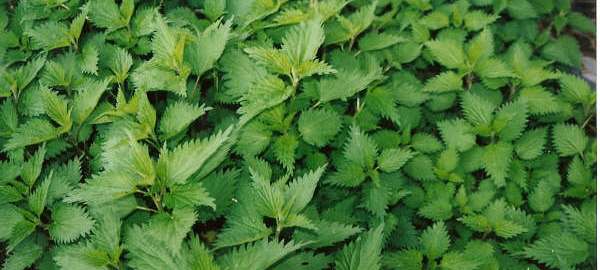
It is best to make use of stinging nettles (Urtica dioica) when they are young (in late March and early April – before they start to flower). I prefer to use them in strong overnight infusions, as a leafy veg in cooking and as a hair rinse. The resilient perennial Urtica dioica is sure to be found fresh somewhere near you and dried nettle is quite easy to find from herbal suppliers. It grows well in nitrogen rich soil, is present above ground almost year round but to avoid woodiness only harvest until it comes into flower.
This herb is packed with vitamins and minerals, is extremely nourishing and energises the body and mind. Taken regularly it can build strength in many ways. I’ll post lots more about nettle in future but for now here’s a link to an informative post by Susun Weed about nettle and how to make effective, strong nettle infusions from dried herb. There are a many recipes available which include nettle, in my experience many are quite bland. However many traditional Italian recipes feature nettle and taste very good. Here is a simple, tastey combination of pasta and nettle. Stinging nettle tops are ripe for the picking at the moment, so it’s a great time to try this recipe.
Strettine – Nettle Pasta
120ml nettle purée
360g Italian tipo 00 flour
2 eggs
good pinch of salt
good pinch of black pepper
Make nettle purée as follows: Harvest about 200g of healthy nettle tops, clean them before adding to a pan of boiling water. Boil rapidly for 2 minutes. Strain and place the wet, cooked nettles into a clean muslin, jelly bag or tea towel. Wring out until the nettles become quite dry. Blend the nettle in a food processor until smooth. You need about 120ml of nettle puree for this pasta, freeze the remainder for later use.
Seive the flour onto a pastry board or clean worktop.
Mix the nettle puree, salt and black pepper into the flour.
Form a well in the centre of the nettle-flour mix and break the eggs into this well.
Use a fork to lightly break up the eggs in the well and use it to start working the nettle-flour into the eggs.
Use your hands to work the rest of the nttle-flour in with the eggs.
When all is basically combined, knead the dough with your hands to form a smooth pliable ball.
Wrap with a clean cloth or clingfilm and place in refrigerator to rest, for about 30 minutes.
Now the pasta dough is ready to roll and cut. Divide the dough into three roughly equal pieces and pass through the rollers of a lightly-floured pasta machine. Work through the machine several times until until you have obtained a smooth and elastic sheet, at least through roller setting number 3.
Pass the rolled sheet of pasta through the tagliatelle cutting blades.
Dry the taglietelle a little by spreading it out on a clean cloth or a pasta drying stand. Allow to dry at room temperature for about 15 minutes.
Cook in salted boiling water for 2-4 minutes, until al dente.



















 Urban Herbology
