I tend a tree pit outside of my apartment and had the council dig me a small pavement garden, in a totally dry spot beneath my bay window. With the right plants these patches are hardly any work but give plenty of reward. I harvest wormwood, rosemary, lavender, lemon balm and more herbs each year from these spots, plus me and my neighbours have an improved view.
I fancy improving some other small neglected spots in Amsterdam and wonder if anyone would like to join me? I love the idea of guerilla gardening but most of the information that I’ve found about that in Amsterdam, is far too political for me. I’m also not available for night time gardening, I like to sleep. I’m thinking more of selecting a few herbs to suit a specific location, herbs which would enhance it and maybe produce a small crop. Then planting some seedlings and keeping an eye on them now and then.
I love the idea of finding calendula flowers around a tree base, nasturtians tumbling over a canal edge, the odd passionflower or wild strawberry creeping around the undergrowth on a train embankment. The possibilities are endless and could really increase the number of herbs available to us.
Guerrillagardening.org is an inspiring link which may be interesting. Do contact me, preferably via the message board on the meetup.com group, if you fancy some low key, non political, herb orientated, surreptitious gardening…
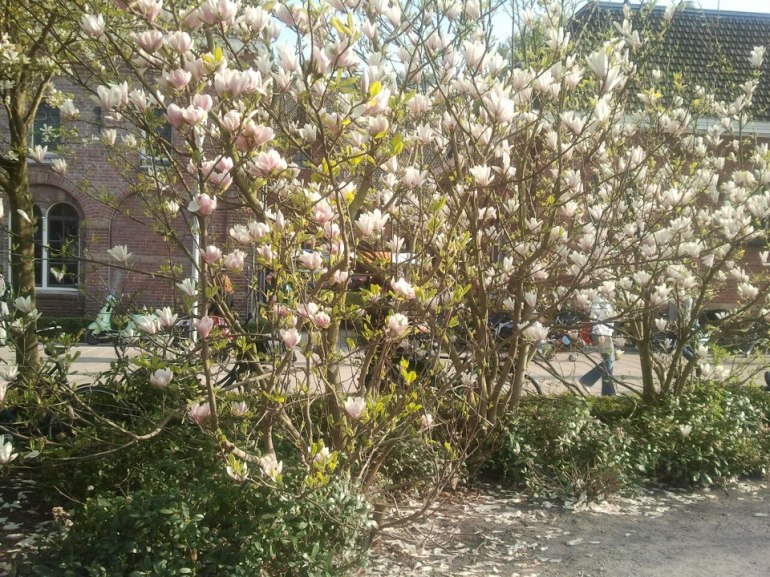
Magnolia is a tree which I fall in love with again, every year. Everything about it enthralls me. From the graceful angles of the branches, the bark, exotic blooms to the glossy evergreen leaves. A huge magnolia in bloom is a show stopper. One such tree arches quietly over the terrace behind Huize Frankendael, in Amsterdam east. Hundreds of visitors must walk beneath it without giving the tree much thought, until in March or April it explodes into bloom. There is no other tree that I would rather sit beneath and gaze up through than that magnificent magnolia in spring!
Edible and Medicinal Magnolia Petals
The flowers of Magnolia trees are edible and medicinal. In Traditional Chinese Medicine, Magnolia flowers are known as Xin yi hua and are associated with the lung and stomach meridians. I enjoy eating them fresh plucked each year and happily report that they taste fragrant and spicy. I can also report that when I eat Magnolia petal, my sinuses become clear, quite like magic.
Imagine a slightly rubbery super sized rose petal which clears the sinuses a little, when you bite into it and you are getting close to the mouth feel and flavour of a magnolia petal. I like them very much and because a little goes a long way with these large petals, I can certainly recommend them to other urban herb lovers. As you may know, via my Apprenticeshipand walks, I teach how to harvest interesting herbs in towns and cities, in a safe and ethical way. This entails taking only a little, leaving no trace and really make the most of the harvest. Do contact me if you would like to know more – This is my passion!
Medicinal Bark
Fairly recent research suggests that Magnolia bark extract can help with oral health, stress reduction and several other disorders. In traditional medicine it is reportedly used as an antibacterial, anti-inflammatory, anticancer agent, in the treatment of Alzheimer disease, depression, diabetes, and menopause. All Magnolia species varieties are considered to possess the same medicinal qualities and there are apparently no known side effects – although we know that someone somewhere, could be allergic to the plant, so please be cautious. Magnolia Bark Extract is widely available for sale and Magnolia bark is an ingredient in many traditional Chinese medicines including Hsiao-cheng-chi-tang, Wuu-Ji-San, Heii-san, Shimpi-to, Hangekouboku-to, Masinin-gan, Sai-boku-to, Syosaiko-to, Irei-to and Goshaku-san.
Japanese traditional medicine also prizes both the bark and flowers of Magnolia. Bark harvesting is not something suggested for the urban forager because it certainly leaves a trace and it is certainly not ethical.
Magnolias in Westerpark
Stealthy Petal Plucking
When harvesting from perhaps the most beautiful of city trees, one would perhaps look both foolish and anti-social to pluck entire flowers. So I suggest that you don’t. Instead, I recommend that when stumbling upon a prime Magnolia specimen in bloom, and feeling the urge to eat it, you do the following:
1. After checking for unwanted observers, wander nonchalantly up to the tree. Are the blossoms within your reach? If not move on to another.
2. If so, reach up as if to smell the fragrance of a prime bloom, pull it gently to your nose with one hand, whilst deftly plucking a single petal from its base, with the other hand whilst simultaneously inhaling the spicy aroma.
3. Tuck the plucked petal in your pocket as you gently release the bloom with your other hand.
4. Move along to another flower, as if to compare its scent with the previous bloom. Repeat steps 1 to 3 until you have harvested three or four petals.
A magnolia flower can miss one petal without much issue. If two or more petals are plucked from one bloom, evidence of foraging shows and that is not the plan. So one petal from a flower, move to another, one more petal and so on. When you have three or four petals, you are done. That is enough to make something very tasty and useful and you will have increased your stealth foraging skills..
Untouched – Delicious
Favourite Trees
I tend to forage a handful of petals each year, from 6 favourite Magnolias which are dotted around east Amsterdam. They are all growing in public spaces so stealth foraging is required. I don’t harvest from them if other people are around because apart from it just looks silly. I also limit myself to plucking a petal from two flowers per tree. I first wrote about my love of Magnolia petals on 2012. Since then urban foraging has increased in popularity so I also am careful to only pluck from Magnolias which seem not to have been visited by other foragers.
Magnolia Petal Recipes
Things that I like to do with a precious handful of magnolia petals. I hope that you have a go and let me know how you get on in the comments.
Magnolia Petal Pickle
They can be pickled, old English style by simply filling a small jar with fresh petals and then completely filling the jar again with rice wine vinegar or apple cider vinegar with a little salt and sugar to balance the flavours. I don’t add sugar or salt so I guess my version is simply Magnolia petal vinegar – I don’t mind because it tastes good 🙂
Fermented Magnolia Petals
You may like to ferment them using a little salt and water, in the style of Sandor Katz.
I prefer to lay them in my handy small Japanese vegetable press. I then sprinkle with a pinch of salt and apply the gentle but consistent pressure of the Japanese press for about 3 hours. This produces a very light ferment and it draws out some of the water from the petals (which tastes good too). You can leave the pressure for a lot longer if you prefer, winding the contraption every few hours to ensure the petals are in fact under a little pressure and to encourage the process.
Magnolia Petal Honey When I first tasted a Magnolia petal and felt its clearing effect on my sinuses, I decided to transfer the petals’ properties to honey. This is soooo simple to make. It creates something which my family and friends find delicious and I hope you will too. If the honey turns you off, try Agave syrup. It works very well but in my experience is less spreadable (being rather runny).
Magnolia petals infusing in honey
How to Make Magnolia Petal Honey (or use Agave syrup)
1. Gather your petals.
2. I rarely wash magnolia petals because I only harvest clean looking ones, which are from way above the ground but unsoiled by birds. You may like to wash yours. If so, then dry them off.
3. Tear the clean, surface dry petals into a sterile small glass jar. I use dishwasher cleaned pesto jars for this sort of thing.
4. Covered completely with runny honey. Use a chop stick or knitting needle to loosen trapped air bubbles. You may need to release the air and top up with honey several times. The jar should be filled to the brim with honey. The air bubbles won’t all leave the honey but prodding with chopsticks, helps them to escape and thus reduces the risk of contamination.
5. When no more air bubbles are escaping and no more honey needs to be added, close the jar tightly with its lid.
6. The constituents of the petals will infuse into the honey over the following days and weeks but the honey will take on a delicious Magnolia aroma and taste within a few hours.
7. Eat in any honey way (smear on bread, add to smoothies, mix with a little vinegar for an elixir, etc) you choose or take a teaspoon now and them to help soothe anxiety, sore throats or respiratory congestion. I don’t bother to strain this honey as I like the petal crunch. You could strain after 6 weeks if you preferred. It seems a waste of those petals though.
Please note that the herbal honey may start to ferment after a while, due to the high water content in the petals. Keep an eye on the jar, if it starts to bubble, the lid must be loosened to avoid pressure building up and the glass jar exploding. Storing it in a cool dark location will help to preserve its shelf life. Eating it all up will also avoid the problem 🙂
I hope that you get a taste for Magnolia petals this year and have a try at infusing them in honey, agave syrup, vinegar, vodka or olive oil. This herb is so beautiful, so giving and so tasty – it would be a pity to miss the fun completely wouldn’t it? I was looking at my favourite Magnolia at twilight this evening. It will open its blooms very soon and I will be waiting and thanking it for every petal.
Do you like it?
Please do add a comment about your magnolia experiences at the foot of the page or fill in the contact form. I would love to hear how you get on with magnolia and what else you are keen to learn about!
Urban Herbology Online Apprenticeship
If you want to learn more about foraging and using herbs in towns and cities, take a look at my Apprenticeship Course. I have helped hundreds of wonderful people learn about Urban Herbology over the years and I would love to help you on your journey!
I so enjoyed harvesting, cooking and eating Japanese knotweed today, for the first time in my life.
I found several patches of the plant locally and harvested using a small knife, in much the same way as you would asparagus, except above the ground. The more mature stems were hollow, younger ones were very like asparagus within. Some had thin stems, some fat. I harvested young shoots, about 6 to 8 inches long, took them home, stripped away the leaves and thoroughly washed the stems before chopping them and boiling for 5 minutes in a little water.
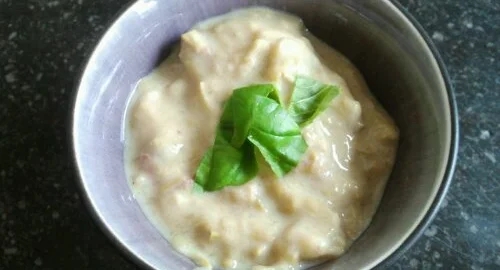
The taste was very rhubarby; tart, sour and in need of some sweet. Once cooled a little, I mashed the soft stewed stems with a little banana, homemade yoghurt, a dab of honey and a good pinch each of ground ginger and cinnamon. When combined to my liking, I served in a small bowl and garnished with torn basil leaves.
The outside of the knotweed was more fibrous than I had expected so next time, I shall either push the stewed stems through a fine sieve or pulverize them with a blender, before mixing with the other ingredients. Stringiness aside, this is a delicious dessert! Maida Silverwood’s book proposes freezing stewed knotweed and I shall certainly have a go at that, when I find more of it. I will also keep an eye on how the cut stems repair at my harvesting spot.
Please be aware of harvesting from clean untreated places (not the location shown above), the rules for rhizome disposal for this plant in your locality. In some countries it is a criminal offense to allow spread of the plant by careless disposal of the roots.
The roots were apparently used in ancient Chinese medicine for menstrual and post partum problems. It is certainly very astringent to taste and thus must have a drying, constricting effect on the body, at least to some extent.
I’ll do some research into the similarities with rhubarb and more historic medicinal uses. It is truly delicious and if you are a rhubarb fan I am quite certain you could also come to love Japanese knotweed.
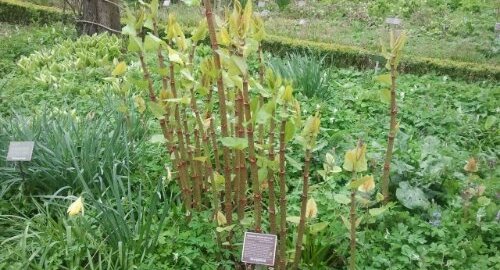
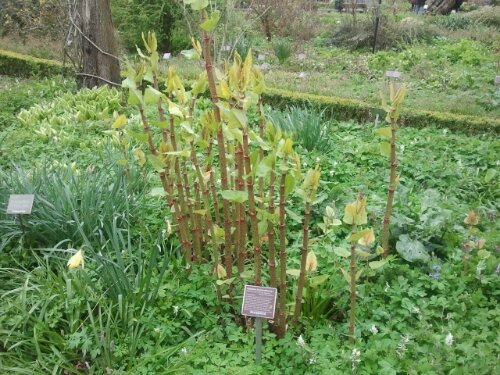
Japanese knotweed (polygonum cuspidatum) is an extremely invasive non-indigenous plant and gardeners who know it are generally distressed to find it on their patch. However, today I spotted this deliberately positioned specimen, growing happily in the Hortus Botanicus, Amsterdam. It’s even got an identification plate!
I once saw Japanese knotweed growing into a house which was being auctioned, yes into it, through the walls and under the floor! Needless to say, I didn’t make an offer to buy the place.
Seeing the plant reminded me that it is edible and apparently rather tasty too. According to the late Maida Silverman in her book, A City Herbal, it can be harvested and eaten in the same way as bamboo shoots, at this time of year. New York forager Steve Brill seems to like it, likening it’s taste to rhubarb. He also mentions it’s suitability as a companion plant, due to pesticide qualities. Personally, I don’t find the plant calls me to try it and I worry that by harvesting young shoots, the plant would further proliferate, in an attempt to survive. I hope I’m wrong because there is plenty of this plant growing in Amsterdam and I do love rhubarb crumble! What a great foraging plant this could be.
I’d love to hear from anyone who has tasted this plant. It is said to be quite tender, when cooked and to act as a gentle laxative. I’m also keen to know if harvesting, without pulling up the roots, would increase the plant’s chances of survival.
I wrote to Steve Brill about the harvesting issue. Here’s his reply…
On Apr 18, 2012 1:16 AM, “Steve Brill” wrote:
>
> Hi Lynn,
>
> Thanks for writing. As far as I can tell, it spreads wherever it can whether or not it’s harvested.
>
> Happy Foraging!
>
I was out walking in my Amsterdam neighborhood today and as usual noticed lots of Oregon grape (Berberis aquifolium) in landscaped areas. Every time I see this plant, I remember reading about how it is edible and in fact, a highly regarded herb. I have never used it but decided to learn and share a little about it today.
You can easily find out lots of information regarding this herb on the Internet or in books. It’s a herb with quite a history, being the state plant of Oregon. I find the most interesting facts are that:
1. It is a powerful liver stimulant and cleanser.
2. The roots are bright yellow and highly regarded by herbalists seeking a strong stimulant effect.
It doesn’t really sound like a herb for me because of this potency. Tonics tend to be much safer and more appropriate for adding to everyday meals.
3. It must be avoided by those who already tax their systems, for instance by eating lots of heavy meals.
4. The berries are black, obvious and plentiful when autumn arrives. They are very rich in vitamin c and have a very bitter taste.
I’ll be sampling the berries in autumn and will post more Oregon grape entries on Boskoi. I’m thinking of adding a handful to a Rumpot. It has obviously been an Amsterdam landscape architect’s favorite over the years consequently there are plenty of dense Oregon grape plantings in town.
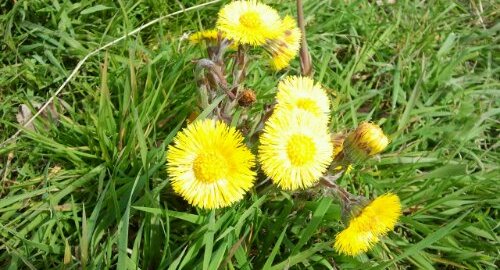
I found this cheerful looking Coltsfoot (NL: Klein hoefblad) plant in Frankendael a couple of days ago and thought it was time to look at some look-a-like plants which herbal foragers should be aware of.
Coltsfoot (Tussilago farfara) and Dandelion (Taraxacum officinale), which people often confuse it with, are both members of the same plant family (Asteraceae). Both herbs are useful but Dandelion is generally the plant which herbal foragers are after. It is such a well known bitter herb and has earned an enduring place in the sophisticated kitchens of many cultures. Coltsfoot flowers (if enough of them were to be gathered) can be used to make a traditional children’s cough remedy. However there are many who now avoid internal consumption of Coltsfoot, due to the discovery that it contains certain liver toxins called Pyrrolizidine alkaloids.
Many herbs contain small amounts of potentially harmful chemicals but when they are ingested as plant rather than separated chemical they tend to have a quite different effect on the body. One tip for herbal foragers, who are concerned by toxicity, is that generally flowers contain less volatile and active ingredients than other parts of a plant. Thus a flower remedy, made from Coltsfoot, should contain less alkaloids than one made from the leaves and roots.
How to differentiate Coltsfoot from Dandelion:
1. The solid & scaley Coltsfoot stem is quite different to the smooth & hollow stem of Dandelion.
2. Both being members of the Asteraceae family, their flowers are similar but Coltsfoot flowers bloom on stems before the leaves have grown. With Dandelion, the obvious, downward toothed leaves develop well before the flowers appear.
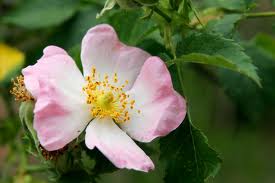
Recently, I was interviewed for a Time Out article about city foraging. As the journalist and I discussed the merits and perils of city foraging, I mentioned how underused roses are. Very soon Amsterdam should be dripping with fragrant blooming roses. Most petals simply tumble to the ground and at times make a soggy rotting mess on pavements. I urge you to find roses in healthy locations, ask the owners if they would mind you harvesting very sparingly and get ready for lots of rose tinted recipes!
Many Roses will bloom by mid May and the season will hopefully last right throughout the summer months. Our rooftop Rambling Rector is not in good shape, following the late cold weather, so I’m on the hunt for local neglected roses.
Rose petal butter
Here are 3 methods, all make a fragrant, eye catching and somewhat romantic butter. The first method are very simple, the third method is traditional but well worth the extra effort.
Please note:
Roses from a florist are not to be eaten as they will surely have been sprayed with chemicals. Likewise, roses from sprayed gardens must be avoided, as should those from unknown, unclean or suspect sources or those with no scent. If you gather petals in the morning, just after the dew has evaporated, you will have petals of a higher oil content and these will make the best butter.
Method 1. Simply chop, or tear, upto a cup full of fragrant rose petals and mix throughout a block of softened butter. It can be mixed until the butter becomes creamy. Shape the butter – petal mix as you wish before refrigerating for about 2 hours prior to use. and leave in refridgerator for two hours, prior to use.
Method 2. Allow a block of butter to soften so that you can shape it as desired. Cover it with lots of petals and place it in a glass container. It should ideally be completely drowned in petals, beneath it, all around it – really packed in petals. Leave the container for a good 24 hours, to allow the fragrance to penetrate the butter. To use, remove the butter from most or all of the petals, use petals as mentioned in 3 below and refrigerate your butter if you wish.
Method 3. Over the bottom of a glass jar, spread a layer of softened butter then cover it with a layer of washed and blotted-dry whole rose petals. Place a cut to size sheet of baking parchment over the petal layer and cover that with another layer of butter and a subsequent layer of rose petals. Make several layers in this way before sealing. Store for several days, at room temperature or in a refrigerator. Finally, separate the paper, petals and butter. Reuse or recycle the paper, shape the butter as desired, set the petals aside to use a garnish or sandwich filling. Butter and petal quantities, required for this method, depend upon how much you would like to make or have access to.
Rose butter is versatile, you may like to try it on sandwiches, hot breads, crumpets or cakes.
I posted a Rose cupcakes recipe last year, more rose recipes to follow over the coming months.
(There are no photos for this posting as I didn’t take a photo, the last time I made rose butter. When the rose season arrives, I’ll add a few.)
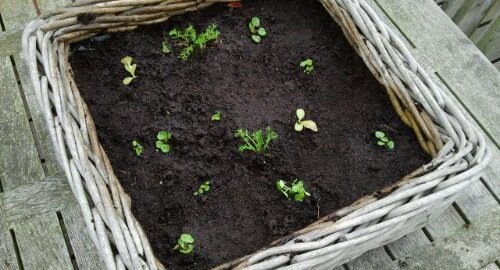
I guess you’d call this a table planter of edible herbs. It’s also a good way to rehome some self-seeded plants. I planted it out yesterday using some herb & salad seedlings, which had spread around other pots on my roof terrace. I filled the planter last year, using shop-bought seeds and although the plants didn’t have space to grow very large, they were really useful. This time I was able to relocate some seedlings of watercress, lettuce, and chamomile, which I added to the pot and supplemented with a sprinkling of old seeds.
Last year the planter provided a beautiful and tastes collection of plants which we would sit and pluck leaves from and eat directly with outdoor meals. I hope it will work well this year.
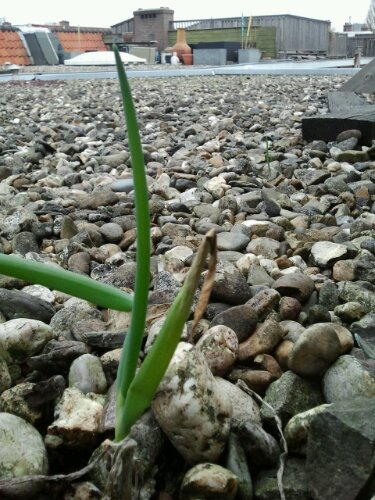
I also rehoused some self-seeded Welsh onions which had jumped ship to our neighbour’s gravel roof. They are now sitting pretty in one of the permapots.
Many visitors to this site are interested in wild herbs and foraging. As you probably know, I do my foraging in the city of Amsterdam and am keen to encourage more of you to learn about the herbs around you. Often those I speak to are unaware that right here in Amsterdam, there are herbs to be foraged every single day of the year – if you know where to look.
From the New Moon in April 2012 I’ll be adding a little challenge to this site. I’m calling it 365 Frankendael because I live close to that beautiful Amsterdam park. I aim to post a photo and comment about herbs I have found in and around Park Frankendael, every day, for a year.
I’m sure to be away for some part of the year so will appeal for a little assistance when those times approach. If you’d like to help out then please contact me.
I hope you like the idea and will enjoy watching the herbal year in Frankendael unfold.
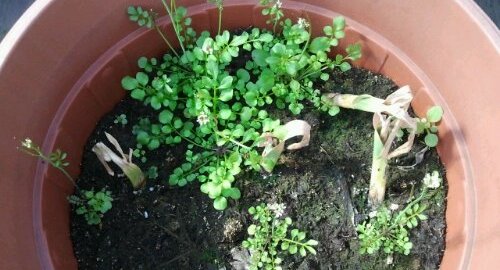
I did a spot of roof gardening this morning and was very pleased to find this herb growing in a neglected plant pot. It’s thought of as weed by most and yet it’s providing at least two services here; covering lots of surface soil thus acting as a green mulch and also it’s soon to be part of my food! Hairy bittercress (Cardamine hirsuta) spreads readily by seed and is very successful at monopolising open ground. According to Wikipedia it can be quite a nuisance in lawns, in fact there are many articles on the internet dedicated to eradicating this plant. What a waste, it tastes so good and I’d prefer a useful mixed “weed” lawn to a monoculture of grass any day! It’s very welcome in my plant pots, I’d also say it’s non-invasive in this situation as it’s very easy to pull out completely when you need to.
Hairy bitter cress is part of the brassica/mustard family and is often confused with chickweed. Although it’s habit of growing out like a star from it’s base, it’s flowers and of course the hairs, are quite different from chickweed. Both are annuals. In any case, confusing it with chickweed may be a good way to get to know it. Both are useful and nutritious, full of vitamins and minerals, tasting peppery and great additions to salad.
I’ll let these come on for a few more days in the plant pot before harvesting the strongest plants and rehousing the others.













 Urban Herbology